
- Buy Crypto
- Markets
 Futures
- Spot
- Copy Trade
 Earn
Earn- More
Will the Cryptocurrency Industry Thrive in 2026?

Original Article Title: "Will the Crypto Industry Be Good in 2026?"
Original Article Author: Viee Xiaowei, Biteye
In the last few months of 2025, a bearish atmosphere began to spread.
Bitcoin slipped from its high of $120,000, ETF inflows were temporarily interrupted, various coins showed divergent trends, and meme coins that once ignited emotions also began to be ignored. Unlike the sudden regulatory crackdown seen at the end of 2021, and apart from the major flash crash on 1011, there did not seem to be a severe liquidity crisis, yet something still felt amiss.
If the cryptocurrency world in 2025 was a recalibration of true and false value, will the crypto industry be good in 2026?
This article attempts to find an answer. Perhaps we need to accept a fact: the cryptocurrency industry may be entering an era that no longer relies on unilateral price increases or is primarily driven by a "casino narrative."
1. Macroeconomic Trends Are Improving, Bitcoin Still Riding the Wave
Over the past year, both Bitcoin's price performance and market positioning have undergone significant changes.
After surging to a historic high of $120,000, the market began to decline, volatility increased, and market sentiment gradually cooled. Unlike previous rallies driven by retail investors, the main force behind this rally was institutional funds behind ETFs. From the perspective of average entry price, CryptoQuant analyst Axel Adler Jr. pointed out last month that the average entry price of U.S. ETFs is $79,000, which many consider to be one of the price support zones. Therefore, Bitcoin's current trend is increasingly resembling a high-volatility institutional asset, with a positioning similar to gold's inflation hedge on the one hand and exhibiting beta properties influenced by macro sentiment and risk appetite like tech stocks on the other.
From a broader perspective, 2025 was a year of improved global risk asset sentiment. AI was a major theme, the U.S. stock market continued to hit new highs, and the Federal Reserve announced three interest rate cuts in December, leading the market back into a phase of improving liquidity expectations. The FOMC's year-end economic forecast showed that the expected GDP growth rate for the U.S. in 2026 was revised upward from 1.8% to 2.2–2.5%. There is a general expectation that next year will continue to be accommodative, which may bode well for assets like Bitcoin.
However, the market is not without risks. If the global economy unexpectedly weakens in 2026 or if inflation unexpectedly rebounds, risk assets may still face significant adjustments.
2. Regulatory Turning Point: US and Hong Kong Policy Trends
Another significant change in 2025 was the formalization of regulation.
In the United States, two key bills were passed. The first one was the Stablecoin Act (GENIUS Act), which defined stablecoins, outlined reserve requirements, and set issuance qualification thresholds, providing a compliance pathway for major stablecoin issuers. This act was signed into law by the president in July 2025 and will come into effect 18 months after signing or 120 days after regulatory agencies release final rules. The second one was the Crypto Asset Market Structure Act (CLARITY Act), which systematically delineated the boundaries between "security-type tokens" (regulated by the SEC) and "commodity-type tokens" (regulated by the CFTC) and proposed a tiered regulatory framework. This act is set to be submitted to the Senate in January and may require presidential signature, with the effective date to be determined. Meanwhile, the SEC is accelerating the approval of more crypto ETFs, opening the path for institutional products.
In Hong Kong, regulatory efforts are also ramping up. In 2025, the HKMA introduced a regulatory regime for stablecoin issuers, requiring all Hong Kong-related stablecoin issuers to be licensed. This means that in the future, issuing stablecoins pegged to currencies like the US dollar or Chinese yuan in Hong Kong will require meeting certain capital and compliance requirements. In addition, HashKey has been listed on the Hong Kong Stock Exchange, becoming the first compliant platform with a core business in crypto trading to IPO in Hong Kong, marking a milestone.
Overall, the regulatory trends in the United States and Hong Kong are aimed at not only curbing illegal speculation but also opening up pathways for legal business, driving the industry towards institutionalization and compliance.
3. Stablecoins, Prediction Markets, On-chain Stocks: Three Major Themes
Over the past few years, the most stable growth curve in the crypto industry has actually been stablecoins.
By 2025, the global stablecoin issuance has exceeded $300 billion, with USDT and USDC, the two major stablecoin types, accounting for over 80%. Stablecoins are becoming part of the global payment network, with use cases for USDT and USDC already permeating daily merchant transactions and cross-border settlements.
In 2026, stablecoins are likely to be even closer to the real world. Traditional giants like Visa, Stripe, and PayPal are already settling transactions using stablecoins. For example, Stripe now supports merchants' subscription payments with stablecoins, with real-world services already implemented.
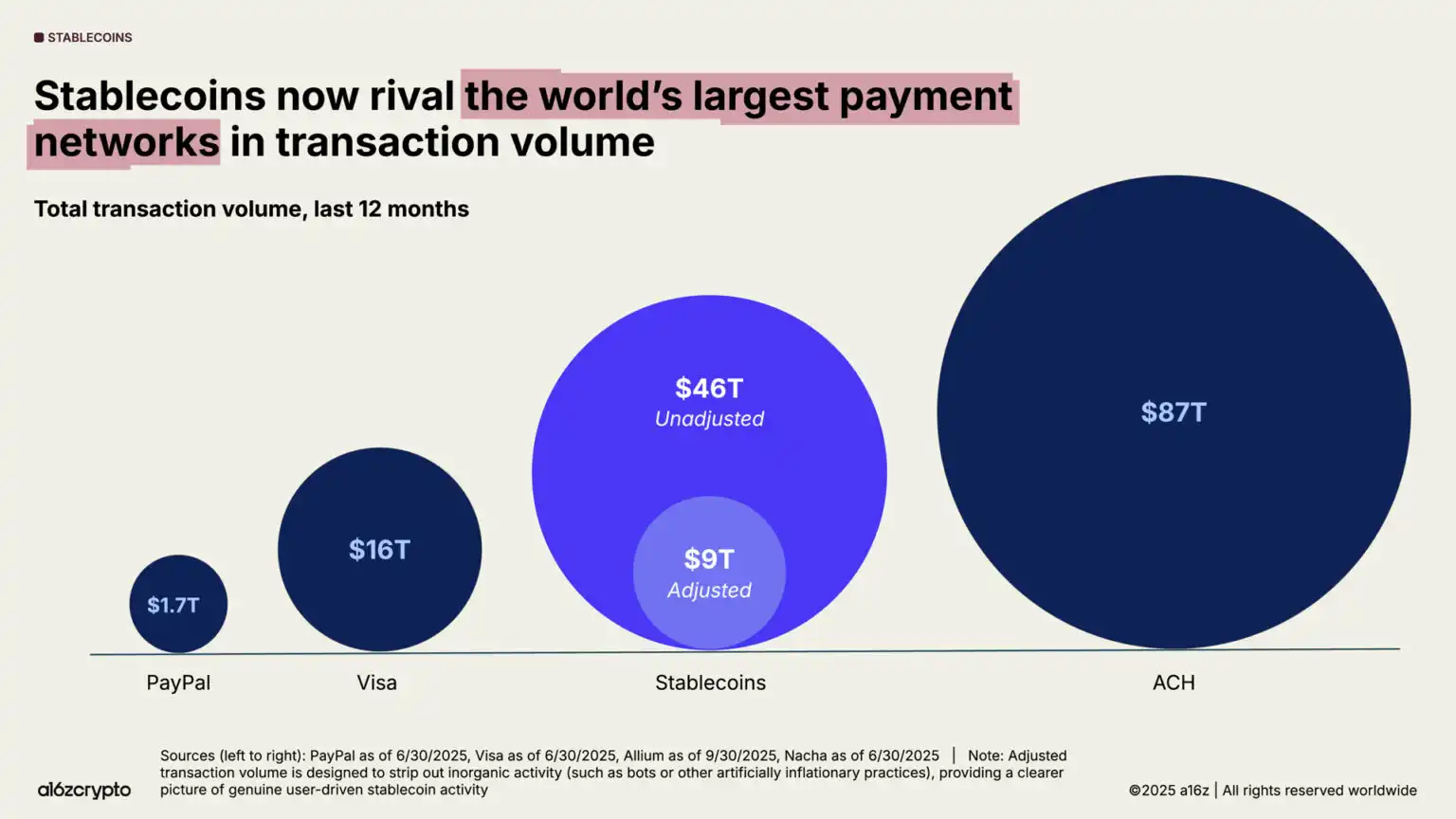
Image Source: a16z
In addition, as regulation becomes clearer, sovereign-backed stablecoins (backed by high-quality assets) are expected to emerge, along with regional stablecoins such as the digital currency bridge projects implemented by Japan and the European Union.
Another aspect worth paying attention to is prediction markets.
Originally, most people considered prediction markets to be niche products or non-compliant. However, now it is evolving into a combination of "on-chain betting + pricing tool" under themes such as the U.S. presidential election, sports matches, and economic data.
For example, Kalshi has obtained an official futures license from the U.S. CFTC, allowing it to legally launch prediction trades related to macroeconomic data. Its current valuation has soared to $11 billion. Meanwhile, Polymarket has become a hub for a large number of users to bet on and gauge public sentiment around topics like the U.S. presidential election and entertainment events.
In 2026, prediction markets may move beyond pure speculation circles. For instance, users may not only bet on outcomes but also use money to vote, expressing their judgment of the probability of a certain result. This collective wisdom pricing method could be used by media, research institutions, and even trading strategies as a reference. Additionally, AI will open up new possibilities for prediction markets, enabling them to not only rely on human bets but also automatically analyze data, place orders, and even create new betting options. This will make prediction markets more responsive and intelligent, gradually transforming them into tools for assessing risk and trends rather than just places for betting on outcomes.
Lastly, the development of tokenized stocks on the blockchain is another undeniable trend.
Simply put, the crypto industry is now not only trading crypto assets but also starting to bring real-world assets onto the blockchain. For example, the company Securitize plans to launch the first fully compliant tokenized stock trading platform in 2026. Tokens purchased on the blockchain represent real company stocks, allowing holders to have voting rights and receive dividends.
IV. Emergent Narratives: New Directions that Might Take Flight in 2026
Meanwhile, some seemingly more fringe directions are also worth noting. The following content is referenced from the article "a16z: 17 Structural Changes in the Crypto Industry."
https://a16zcrypto.com/posts/article/big-ideas-things-excited-about-crypto-2026/
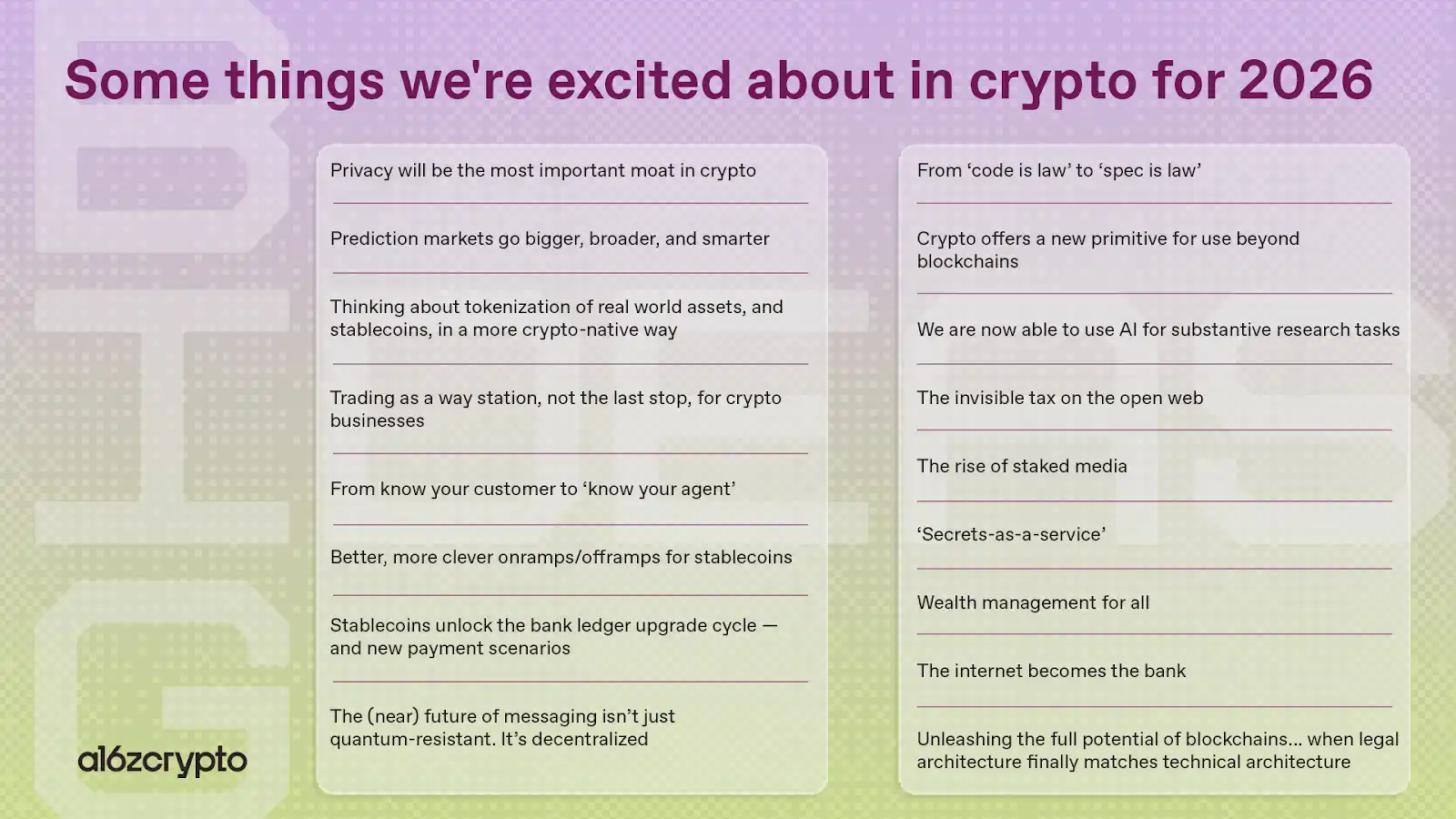
Image Source: a16z
1. Identity Challenge of AI Agents
As AI agents start engaging in transactions, browsing, placing orders, and even interacting with smart contracts, a key issue arises: how can these non-human identities prove "who they are"?
The concept of "Know Your Agent" (KYA) proposed by a16z aims to address this issue. On-chain, any agent looking to initiate a transaction must have clear permissions and ownership, requiring credentials with encrypted signatures to transact. By 2026, this may become a prerequisite for the widespread deployment of on-chain AI.
2. x402 Protocols and Micropayments
a16z predicts that as AI agents engage in extensive data exchanges, leverage computing power, and interact with APIs, we will enter an era of "automated settlement + programmatic payments."
No longer reliant on manual payments, AI agents can identify needs and autonomously facilitate payments, a reality that protocols like x402 are addressing. In 2026, their presence will become increasingly pronounced.
3. Increased Focus on Privacy Chains
a16z highlights a key trend: compared to performance-driven convergence, privacy will become the core moat of future public blockchains. While in the past, privacy chains were viewed as hindrances to regulation due to their lack of transparency, the tables have turned. Now, the issue is that business data is too sensitive; without privacy protection, regulatory bodies are hesitant to utilize on-chain solutions. Consequently, chains that inherently prioritize privacy are gaining attractiveness. Once users adopt these chains, data remains secure, migration costs increase, and a new form of user stickiness emerges through network effects.
4. Staked Media
In an era where AI generates vast amounts of content, determining the credibility of a statement requires looking not only at who said it but also at the cost associated with making that statement. Therefore, a16z introduces a new media model where content creators not only express opinions but also "stake" their positions through mechanisms such as locking tokens, prediction markets, and NFT credentials.
For example, if you post a bullish view on ETH, you also simultaneously lock up your own ETH as collateral; if you make an election prediction, you also place a bet on the chain. These publicly tied interests will make content more than just lip service. If this gameplay can be successfully implemented, it may become the new norm for on-chain media.
Of course, the directions proposed in the a16z report go far beyond these few examples. This article focuses on four trends that we believe are more representative, while other directions are equally worth paying attention to, such as: stablecoin on/off-ramp upgrades, RWA encryption nativeization, stablecoin-driven upgrade of bank ledger systems, wealth management diversification, the rise of AI research assistants, real-time content sharing mechanism of AI agents, decentralized post-quantum communication, "privacy as a service" becoming infrastructure, DeFi security paradigm shift, intelligent prediction markets, verifiable cloud computing, emphasis on Product-Market Fit (PMF), and crypto regulations unlocking more blockchain potential.
Interested readers can refer to the original a16z report for further in-depth understanding.
5. The Crypto Industry is Breaking Out of its Internal Loop
The early growth of the crypto industry was mostly built within a self-referential system, where coin issuance, referrals, and airdrops all attempted to attract more insiders to stay. However, this closed loop is gradually being broken by reality.
From Polymarket to USDT, and then to the cross-border applications of USDC, we see more and more people who are not Web3 users using blockchain tools. Street vendors in Lagos may not understand wallet structures, but they know that using USDT is much faster than banking transfers. In high inflationary countries, depositors flock to USDC for hedging rather than speculation. One of the most obvious changes is seen in payment scenarios in developing countries, such as the partnership between the trading platform Coins.ph in the Philippines and Circle to open a low-cost USDC remittance channel.
This underlying trend indicates that cryptographic technology is embedding itself in real-world scenarios such as cross-border payments and remittance channels. The true future of crypto may lie in how to use technology to solve real problems and make more ordinary people unconsciously start using blockchain.
6. The Crypto Industry from a KOL Perspective
The recent discussion about whether spending years in the crypto industry is worthwhile is essentially a collective retrospective of the industry.
Castle Island Ventures partner Nic Carter @nic_carter continued the reflection on "whether spending 8 years in crypto is a waste," admitting that only Bitcoin, stablecoins, DEXs, and prediction markets have truly achieved significant PMF to this day. He chooses to maintain a pragmatic idealism, accepting that bubbles and frenzies are part of the path, not the whole.
Dragonfly Partner Haseeb @hosseeb put it more bluntly, pointing out that the issue is not the existence of the casino, but rather that by only focusing on the glamour of the casino, one would miss the industry's true transformation. He believes that cryptocurrency is a better vessel for finance, one that will forever change the nature of money. He hopes the industry maintains patience: "The Industrial Revolution also took 50 years to change productivity, and we are only 15 years in."
XHunt & Biteye Founder @DeFiTeddy2020's summary is also very realistic. In his view, the crypto industry can quickly expose the essence of finance, facing zeroing projects, detachment of price from fundamentals, and even insider trading, manipulation, and rug pulls. It is not a breeding ground for idealism but a market that educates participants with real money continually, very much toughening the mindset.
Looking ahead to the future direction of the industry, KOL Crypto Goddess @xincctnnq provides a long-term perspective. What cryptocurrency is truly trying to address is the long-term issues of the monetary system, contract execution, digital ownership, capital market efficiency, and financial inclusion. Even if the outcome is distant and the process rough, it is worth constantly trying.
Furthermore, Trader & Analyst @CryptoPainter offers a more market structure-oriented explanation. The crypto market repeats its consistent operational mechanism, "Value Investment" - "Faith Investment" - "Emotional Speculation" - "Utter Disappointment," and then starts over again. This cycle has occurred in 2018, 2022, and is destined to happen again. Gamblers and the casino are not anomalies but rather part of consuming bubbles and completing market self-adjustment.
Figment Capital member DougieDeLuca @DougieDeLuca's position, on the other hand, seems like a phased summary. He bluntly states that "Crypto is dead" does not mean that the price is zero or the blockchain has stopped working. Instead, it means "Crypto as a closed industry form is dying," and true success should be integrating Crypto technology into the everyday lives of ordinary people.
From a more institutional perspective, KOL & Researcher Blue Fox @lanhubiji mentioned that as old users begin to exit, newcomers from traditional finance backgrounds are entering. In their understanding, crypto is a long-term trend that has already entered a path of standardization, interoperability, and scalability. Three years later, a brand-new era of on-chain finance, an on-chain Wall Street era, will gradually emerge.
Meanwhile, LD Capital Founder Jack Yi Hua @Jackyi_ld's assessment is more closely related to the current cycle. He points out that the recent downturn in crypto is more of a temporary resonance of liquidity and macro events. Currently, negative factors are gradually dissipating, and with the dual positive factors of interest rate cuts and crypto-friendly policies, he continues to be optimistic about the subsequent market.
At a more macro level of regulation and industry structure, Hashkey Group Chairman Xiao Feng's judgment is particularly systematic, as he has put forward three major trends for the future:
First, the global trend of crypto regulation is shifting from "voluntary acceptance" to "mandatory compliance," with governments around the world gradually eliminating offshore gray areas and moving crypto transactions towards licensing. For example, in Hong Kong, China, starting from June 2023, all unlicensed trading platforms must exit the market.
Second, crypto is no longer limited to native assets like BTC and ETH; more traditional financial assets are being tokenized and moving onto the blockchain to create a regulated and compliant new tokenized securities market.
Third, from "off-chain" to "on-chain," he predicts that the latter half of 2026 may be a key turning point for the emergence of the "Wall Street on the blockchain."
7. Conclusion
Will crypto be better in 2026?
If you are expecting a "meteoric rise in prices," the answer may be uncertain.
But if you are asking whether this industry is heading towards a more realistic and useful direction, the answer may be affirmative.
From crypto ETFs to stablecoin payments, from on-chain national debts to prediction markets, from on-chain Agents to decentralized AI, all these indicate one thing:
The crypto industry may be starting to land in a more real-world direction, and perhaps it will increasingly resemble a twin financial system running parallel to the real-world financial system, resonating with the stock market, macro liquidity, policy expectations, and even AI cycles.
This article is contributed content and does not represent the views of BlockBeats
You may also like

Token Cannot Compound, Where Is the Real Investment Opportunity?

February 6th Market Key Intelligence, How Much Did You Miss?

China's Central Bank and Eight Other Departments' Latest Regulatory Focus: Key Attention to RWA Tokenized Asset Risk
Foreword: Today, the People's Bank of China's website published the "Notice of the People's Bank of China, National Development and Reform Commission, Ministry of Industry and Information Technology, Ministry of Public Security, State Administration for Market Regulation, China Banking and Insurance Regulatory Commission, China Securities Regulatory Commission, State Administration of Foreign Exchange on Further Preventing and Dealing with Risks Related to Virtual Currency and Others (Yinfa [2026] No. 42)", the latest regulatory requirements from the eight departments including the central bank, which are basically consistent with the regulatory requirements of recent years. The main focus of the regulation is on speculative activities such as virtual currency trading, exchanges, ICOs, overseas platform services, and this time, regulatory oversight of RWA has been added, explicitly prohibiting RWA tokenization, stablecoins (especially those pegged to the RMB). The following is the full text:
To the people's governments of all provinces, autonomous regions, and municipalities directly under the Central Government, the Xinjiang Production and Construction Corps:
Recently, there have been speculative activities related to virtual currency and Real-World Assets (RWA) tokenization, disrupting the economic and financial order and jeopardizing the property security of the people. In order to further prevent and address the risks related to virtual currency and Real-World Assets tokenization, effectively safeguard national security and social stability, in accordance with the "Law of the People's Republic of China on the People's Bank of China," "Law of the People's Republic of China on Commercial Banks," "Securities Law of the People's Republic of China," "Law of the People's Republic of China on Securities Investment Funds," "Law of the People's Republic of China on Futures and Derivatives," "Cybersecurity Law of the People's Republic of China," "Regulations of the People's Republic of China on the Administration of Renminbi," "Regulations on Prevention and Disposal of Illegal Fundraising," "Regulations of the People's Republic of China on Foreign Exchange Administration," "Telecommunications Regulations of the People's Republic of China," and other provisions, after reaching consensus with the Cyberspace Administration of China, the Supreme People's Court, and the Supreme People's Procuratorate, and with the approval of the State Council, the relevant matters are notified as follows:
(I) Virtual currency does not possess the legal status equivalent to fiat currency. Virtual currencies such as Bitcoin, Ether, Tether, etc., have the main characteristics of being issued by non-monetary authorities, using encryption technology and distributed ledger or similar technology, existing in digital form, etc. They do not have legal tender status, should not and cannot be circulated and used as currency in the market.
The business activities related to virtual currency are classified as illegal financial activities. The exchange of fiat currency and virtual currency within the territory, exchange of virtual currencies, acting as a central counterparty in buying and selling virtual currencies, providing information intermediary and pricing services for virtual currency transactions, token issuance financing, and trading of virtual currency-related financial products, etc., fall under illegal financial activities, such as suspected illegal issuance of token vouchers, unauthorized public issuance of securities, illegal operation of securities and futures business, illegal fundraising, etc., are strictly prohibited across the board and resolutely banned in accordance with the law. Overseas entities and individuals are not allowed to provide virtual currency-related services to domestic entities in any form.
A stablecoin pegged to a fiat currency indirectly fulfills some functions of the fiat currency in circulation. Without the consent of relevant authorities in accordance with the law and regulations, any domestic or foreign entity or individual is not allowed to issue a RMB-pegged stablecoin overseas.
(II)Tokenization of Real-World Assets refers to the use of encryption technology and distributed ledger or similar technologies to transform ownership rights, income rights, etc., of assets into tokens (tokens) or other interests or bond certificates with token (token) characteristics, and carry out issuance and trading activities.
Engaging in the tokenization of real-world assets domestically, as well as providing related intermediary, information technology services, etc., which are suspected of illegal issuance of token vouchers, unauthorized public offering of securities, illegal operation of securities and futures business, illegal fundraising, and other illegal financial activities, shall be prohibited; except for relevant business activities carried out with the approval of the competent authorities in accordance with the law and regulations and relying on specific financial infrastructures. Overseas entities and individuals are not allowed to illegally provide services related to the tokenization of real-world assets to domestic entities in any form.
(III) Inter-agency Coordination. The People's Bank of China, together with the National Development and Reform Commission, the Ministry of Industry and Information Technology, the Ministry of Public Security, the State Administration for Market Regulation, the China Banking and Insurance Regulatory Commission, the China Securities Regulatory Commission, the State Administration of Foreign Exchange, and other departments, will improve the work mechanism, strengthen coordination with the Cyberspace Administration of China, the Supreme People's Court, and the Supreme People's Procuratorate, coordinate efforts, and overall guide regions to carry out risk prevention and disposal of virtual currency-related illegal financial activities.
The China Securities Regulatory Commission, together with the National Development and Reform Commission, the Ministry of Industry and Information Technology, the Ministry of Public Security, the People's Bank of China, the State Administration for Market Regulation, the China Banking and Insurance Regulatory Commission, the State Administration of Foreign Exchange, and other departments, will improve the work mechanism, strengthen coordination with the Cyberspace Administration of China, the Supreme People's Court, and the Supreme People's Procuratorate, coordinate efforts, and overall guide regions to carry out risk prevention and disposal of illegal financial activities related to the tokenization of real-world assets.
(IV) Strengthening Local Implementation. The people's governments at the provincial level are overall responsible for the prevention and disposal of risks related to virtual currencies and the tokenization of real-world assets in their respective administrative regions. The specific leading department is the local financial regulatory department, with participation from branches and dispatched institutions of the State Council's financial regulatory department, telecommunications regulators, public security, market supervision, and other departments, in coordination with cyberspace departments, courts, and procuratorates, to improve the normalization of the work mechanism, effectively connect with the relevant work mechanisms of central departments, form a cooperative and coordinated working pattern between central and local governments, effectively prevent and properly handle risks related to virtual currencies and the tokenization of real-world assets, and maintain economic and financial order and social stability.
(5) Enhanced Risk Monitoring. The People's Bank of China, China Securities Regulatory Commission, National Development and Reform Commission, Ministry of Industry and Information Technology, Ministry of Public Security, State Administration of Foreign Exchange, Cyberspace Administration of China, and other departments continue to improve monitoring techniques and system support, enhance cross-departmental data analysis and sharing, establish sound information sharing and cross-validation mechanisms, promptly grasp the risk situation of activities related to virtual currency and real-world asset tokenization. Local governments at all levels give full play to the role of local monitoring and early warning mechanisms. Local financial regulatory authorities, together with branches and agencies of the State Council's financial regulatory authorities, as well as departments of cyberspace and public security, ensure effective connection between online monitoring, offline investigation, and fund tracking, efficiently and accurately identify activities related to virtual currency and real-world asset tokenization, promptly share risk information, improve early warning information dissemination, verification, and rapid response mechanisms.
(6) Strengthened Oversight of Financial Institutions, Intermediaries, and Technology Service Providers. Financial institutions (including non-bank payment institutions) are prohibited from providing account opening, fund transfer, and clearing services for virtual currency-related business activities, issuing and selling financial products related to virtual currency, including virtual currency and related financial products in the scope of collateral, conducting insurance business related to virtual currency, or including virtual currency in the scope of insurance liability. Financial institutions (including non-bank payment institutions) are prohibited from providing custody, clearing, and settlement services for unauthorized real-world asset tokenization-related business and related financial products. Relevant intermediary institutions and information technology service providers are prohibited from providing intermediary, technical, or other services for unauthorized real-world asset tokenization-related businesses and related financial products.
(7) Enhanced Management of Internet Information Content and Access. Internet enterprises are prohibited from providing online business venues, commercial displays, marketing, advertising, or paid traffic diversion services for virtual currency and real-world asset tokenization-related business activities. Upon discovering clues of illegal activities, they should promptly report to relevant departments and provide technical support and assistance for related investigations and inquiries. Based on the clues transferred by the financial regulatory authorities, the cyberspace administration, telecommunications authorities, and public security departments should promptly close and deal with websites, mobile applications (including mini-programs), and public accounts engaged in virtual currency and real-world asset tokenization-related business activities in accordance with the law.
(8) Strengthened Entity Registration and Advertisement Management. Market supervision departments strengthen entity registration and management, and enterprise and individual business registrations must not contain terms such as "virtual currency," "virtual asset," "cryptocurrency," "crypto asset," "stablecoin," "real-world asset tokenization," or "RWA" in their names or business scopes. Market supervision departments, together with financial regulatory authorities, legally enhance the supervision of advertisements related to virtual currency and real-world asset tokenization, promptly investigating and handling relevant illegal advertisements.
(IX) Continued Rectification of Virtual Currency Mining Activities. The National Development and Reform Commission, together with relevant departments, strictly controls virtual currency mining activities, continuously promotes the rectification of virtual currency mining activities. The people's governments of various provinces take overall responsibility for the rectification of "mining" within their respective administrative regions. In accordance with the requirements of the National Development and Reform Commission and other departments in the "Notice on the Rectification of Virtual Currency Mining Activities" (NDRC Energy-saving Building [2021] No. 1283) and the provisions of the "Guidance Catalog for Industrial Structure Adjustment (2024 Edition)," a comprehensive review, investigation, and closure of existing virtual currency mining projects are conducted, new mining projects are strictly prohibited, and mining machine production enterprises are strictly prohibited from providing mining machine sales and other services within the country.
(X) Severe Crackdown on Related Illegal Financial Activities. Upon discovering clues to illegal financial activities related to virtual currency and the tokenization of real-world assets, local financial regulatory authorities, branches of the State Council's financial regulatory authorities, and other relevant departments promptly investigate, determine, and properly handle the issues in accordance with the law, and seriously hold the relevant entities and individuals legally responsible. Those suspected of crimes are transferred to the judicial authorities for processing according to the law.
(XI) Severe Crackdown on Related Illegal and Criminal Activities. The Ministry of Public Security, the People's Bank of China, the State Administration for Market Regulation, the China Banking and Insurance Regulatory Commission, the China Securities Regulatory Commission, as well as judicial and procuratorial organs, in accordance with their respective responsibilities, rigorously crack down on illegal and criminal activities related to virtual currency, the tokenization of real-world assets, such as fraud, money laundering, illegal business operations, pyramid schemes, illegal fundraising, and other illegal and criminal activities carried out under the guise of virtual currency, the tokenization of real-world assets, etc.
(XII) Strengthen Industry Self-discipline. Relevant industry associations should enhance membership management and policy advocacy, based on their own responsibilities, advocate and urge member units to resist illegal financial activities related to virtual currency and the tokenization of real-world assets. Member units that violate regulatory policies and industry self-discipline rules are to be disciplined in accordance with relevant self-regulatory management regulations. By leveraging various industry infrastructure, conduct risk monitoring related to virtual currency, the tokenization of real-world assets, and promptly transfer issue clues to relevant departments.
(XIII) Without the approval of relevant departments in accordance with the law and regulations, domestic entities and foreign entities controlled by them may not issue virtual currency overseas.
(XIV) Domestic entities engaging directly or indirectly in overseas external debt-based tokenization of real-world assets, or conducting asset securitization activities abroad based on domestic ownership rights, income rights, etc. (hereinafter referred to as domestic equity), should be strictly regulated in accordance with the principles of "same business, same risk, same rules." The National Development and Reform Commission, the China Securities Regulatory Commission, the State Administration of Foreign Exchange, and other relevant departments regulate it according to their respective responsibilities. For other forms of overseas real-world asset tokenization activities based on domestic equity by domestic entities, the China Securities Regulatory Commission, together with relevant departments, supervise according to their division of responsibilities. Without the consent and filing of relevant departments, no unit or individual may engage in the above-mentioned business.
(15) Overseas subsidiaries and branches of domestic financial institutions providing Real World Asset Tokenization-related services overseas shall do so legally and prudently. They shall have professional personnel and systems in place to effectively mitigate business risks, strictly implement customer onboarding, suitability management, anti-money laundering requirements, and incorporate them into the domestic financial institutions' compliance and risk management system. Intermediaries and information technology service providers offering Real World Asset Tokenization services abroad based on domestic equity or conducting Real World Asset Tokenization business in the form of overseas debt for domestic entities directly or indirectly venturing abroad must strictly comply with relevant laws and regulations. They should establish and improve relevant compliance and internal control systems in accordance with relevant normative requirements, strengthen business and risk control, and report the business developments to the relevant regulatory authorities for approval or filing.
(16) Strengthen organizational leadership and overall coordination. All departments and regions should attach great importance to the prevention of risks related to virtual currencies and Real World Asset Tokenization, strengthen organizational leadership, clarify work responsibilities, form a long-term effective working mechanism with centralized coordination, local implementation, and shared responsibilities, maintain high pressure, dynamically monitor risks, effectively prevent and mitigate risks in an orderly and efficient manner, legally protect the property security of the people, and make every effort to maintain economic and financial order and social stability.
(17) Widely carry out publicity and education. All departments, regions, and industry associations should make full use of various media and other communication channels to disseminate information through legal and policy interpretation, analysis of typical cases, and education on investment risks, etc. They should promote the illegality and harm of virtual currencies and Real World Asset Tokenization-related businesses and their manifestations, fully alert to potential risks and hidden dangers, and enhance public awareness and identification capabilities for risk prevention.
(18) Engaging in illegal financial activities related to virtual currencies and Real World Asset Tokenization in violation of this notice, as well as providing services for virtual currencies and Real World Asset Tokenization-related businesses, shall be punished in accordance with relevant regulations. If it constitutes a crime, criminal liability shall be pursued according to the law. For domestic entities and individuals who knowingly or should have known that overseas entities illegally provided virtual currency or Real World Asset Tokenization-related services to domestic entities and still assisted them, relevant responsibilities shall be pursued according to the law. If it constitutes a crime, criminal liability shall be pursued according to the law.
(19) If any unit or individual invests in virtual currencies, Real World Asset Tokens, and related financial products against public order and good customs, the relevant civil legal actions shall be invalid, and any resulting losses shall be borne by them. If there are suspicions of disrupting financial order and jeopardizing financial security, the relevant departments shall deal with them according to the law.
This notice shall enter into force upon the date of its issuance. The People's Bank of China and ten other departments' "Notice on Further Preventing and Dealing with the Risks of Virtual Currency Trading Speculation" (Yinfa [2021] No. 237) is hereby repealed.

Former Partner's Perspective on Multicoin: Kyle's Exit, But the Game He Left Behind Just Getting Started
Why Bitcoin Is Falling Now: The Real Reasons Behind BTC's Crash & WEEX's Smart Profit Playbook
Bitcoin's ongoing crash explained: Discover the 5 hidden triggers behind BTC's plunge & how WEEX's Auto Earn and Trade to Earn strategies help traders profit from crypto market volatility.

Wall Street's Hottest Trades See Exodus

Vitalik Discusses Ethereum Scaling Path, Circle Announces Partnership with Polymarket, What's the Overseas Crypto Community Talking About Today?

Believing in the Capital Markets - The Essence and Core Value of Cryptocurrency

Polymarket's 'Weatherman': Predict Temperature, Win Million-Dollar Payout

$15K+ Profits: The 4 AI Trading Secrets WEEX Hackathon Prelim Winners Used to Dominate Volatile Crypto Markets
How WEEX Hackathon's top AI trading strategies made $15K+ in crypto markets: 4 proven rules for ETH/BTC trading, market structure analysis, and risk management in volatile conditions.

A nearly 20% one-day plunge, how long has it been since you last saw a $60,000 Bitcoin?

Raoul Pal: I've seen every single panic, and they are never the end.

Key Market Information Discrepancy on February 6th - A Must-Read! | Alpha Morning Report

2026 Crypto Industry's First Snowfall
The Harsh Reality Behind the $26 Billion Crypto Liquidation: Liquidity Is Killing the Market
Why Is Gold, US Stocks, Bitcoin All Falling?

Key Market Intelligence for February 5th, how much did you miss out on?

Wintermute: By 2026, crypto had gradually become the settlement layer of the Internet economy
Token Cannot Compound, Where Is the Real Investment Opportunity?
February 6th Market Key Intelligence, How Much Did You Miss?
China's Central Bank and Eight Other Departments' Latest Regulatory Focus: Key Attention to RWA Tokenized Asset Risk
Foreword: Today, the People's Bank of China's website published the "Notice of the People's Bank of China, National Development and Reform Commission, Ministry of Industry and Information Technology, Ministry of Public Security, State Administration for Market Regulation, China Banking and Insurance Regulatory Commission, China Securities Regulatory Commission, State Administration of Foreign Exchange on Further Preventing and Dealing with Risks Related to Virtual Currency and Others (Yinfa [2026] No. 42)", the latest regulatory requirements from the eight departments including the central bank, which are basically consistent with the regulatory requirements of recent years. The main focus of the regulation is on speculative activities such as virtual currency trading, exchanges, ICOs, overseas platform services, and this time, regulatory oversight of RWA has been added, explicitly prohibiting RWA tokenization, stablecoins (especially those pegged to the RMB). The following is the full text:
To the people's governments of all provinces, autonomous regions, and municipalities directly under the Central Government, the Xinjiang Production and Construction Corps:
Recently, there have been speculative activities related to virtual currency and Real-World Assets (RWA) tokenization, disrupting the economic and financial order and jeopardizing the property security of the people. In order to further prevent and address the risks related to virtual currency and Real-World Assets tokenization, effectively safeguard national security and social stability, in accordance with the "Law of the People's Republic of China on the People's Bank of China," "Law of the People's Republic of China on Commercial Banks," "Securities Law of the People's Republic of China," "Law of the People's Republic of China on Securities Investment Funds," "Law of the People's Republic of China on Futures and Derivatives," "Cybersecurity Law of the People's Republic of China," "Regulations of the People's Republic of China on the Administration of Renminbi," "Regulations on Prevention and Disposal of Illegal Fundraising," "Regulations of the People's Republic of China on Foreign Exchange Administration," "Telecommunications Regulations of the People's Republic of China," and other provisions, after reaching consensus with the Cyberspace Administration of China, the Supreme People's Court, and the Supreme People's Procuratorate, and with the approval of the State Council, the relevant matters are notified as follows:
(I) Virtual currency does not possess the legal status equivalent to fiat currency. Virtual currencies such as Bitcoin, Ether, Tether, etc., have the main characteristics of being issued by non-monetary authorities, using encryption technology and distributed ledger or similar technology, existing in digital form, etc. They do not have legal tender status, should not and cannot be circulated and used as currency in the market.
The business activities related to virtual currency are classified as illegal financial activities. The exchange of fiat currency and virtual currency within the territory, exchange of virtual currencies, acting as a central counterparty in buying and selling virtual currencies, providing information intermediary and pricing services for virtual currency transactions, token issuance financing, and trading of virtual currency-related financial products, etc., fall under illegal financial activities, such as suspected illegal issuance of token vouchers, unauthorized public issuance of securities, illegal operation of securities and futures business, illegal fundraising, etc., are strictly prohibited across the board and resolutely banned in accordance with the law. Overseas entities and individuals are not allowed to provide virtual currency-related services to domestic entities in any form.
A stablecoin pegged to a fiat currency indirectly fulfills some functions of the fiat currency in circulation. Without the consent of relevant authorities in accordance with the law and regulations, any domestic or foreign entity or individual is not allowed to issue a RMB-pegged stablecoin overseas.
(II)Tokenization of Real-World Assets refers to the use of encryption technology and distributed ledger or similar technologies to transform ownership rights, income rights, etc., of assets into tokens (tokens) or other interests or bond certificates with token (token) characteristics, and carry out issuance and trading activities.
Engaging in the tokenization of real-world assets domestically, as well as providing related intermediary, information technology services, etc., which are suspected of illegal issuance of token vouchers, unauthorized public offering of securities, illegal operation of securities and futures business, illegal fundraising, and other illegal financial activities, shall be prohibited; except for relevant business activities carried out with the approval of the competent authorities in accordance with the law and regulations and relying on specific financial infrastructures. Overseas entities and individuals are not allowed to illegally provide services related to the tokenization of real-world assets to domestic entities in any form.
(III) Inter-agency Coordination. The People's Bank of China, together with the National Development and Reform Commission, the Ministry of Industry and Information Technology, the Ministry of Public Security, the State Administration for Market Regulation, the China Banking and Insurance Regulatory Commission, the China Securities Regulatory Commission, the State Administration of Foreign Exchange, and other departments, will improve the work mechanism, strengthen coordination with the Cyberspace Administration of China, the Supreme People's Court, and the Supreme People's Procuratorate, coordinate efforts, and overall guide regions to carry out risk prevention and disposal of virtual currency-related illegal financial activities.
The China Securities Regulatory Commission, together with the National Development and Reform Commission, the Ministry of Industry and Information Technology, the Ministry of Public Security, the People's Bank of China, the State Administration for Market Regulation, the China Banking and Insurance Regulatory Commission, the State Administration of Foreign Exchange, and other departments, will improve the work mechanism, strengthen coordination with the Cyberspace Administration of China, the Supreme People's Court, and the Supreme People's Procuratorate, coordinate efforts, and overall guide regions to carry out risk prevention and disposal of illegal financial activities related to the tokenization of real-world assets.
(IV) Strengthening Local Implementation. The people's governments at the provincial level are overall responsible for the prevention and disposal of risks related to virtual currencies and the tokenization of real-world assets in their respective administrative regions. The specific leading department is the local financial regulatory department, with participation from branches and dispatched institutions of the State Council's financial regulatory department, telecommunications regulators, public security, market supervision, and other departments, in coordination with cyberspace departments, courts, and procuratorates, to improve the normalization of the work mechanism, effectively connect with the relevant work mechanisms of central departments, form a cooperative and coordinated working pattern between central and local governments, effectively prevent and properly handle risks related to virtual currencies and the tokenization of real-world assets, and maintain economic and financial order and social stability.
(5) Enhanced Risk Monitoring. The People's Bank of China, China Securities Regulatory Commission, National Development and Reform Commission, Ministry of Industry and Information Technology, Ministry of Public Security, State Administration of Foreign Exchange, Cyberspace Administration of China, and other departments continue to improve monitoring techniques and system support, enhance cross-departmental data analysis and sharing, establish sound information sharing and cross-validation mechanisms, promptly grasp the risk situation of activities related to virtual currency and real-world asset tokenization. Local governments at all levels give full play to the role of local monitoring and early warning mechanisms. Local financial regulatory authorities, together with branches and agencies of the State Council's financial regulatory authorities, as well as departments of cyberspace and public security, ensure effective connection between online monitoring, offline investigation, and fund tracking, efficiently and accurately identify activities related to virtual currency and real-world asset tokenization, promptly share risk information, improve early warning information dissemination, verification, and rapid response mechanisms.
(6) Strengthened Oversight of Financial Institutions, Intermediaries, and Technology Service Providers. Financial institutions (including non-bank payment institutions) are prohibited from providing account opening, fund transfer, and clearing services for virtual currency-related business activities, issuing and selling financial products related to virtual currency, including virtual currency and related financial products in the scope of collateral, conducting insurance business related to virtual currency, or including virtual currency in the scope of insurance liability. Financial institutions (including non-bank payment institutions) are prohibited from providing custody, clearing, and settlement services for unauthorized real-world asset tokenization-related business and related financial products. Relevant intermediary institutions and information technology service providers are prohibited from providing intermediary, technical, or other services for unauthorized real-world asset tokenization-related businesses and related financial products.
(7) Enhanced Management of Internet Information Content and Access. Internet enterprises are prohibited from providing online business venues, commercial displays, marketing, advertising, or paid traffic diversion services for virtual currency and real-world asset tokenization-related business activities. Upon discovering clues of illegal activities, they should promptly report to relevant departments and provide technical support and assistance for related investigations and inquiries. Based on the clues transferred by the financial regulatory authorities, the cyberspace administration, telecommunications authorities, and public security departments should promptly close and deal with websites, mobile applications (including mini-programs), and public accounts engaged in virtual currency and real-world asset tokenization-related business activities in accordance with the law.
(8) Strengthened Entity Registration and Advertisement Management. Market supervision departments strengthen entity registration and management, and enterprise and individual business registrations must not contain terms such as "virtual currency," "virtual asset," "cryptocurrency," "crypto asset," "stablecoin," "real-world asset tokenization," or "RWA" in their names or business scopes. Market supervision departments, together with financial regulatory authorities, legally enhance the supervision of advertisements related to virtual currency and real-world asset tokenization, promptly investigating and handling relevant illegal advertisements.
(IX) Continued Rectification of Virtual Currency Mining Activities. The National Development and Reform Commission, together with relevant departments, strictly controls virtual currency mining activities, continuously promotes the rectification of virtual currency mining activities. The people's governments of various provinces take overall responsibility for the rectification of "mining" within their respective administrative regions. In accordance with the requirements of the National Development and Reform Commission and other departments in the "Notice on the Rectification of Virtual Currency Mining Activities" (NDRC Energy-saving Building [2021] No. 1283) and the provisions of the "Guidance Catalog for Industrial Structure Adjustment (2024 Edition)," a comprehensive review, investigation, and closure of existing virtual currency mining projects are conducted, new mining projects are strictly prohibited, and mining machine production enterprises are strictly prohibited from providing mining machine sales and other services within the country.
(X) Severe Crackdown on Related Illegal Financial Activities. Upon discovering clues to illegal financial activities related to virtual currency and the tokenization of real-world assets, local financial regulatory authorities, branches of the State Council's financial regulatory authorities, and other relevant departments promptly investigate, determine, and properly handle the issues in accordance with the law, and seriously hold the relevant entities and individuals legally responsible. Those suspected of crimes are transferred to the judicial authorities for processing according to the law.
(XI) Severe Crackdown on Related Illegal and Criminal Activities. The Ministry of Public Security, the People's Bank of China, the State Administration for Market Regulation, the China Banking and Insurance Regulatory Commission, the China Securities Regulatory Commission, as well as judicial and procuratorial organs, in accordance with their respective responsibilities, rigorously crack down on illegal and criminal activities related to virtual currency, the tokenization of real-world assets, such as fraud, money laundering, illegal business operations, pyramid schemes, illegal fundraising, and other illegal and criminal activities carried out under the guise of virtual currency, the tokenization of real-world assets, etc.
(XII) Strengthen Industry Self-discipline. Relevant industry associations should enhance membership management and policy advocacy, based on their own responsibilities, advocate and urge member units to resist illegal financial activities related to virtual currency and the tokenization of real-world assets. Member units that violate regulatory policies and industry self-discipline rules are to be disciplined in accordance with relevant self-regulatory management regulations. By leveraging various industry infrastructure, conduct risk monitoring related to virtual currency, the tokenization of real-world assets, and promptly transfer issue clues to relevant departments.
(XIII) Without the approval of relevant departments in accordance with the law and regulations, domestic entities and foreign entities controlled by them may not issue virtual currency overseas.
(XIV) Domestic entities engaging directly or indirectly in overseas external debt-based tokenization of real-world assets, or conducting asset securitization activities abroad based on domestic ownership rights, income rights, etc. (hereinafter referred to as domestic equity), should be strictly regulated in accordance with the principles of "same business, same risk, same rules." The National Development and Reform Commission, the China Securities Regulatory Commission, the State Administration of Foreign Exchange, and other relevant departments regulate it according to their respective responsibilities. For other forms of overseas real-world asset tokenization activities based on domestic equity by domestic entities, the China Securities Regulatory Commission, together with relevant departments, supervise according to their division of responsibilities. Without the consent and filing of relevant departments, no unit or individual may engage in the above-mentioned business.
(15) Overseas subsidiaries and branches of domestic financial institutions providing Real World Asset Tokenization-related services overseas shall do so legally and prudently. They shall have professional personnel and systems in place to effectively mitigate business risks, strictly implement customer onboarding, suitability management, anti-money laundering requirements, and incorporate them into the domestic financial institutions' compliance and risk management system. Intermediaries and information technology service providers offering Real World Asset Tokenization services abroad based on domestic equity or conducting Real World Asset Tokenization business in the form of overseas debt for domestic entities directly or indirectly venturing abroad must strictly comply with relevant laws and regulations. They should establish and improve relevant compliance and internal control systems in accordance with relevant normative requirements, strengthen business and risk control, and report the business developments to the relevant regulatory authorities for approval or filing.
(16) Strengthen organizational leadership and overall coordination. All departments and regions should attach great importance to the prevention of risks related to virtual currencies and Real World Asset Tokenization, strengthen organizational leadership, clarify work responsibilities, form a long-term effective working mechanism with centralized coordination, local implementation, and shared responsibilities, maintain high pressure, dynamically monitor risks, effectively prevent and mitigate risks in an orderly and efficient manner, legally protect the property security of the people, and make every effort to maintain economic and financial order and social stability.
(17) Widely carry out publicity and education. All departments, regions, and industry associations should make full use of various media and other communication channels to disseminate information through legal and policy interpretation, analysis of typical cases, and education on investment risks, etc. They should promote the illegality and harm of virtual currencies and Real World Asset Tokenization-related businesses and their manifestations, fully alert to potential risks and hidden dangers, and enhance public awareness and identification capabilities for risk prevention.
(18) Engaging in illegal financial activities related to virtual currencies and Real World Asset Tokenization in violation of this notice, as well as providing services for virtual currencies and Real World Asset Tokenization-related businesses, shall be punished in accordance with relevant regulations. If it constitutes a crime, criminal liability shall be pursued according to the law. For domestic entities and individuals who knowingly or should have known that overseas entities illegally provided virtual currency or Real World Asset Tokenization-related services to domestic entities and still assisted them, relevant responsibilities shall be pursued according to the law. If it constitutes a crime, criminal liability shall be pursued according to the law.
(19) If any unit or individual invests in virtual currencies, Real World Asset Tokens, and related financial products against public order and good customs, the relevant civil legal actions shall be invalid, and any resulting losses shall be borne by them. If there are suspicions of disrupting financial order and jeopardizing financial security, the relevant departments shall deal with them according to the law.
This notice shall enter into force upon the date of its issuance. The People's Bank of China and ten other departments' "Notice on Further Preventing and Dealing with the Risks of Virtual Currency Trading Speculation" (Yinfa [2021] No. 237) is hereby repealed.
Former Partner's Perspective on Multicoin: Kyle's Exit, But the Game He Left Behind Just Getting Started
Why Bitcoin Is Falling Now: The Real Reasons Behind BTC's Crash & WEEX's Smart Profit Playbook
Bitcoin's ongoing crash explained: Discover the 5 hidden triggers behind BTC's plunge & how WEEX's Auto Earn and Trade to Earn strategies help traders profit from crypto market volatility.


 App
App