
- Buy Crypto
- Markets
 Futures
- Spot
- Copy Trade
 Earn
Earn- More
Under the upheaval of the Web3 industry, why is Binance Blockchain Week the most worth paying attention to?

Source: Binance
As the global cryptocurrency industry accelerates into a new cycle, the industry narrative for 2025 is about to converge in Dubai. The 7th Binance Blockchain Week (BBW) will once again be held in Dubai, marking the second consecutive year that Binance has brought its annual flagship event to the city.
The decision to once again choose Dubai showcases Binance's precise assessment of the global Web3 landscape. The city has become the world's fastest-growing Web3 hub, attracting thousands of blockchain companies and capital institutions, with its open policies, clear regulations, and strong atmosphere of innovation providing a true breeding ground for the global crypto industry. It is no longer just a financial hub in the Middle East but a digital center connecting the funding and innovation of Asia, Europe, and Africa.
As Binance CEO Richard Teng stated, the UAE has become one of the most dynamic regions in global Web3 development. Thousands of blockchain businesses have established a presence here, and the clear regulatory framework established by the Dubai Virtual Asset Regulatory Authority (VARA) has provided global Web3 innovators with a stable and predictable development space.
Data similarly proves Dubai's attractiveness to the global Web3 community. The previous BBW welcomed a total of 204 speakers and 307 KOLs. It attracted over 4,600 onsite participants from 126 countries, with over 60% coming from outside the UAE. Online viewership exceeded 1 million, social media exposure reached 226 million impressions, and engagement surpassed 578,000 interactions. In terms of both breadth of participation and depth of influence, BBW has become one of the most important annual gatherings for the global Web3 audience.
BBW, the Davos Forum of Web3
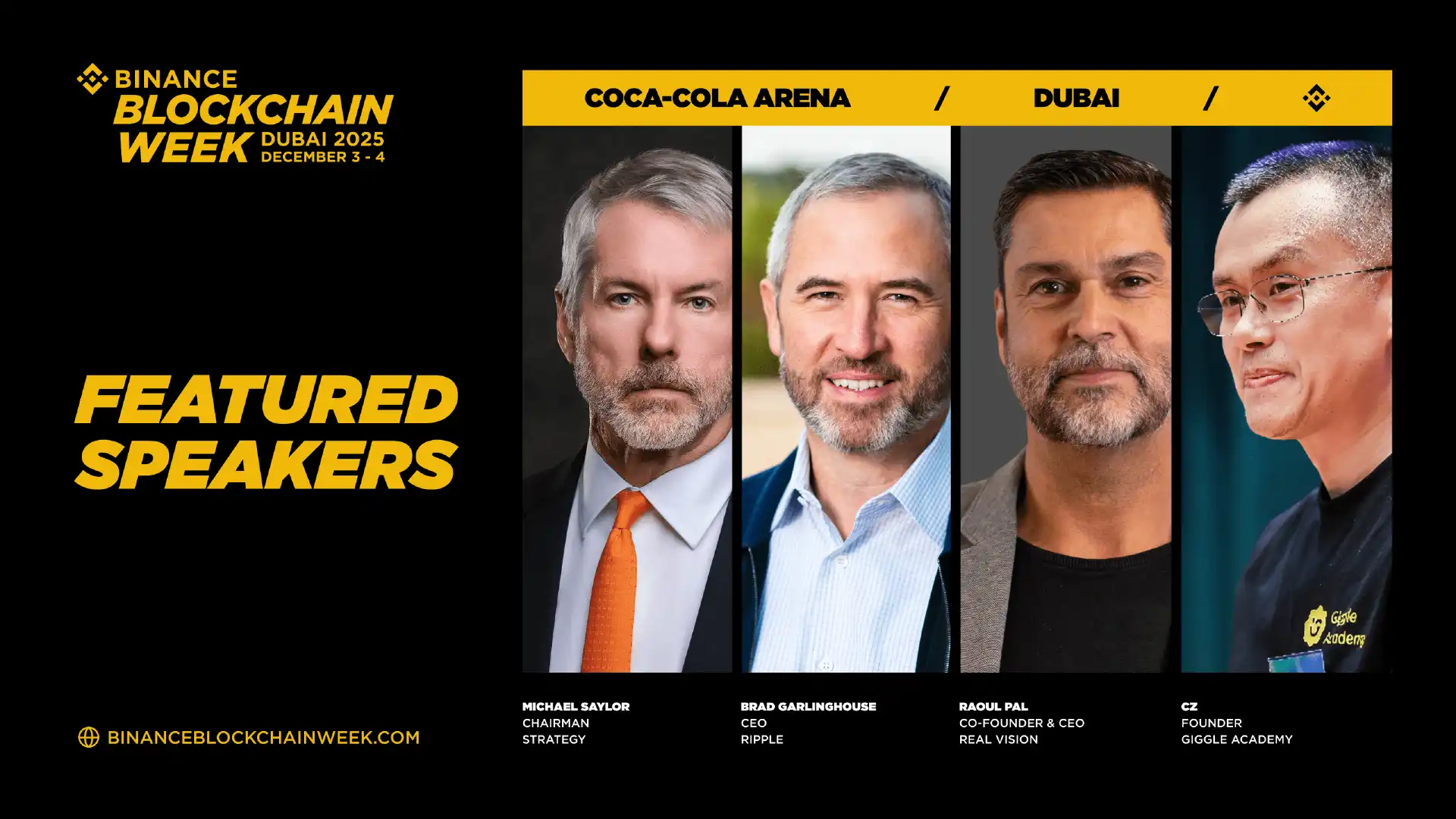
If early blockchain conferences were a geek's carnival, the 2025 BBW has evolved into the most densely packed power intersection of global Web3. When you look at the guest lineup for BBW 2025, you quickly realize that this is not just a conference but a comprehensive aggregation covering compliance policies, technological innovation, financial markets, infrastructure, public chain ecosystems, and popular culture.
In the realm of regulation and policy, UAE Minister of State for Artificial Intelligence and Digital Economy, His Excellency Omar Sultan Al Olama, is personally involved, demonstrating the region's national-level focus on digital assets and AI strategy. Figures such as Bilal Bin Saqib, Chairman of the Pakistan Cryptocurrency Regulations Authority, and heads of cryptocurrency-related departments in the UAE are also on the list, forming a complete chain from policy to regulation.
In the traditional finance sector, giants overseeing trillions of dollars in global liquidity such as BlackRock, Franklin Templeton, Citigroup, Mastercard, and other executives have all shown up, representing a direct epitome of the trend of convergence between traditional finance and financial technology.
On the technological front, an equally unprecedented lineup was present, with cloud solution architects and executives from Web2 tech giants such as Google Cloud, AWS, Microsoft, and Ali Cloud coming together. Infrastructure builders like Sandeep Nailwal from Polygon, Lily Liu from the Solana Foundation, Avery Ching from Aptos, Johann Eid from Chainlink, and others will collaborate with innovators at the application layer to discuss the form of the next-generation internet. This full industry chain coverage from foundational cloud infrastructure to upper-layer dApps ensures that BBW's topics always stay closely aligned with the forefront of technological development.
It is noteworthy that Binance CEO Richard Teng, co-founder He Yi, and the most controversial former Binance CEO CZ will all be present this year. This not only marks Binance's unified public stance during the global regulatory reshaping phase but also symbolizes that BBW has become the most important platform for industry strategic communication.
In addition to finance and technology, BBW 2025 will also feature cross-industry guests, with F1 Alpine driver Pierre Gasly and NBA champion center Tristan Thompson making cross-industry appearances, showcasing the strong permeability of Web3 culture.
Even notable figures such as prominent gold bull and Bitcoin critic Peter Schiff are among the invitees, demonstrating not only BBW's openness but also its desire to present the most real and sharpest clashes of viewpoints on the same stage. Here, there is not only a recharge of faith but also a clash of thoughts.
The Compound Interest of Time: From Prophecy to Actuality
In the crypto industry, true leadership is not about following trends. The ones who truly penetrate through the cycles are never the voices of market hype but those who can identify direction in chaos. Foresight is a more scarce resource than capital and technology.
BBW is such a unique entity. It is not just a yearly conference but more like a trailer of the industry's future. The speeches, themes, conversations, and judgments left behind by the past six editions, when reviewed today, have been almost remarkably validated by time. A conference becomes an industry benchmark not because it records trends but because it creates trends.
The story of BBW began in 2019 in Singapore. While most conferences were still discussing the most basic concepts, BBW's stage was already focusing on more creative topics, DeFi infrastructure, on-chain asset management, and the cultural potential of NFTs. These directions, which were seen as niche explorations at the time, quickly became part of the global narrative in the following periods. The DeFi Summer of 2020 saw the market go from 0 to a trillion, and the NFT revolution of 2021 swept through the art and branding world.
As the industry evolved, BBW's host cities also underwent transformations, from Singapore to Dubai to Paris, and then back to a more open Middle East from Istanbul. The city changes reflected the migration of the narrative, with the 2022 Paris edition perhaps being the most symbolic. Against the backdrop of a global crypto winter, tightening regulations, and recurring trust crises, Binance took a different approach by focusing the theme on cultural integration and regulatory compliance. Many thought at the time that this was going against the current, but soon after, the MiCA regulation was implemented, Proof of Reserves became an industry standard, institutions flowed back in large numbers under a strict regulatory framework, all of which validated the foresight of the Paris edition.
BBW is not about following the trend but about defining the next wave.
In 2023, the Istanbul edition saw Binance make another bold contrarian prophecy. At that time, market sentiment was at its lowest, liquidity was tight, and many projects were struggling. At the least favorable moment, BBW introduced the theme "The Next Billion," advocating that Web3 needed to refocus on true global users rather than just the industry insiders. At that time, some industry participants thought the theme was too idealistic. However, a year later, with the approval of a Bitcoin spot ETF, the explosion of L2 scaling, and the accelerated implementation of on-chain identity and payments, the trend towards mass adoption finally became visible. The concept of the "next billion users" finally shifted from a slogan to a tangible path.
In addition to the forward-looking nature of the theme itself, the real impact of BBW is hidden in the changes to the participant structure. The initial attendees were mostly developers, entrepreneurs, geeks, and early crypto investors. But now, it is a different scene, with Wall Street institutions, sovereign funds, international regulators, Web2 tech giants, and global brand executives all in attendance. In other words, BBW is no longer limited to the crypto community but has become a hub for the intersection of technology, finance, and culture. Web3 is no longer an edge experiment but has become an integral part of the global industry upgrade. Binance is indeed one of the central forces driving this transformation.
The history of BBW is a condensed evolution history of Web3. It proves that BBW is not just an annual conference but a pre-drawn industry roadmap.
By summarizing and deploying key issues in advance, Binance has demonstrated unparalleled industry foresight and leadership. For global builders, investors, and policymakers, BBW has become an indispensable reference point. To understand the next stop of Web3, one must pay attention to what Binance Blockchain Week is saying. Because here, what is said will ultimately experience "compound interest" in reality.
Aggregating Industry's Stable Coordinate Point
Looking back at Binance's role in the global Web3 development journey, its influence has long surpassed the category of a mere trading platform, becoming a key force driving the industry forward. From the early stages of the industry to the current era of tens of millions of users, Binance has always been one of the earliest and fastest platforms to bring crypto assets into the mainstream view. This popularization was not achieved solely through products but through long-standing user education, localized community building, and deep engagement in emerging markets, enabling Web3 to truly have the ability to reach the masses. The commitment to lowering industry barriers and achieving financial inclusion has allowed Binance to continually inject fresh blood into the global Web3, laying the foundation for the emergence of large-scale applications.
At the same time, Binance has not stayed within the trading ecosystem. Through core elements such as BNB Chain and YZi Labs, it continues to provide key infrastructure and early-stage capital for the next generation of Web3 applications. Many groundbreaking projects have grown from early technical concepts to real-world applications with the support of Binance's global resource network. What Binance has built is a complete acceleration path from innovative germination to industrialization.
Over the past decade, the global Web3 development has experienced peaks and troughs, undergone technical breakthroughs, regulatory tests, and market cycles. On this curve where fluctuations and innovations intertwine, Binance has always been a consistently stable coordinate point, aggregating innovative forces from around the world, enabling the industry to see a clearer future in a complex environment.
This influence, further amplified into a global "aggregated momentum," has been enhanced through the continued hosting of BBW. BBW eliminates the barriers of geography, language, and culture, allowing both startups, seasoned professionals, policymakers, and technical researchers to achieve high-speed dialogue and cross-border communication on the same stage. This connectivity is reshaping the industry's internal communication methods.
In fact, BBW has become a compass for connecting industry islands and facilitating efficient flow of knowledge and resources. It not only records trends but also consistently drives trends. It observes the industry while also shaping it.
This article is a contributed submission and does not represent the views of BlockBeats.
You may also like

Key Market Information Discrepancy on February 9th - A Must-See! | Alpha Morning Report

"2.5 Dip" Real Reason: Wall Street Deleveraging Induced Overreaction

Kyle's review of Hyperliquid sparks controversy, Solitude Bank officially opens, what are the overseas crypto communities talking about today?

Cryptocurrency prices in the dumps, but the prediction market is going wild?

Decoding Strategy’s Latest Financial Report: After a $12.4 Billion Loss, How Long Can the Bitcoin Flywheel Keep Spinning?
When earnings reports become electrocardiograms of Bitcoin’s price, Strategy is not merely a company—it’s an experiment testing whether faith can overcome gravity.

Discover How to Participate in Staking
Staking is a digital asset yield product launched by the WEEX platform. By subscribing to Staking products, users can stake their idle digital assets and earn corresponding Staking rewards.

WEEX AI Trading Hackathon Rules & Guidelines
This article explains the rules, requirements, and prize structure for the WEEX AI Trading Hackathon Finals, where finalists compete using AI-driven trading strategies under real market conditions.

From 0 to $1 Million: Five Steps to Outperform the Market Through Wallet Tracking

Token Cannot Compound, Where Is the Real Investment Opportunity?

February 6th Market Key Intelligence, How Much Did You Miss?

China's Central Bank and Eight Other Departments' Latest Regulatory Focus: Key Attention to RWA Tokenized Asset Risk
Foreword: Today, the People's Bank of China's website published the "Notice of the People's Bank of China, National Development and Reform Commission, Ministry of Industry and Information Technology, Ministry of Public Security, State Administration for Market Regulation, China Banking and Insurance Regulatory Commission, China Securities Regulatory Commission, State Administration of Foreign Exchange on Further Preventing and Dealing with Risks Related to Virtual Currency and Others (Yinfa [2026] No. 42)", the latest regulatory requirements from the eight departments including the central bank, which are basically consistent with the regulatory requirements of recent years. The main focus of the regulation is on speculative activities such as virtual currency trading, exchanges, ICOs, overseas platform services, and this time, regulatory oversight of RWA has been added, explicitly prohibiting RWA tokenization, stablecoins (especially those pegged to the RMB). The following is the full text:
To the people's governments of all provinces, autonomous regions, and municipalities directly under the Central Government, the Xinjiang Production and Construction Corps:
Recently, there have been speculative activities related to virtual currency and Real-World Assets (RWA) tokenization, disrupting the economic and financial order and jeopardizing the property security of the people. In order to further prevent and address the risks related to virtual currency and Real-World Assets tokenization, effectively safeguard national security and social stability, in accordance with the "Law of the People's Republic of China on the People's Bank of China," "Law of the People's Republic of China on Commercial Banks," "Securities Law of the People's Republic of China," "Law of the People's Republic of China on Securities Investment Funds," "Law of the People's Republic of China on Futures and Derivatives," "Cybersecurity Law of the People's Republic of China," "Regulations of the People's Republic of China on the Administration of Renminbi," "Regulations on Prevention and Disposal of Illegal Fundraising," "Regulations of the People's Republic of China on Foreign Exchange Administration," "Telecommunications Regulations of the People's Republic of China," and other provisions, after reaching consensus with the Cyberspace Administration of China, the Supreme People's Court, and the Supreme People's Procuratorate, and with the approval of the State Council, the relevant matters are notified as follows:
(I) Virtual currency does not possess the legal status equivalent to fiat currency. Virtual currencies such as Bitcoin, Ether, Tether, etc., have the main characteristics of being issued by non-monetary authorities, using encryption technology and distributed ledger or similar technology, existing in digital form, etc. They do not have legal tender status, should not and cannot be circulated and used as currency in the market.
The business activities related to virtual currency are classified as illegal financial activities. The exchange of fiat currency and virtual currency within the territory, exchange of virtual currencies, acting as a central counterparty in buying and selling virtual currencies, providing information intermediary and pricing services for virtual currency transactions, token issuance financing, and trading of virtual currency-related financial products, etc., fall under illegal financial activities, such as suspected illegal issuance of token vouchers, unauthorized public issuance of securities, illegal operation of securities and futures business, illegal fundraising, etc., are strictly prohibited across the board and resolutely banned in accordance with the law. Overseas entities and individuals are not allowed to provide virtual currency-related services to domestic entities in any form.
A stablecoin pegged to a fiat currency indirectly fulfills some functions of the fiat currency in circulation. Without the consent of relevant authorities in accordance with the law and regulations, any domestic or foreign entity or individual is not allowed to issue a RMB-pegged stablecoin overseas.
(II)Tokenization of Real-World Assets refers to the use of encryption technology and distributed ledger or similar technologies to transform ownership rights, income rights, etc., of assets into tokens (tokens) or other interests or bond certificates with token (token) characteristics, and carry out issuance and trading activities.
Engaging in the tokenization of real-world assets domestically, as well as providing related intermediary, information technology services, etc., which are suspected of illegal issuance of token vouchers, unauthorized public offering of securities, illegal operation of securities and futures business, illegal fundraising, and other illegal financial activities, shall be prohibited; except for relevant business activities carried out with the approval of the competent authorities in accordance with the law and regulations and relying on specific financial infrastructures. Overseas entities and individuals are not allowed to illegally provide services related to the tokenization of real-world assets to domestic entities in any form.
(III) Inter-agency Coordination. The People's Bank of China, together with the National Development and Reform Commission, the Ministry of Industry and Information Technology, the Ministry of Public Security, the State Administration for Market Regulation, the China Banking and Insurance Regulatory Commission, the China Securities Regulatory Commission, the State Administration of Foreign Exchange, and other departments, will improve the work mechanism, strengthen coordination with the Cyberspace Administration of China, the Supreme People's Court, and the Supreme People's Procuratorate, coordinate efforts, and overall guide regions to carry out risk prevention and disposal of virtual currency-related illegal financial activities.
The China Securities Regulatory Commission, together with the National Development and Reform Commission, the Ministry of Industry and Information Technology, the Ministry of Public Security, the People's Bank of China, the State Administration for Market Regulation, the China Banking and Insurance Regulatory Commission, the State Administration of Foreign Exchange, and other departments, will improve the work mechanism, strengthen coordination with the Cyberspace Administration of China, the Supreme People's Court, and the Supreme People's Procuratorate, coordinate efforts, and overall guide regions to carry out risk prevention and disposal of illegal financial activities related to the tokenization of real-world assets.
(IV) Strengthening Local Implementation. The people's governments at the provincial level are overall responsible for the prevention and disposal of risks related to virtual currencies and the tokenization of real-world assets in their respective administrative regions. The specific leading department is the local financial regulatory department, with participation from branches and dispatched institutions of the State Council's financial regulatory department, telecommunications regulators, public security, market supervision, and other departments, in coordination with cyberspace departments, courts, and procuratorates, to improve the normalization of the work mechanism, effectively connect with the relevant work mechanisms of central departments, form a cooperative and coordinated working pattern between central and local governments, effectively prevent and properly handle risks related to virtual currencies and the tokenization of real-world assets, and maintain economic and financial order and social stability.
(5) Enhanced Risk Monitoring. The People's Bank of China, China Securities Regulatory Commission, National Development and Reform Commission, Ministry of Industry and Information Technology, Ministry of Public Security, State Administration of Foreign Exchange, Cyberspace Administration of China, and other departments continue to improve monitoring techniques and system support, enhance cross-departmental data analysis and sharing, establish sound information sharing and cross-validation mechanisms, promptly grasp the risk situation of activities related to virtual currency and real-world asset tokenization. Local governments at all levels give full play to the role of local monitoring and early warning mechanisms. Local financial regulatory authorities, together with branches and agencies of the State Council's financial regulatory authorities, as well as departments of cyberspace and public security, ensure effective connection between online monitoring, offline investigation, and fund tracking, efficiently and accurately identify activities related to virtual currency and real-world asset tokenization, promptly share risk information, improve early warning information dissemination, verification, and rapid response mechanisms.
(6) Strengthened Oversight of Financial Institutions, Intermediaries, and Technology Service Providers. Financial institutions (including non-bank payment institutions) are prohibited from providing account opening, fund transfer, and clearing services for virtual currency-related business activities, issuing and selling financial products related to virtual currency, including virtual currency and related financial products in the scope of collateral, conducting insurance business related to virtual currency, or including virtual currency in the scope of insurance liability. Financial institutions (including non-bank payment institutions) are prohibited from providing custody, clearing, and settlement services for unauthorized real-world asset tokenization-related business and related financial products. Relevant intermediary institutions and information technology service providers are prohibited from providing intermediary, technical, or other services for unauthorized real-world asset tokenization-related businesses and related financial products.
(7) Enhanced Management of Internet Information Content and Access. Internet enterprises are prohibited from providing online business venues, commercial displays, marketing, advertising, or paid traffic diversion services for virtual currency and real-world asset tokenization-related business activities. Upon discovering clues of illegal activities, they should promptly report to relevant departments and provide technical support and assistance for related investigations and inquiries. Based on the clues transferred by the financial regulatory authorities, the cyberspace administration, telecommunications authorities, and public security departments should promptly close and deal with websites, mobile applications (including mini-programs), and public accounts engaged in virtual currency and real-world asset tokenization-related business activities in accordance with the law.
(8) Strengthened Entity Registration and Advertisement Management. Market supervision departments strengthen entity registration and management, and enterprise and individual business registrations must not contain terms such as "virtual currency," "virtual asset," "cryptocurrency," "crypto asset," "stablecoin," "real-world asset tokenization," or "RWA" in their names or business scopes. Market supervision departments, together with financial regulatory authorities, legally enhance the supervision of advertisements related to virtual currency and real-world asset tokenization, promptly investigating and handling relevant illegal advertisements.
(IX) Continued Rectification of Virtual Currency Mining Activities. The National Development and Reform Commission, together with relevant departments, strictly controls virtual currency mining activities, continuously promotes the rectification of virtual currency mining activities. The people's governments of various provinces take overall responsibility for the rectification of "mining" within their respective administrative regions. In accordance with the requirements of the National Development and Reform Commission and other departments in the "Notice on the Rectification of Virtual Currency Mining Activities" (NDRC Energy-saving Building [2021] No. 1283) and the provisions of the "Guidance Catalog for Industrial Structure Adjustment (2024 Edition)," a comprehensive review, investigation, and closure of existing virtual currency mining projects are conducted, new mining projects are strictly prohibited, and mining machine production enterprises are strictly prohibited from providing mining machine sales and other services within the country.
(X) Severe Crackdown on Related Illegal Financial Activities. Upon discovering clues to illegal financial activities related to virtual currency and the tokenization of real-world assets, local financial regulatory authorities, branches of the State Council's financial regulatory authorities, and other relevant departments promptly investigate, determine, and properly handle the issues in accordance with the law, and seriously hold the relevant entities and individuals legally responsible. Those suspected of crimes are transferred to the judicial authorities for processing according to the law.
(XI) Severe Crackdown on Related Illegal and Criminal Activities. The Ministry of Public Security, the People's Bank of China, the State Administration for Market Regulation, the China Banking and Insurance Regulatory Commission, the China Securities Regulatory Commission, as well as judicial and procuratorial organs, in accordance with their respective responsibilities, rigorously crack down on illegal and criminal activities related to virtual currency, the tokenization of real-world assets, such as fraud, money laundering, illegal business operations, pyramid schemes, illegal fundraising, and other illegal and criminal activities carried out under the guise of virtual currency, the tokenization of real-world assets, etc.
(XII) Strengthen Industry Self-discipline. Relevant industry associations should enhance membership management and policy advocacy, based on their own responsibilities, advocate and urge member units to resist illegal financial activities related to virtual currency and the tokenization of real-world assets. Member units that violate regulatory policies and industry self-discipline rules are to be disciplined in accordance with relevant self-regulatory management regulations. By leveraging various industry infrastructure, conduct risk monitoring related to virtual currency, the tokenization of real-world assets, and promptly transfer issue clues to relevant departments.
(XIII) Without the approval of relevant departments in accordance with the law and regulations, domestic entities and foreign entities controlled by them may not issue virtual currency overseas.
(XIV) Domestic entities engaging directly or indirectly in overseas external debt-based tokenization of real-world assets, or conducting asset securitization activities abroad based on domestic ownership rights, income rights, etc. (hereinafter referred to as domestic equity), should be strictly regulated in accordance with the principles of "same business, same risk, same rules." The National Development and Reform Commission, the China Securities Regulatory Commission, the State Administration of Foreign Exchange, and other relevant departments regulate it according to their respective responsibilities. For other forms of overseas real-world asset tokenization activities based on domestic equity by domestic entities, the China Securities Regulatory Commission, together with relevant departments, supervise according to their division of responsibilities. Without the consent and filing of relevant departments, no unit or individual may engage in the above-mentioned business.
(15) Overseas subsidiaries and branches of domestic financial institutions providing Real World Asset Tokenization-related services overseas shall do so legally and prudently. They shall have professional personnel and systems in place to effectively mitigate business risks, strictly implement customer onboarding, suitability management, anti-money laundering requirements, and incorporate them into the domestic financial institutions' compliance and risk management system. Intermediaries and information technology service providers offering Real World Asset Tokenization services abroad based on domestic equity or conducting Real World Asset Tokenization business in the form of overseas debt for domestic entities directly or indirectly venturing abroad must strictly comply with relevant laws and regulations. They should establish and improve relevant compliance and internal control systems in accordance with relevant normative requirements, strengthen business and risk control, and report the business developments to the relevant regulatory authorities for approval or filing.
(16) Strengthen organizational leadership and overall coordination. All departments and regions should attach great importance to the prevention of risks related to virtual currencies and Real World Asset Tokenization, strengthen organizational leadership, clarify work responsibilities, form a long-term effective working mechanism with centralized coordination, local implementation, and shared responsibilities, maintain high pressure, dynamically monitor risks, effectively prevent and mitigate risks in an orderly and efficient manner, legally protect the property security of the people, and make every effort to maintain economic and financial order and social stability.
(17) Widely carry out publicity and education. All departments, regions, and industry associations should make full use of various media and other communication channels to disseminate information through legal and policy interpretation, analysis of typical cases, and education on investment risks, etc. They should promote the illegality and harm of virtual currencies and Real World Asset Tokenization-related businesses and their manifestations, fully alert to potential risks and hidden dangers, and enhance public awareness and identification capabilities for risk prevention.
(18) Engaging in illegal financial activities related to virtual currencies and Real World Asset Tokenization in violation of this notice, as well as providing services for virtual currencies and Real World Asset Tokenization-related businesses, shall be punished in accordance with relevant regulations. If it constitutes a crime, criminal liability shall be pursued according to the law. For domestic entities and individuals who knowingly or should have known that overseas entities illegally provided virtual currency or Real World Asset Tokenization-related services to domestic entities and still assisted them, relevant responsibilities shall be pursued according to the law. If it constitutes a crime, criminal liability shall be pursued according to the law.
(19) If any unit or individual invests in virtual currencies, Real World Asset Tokens, and related financial products against public order and good customs, the relevant civil legal actions shall be invalid, and any resulting losses shall be borne by them. If there are suspicions of disrupting financial order and jeopardizing financial security, the relevant departments shall deal with them according to the law.
This notice shall enter into force upon the date of its issuance. The People's Bank of China and ten other departments' "Notice on Further Preventing and Dealing with the Risks of Virtual Currency Trading Speculation" (Yinfa [2021] No. 237) is hereby repealed.

Former Partner's Perspective on Multicoin: Kyle's Exit, But the Game He Left Behind Just Getting Started
Why Bitcoin Is Falling Now: The Real Reasons Behind BTC's Crash & WEEX's Smart Profit Playbook
Bitcoin's ongoing crash explained: Discover the 5 hidden triggers behind BTC's plunge & how WEEX's Auto Earn and Trade to Earn strategies help traders profit from crypto market volatility.

Wall Street's Hottest Trades See Exodus

Vitalik Discusses Ethereum Scaling Path, Circle Announces Partnership with Polymarket, What's the Overseas Crypto Community Talking About Today?

Believing in the Capital Markets - The Essence and Core Value of Cryptocurrency
Polymarket's 'Weatherman': Predict Temperature, Win Million-Dollar Payout

$15K+ Profits: The 4 AI Trading Secrets WEEX Hackathon Prelim Winners Used to Dominate Volatile Crypto Markets
How WEEX Hackathon's top AI trading strategies made $15K+ in crypto markets: 4 proven rules for ETH/BTC trading, market structure analysis, and risk management in volatile conditions.
Key Market Information Discrepancy on February 9th - A Must-See! | Alpha Morning Report
"2.5 Dip" Real Reason: Wall Street Deleveraging Induced Overreaction
Kyle's review of Hyperliquid sparks controversy, Solitude Bank officially opens, what are the overseas crypto communities talking about today?
Cryptocurrency prices in the dumps, but the prediction market is going wild?
Decoding Strategy’s Latest Financial Report: After a $12.4 Billion Loss, How Long Can the Bitcoin Flywheel Keep Spinning?
When earnings reports become electrocardiograms of Bitcoin’s price, Strategy is not merely a company—it’s an experiment testing whether faith can overcome gravity.
Discover How to Participate in Staking
Staking is a digital asset yield product launched by the WEEX platform. By subscribing to Staking products, users can stake their idle digital assets and earn corresponding Staking rewards.


 App
App