
- Buy Crypto
- Markets
 Futures
- Spot
- Copy Trade
 Earn
Earn- More
The Truth About Liquidity: 2024 Exchange Listing Effect Research Report

Original Title: "The Truth About Liquidity: A Study on the Listing Effect of 2024 Trading Platforms"
Original Source: Klein Labs
1. Research Introduction
1.1 Research Background
Throughout this year, there has been widespread discussion in the market regarding VC tokens with high Fully Diluted Valuation (FDV) but low Market Capitalization (MC). With the tokens newly issued in 2024, the MC/FDV ratio has dropped to the lowest level in the past three years, indicating a significant amount of tokens will be unlocked and enter the market in the future. Despite the initially low circulation, the market may experience a price surge in the short term due to increased demand; however, this surge lacks sustainability. Once a large number of tokens unlock and enter the market, the risk of oversupply intensifies, and investors start to worry that this market structure may not be able to sustain price growth in the long term.
As a result, many investors have shifted their focus from these VC tokens to Meme coins. Meme coins are characterized by the majority of tokens being fully unlocked at TGE, with a higher circulation rate and no selling pressure from future unlocks. This structure reduces supply pressure in the market, giving investors more confidence. Many Meme coins have an MC/FDV ratio close to 1 at issuance, meaning holders will not face dilution due to further token issuance, providing a relatively stable market environment. As awareness of the risk of large-scale token unlocks deepens, investors have gradually turned their attention to these high-circulation, low-inflation Meme coins, even though these tokens may lack practical use cases.
In the current market landscape, investors are required to be more cautious in selecting tokens. However, when choosing tokens, investors often struggle to independently evaluate the value and potential of each project. At this point, the screening mechanism of trading platforms becomes crucial. As the "gatekeepers" who directly introduce token assets to users, centralized exchanges not only help validate the compliance and market potential of tokens but also play a role in filtering high-quality projects. Despite another perspective in the market, which suggests that on-chain transactions will surpass CEX transactions, Klein Labs believes that the market share of centralized exchanges will not be overtaken by on-chain transactions. Factors such as the smoothness of transactions on CEX, centralized custody of assets with accountability, user habits and mindset, the liquidity barrier, and the global regulatory compliance trend make the transaction share on CEX continue to exceed that of on-chain transactions in the long term.
So, the ensuing question is, how do centralized exchanges screen and decide on listings among numerous projects? How has the overall performance been of the tokens that have been listed over the past year? Is there a correlation between the performance of these listed tokens and the chosen trading platforms?
To address these market concerns, this study aims to explore the listing status on major exchanges and analyze its actual impact on token market performance, focusing on changes in trading volume and price volatility after listing to identify the influence of different exchanges on the post-listing market performance of a token.
1.2 Research Method
1.2.1 Research Subject
We categorize exchanges based on their region and target market into three main types:
· Chinese-founded, Global-facing: Binance, Bybit, OKX, Bitget, KuCoin, Gate, etc. These are well-known exchanges founded by Chinese individuals and targeting the global market. There are numerous Chinese exchanges, and for research purposes, exchanges with different development characteristics have been selected. Exchanges not selected also have their own advantages.
· Korean-founded, Local-facing: Bithumb, UPbit, etc. These exchanges primarily target the local Korean market.
· U.S.-founded, Europe- and U.S.-facing: Coinbase, Kraken, etc. These U.S.-based exchanges mainly target the European and U.S. markets and are usually subject to strict regulations such as the SEC and CFTC.
Exchanges from other regions such as Latin America, India, Africa, etc., have an overall trading volume and liquidity of less than 5% and are therefore not deeply analyzed in this research report.
We have selected a total of 10 representative exchanges from the above categories to analyze their listing performance, including the number of listing events and their subsequent market impacts.
1.2.2 Timeframe
We mainly focus on the price changes on the 1st day, 7th day, and 30th day after the token generation event (TGE) to analyze the trends, volatility patterns, and market reactions for the following reasons:
· On the TGE's first day, a new asset is issued, and trading volume is highly active, reflecting the market's immediate acceptance. Influenced significantly by rush fundraising and FOMO sentiment, it is a critical stage for the initial market pricing.
· Price changes in the first 7 days after TGE can capture the market's short-term sentiment toward the new token, as well as the initial recognition of the project's fundamentals, measuring the sustainability of market enthusiasm and returning to a project's reasonably initial pricing.
· First 30 Days After TGE observe the long-term support of the token, with short-term hype cooling down and speculators gradually exiting. Whether the token price and trading volume are maintained becomes an important reference for market acceptance.
1.2.3 Data Processing
This study adopts a systematic data processing method to ensure the scientific analysis. Compared to common research methods in the market, this study is more intuitive, concise, and efficient.
In this research report, the data mainly comes from TradingView, covering price data of tokens newly listed on major exchanges in 2024, including the initial listing price, market price at different time points, and trading volume data. Due to the large number of sample points, this large-scale data analysis helps reduce the impact of individual abnormal data on the overall trend, thereby improving the reliability of the statistical results.
(I)Multivariable Overview of Listing Activity
This study adopts a multivariable analysis method, comprehensively considering factors such as market trends, trading depth, and liquidity to ensure the completeness and scientific nature of the results. We compared the average price changes of different coins newly listed on exchanges and conducted in-depth analysis combined with exchange market positioning (such as user base, liquidity, listing strategy).
(II)Mean Value Judgment of Overall Performance
To measure the token's market performance, we calculated its percentage change relative to the initial listing price, with the following formula:

Considering that extreme situations in the market may affect the overall data trend, we excluded the top 10% and bottom 10% of extreme outliers to reduce the interference of incidental market events (such as sudden positive news, market manipulation, liquidity anomalies) on statistical results. This processing method makes the calculation results more representative, accurately reflecting the true market performance of new coins on different exchanges. Subsequently, we calculated the average price changes of new coins on each exchange to measure the overall performance of new coins on different platforms.
(III)Coefficient of Variation for Stability Assessment
The coefficient of variation (CV) is an indicator that measures the relative variability of data, calculated by the following formula:

Where σ is the standard deviation and μ is the mean. The coefficient of variation is a dimensionless indicator that is not affected by data units, making it suitable for comparing the volatility of different datasets. In market analysis, CV is mainly used to measure the relative volatility of prices or returns. In a trading platform or token price analysis, CV can reflect the relative stability of different markets, providing investors with a basis for risk assessment. The coefficient of variation is used here instead of the standard deviation because it is more applicable than the standard deviation.
2. Listing Event Overview
2.1 Comparison Among Trading Platforms
2.1.1 Listing Quantity and FDV Preference
2024 Listing Event Overview
We found that overall, the top-tier trading platforms (such as Binance, UPbit, Coinbase) generally have fewer listing events compared to other trading platforms. This reflects the influence of the exchanges' different positions on the listing style.
In terms of listing quantity, exchanges like Binance, OKX, UPbit, and Coinbase have stricter listing rules, resulting in fewer listings but on a larger scale. On the other hand, platforms like Gate list new assets more frequently, providing more trading opportunities. The data shows that there is a negative correlation between the listing quantity and FDV, meaning that exchanges listing more high FDV projects tend to have fewer listings.
CEXs adopt different strategies to determine the listing priority, with a focus on different levels of fully diluted valuation (FDV). Here, we categorize projects based on their FDV to better understand the listing standards of trading platforms. When evaluating tokens, we often consider Market Cap (MC) and FDV, which jointly reflect the token's valuation, market size, and liquidity.
· MC only calculates the total value of the currently circulating tokens, without considering future unlocked tokens, which may underestimate the true valuation of the project, especially when most tokens are still locked up, leading to potential misinterpretation.
· FDV, on the other hand, is based on the calculation of the total token supply, providing a more comprehensive reflection of the project's potential valuation, helping investors assess future selling pressure risks and long-term value. For projects with low MC/FDV, the short-term significance of FDV is limited, and it serves more as a long-term reference.
Therefore, when analyzing newly listed tokens, FDV is more informative than Market Cap. Here, we choose FDV as the standard.
In addition, in terms of the attitude towards initial projects, most trading platforms usually adopt a balanced strategy, considering both initial and non-initial projects. However, the requirements for non-initial projects are usually higher because initial projects bring in more new users. Furthermore, two Korean exchanges, UPbit and Bithumb, mainly focus on listing non-initial projects. This is because compared to initial projects, listing non-initial projects can reduce screening risks, avoid market fluctuations during the initial stage, and mitigate the issue of insufficient early-stage liquidity. Additionally, for project teams, listing non-initially rather than conducting an initial listing can reduce the pressure of market promotion and liquidity management. Listing non-initially can leverage existing market recognition to drive growth.
2.1.2 Track Preference
Binance
In 2024, Meme coins still account for the largest proportion. Infrastructure and DeFi projects have a significant share. The RWA and DePIN tracks have relatively fewer listings on Binance, but they have performed well overall. The USUAL spot had the highest surge of up to 7081%. Although Binance is cautious in its listing choices in these areas, once listed, the market response is usually positive. In the second half of the year, Binance's listing preference in the AI track noticeably tilted towards AI Agent tokens, which had the highest share among AI projects.
In 2024, Binance prefers projects related to the BNB ecosystem. For example, the listing of projects like BANANA and CGPT indicates Binance's strengthening support for its own on-chain ecosystem.
OKX
Looking at the number of listings on OKX, Meme coins also have the highest count, accounting for about 25%. However, compared to other trading platforms, there are more listings in the public chain and infrastructure tracks, with a combined share of up to 34%. This indicates that OKX in 2024 is more focused on underlying technological innovation, scalability optimization, and the sustainable development of the blockchain ecosystem.
In the emerging tracks, OKX has only listed 4 AI tokens, including DMAIL and GPT, launched 3 new tokens in the RWA track, and only 3 in the DePIN track. This reflects OKX's cautious layout in relatively emerging tracks.
UPbit
The main feature of UPbit's 2024 listings is the extensive track coverage and generally good token performance. In 2024, UNI and BNT were listed in the DEX track at UPbit. This indicates that UPbit still has significant potential and room for development in listing popular assets, with many mainstream or high market value tokens yet to be listed, and may further expand support in the future. At the same time, this also reflects UPbit's strict listing review process, leaning towards cautiously selecting assets with long-term potential.
On UPbit, the tokens in each track have shown significant price increases. Tokens from tracks such as PEPE (Meme), AGLD (Game), DRIFT (DeFi), SAFE (Infra), experienced notable price surges in the short term, with gains reaching as high as 100% and even exceeding 150%. UNI saw a remarkable 93.5% price increase on its 30th day of listing compared to the first day. This reflects the high level of approval from Korean users towards projects listed on UPbit.
Furthermore, from a public blockchain ecosystem perspective, ecosystems like Solana and TON have been favored.
We have also observed that exchanges are gradually deepening their support for their own blockchain ecosystems. For example, Binance-affiliated BSC and opBNB chains have been continuously strengthening their support for their on-chain ecosystem. Similarly, Coinbase's introduced Base has become a key focus, with Base projects accounting for nearly 40% of all new listings in 2024. Additionally, OKX continues to make efforts in the X Layer ecosystem layout. Moreover, the planned launch of Kraken's L2 network, Ink further indicates that top exchanges are actively advancing on-chain infrastructure development.
Behind this trend is the exploration of exchanges transitioning from "off-chain" to "on-chain," expanding their business scope, and strengthening their competitiveness in the DeFi sector. By supporting projects on their own chain, exchanges can not only drive ecosystem development but also enhance user stickiness and earn higher returns in the issuance and trading of new assets. This also implies that in the future, exchanges' listing strategies will increasingly favor projects within their own ecosystem to enhance the activity and market influence of their blockchain networks.
2.2 Time Dimension Analysis
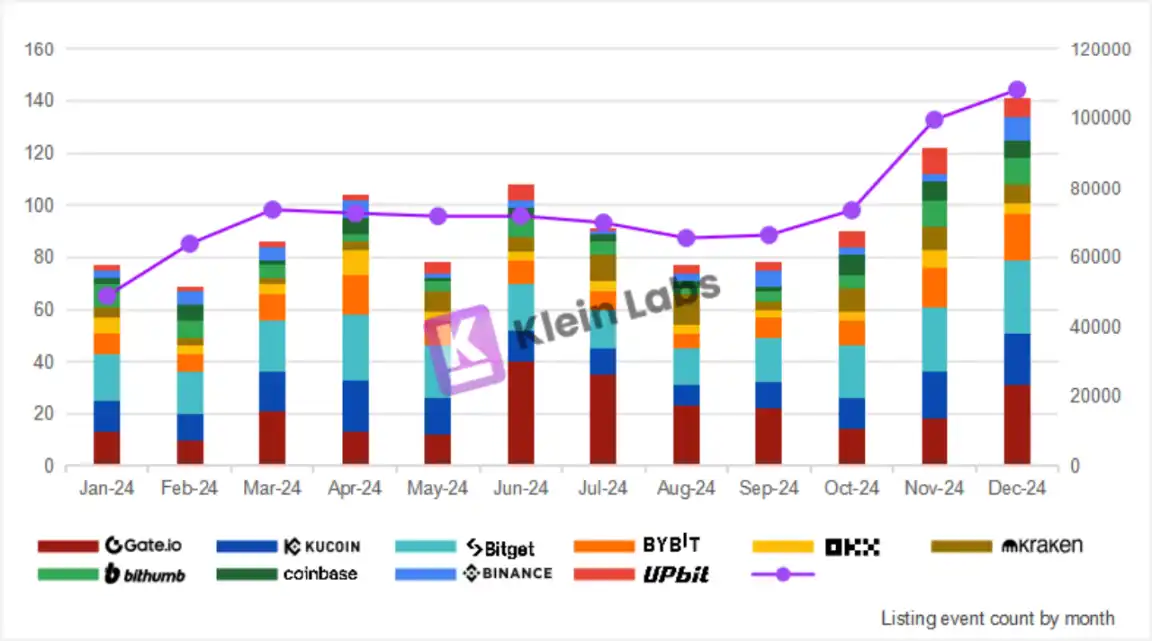
Number of listings per month on different exchanges
· The trend of listing events correlates with the price fluctuations of BTC. During BTC's price increases (February to March and August to December), there were more listing events, whereas during periods of BTC consolidation or decline (April to July), the number of listing events notably decreased.
· The listing activities of top-tier exchanges (Binance, UPbit) were less affected during the bear market, with their listing share actually expanding during this period, demonstrating stronger market leadership and countercyclical capabilities.
· Bitget's listing quantity remained relatively stable, with less impact from market fluctuations, while the listing pace of other exchanges showed greater volatility. This may be related to its more balanced listing strategy.
· Gate and KuCoin had a higher listing frequency, but the listing quantity fluctuated more with market conditions, indicating that these exchanges may rely more on the higher liquidity of new projects during bull markets to attract users.
3. Trading Volume Analysis
3.1 Overall Situation of Trading Volume on Different Exchanges
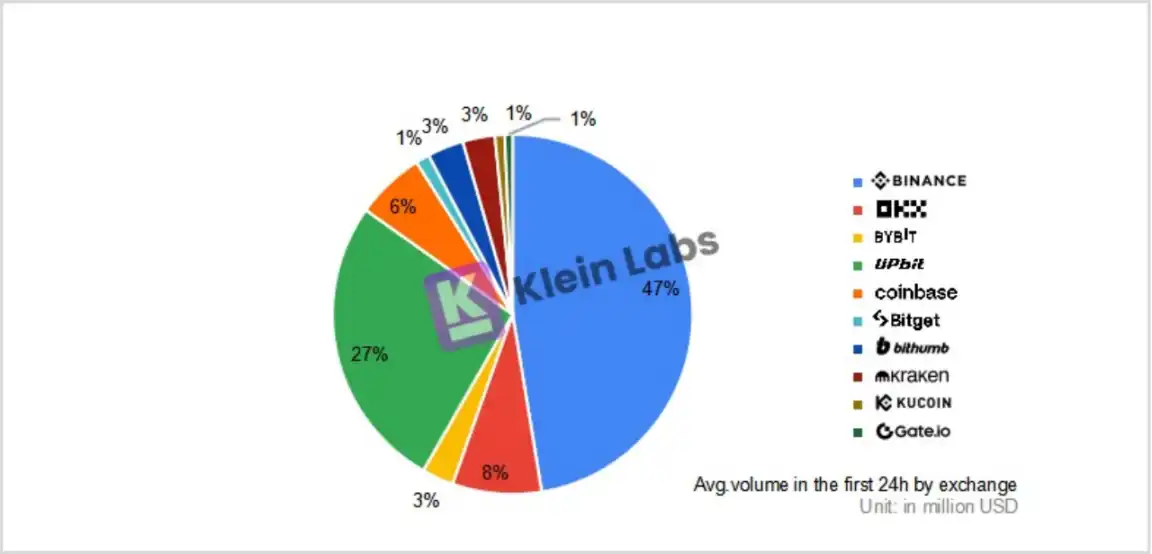
Average trading volume of projects on each exchange 24 hours after TGE in 2024
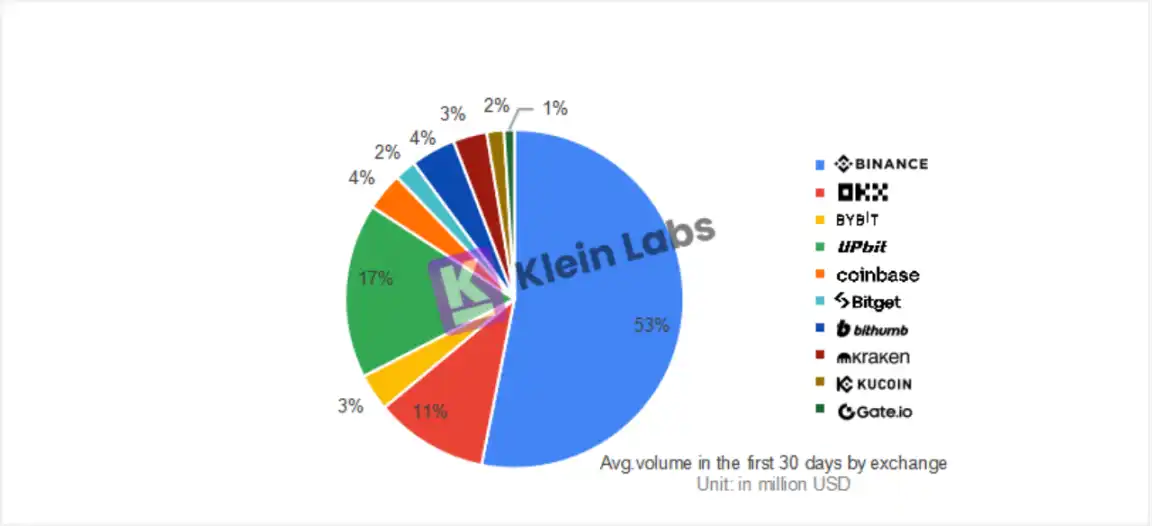
Average trading volume of projects on each exchange 30 days after TGE in 2024
· UPbit had a very high proportion of trading volume within 24 hours of listing, even surpassing half of Binance's volume, showing its strong short-term market appeal and significant liquidity influx. Although the proportion slightly decreased after 30 days, it still maintains a high market share, with a proportion even close to the sum of OKX, Coinbase, and Bybit, the top three exchanges, indicating UPbit's crucial position in the listing market.
· Binance and OKX experienced steady growth in trading volume, maintaining a leading market share after 30 days, demonstrating strong market recognition and liquidity depth. Binance held a 47% share within 24 hours, which increased to 53% after 30 days, indicating its long-term market leadership. OKX also maintained a high share after 30 days.
· Bybit performed well in both short-term and long-term trading volume, remaining relatively stable. Meanwhile, Bithumb's market share slightly increased after 30 days, indicating that it not only retained early trading volume but also attracted more liquidity. This suggests that Bithumb's competitiveness in the listing market has strengthened.
Although Korean exchanges are known for favoring non-initial projects, as the above data shows, these projects are still able to generate very strong trading volumes. The ability of non-initial projects on Korean exchanges to generate such significant trading volume is primarily due to the unique market environment:
Closed Nature of the Korean Trading Market and Liquidity Concentration
· Market Closure: Due to the strict local KYC policies in Korea, overseas users are basically unable to directly use Korean exchanges, leading to a relatively closed trading ecosystem in the Korean market; a large number of local users prefer to trade on Korean exchanges. Therefore, liquidity within the Korean market is more concentrated.
· Exchange Platform Monopoly: The Korean crypto market exhibits a highly monopolistic structure, with UPbit currently holding 70%-80% of the Korean crypto market share, firmly positioned as the industry leader. After UPbit established its leading position in 2021, Bithumb's previous first-place position was replaced, with its market share falling to 15%-20%. Korean trading volume and liquidity converge towards the top platforms, demonstrating a strong fund aggregation effect.
Therefore, even if a token has already been listed globally, its trading situation in the Korean market may still exhibit a similar effect to an "initial listing," driving significant market attention and capital inflow.
High Holding Rate and Capital Advantage of the Korean Crypto Market
· High Penetration of Crypto Assets: Korean investors have a very high proportion of crypto asset holdings, far exceeding other major markets. As of November 2024, the number of people holding crypto assets on Korean exchanges exceeded 15.59 million, equivalent to over 30% of the total Korean population. Many Koreans hold a large amount of crypto assets themselves and tend to lean towards digital assets in their investment choices. Despite accounting for only 0.6% of the global population, Korea contributes to 30% of global cryptocurrency trading volume.
· Sufficient Social Capital: In addition, as Korea is a high GDP developed country, overall social capital is relatively abundant, with a large amount of investable funds, providing ample liquidity to the crypto market.
· Limited Space for Young People in Traditional Industries: Korea is a capitalist country dominated by chaebols, and young people face significant employment and life pressures, with intensified class rigidity increasing the desire for wealth appreciation channels. Approximately 3.08 million young people aged 20-39 are involved in cryptocurrency trading, accounting for 23% of the total population in that age group.
As of November 2024, the total amount of cryptocurrency held by the South Korean population has increased to 102.6 trillion South Korean won (approximately 697.68 billion US dollars), and the daily average transaction amount has also risen to 14.9 trillion South Korean won (approximately 101.32 billion US dollars). UPbit became the fastest-growing CEX in terms of trading volume in the fourth quarter of 2024, increasing from 135.5 billion US dollars to 561.9 billion US dollars, a quarter-on-quarter growth of 314.8%. This growth reflects the strong demand for crypto assets in the Korean market and further confirms the high trading volume trend of Korean exchanges in non-IPO projects.
4. Price Performance Analysis
4.1 Price Performance by Exchange Comparison
4.1.1 Overall Price Performance on Different Exchanges
Comparison of the mean and median of the trading volume price after TGE for 7 days on various exchanges
· Binance performed the best, with both the mean and median being outstanding. The top three in terms of mean price ranking are Binance, OKX, Bitget. While OKX has a positive mean, the median is negative, indicating significant price volatility for rising tokens, with sharp short-term price fluctuations and noticeable outliers. Bitget's performance is relatively prominent, being closest to the two leading exchanges among other trading platforms. Additionally, its median price increase ranks second among all exchanges, closely following Binance, and shows a relatively high positive value, indicating a strong, upward price trend for tokens on Bitget.
· Among mid-sized exchanges, Bithumb, Gate, KuCoin showed better performance. Among them, Bithumb is relatively balanced in price performance, with the smallest difference between absolute value and median, indicating lower price volatility and stable performance. However, KuCoin and Gate have negative medians with relatively high absolute values, suggesting lower token win rates and the possibility of many upward outliers causing interference.
Comparison of the mean and median of the trading volume price after TGE for 30 days on various exchanges
· By the 30th day, overall, the median prices have dropped, indicating that after 30 days, especially for tokens with poor liquidity, some speculative funds have withdrawn significantly from the market, increasing selling pressure and insufficient buying support, leading to price declines. Gate may have experienced significant market volatility due to a large number of listings, resulting in inadequate liquidity. This indicates that the platform has not attracted enough stable inflows of capital, and the excessive token selection has dispersed liquidity, disrupting the balance between buyers and sellers, resulting in a significant price drop.
· Binance has been minimally affected, with a slight decrease in the mean value, indicating that its listed tokens still maintain strong market support and stable trading volume 30 days later, with some tokens still having room for growth. As a top-tier exchange platform, Binance, with its significant market liquidity and wide user base, can sustain relatively high token prices even when the overall new coin market is bearish 30 days later.
· Among medium-sized exchange platforms, Bithumb is the only platform that saw an increase after 30 days, with positive 7-day and median gains. This suggests that Bithumb, leveraging good market liquidity and stability, successfully attracted funds, demonstrating strong resilience to downturns and market appeal. This may be due to Bithumb's lower listing volume, allowing it to concentrate liquidity, maintain strong market activity, and enable newly listed tokens to perform better in terms of price.
4.1.2 Monthly Price Performance of Tokens Listed on Each Exchange
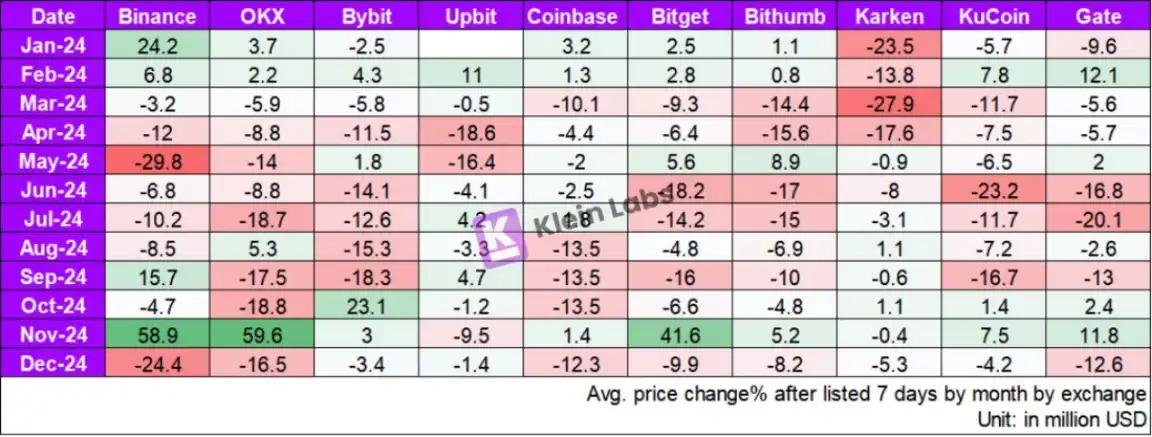
Price changes for each exchange one week after Token Generation Event (TGE) and each month thereafter
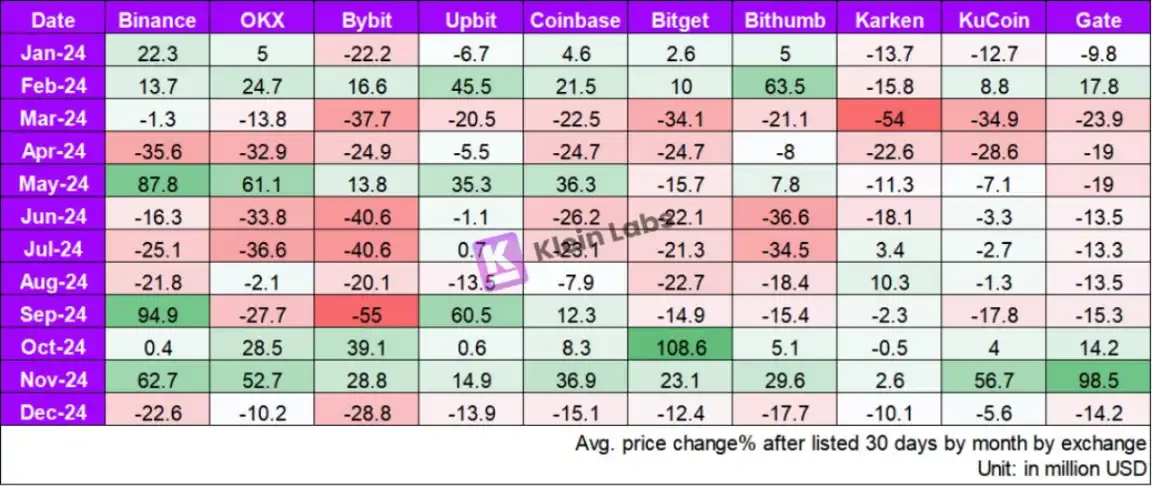
Price changes for each exchange 30 days after Token Generation Event (TGE) and each month thereafter
· Binance and UPbit exhibit significant price advantages, greatly influenced by market sentiment. The listing of tokens on Binance and UPbit performs exceptionally well during positive market trends, such as in May and September when Binance saw 30-day gains of 87.8% and 94.9%, respectively, and UPbit had a 60.5% increase in September, demonstrating strong price advantages but with high volatility. They experienced significant drops in April and July, showing the significant impact of market sentiment.
· The overall market trend significantly affects token performance, with listings on top-tier exchanges experiencing larger gains during bull markets, while medium-sized exchanges are more prone to significant drops during market downturns. For instance, Bybit and OKX saw 30-day decreases of -40.6% and -36.6% in July, respectively, and Kraken and KuCoin also had weaker overall performances after 7 days, especially with Kraken experiencing -23.5% and -27.9% drops in January and March, respectively.
4.2 Price Volatility Fluctuation
In the previous section, we used the mean to reflect the overall price volatility level. Next, we will use the coefficient of variation to represent the fluctuation of the sample data around the average price volatility. If the coefficient of variation is small, it indicates that the data distribution is relatively concentrated, and the price volatility of most tokens is close to the average level, showing a more stable market performance with higher predictability of price fluctuations after listing on the trading platform; otherwise, the price trend after listing is more uncertain;
Next, we will analyze the prices for 1 day and 30 days, respectively:
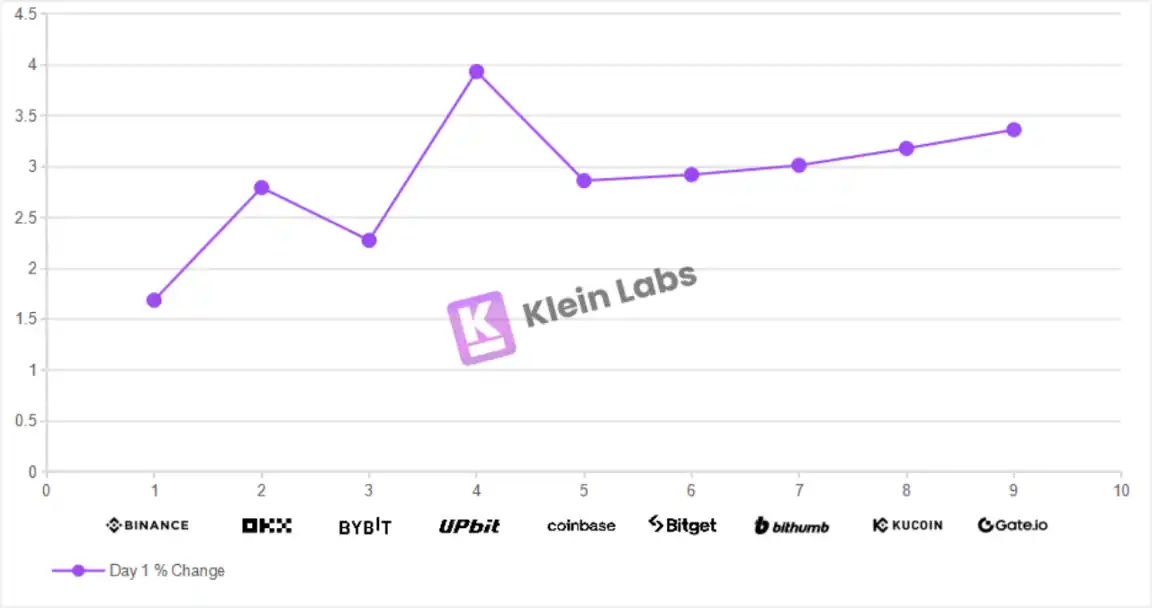
Coefficient of Variation on the 1st Day after TGE
· Binance has the lowest coefficient of variation, indicating that the price volatility of the tokens listed on its platform on the first day is relatively small, showing the most stable market performance. UPbit has the highest coefficient of variation, showing a larger fluctuation on the first day. However, combined with the previous analysis of the mean, it is estimated that its overall market is likely to have a general upward trend.
· Medium-sized trading platforms (along the axis from left to right) show a linear increasing trend in the coefficient of variation. From Bitget with the lowest coefficient of variation to Gate with the highest, indicating that the market performance of these platforms from listing is gradually moving towards higher uncertainty, shifting from relatively stable short-term investment risk to gradual elevation.
· Bybit has a relatively low coefficient of variation, closest to Binance, indicating that its market volatility is also relatively manageable. However, considering Bybit has listed more projects while still maintaining a low coefficient of variation, it indicates that the overall quality of the projects listed is high, with no large-scale highly volatile assets. Additionally, this also reflects that Bybit's listing selection strategy may lean towards tokens with strong stability, thereby reducing sharp market fluctuations in the short term.
Coefficient of Variation on the 30th Day after TGE
· Looking at the Day 30 coefficient of variation, UPbit still maintains a high coefficient of variation after 7 days and 30 days, indicating significant price fluctuations for its trading pairs with high market liquidity. When observing the mean, UPbit's trading pairs have a positive average value, and the price decline is relatively slow, indicating active buy and sell orders in the market, sufficient liquidity depth, and overall market health. From the perspective of the coefficient of variation, UPbit has a significant advantage over other trading platforms at this point.
· Binance and Coinbase continue to be relatively stable trading platforms, with Binance showing a more stable price increase throughout the entire period, while Coinbase's fluctuations tend to stabilize between 7 and 30 days, indicating that its token market is more inclined towards long-term stable development rather than short-term intense volatility.
· Mid-sized exchanges (such as Bitget, Bithumb, Gate, KuCoin) experienced a significant increase in the coefficient of variation on the 30th day, indicating that after the short-term arbitrage funds exited, liquidity decreased, leading to intensified price fluctuations. The market is still dominated by short-term funds, with a relatively low proportion of long-term funds, resulting in overall weaker stability. Especially Bitget, which has high activity but also has higher volatility.
5. Key Highlights Summary
5.1 Data Conclusion
Based on the above research and data, we have reached the following conclusions:
5.1.1 Exchange Listing Selection Significantly Affects Listing Performance
In general, exchanges with fewer and more stringent listings tend to have better price performance after removing extreme outliers. However, overall Bitcoin trends, regional market environments, and user characteristics also impact listing performance.
Exchanges with a higher number of listings do tend to show relatively prominent short-term average performance. Still, in the long run, having more listings leads to greater liquidity dispersion, which may result in a larger pullback after 30 days, leading to lower price stability.
5.1.2 Top-tier Exchanges often have a greater price increase advantage compared to mid-sized exchanges in a bullish market
However, when looking at another indicator, the average price increase, the top-tier exchanges have different price performance in terms of 7-day and 30-day increases, but overall positive. Binance shows the best performance across various price metrics. OKX exhibits greater volatility in the medium to long term. Among the top-tier exchanges, UPbit shows the most stable performance, possibly due to its deep liquidity. UPbit can actually achieve a very high price swing on the token's first day of listing. However, since this study records the closing price of the first day, it may not capture these outstanding performances. Among mid-sized exchanges, Bitget and Bithumb show relatively prominent performance. Bitget's performance is stable, while Bithumb shows outstanding performance in some price metrics.
5.1.3 Advantages of the Korean Market and Listing Effect
The Korean market has a unique market environment with high trading volume and good liquidity, allowing tokens to quickly attract funds after being listed. Although there is significant price fluctuation in the initial period, the overall trend is upward. Even after 7 days and 30 days, the price fluctuation remains significant. This indicates that in the Korean market, a listed token will have a longer development cycle and higher level of attention.
5.1.4 Impact of Exchange Selection Process on Token Performance and Market Stability
During data processing, we found that certain exchanges had a significantly higher number of outliers, indicating that the token selection and review process is crucial to post-listing performance. Outliers usually reflect deviations in token prices from expectations, which may be influenced by market manipulation or project risks. Exchanges that frequently experience outliers may have a more lenient screening process, allowing unstable tokens to enter the market and increasing price volatility risk. Therefore, an exchange's token selection process directly affects the token's market performance and overall market stability.
5.2 Exchange Performance
5.2.1 Binance & OKX
Both exchanges have performed well across various metrics, but in the long run, Binance has a greater advantage in terms of stability. Binance exhibits a more stable market performance, maintaining consistent growth with lower volatility. In comparison, while OKX has higher market volatility than Binance, it is nearly on par with Binance across multiple indicators.
5.2.2 Upbit & Bithumb
Upbit and Bithumb are the two leading cryptocurrency exchanges in Korea and have generally outstanding performance. Upbit has consistently ranked high among global exchanges. As one of the earliest exchanges in Korea, Bithumb has shown outstanding performance with some listed tokens. The speculative trading fervor in the Korean market has attracted a significant amount of capital to local exchanges, resulting in high liquidity and trading volume. With deep liquidity and a large number of retail investors in Korea, price changes are not too significant on a medium to long-term scale. However, focusing on short-term intraday trading, Korean exchanges exhibit higher trading volume and price volatility compared to other exchanges at the same level. As this study mainly focuses on price changes 1 day, 7 days, and 30 days after token listing, it may not fully reflect the outstanding performance of Korean exchanges.
It is worth noting that Upbit and Bithumb have a significant "Kimchi Premium" regional advantage. After certain tokens are listed on Korean exchanges, their prices usually experience a short-term increase compared to other global exchanges, giving Upbit and Bithumb an advantage that other exchanges around the world cannot match.
5.2.3 Bybit
As one of the top exchanges, Bybit has strong liquidity depth and extensive listing experience, providing a stable trading environment. Although Bybit experienced a significant hack in early 2025, it demonstrated its crisis response capabilities as a major exchange through timely and effective public relations handling and security measures. In contrast, many small exchanges often lack the capacity to deal with such challenges. Bybit's risk management and public relations strategies were well executed, especially in maintaining sufficient financial resources, swiftly restoring user trust, and continuing to maintain its competitiveness in the market.
5.2.4 Bitget
Bitget has particularly excelled among medium-sized exchanges and has shown rapid development. Bitget is currently in a transition phase towards becoming a top-tier exchange, leaning towards implementing a more rigorous listing mechanism. The platform has listed a large number of new tokens, providing investors with a wider range of choices. Overall, the performance of listed tokens has been good on average, with the positive price movements of the tokens far exceeding those on similar platforms. The preference for high-quality projects on Bitget is gradually becoming apparent, as the platform maintains cautiousness in project selection and achieves more precise quality selection through a two-way incentive mechanism. In general, Bitget's market performance falls between that of top-tier exchanges and medium-sized exchanges, demonstrating good price performance and market recognition. Compared to exchanges at a similar level, token prices on Bitget have shown relatively stable fluctuations, exhibiting a high level of resilience during market volatility to maintain strong market competitiveness and user trust.
5.2.5 Gate
Gate is rapidly rising. With a relatively high proportion of listed tokens and a continuously innovative listing strategy, Gate's performance in 2024 data was quite impressive, with gradually increasing trading volumes and significant token price increases. Gate has successfully attracted numerous emerging projects, significantly boosted its market competitiveness, and continuously expanded its influence in the cryptocurrency market. Gate has excelled in the Meme sector and established an Innovation Zone, providing a dedicated section for newly listed tokens. With keen market insights, it has successfully launched multiple popular tokens, attracting a large number of investors. Its innovative listing strategy and precise project selection have helped the platform rapidly expand its ecosystem, enhance user stickiness, and drive growth in trading volume and liquidity.
5.2.6 KuCoin
In addition to the listing focus of this report, KuCoin has made significant progress in compliance, having reached a settlement with the U.S. Department of Justice (DOJ). This outcome has paved the way for KuCoin and its new leadership team's future development. KuCoin is also actively seeking relevant licenses, particularly in Australia and India, while also making strategic moves in Europe, Turkey, and elsewhere. KuCoin has applied for a license compliant with the Market in Crypto-Assets Regulation (MiCAR) in Austria through KuCoin EU Exchange GmbH. Additionally, KuCoin is the first global cryptocurrency exchange in India to comply with Financial Intelligence Unit (FIU) regulations. By promoting compliance and regional expansion, KuCoin is expected to attract more potential users, boost trading volume and price growth, and create favorable conditions for its ongoing growth.
5.2.7 Coinbase & Kraken
As the largest U.S. exchange with strong liquidity and a deep market, Coinbase has a cautious listing strategy coupled with the relatively strict cryptocurrency regulatory policies in the United States, resulting in a relatively small number of listed assets but also higher security and stability. This indicates that Coinbase has adopted a conservative listing approach for new projects, especially high-risk assets like meme coins. However, in terms of price performance, by pursuing stability and long-term development, Coinbase has also missed out on many upward opportunities. Kraken is known for its security and is subject to stringent regulations, leading to fewer product offerings compared to other exchanges.
References
1. Animoca Brands Research on 2024 Listing Report
https://research.animocabrands.com/post/cm71o17u2t6f107mlc6v09ujq
2. Low Float & High FDV: How Did We Get Here?
https://www.binance.com/en/research/analysis/low-float-and-high-FDV-how-did-we-get-here
2. CoinGecko 2024 Annual Crypto Industry Report
https://www.coingecko.com/research/publications/2024-annual-crypto-report
4. Domestic Coin Exchange Total Investors Exceed 15 Million for the First Time... November Up by 600,000
https://www.yna.co.kr/view/AKR20241224079900002
This article is contributed content and does not represent the views of BlockBeats.
You may also like

Token Cannot Compound, Where Is the Real Investment Opportunity?

February 6th Market Key Intelligence, How Much Did You Miss?

China's Central Bank and Eight Other Departments' Latest Regulatory Focus: Key Attention to RWA Tokenized Asset Risk
Foreword: Today, the People's Bank of China's website published the "Notice of the People's Bank of China, National Development and Reform Commission, Ministry of Industry and Information Technology, Ministry of Public Security, State Administration for Market Regulation, China Banking and Insurance Regulatory Commission, China Securities Regulatory Commission, State Administration of Foreign Exchange on Further Preventing and Dealing with Risks Related to Virtual Currency and Others (Yinfa [2026] No. 42)", the latest regulatory requirements from the eight departments including the central bank, which are basically consistent with the regulatory requirements of recent years. The main focus of the regulation is on speculative activities such as virtual currency trading, exchanges, ICOs, overseas platform services, and this time, regulatory oversight of RWA has been added, explicitly prohibiting RWA tokenization, stablecoins (especially those pegged to the RMB). The following is the full text:
To the people's governments of all provinces, autonomous regions, and municipalities directly under the Central Government, the Xinjiang Production and Construction Corps:
Recently, there have been speculative activities related to virtual currency and Real-World Assets (RWA) tokenization, disrupting the economic and financial order and jeopardizing the property security of the people. In order to further prevent and address the risks related to virtual currency and Real-World Assets tokenization, effectively safeguard national security and social stability, in accordance with the "Law of the People's Republic of China on the People's Bank of China," "Law of the People's Republic of China on Commercial Banks," "Securities Law of the People's Republic of China," "Law of the People's Republic of China on Securities Investment Funds," "Law of the People's Republic of China on Futures and Derivatives," "Cybersecurity Law of the People's Republic of China," "Regulations of the People's Republic of China on the Administration of Renminbi," "Regulations on Prevention and Disposal of Illegal Fundraising," "Regulations of the People's Republic of China on Foreign Exchange Administration," "Telecommunications Regulations of the People's Republic of China," and other provisions, after reaching consensus with the Cyberspace Administration of China, the Supreme People's Court, and the Supreme People's Procuratorate, and with the approval of the State Council, the relevant matters are notified as follows:
(I) Virtual currency does not possess the legal status equivalent to fiat currency. Virtual currencies such as Bitcoin, Ether, Tether, etc., have the main characteristics of being issued by non-monetary authorities, using encryption technology and distributed ledger or similar technology, existing in digital form, etc. They do not have legal tender status, should not and cannot be circulated and used as currency in the market.
The business activities related to virtual currency are classified as illegal financial activities. The exchange of fiat currency and virtual currency within the territory, exchange of virtual currencies, acting as a central counterparty in buying and selling virtual currencies, providing information intermediary and pricing services for virtual currency transactions, token issuance financing, and trading of virtual currency-related financial products, etc., fall under illegal financial activities, such as suspected illegal issuance of token vouchers, unauthorized public issuance of securities, illegal operation of securities and futures business, illegal fundraising, etc., are strictly prohibited across the board and resolutely banned in accordance with the law. Overseas entities and individuals are not allowed to provide virtual currency-related services to domestic entities in any form.
A stablecoin pegged to a fiat currency indirectly fulfills some functions of the fiat currency in circulation. Without the consent of relevant authorities in accordance with the law and regulations, any domestic or foreign entity or individual is not allowed to issue a RMB-pegged stablecoin overseas.
(II)Tokenization of Real-World Assets refers to the use of encryption technology and distributed ledger or similar technologies to transform ownership rights, income rights, etc., of assets into tokens (tokens) or other interests or bond certificates with token (token) characteristics, and carry out issuance and trading activities.
Engaging in the tokenization of real-world assets domestically, as well as providing related intermediary, information technology services, etc., which are suspected of illegal issuance of token vouchers, unauthorized public offering of securities, illegal operation of securities and futures business, illegal fundraising, and other illegal financial activities, shall be prohibited; except for relevant business activities carried out with the approval of the competent authorities in accordance with the law and regulations and relying on specific financial infrastructures. Overseas entities and individuals are not allowed to illegally provide services related to the tokenization of real-world assets to domestic entities in any form.
(III) Inter-agency Coordination. The People's Bank of China, together with the National Development and Reform Commission, the Ministry of Industry and Information Technology, the Ministry of Public Security, the State Administration for Market Regulation, the China Banking and Insurance Regulatory Commission, the China Securities Regulatory Commission, the State Administration of Foreign Exchange, and other departments, will improve the work mechanism, strengthen coordination with the Cyberspace Administration of China, the Supreme People's Court, and the Supreme People's Procuratorate, coordinate efforts, and overall guide regions to carry out risk prevention and disposal of virtual currency-related illegal financial activities.
The China Securities Regulatory Commission, together with the National Development and Reform Commission, the Ministry of Industry and Information Technology, the Ministry of Public Security, the People's Bank of China, the State Administration for Market Regulation, the China Banking and Insurance Regulatory Commission, the State Administration of Foreign Exchange, and other departments, will improve the work mechanism, strengthen coordination with the Cyberspace Administration of China, the Supreme People's Court, and the Supreme People's Procuratorate, coordinate efforts, and overall guide regions to carry out risk prevention and disposal of illegal financial activities related to the tokenization of real-world assets.
(IV) Strengthening Local Implementation. The people's governments at the provincial level are overall responsible for the prevention and disposal of risks related to virtual currencies and the tokenization of real-world assets in their respective administrative regions. The specific leading department is the local financial regulatory department, with participation from branches and dispatched institutions of the State Council's financial regulatory department, telecommunications regulators, public security, market supervision, and other departments, in coordination with cyberspace departments, courts, and procuratorates, to improve the normalization of the work mechanism, effectively connect with the relevant work mechanisms of central departments, form a cooperative and coordinated working pattern between central and local governments, effectively prevent and properly handle risks related to virtual currencies and the tokenization of real-world assets, and maintain economic and financial order and social stability.
(5) Enhanced Risk Monitoring. The People's Bank of China, China Securities Regulatory Commission, National Development and Reform Commission, Ministry of Industry and Information Technology, Ministry of Public Security, State Administration of Foreign Exchange, Cyberspace Administration of China, and other departments continue to improve monitoring techniques and system support, enhance cross-departmental data analysis and sharing, establish sound information sharing and cross-validation mechanisms, promptly grasp the risk situation of activities related to virtual currency and real-world asset tokenization. Local governments at all levels give full play to the role of local monitoring and early warning mechanisms. Local financial regulatory authorities, together with branches and agencies of the State Council's financial regulatory authorities, as well as departments of cyberspace and public security, ensure effective connection between online monitoring, offline investigation, and fund tracking, efficiently and accurately identify activities related to virtual currency and real-world asset tokenization, promptly share risk information, improve early warning information dissemination, verification, and rapid response mechanisms.
(6) Strengthened Oversight of Financial Institutions, Intermediaries, and Technology Service Providers. Financial institutions (including non-bank payment institutions) are prohibited from providing account opening, fund transfer, and clearing services for virtual currency-related business activities, issuing and selling financial products related to virtual currency, including virtual currency and related financial products in the scope of collateral, conducting insurance business related to virtual currency, or including virtual currency in the scope of insurance liability. Financial institutions (including non-bank payment institutions) are prohibited from providing custody, clearing, and settlement services for unauthorized real-world asset tokenization-related business and related financial products. Relevant intermediary institutions and information technology service providers are prohibited from providing intermediary, technical, or other services for unauthorized real-world asset tokenization-related businesses and related financial products.
(7) Enhanced Management of Internet Information Content and Access. Internet enterprises are prohibited from providing online business venues, commercial displays, marketing, advertising, or paid traffic diversion services for virtual currency and real-world asset tokenization-related business activities. Upon discovering clues of illegal activities, they should promptly report to relevant departments and provide technical support and assistance for related investigations and inquiries. Based on the clues transferred by the financial regulatory authorities, the cyberspace administration, telecommunications authorities, and public security departments should promptly close and deal with websites, mobile applications (including mini-programs), and public accounts engaged in virtual currency and real-world asset tokenization-related business activities in accordance with the law.
(8) Strengthened Entity Registration and Advertisement Management. Market supervision departments strengthen entity registration and management, and enterprise and individual business registrations must not contain terms such as "virtual currency," "virtual asset," "cryptocurrency," "crypto asset," "stablecoin," "real-world asset tokenization," or "RWA" in their names or business scopes. Market supervision departments, together with financial regulatory authorities, legally enhance the supervision of advertisements related to virtual currency and real-world asset tokenization, promptly investigating and handling relevant illegal advertisements.
(IX) Continued Rectification of Virtual Currency Mining Activities. The National Development and Reform Commission, together with relevant departments, strictly controls virtual currency mining activities, continuously promotes the rectification of virtual currency mining activities. The people's governments of various provinces take overall responsibility for the rectification of "mining" within their respective administrative regions. In accordance with the requirements of the National Development and Reform Commission and other departments in the "Notice on the Rectification of Virtual Currency Mining Activities" (NDRC Energy-saving Building [2021] No. 1283) and the provisions of the "Guidance Catalog for Industrial Structure Adjustment (2024 Edition)," a comprehensive review, investigation, and closure of existing virtual currency mining projects are conducted, new mining projects are strictly prohibited, and mining machine production enterprises are strictly prohibited from providing mining machine sales and other services within the country.
(X) Severe Crackdown on Related Illegal Financial Activities. Upon discovering clues to illegal financial activities related to virtual currency and the tokenization of real-world assets, local financial regulatory authorities, branches of the State Council's financial regulatory authorities, and other relevant departments promptly investigate, determine, and properly handle the issues in accordance with the law, and seriously hold the relevant entities and individuals legally responsible. Those suspected of crimes are transferred to the judicial authorities for processing according to the law.
(XI) Severe Crackdown on Related Illegal and Criminal Activities. The Ministry of Public Security, the People's Bank of China, the State Administration for Market Regulation, the China Banking and Insurance Regulatory Commission, the China Securities Regulatory Commission, as well as judicial and procuratorial organs, in accordance with their respective responsibilities, rigorously crack down on illegal and criminal activities related to virtual currency, the tokenization of real-world assets, such as fraud, money laundering, illegal business operations, pyramid schemes, illegal fundraising, and other illegal and criminal activities carried out under the guise of virtual currency, the tokenization of real-world assets, etc.
(XII) Strengthen Industry Self-discipline. Relevant industry associations should enhance membership management and policy advocacy, based on their own responsibilities, advocate and urge member units to resist illegal financial activities related to virtual currency and the tokenization of real-world assets. Member units that violate regulatory policies and industry self-discipline rules are to be disciplined in accordance with relevant self-regulatory management regulations. By leveraging various industry infrastructure, conduct risk monitoring related to virtual currency, the tokenization of real-world assets, and promptly transfer issue clues to relevant departments.
(XIII) Without the approval of relevant departments in accordance with the law and regulations, domestic entities and foreign entities controlled by them may not issue virtual currency overseas.
(XIV) Domestic entities engaging directly or indirectly in overseas external debt-based tokenization of real-world assets, or conducting asset securitization activities abroad based on domestic ownership rights, income rights, etc. (hereinafter referred to as domestic equity), should be strictly regulated in accordance with the principles of "same business, same risk, same rules." The National Development and Reform Commission, the China Securities Regulatory Commission, the State Administration of Foreign Exchange, and other relevant departments regulate it according to their respective responsibilities. For other forms of overseas real-world asset tokenization activities based on domestic equity by domestic entities, the China Securities Regulatory Commission, together with relevant departments, supervise according to their division of responsibilities. Without the consent and filing of relevant departments, no unit or individual may engage in the above-mentioned business.
(15) Overseas subsidiaries and branches of domestic financial institutions providing Real World Asset Tokenization-related services overseas shall do so legally and prudently. They shall have professional personnel and systems in place to effectively mitigate business risks, strictly implement customer onboarding, suitability management, anti-money laundering requirements, and incorporate them into the domestic financial institutions' compliance and risk management system. Intermediaries and information technology service providers offering Real World Asset Tokenization services abroad based on domestic equity or conducting Real World Asset Tokenization business in the form of overseas debt for domestic entities directly or indirectly venturing abroad must strictly comply with relevant laws and regulations. They should establish and improve relevant compliance and internal control systems in accordance with relevant normative requirements, strengthen business and risk control, and report the business developments to the relevant regulatory authorities for approval or filing.
(16) Strengthen organizational leadership and overall coordination. All departments and regions should attach great importance to the prevention of risks related to virtual currencies and Real World Asset Tokenization, strengthen organizational leadership, clarify work responsibilities, form a long-term effective working mechanism with centralized coordination, local implementation, and shared responsibilities, maintain high pressure, dynamically monitor risks, effectively prevent and mitigate risks in an orderly and efficient manner, legally protect the property security of the people, and make every effort to maintain economic and financial order and social stability.
(17) Widely carry out publicity and education. All departments, regions, and industry associations should make full use of various media and other communication channels to disseminate information through legal and policy interpretation, analysis of typical cases, and education on investment risks, etc. They should promote the illegality and harm of virtual currencies and Real World Asset Tokenization-related businesses and their manifestations, fully alert to potential risks and hidden dangers, and enhance public awareness and identification capabilities for risk prevention.
(18) Engaging in illegal financial activities related to virtual currencies and Real World Asset Tokenization in violation of this notice, as well as providing services for virtual currencies and Real World Asset Tokenization-related businesses, shall be punished in accordance with relevant regulations. If it constitutes a crime, criminal liability shall be pursued according to the law. For domestic entities and individuals who knowingly or should have known that overseas entities illegally provided virtual currency or Real World Asset Tokenization-related services to domestic entities and still assisted them, relevant responsibilities shall be pursued according to the law. If it constitutes a crime, criminal liability shall be pursued according to the law.
(19) If any unit or individual invests in virtual currencies, Real World Asset Tokens, and related financial products against public order and good customs, the relevant civil legal actions shall be invalid, and any resulting losses shall be borne by them. If there are suspicions of disrupting financial order and jeopardizing financial security, the relevant departments shall deal with them according to the law.
This notice shall enter into force upon the date of its issuance. The People's Bank of China and ten other departments' "Notice on Further Preventing and Dealing with the Risks of Virtual Currency Trading Speculation" (Yinfa [2021] No. 237) is hereby repealed.

Former Partner's Perspective on Multicoin: Kyle's Exit, But the Game He Left Behind Just Getting Started
Why Bitcoin Is Falling Now: The Real Reasons Behind BTC's Crash & WEEX's Smart Profit Playbook
Bitcoin's ongoing crash explained: Discover the 5 hidden triggers behind BTC's plunge & how WEEX's Auto Earn and Trade to Earn strategies help traders profit from crypto market volatility.

Wall Street's Hottest Trades See Exodus

Vitalik Discusses Ethereum Scaling Path, Circle Announces Partnership with Polymarket, What's the Overseas Crypto Community Talking About Today?

Believing in the Capital Markets - The Essence and Core Value of Cryptocurrency

Polymarket's 'Weatherman': Predict Temperature, Win Million-Dollar Payout

$15K+ Profits: The 4 AI Trading Secrets WEEX Hackathon Prelim Winners Used to Dominate Volatile Crypto Markets
How WEEX Hackathon's top AI trading strategies made $15K+ in crypto markets: 4 proven rules for ETH/BTC trading, market structure analysis, and risk management in volatile conditions.

A nearly 20% one-day plunge, how long has it been since you last saw a $60,000 Bitcoin?

Raoul Pal: I've seen every single panic, and they are never the end.

Key Market Information Discrepancy on February 6th - A Must-Read! | Alpha Morning Report

2026 Crypto Industry's First Snowfall
The Harsh Reality Behind the $26 Billion Crypto Liquidation: Liquidity Is Killing the Market
Why Is Gold, US Stocks, Bitcoin All Falling?

Key Market Intelligence for February 5th, how much did you miss out on?

Wintermute: By 2026, crypto had gradually become the settlement layer of the Internet economy
Token Cannot Compound, Where Is the Real Investment Opportunity?
February 6th Market Key Intelligence, How Much Did You Miss?
China's Central Bank and Eight Other Departments' Latest Regulatory Focus: Key Attention to RWA Tokenized Asset Risk
Foreword: Today, the People's Bank of China's website published the "Notice of the People's Bank of China, National Development and Reform Commission, Ministry of Industry and Information Technology, Ministry of Public Security, State Administration for Market Regulation, China Banking and Insurance Regulatory Commission, China Securities Regulatory Commission, State Administration of Foreign Exchange on Further Preventing and Dealing with Risks Related to Virtual Currency and Others (Yinfa [2026] No. 42)", the latest regulatory requirements from the eight departments including the central bank, which are basically consistent with the regulatory requirements of recent years. The main focus of the regulation is on speculative activities such as virtual currency trading, exchanges, ICOs, overseas platform services, and this time, regulatory oversight of RWA has been added, explicitly prohibiting RWA tokenization, stablecoins (especially those pegged to the RMB). The following is the full text:
To the people's governments of all provinces, autonomous regions, and municipalities directly under the Central Government, the Xinjiang Production and Construction Corps:
Recently, there have been speculative activities related to virtual currency and Real-World Assets (RWA) tokenization, disrupting the economic and financial order and jeopardizing the property security of the people. In order to further prevent and address the risks related to virtual currency and Real-World Assets tokenization, effectively safeguard national security and social stability, in accordance with the "Law of the People's Republic of China on the People's Bank of China," "Law of the People's Republic of China on Commercial Banks," "Securities Law of the People's Republic of China," "Law of the People's Republic of China on Securities Investment Funds," "Law of the People's Republic of China on Futures and Derivatives," "Cybersecurity Law of the People's Republic of China," "Regulations of the People's Republic of China on the Administration of Renminbi," "Regulations on Prevention and Disposal of Illegal Fundraising," "Regulations of the People's Republic of China on Foreign Exchange Administration," "Telecommunications Regulations of the People's Republic of China," and other provisions, after reaching consensus with the Cyberspace Administration of China, the Supreme People's Court, and the Supreme People's Procuratorate, and with the approval of the State Council, the relevant matters are notified as follows:
(I) Virtual currency does not possess the legal status equivalent to fiat currency. Virtual currencies such as Bitcoin, Ether, Tether, etc., have the main characteristics of being issued by non-monetary authorities, using encryption technology and distributed ledger or similar technology, existing in digital form, etc. They do not have legal tender status, should not and cannot be circulated and used as currency in the market.
The business activities related to virtual currency are classified as illegal financial activities. The exchange of fiat currency and virtual currency within the territory, exchange of virtual currencies, acting as a central counterparty in buying and selling virtual currencies, providing information intermediary and pricing services for virtual currency transactions, token issuance financing, and trading of virtual currency-related financial products, etc., fall under illegal financial activities, such as suspected illegal issuance of token vouchers, unauthorized public issuance of securities, illegal operation of securities and futures business, illegal fundraising, etc., are strictly prohibited across the board and resolutely banned in accordance with the law. Overseas entities and individuals are not allowed to provide virtual currency-related services to domestic entities in any form.
A stablecoin pegged to a fiat currency indirectly fulfills some functions of the fiat currency in circulation. Without the consent of relevant authorities in accordance with the law and regulations, any domestic or foreign entity or individual is not allowed to issue a RMB-pegged stablecoin overseas.
(II)Tokenization of Real-World Assets refers to the use of encryption technology and distributed ledger or similar technologies to transform ownership rights, income rights, etc., of assets into tokens (tokens) or other interests or bond certificates with token (token) characteristics, and carry out issuance and trading activities.
Engaging in the tokenization of real-world assets domestically, as well as providing related intermediary, information technology services, etc., which are suspected of illegal issuance of token vouchers, unauthorized public offering of securities, illegal operation of securities and futures business, illegal fundraising, and other illegal financial activities, shall be prohibited; except for relevant business activities carried out with the approval of the competent authorities in accordance with the law and regulations and relying on specific financial infrastructures. Overseas entities and individuals are not allowed to illegally provide services related to the tokenization of real-world assets to domestic entities in any form.
(III) Inter-agency Coordination. The People's Bank of China, together with the National Development and Reform Commission, the Ministry of Industry and Information Technology, the Ministry of Public Security, the State Administration for Market Regulation, the China Banking and Insurance Regulatory Commission, the China Securities Regulatory Commission, the State Administration of Foreign Exchange, and other departments, will improve the work mechanism, strengthen coordination with the Cyberspace Administration of China, the Supreme People's Court, and the Supreme People's Procuratorate, coordinate efforts, and overall guide regions to carry out risk prevention and disposal of virtual currency-related illegal financial activities.
The China Securities Regulatory Commission, together with the National Development and Reform Commission, the Ministry of Industry and Information Technology, the Ministry of Public Security, the People's Bank of China, the State Administration for Market Regulation, the China Banking and Insurance Regulatory Commission, the State Administration of Foreign Exchange, and other departments, will improve the work mechanism, strengthen coordination with the Cyberspace Administration of China, the Supreme People's Court, and the Supreme People's Procuratorate, coordinate efforts, and overall guide regions to carry out risk prevention and disposal of illegal financial activities related to the tokenization of real-world assets.
(IV) Strengthening Local Implementation. The people's governments at the provincial level are overall responsible for the prevention and disposal of risks related to virtual currencies and the tokenization of real-world assets in their respective administrative regions. The specific leading department is the local financial regulatory department, with participation from branches and dispatched institutions of the State Council's financial regulatory department, telecommunications regulators, public security, market supervision, and other departments, in coordination with cyberspace departments, courts, and procuratorates, to improve the normalization of the work mechanism, effectively connect with the relevant work mechanisms of central departments, form a cooperative and coordinated working pattern between central and local governments, effectively prevent and properly handle risks related to virtual currencies and the tokenization of real-world assets, and maintain economic and financial order and social stability.
(5) Enhanced Risk Monitoring. The People's Bank of China, China Securities Regulatory Commission, National Development and Reform Commission, Ministry of Industry and Information Technology, Ministry of Public Security, State Administration of Foreign Exchange, Cyberspace Administration of China, and other departments continue to improve monitoring techniques and system support, enhance cross-departmental data analysis and sharing, establish sound information sharing and cross-validation mechanisms, promptly grasp the risk situation of activities related to virtual currency and real-world asset tokenization. Local governments at all levels give full play to the role of local monitoring and early warning mechanisms. Local financial regulatory authorities, together with branches and agencies of the State Council's financial regulatory authorities, as well as departments of cyberspace and public security, ensure effective connection between online monitoring, offline investigation, and fund tracking, efficiently and accurately identify activities related to virtual currency and real-world asset tokenization, promptly share risk information, improve early warning information dissemination, verification, and rapid response mechanisms.
(6) Strengthened Oversight of Financial Institutions, Intermediaries, and Technology Service Providers. Financial institutions (including non-bank payment institutions) are prohibited from providing account opening, fund transfer, and clearing services for virtual currency-related business activities, issuing and selling financial products related to virtual currency, including virtual currency and related financial products in the scope of collateral, conducting insurance business related to virtual currency, or including virtual currency in the scope of insurance liability. Financial institutions (including non-bank payment institutions) are prohibited from providing custody, clearing, and settlement services for unauthorized real-world asset tokenization-related business and related financial products. Relevant intermediary institutions and information technology service providers are prohibited from providing intermediary, technical, or other services for unauthorized real-world asset tokenization-related businesses and related financial products.
(7) Enhanced Management of Internet Information Content and Access. Internet enterprises are prohibited from providing online business venues, commercial displays, marketing, advertising, or paid traffic diversion services for virtual currency and real-world asset tokenization-related business activities. Upon discovering clues of illegal activities, they should promptly report to relevant departments and provide technical support and assistance for related investigations and inquiries. Based on the clues transferred by the financial regulatory authorities, the cyberspace administration, telecommunications authorities, and public security departments should promptly close and deal with websites, mobile applications (including mini-programs), and public accounts engaged in virtual currency and real-world asset tokenization-related business activities in accordance with the law.
(8) Strengthened Entity Registration and Advertisement Management. Market supervision departments strengthen entity registration and management, and enterprise and individual business registrations must not contain terms such as "virtual currency," "virtual asset," "cryptocurrency," "crypto asset," "stablecoin," "real-world asset tokenization," or "RWA" in their names or business scopes. Market supervision departments, together with financial regulatory authorities, legally enhance the supervision of advertisements related to virtual currency and real-world asset tokenization, promptly investigating and handling relevant illegal advertisements.
(IX) Continued Rectification of Virtual Currency Mining Activities. The National Development and Reform Commission, together with relevant departments, strictly controls virtual currency mining activities, continuously promotes the rectification of virtual currency mining activities. The people's governments of various provinces take overall responsibility for the rectification of "mining" within their respective administrative regions. In accordance with the requirements of the National Development and Reform Commission and other departments in the "Notice on the Rectification of Virtual Currency Mining Activities" (NDRC Energy-saving Building [2021] No. 1283) and the provisions of the "Guidance Catalog for Industrial Structure Adjustment (2024 Edition)," a comprehensive review, investigation, and closure of existing virtual currency mining projects are conducted, new mining projects are strictly prohibited, and mining machine production enterprises are strictly prohibited from providing mining machine sales and other services within the country.
(X) Severe Crackdown on Related Illegal Financial Activities. Upon discovering clues to illegal financial activities related to virtual currency and the tokenization of real-world assets, local financial regulatory authorities, branches of the State Council's financial regulatory authorities, and other relevant departments promptly investigate, determine, and properly handle the issues in accordance with the law, and seriously hold the relevant entities and individuals legally responsible. Those suspected of crimes are transferred to the judicial authorities for processing according to the law.
(XI) Severe Crackdown on Related Illegal and Criminal Activities. The Ministry of Public Security, the People's Bank of China, the State Administration for Market Regulation, the China Banking and Insurance Regulatory Commission, the China Securities Regulatory Commission, as well as judicial and procuratorial organs, in accordance with their respective responsibilities, rigorously crack down on illegal and criminal activities related to virtual currency, the tokenization of real-world assets, such as fraud, money laundering, illegal business operations, pyramid schemes, illegal fundraising, and other illegal and criminal activities carried out under the guise of virtual currency, the tokenization of real-world assets, etc.
(XII) Strengthen Industry Self-discipline. Relevant industry associations should enhance membership management and policy advocacy, based on their own responsibilities, advocate and urge member units to resist illegal financial activities related to virtual currency and the tokenization of real-world assets. Member units that violate regulatory policies and industry self-discipline rules are to be disciplined in accordance with relevant self-regulatory management regulations. By leveraging various industry infrastructure, conduct risk monitoring related to virtual currency, the tokenization of real-world assets, and promptly transfer issue clues to relevant departments.
(XIII) Without the approval of relevant departments in accordance with the law and regulations, domestic entities and foreign entities controlled by them may not issue virtual currency overseas.
(XIV) Domestic entities engaging directly or indirectly in overseas external debt-based tokenization of real-world assets, or conducting asset securitization activities abroad based on domestic ownership rights, income rights, etc. (hereinafter referred to as domestic equity), should be strictly regulated in accordance with the principles of "same business, same risk, same rules." The National Development and Reform Commission, the China Securities Regulatory Commission, the State Administration of Foreign Exchange, and other relevant departments regulate it according to their respective responsibilities. For other forms of overseas real-world asset tokenization activities based on domestic equity by domestic entities, the China Securities Regulatory Commission, together with relevant departments, supervise according to their division of responsibilities. Without the consent and filing of relevant departments, no unit or individual may engage in the above-mentioned business.
(15) Overseas subsidiaries and branches of domestic financial institutions providing Real World Asset Tokenization-related services overseas shall do so legally and prudently. They shall have professional personnel and systems in place to effectively mitigate business risks, strictly implement customer onboarding, suitability management, anti-money laundering requirements, and incorporate them into the domestic financial institutions' compliance and risk management system. Intermediaries and information technology service providers offering Real World Asset Tokenization services abroad based on domestic equity or conducting Real World Asset Tokenization business in the form of overseas debt for domestic entities directly or indirectly venturing abroad must strictly comply with relevant laws and regulations. They should establish and improve relevant compliance and internal control systems in accordance with relevant normative requirements, strengthen business and risk control, and report the business developments to the relevant regulatory authorities for approval or filing.
(16) Strengthen organizational leadership and overall coordination. All departments and regions should attach great importance to the prevention of risks related to virtual currencies and Real World Asset Tokenization, strengthen organizational leadership, clarify work responsibilities, form a long-term effective working mechanism with centralized coordination, local implementation, and shared responsibilities, maintain high pressure, dynamically monitor risks, effectively prevent and mitigate risks in an orderly and efficient manner, legally protect the property security of the people, and make every effort to maintain economic and financial order and social stability.
(17) Widely carry out publicity and education. All departments, regions, and industry associations should make full use of various media and other communication channels to disseminate information through legal and policy interpretation, analysis of typical cases, and education on investment risks, etc. They should promote the illegality and harm of virtual currencies and Real World Asset Tokenization-related businesses and their manifestations, fully alert to potential risks and hidden dangers, and enhance public awareness and identification capabilities for risk prevention.
(18) Engaging in illegal financial activities related to virtual currencies and Real World Asset Tokenization in violation of this notice, as well as providing services for virtual currencies and Real World Asset Tokenization-related businesses, shall be punished in accordance with relevant regulations. If it constitutes a crime, criminal liability shall be pursued according to the law. For domestic entities and individuals who knowingly or should have known that overseas entities illegally provided virtual currency or Real World Asset Tokenization-related services to domestic entities and still assisted them, relevant responsibilities shall be pursued according to the law. If it constitutes a crime, criminal liability shall be pursued according to the law.
(19) If any unit or individual invests in virtual currencies, Real World Asset Tokens, and related financial products against public order and good customs, the relevant civil legal actions shall be invalid, and any resulting losses shall be borne by them. If there are suspicions of disrupting financial order and jeopardizing financial security, the relevant departments shall deal with them according to the law.
This notice shall enter into force upon the date of its issuance. The People's Bank of China and ten other departments' "Notice on Further Preventing and Dealing with the Risks of Virtual Currency Trading Speculation" (Yinfa [2021] No. 237) is hereby repealed.
Former Partner's Perspective on Multicoin: Kyle's Exit, But the Game He Left Behind Just Getting Started
Why Bitcoin Is Falling Now: The Real Reasons Behind BTC's Crash & WEEX's Smart Profit Playbook
Bitcoin's ongoing crash explained: Discover the 5 hidden triggers behind BTC's plunge & how WEEX's Auto Earn and Trade to Earn strategies help traders profit from crypto market volatility.


 App
App