
- Buy Crypto
- Markets
- Futures
- Spot
- Copy Trade
 Earn
Earn- More
The Crypto Matthew Effect: As market cap is increasingly dominated by mainstream coins, is there still a chance for altcoins?

Original Title: Capital Concentration in an Expanding Crypto Universe
Original Author: Tanay Ved, coinmetrics
Original Translator: Luffy, Foresight News
TL;DR
The crypto investment landscape continues to expand, but capital is increasingly concentrated in a narrowing range of assets: Bitcoin's market dominance is on the rise, while the growth of stablecoins and on-chain derivatives is squeezing the market space for altcoins. The altcoin market is shrinking, with a significant increase in top-heavy concentration: the top ten altcoins by market cap now represent around 82% of the sector's total market cap, a significant increase from 70% five years ago. Since 2023, large-cap crypto assets have significantly outperformed mid-cap and small-cap coins; fund flows in the market post-volatility have further strengthened investor preferences for high liquidity and established flagship assets.
The crypto investment landscape is still expanding. Hundreds of new tokens are launched every year, the universe of stocks focused on digital assets is growing, and tokenization technology is gradually bringing traditional assets such as stocks and commodities onto the blockchain. As investment choices become more varied, market capital is becoming more discriminating.
Bitcoin's market dominance has risen to around 65%, reaching its highest level since early 2021; at the same time, stablecoins and on-chain derivatives (such as wrapped tokens, staking tokens, cross-chain bridge tokens, etc.) account for nearly 12.5% of the total crypto market cap. Therefore, altcoins are facing a dual squeeze, as their total market share is shrinking despite the increasing number of tokens.
This issue of the "Network Market Overview" report will explore whether the crypto market is undergoing a structural shift towards capital concentration. We will analyze the trends in market dominance and performance for assets in different market cap brackets and different sectors to investigate whether capital is continuing to concentrate on a smaller number of tokens that are larger in scale and more mature in development, or if investment opportunities are still widely distributed?
Evolution of Market Dominance
First, let's start with an analysis of market dominance. Bitcoin's market dominance (i.e., Bitcoin's market cap as a percentage of the total crypto market cap) has climbed to 65% in 2025, hitting a new high since 2021. It is worth noting that this growth is not a short-term spike but rather a long-term steady upward trend since hitting a low point in 2022.
The launch of a Bitcoin spot ETF has deepened the institutionalization process, attracting over $150 billion of long-term capital and further boosting its market dominance. This trend has solidified Bitcoin's position as a "safe haven asset" in the crypto market, making it a high-liquidity, standardized entry point for traditional institutional investors into the crypto market. Compared to the previous rounds of altseasons during bull markets, which rapidly diluted Bitcoin's market dominance, Bitcoin's dominance in this round is more enduring.
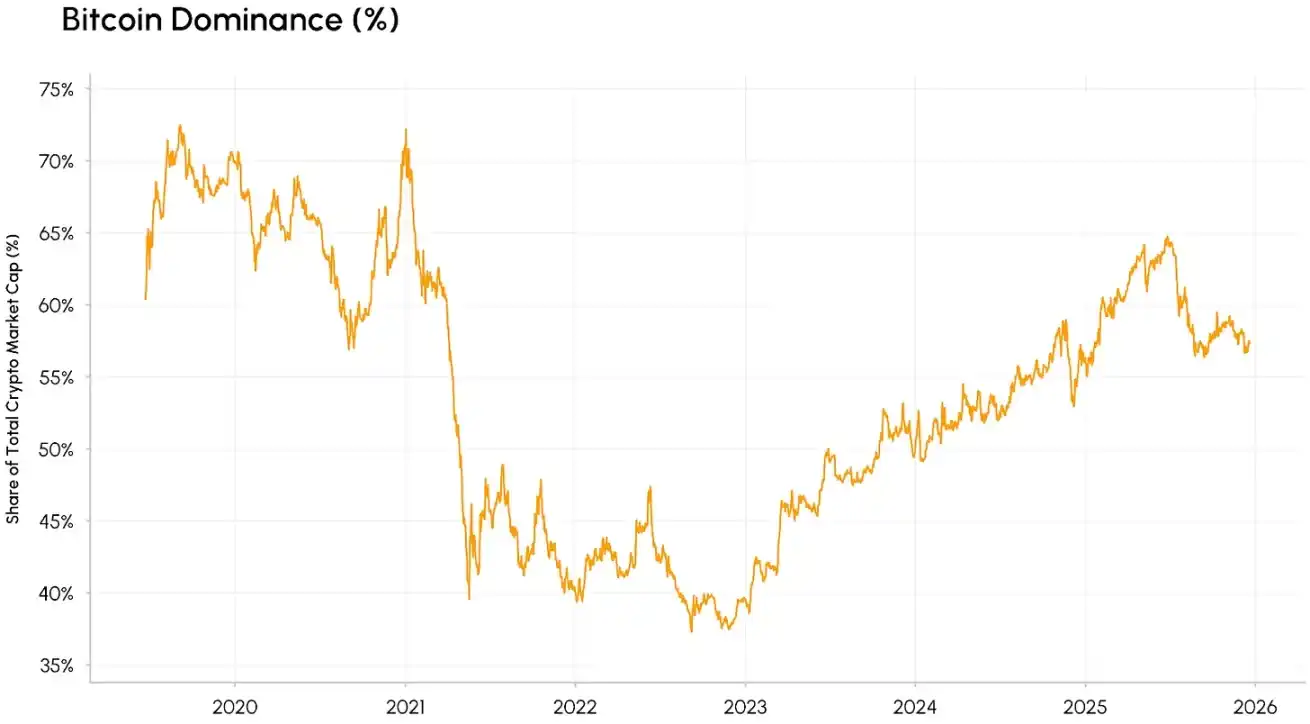
Bitcoin Dominance, Data Source: Coin Metrics
The structure of other assets in the crypto market is also undergoing a transformation. Stablecoins with a market capitalization of over $300 billion and the increasing share of on-chain derivatives in the total market cap are reshaping the market. These tokens serve different functions in the crypto ecosystem: stablecoins are the primary trading medium in the market, while on-chain derivatives provide investors with the right to claim underlying asset returns or create yield-generating channels.
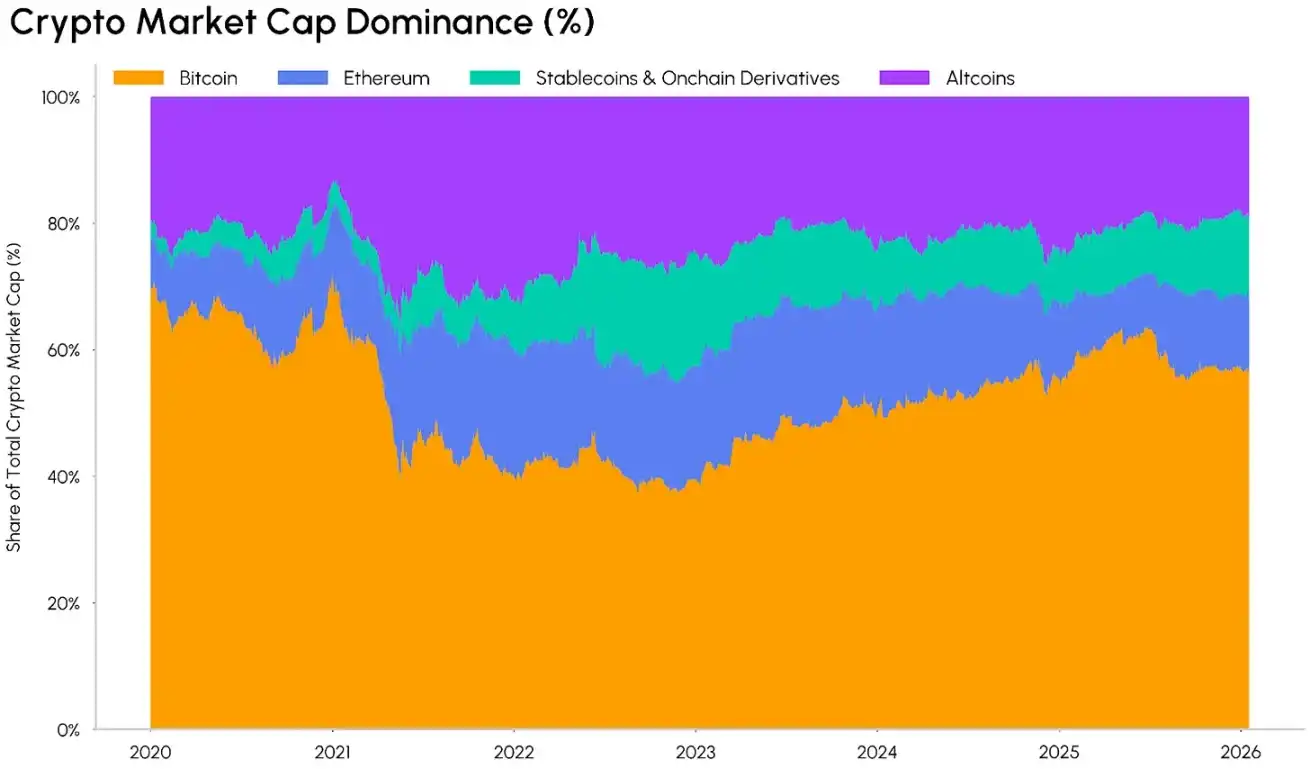
Crypto Market Dominance Distribution, Data Source: Coin Metrics
As a result, the altcoin market is facing a dilemma. The range of investable assets is narrowing, and the concentration of top projects is becoming more evident: market value continues to flow towards assets with higher liquidity and more mature development. These assets often have clear use cases, a defined regulatory development path, and can fully benefit from the development trends of stablecoins, decentralized finance (DeFi), and asset tokenization.
In contrast to previous market cycles, this round has seen a significant slowdown in capital rotation from mainstream coins to altcoins, with ETFs and various institutional investment tools firmly locking market liquidity in top assets. However, with the implementation of universal listing standards, the launch of altcoin and multi-asset ETFs to broaden investment channels for more large-cap altcoins, and the advancement of market structure-related legislation, this market landscape may undergo a transformation.
The "Giant Monopoly" Trend in the Altcoin Sector
Even within the altcoin sector, the trend of capital concentration is intensifying. The top ten altcoins by market cap (excluding Bitcoin) now account for approximately 82% of the sector's total market cap, a significant increase from 64% during the 2021 bull market. In the previous bull market, many small-cap altcoins that briefly created value gradually exited the market, replaced by a more top-heavy sector structure with shorter lifecycles for various short-term market narratives, making it difficult to sustain asset value growth.
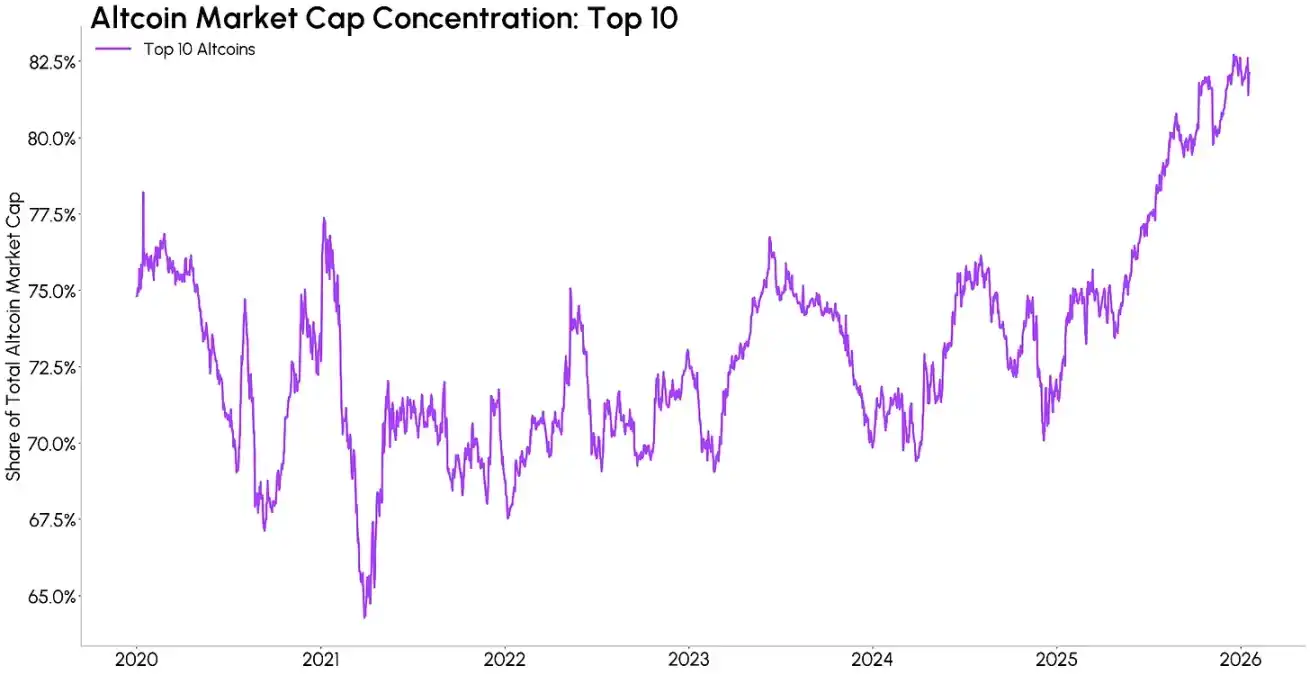
Top 10 Altcoins Market Cap Share, Data Source: Coin Metrics
We can also observe this centralization trend by looking at the number of tokens that have surpassed a specific market cap threshold. Despite the total market cap of the crypto market hitting new all-time highs, the number of altcoins with a market cap exceeding $1 billion has decreased from around 105 at the peak in 2021 to approximately 58 currently. This means that even though the overall asset quantity in the market is increasing, the number of truly "investable" altcoins is decreasing. While this doesn't necessarily indicate a decline in the altcoin sector, the market's attention may further shift towards assets with solid fundamentals and higher risk resilience.
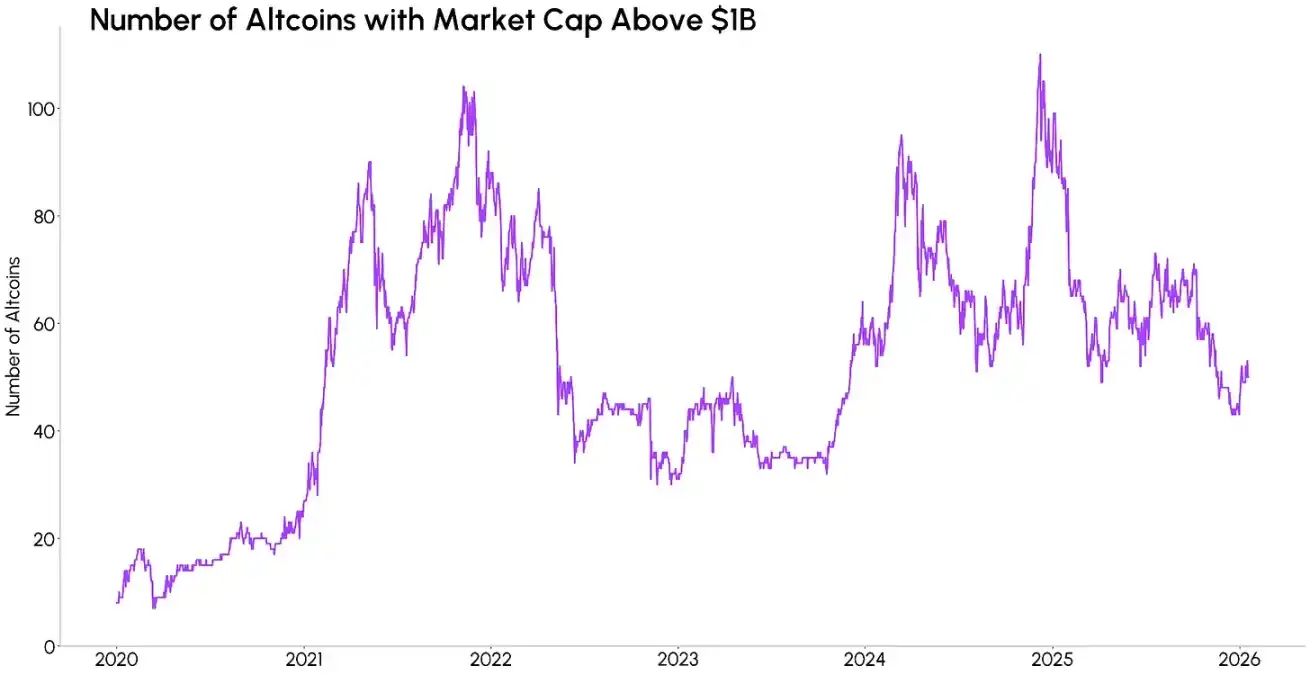
Number of Altcoins with Market Cap over $1 Billion, Data Source: Coin Metrics
The table below summarizes the annual evolution characteristics of the market trends mentioned above. Some metrics still exhibit cyclical patterns, such as Bitcoin's market dominance decreasing during bull markets and increasing during bear markets, but the market share of the top ten altcoins has followed a different trend: from 2020 to 2024, regardless of the market conditions, this ratio consistently stayed between 69% and 73%, but in 2025, it surged significantly to 82%. This change indicates a structural shift in the market towards mature flagship assets, rather than just a short-term "chasing quality assets for price appreciation" behavior.
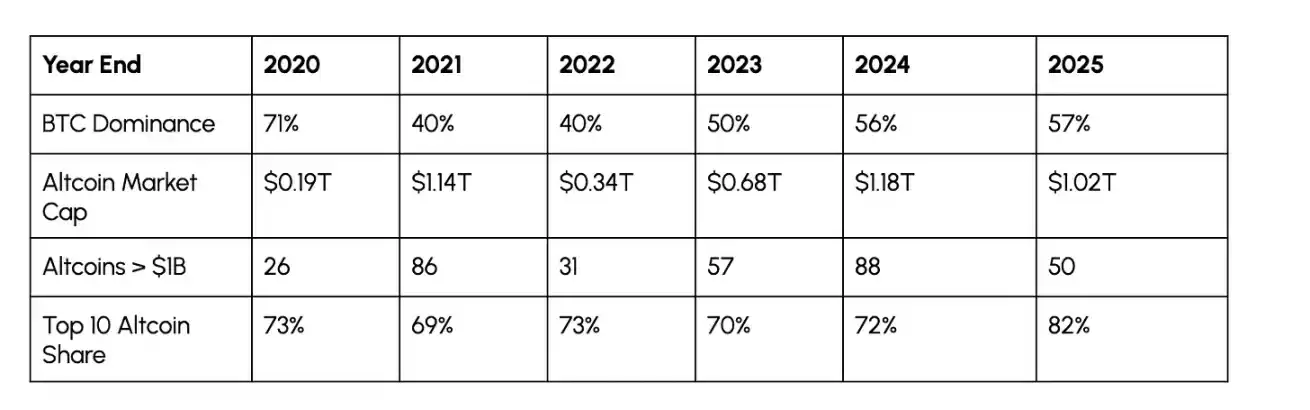
Data Source: Coin Metrics
Capital Flow to Mainstream Coins
This trend of capital concentration is also reflected in asset performance. Since 2023, mid-cap coins (market cap $1 billion - $10 billion), especially small-cap coins (market cap below $1 billion), outperformed large-cap coins (market cap over $100 billion) in the early and late stages of 2024. However, this trend saw a sharp reversal in 2025 due to the rapid waning of market sentiment towards meme coins and other short-term narrative rotations.
On an equally weighted basis, from January 2023 to the present, the overall return of large-cap crypto coins is approximately 365%, while mid-cap and small-cap coins have only seen returns of about 70% and 55%, respectively. Most of the earlier gains have been given up. This phenomenon of return divergence clearly indicates that the market's performance is increasingly favoring developed, liquid assets, making it challenging for small-cap tokens to replicate the sustainability seen in previous cycles.
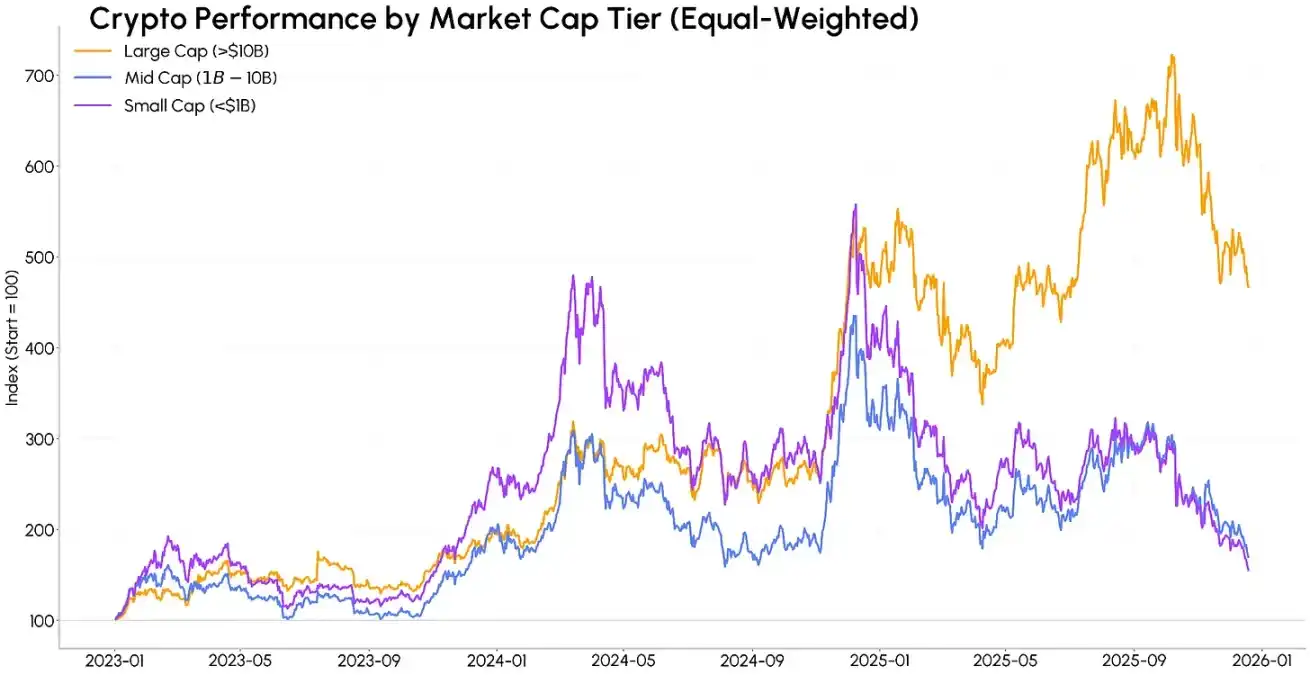
Market Performance of Tokens of Different Market Capitalization Tiers, Data Source: Coin Metrics
On October 10, 2025, the market experienced a large-scale liquidation event due to high leverage positions and liquidity exhaustion. This event may further strengthen the trend of capital inflow into defensive assets, with investors increasingly favoring high liquidity assets rather than small-cap assets with significantly higher volatility.
Conclusion
Various data indicate that the crypto market is undergoing a structural shift, gradually maturing, and moving towards consolidation. Despite the continuous growth in the number of crypto market assets and the increasing richness of traditional asset types supported as underlying infrastructure, the overall liquidity of the market remains limited. Meanwhile, in a multi-asset investment portfolio, crypto assets still need to compete with popular investment themes in the stock market, gold, and other traditional safe-haven assets.
Currently, capital is increasingly flowing into large-cap crypto assets, as well as the infrastructure track supporting stablecoins, tokenized assets, and the development of decentralized finance. The importance of liquidity and scale has been further heightened, raising the barrier for small-cap coins to attract long-term capital.
Of course, if market structure-related rules become clearer, and small-cap coins and multi-asset ETFs continue to proliferate, coupled with an improvement in market liquidity conditions, it is still possible to trigger a new altcoin season. However, it is foreseeable that the beneficiaries of this altcoin season will be more concentrated, and capital allocation will be more discerning than in any previous cycle.
You may also like

Pantera Partner: Predicting the Market is No Longer a 'Betting Game,' But a Core Financial Asset Class

Key Market Intelligence on February 3rd, how much did you miss out on?

From Libya to Iran: The Land of Blackouts, the Land of Uninterrupted Bitcoin Miners

Circle: Not Every Company Can Issue a Stablecoin

Trump Says He Was Unaware of $500M UAE Investment in World Liberty Financial
Key Takeaways: US President Donald Trump denied knowledge of a $500 million UAE investment in World Liberty Financial.…

Crypto Industry and Banks at a Stalemate Over Stablecoin Yield Deal
Key Takeaways The White House has urged a compromise on stablecoin yields to progress Senate crypto legislation. Crypto…

Why Vitalik Buterin Sold Over 700 Ethereum (ETH) Despite Market Recovery
Key Takeaways Vitalik Buterin sold over 700 Ethereum not for market reasons but to finance long-term projects. The…

Binance Withdrawals Restored Following Temporary Disruption
Key Takeaways Binance faced technical difficulties affecting withdrawals, but services were quickly restored within 20 minutes. The disruption…
Asian Markets Stabilize as Bitcoin Trades Around $78K
Key Takeaways Bitcoin steadies at approximately $78,000 as Asian markets recover from recent volatility. Regional equities, including Japan’s…

Bitcoin Price Prediction: The Warsh Shock & The Stablecoin Summit—Is the Bull Case Dead?
Key Takeaways Kevin Warsh’s nomination as Federal Reserve Chair has caused a drop in liquidity for riskier assets,…
White House Continues to Negotiate Over Crypto Market Structure Bill
Key Takeaways The White House is pushing for a compromise on the contentious issue of stablecoin yields in…
Billionaire Michael Saylor’s Strategy Acquires $75M More Bitcoin – Is This a Bullish Sign?
Key Takeaways Michael Saylor’s Strategy has expanded its Bitcoin holdings by purchasing an additional 855 BTC for $75.3…
Polymarket Bettors Assign Over 70% Probability of Bitcoin Dropping Below $65K — Are They Correct?
Key Takeaways Polymarket users predict Bitcoin has a 71% chance of falling below $65,000 in 2026, reflecting market…
CFTC Regulatory Shift Could Unlock New Growth for Coinbase Prediction Markets
Key Takeaways Newly appointed CFTC Chair, Michael Selig, aims for a unified federal oversight approach for crypto-linked prediction…

We Hacked Perplexity AI to Predict the Price of XRP, Bitcoin, and Ethereum By the End of 2026
Key Takeaways Perplexity AI predicts XRP may soar to $8 by 2026, fueled by legal victories and supportive…
Current Crypto Price Predictions: An In-Depth Analysis of XRP, Dogecoin, and Shiba Inu
Key Takeaways XRP, Dogecoin, and Shiba Inu are experiencing significant price declines amid geopolitical uncertainties and general market…

Pepe Coin Forecast: Price Appears Dismal, Yet Savvy Investors Rally Behind the Scenes
Key Takeaways Pepe Coin has experienced significant price drops, yet indicators suggest it may soon bottom out, with…

BitMine Reports 4.285M ETH Holdings, Expands Staked Position With Massive Reward Outlook
Key Takeaways BitMine Immersion Technologies has reported significant crypto holdings valued at $10.7 billion. The company’s Ethereum holdings…
Pantera Partner: Predicting the Market is No Longer a 'Betting Game,' But a Core Financial Asset Class
Key Market Intelligence on February 3rd, how much did you miss out on?
From Libya to Iran: The Land of Blackouts, the Land of Uninterrupted Bitcoin Miners
Circle: Not Every Company Can Issue a Stablecoin
Trump Says He Was Unaware of $500M UAE Investment in World Liberty Financial
Key Takeaways: US President Donald Trump denied knowledge of a $500 million UAE investment in World Liberty Financial.…
Crypto Industry and Banks at a Stalemate Over Stablecoin Yield Deal
Key Takeaways The White House has urged a compromise on stablecoin yields to progress Senate crypto legislation. Crypto…


 App
App