
- Buy Crypto
- Markets
 Futures
- Spot
- Copy Trade
 Earn
Earn- More
Stop obsessing over Alpha, the Beta the market gives you is more important

Original Article Title: Pray for Beta, Not Alpha
Original Article Author: Nick Maggiulli, Author of "Just Keep Buying"
Original Article Translation: Felix, PANews
The investment world generally believes that excess return (Alpha), the ability to outperform the market, is the goal investors should pursue. This is entirely logical. Under other equal conditions, Alpha is always a good thing.
However, having Alpha does not always mean a better investment return. Because your Alpha always depends on the market performance. If the market performs poorly, Alpha may not necessarily make you profitable.
For example, imagine two investors: Alex and Pat. Alex is very good at investing and outperforms the market by 5% every year. Pat, on the other hand, is a poor investor and underperforms the market by 5% every year. If Alex and Pat invest during the same time period, Alex's annual return is always 10% higher than Pat's.
But what if Pat and Alex start investing at different times? Is there a situation where, even though Alex is more skilled, Pat's return exceeds Alex's?
The answer is yes. In fact, if Alex invested in US stocks from 1960 to 1980, and Pat invested in US stocks from 1980 to 2000, then 20 years later, Pat's investment return will exceed Alex's. The following image illustrates this:
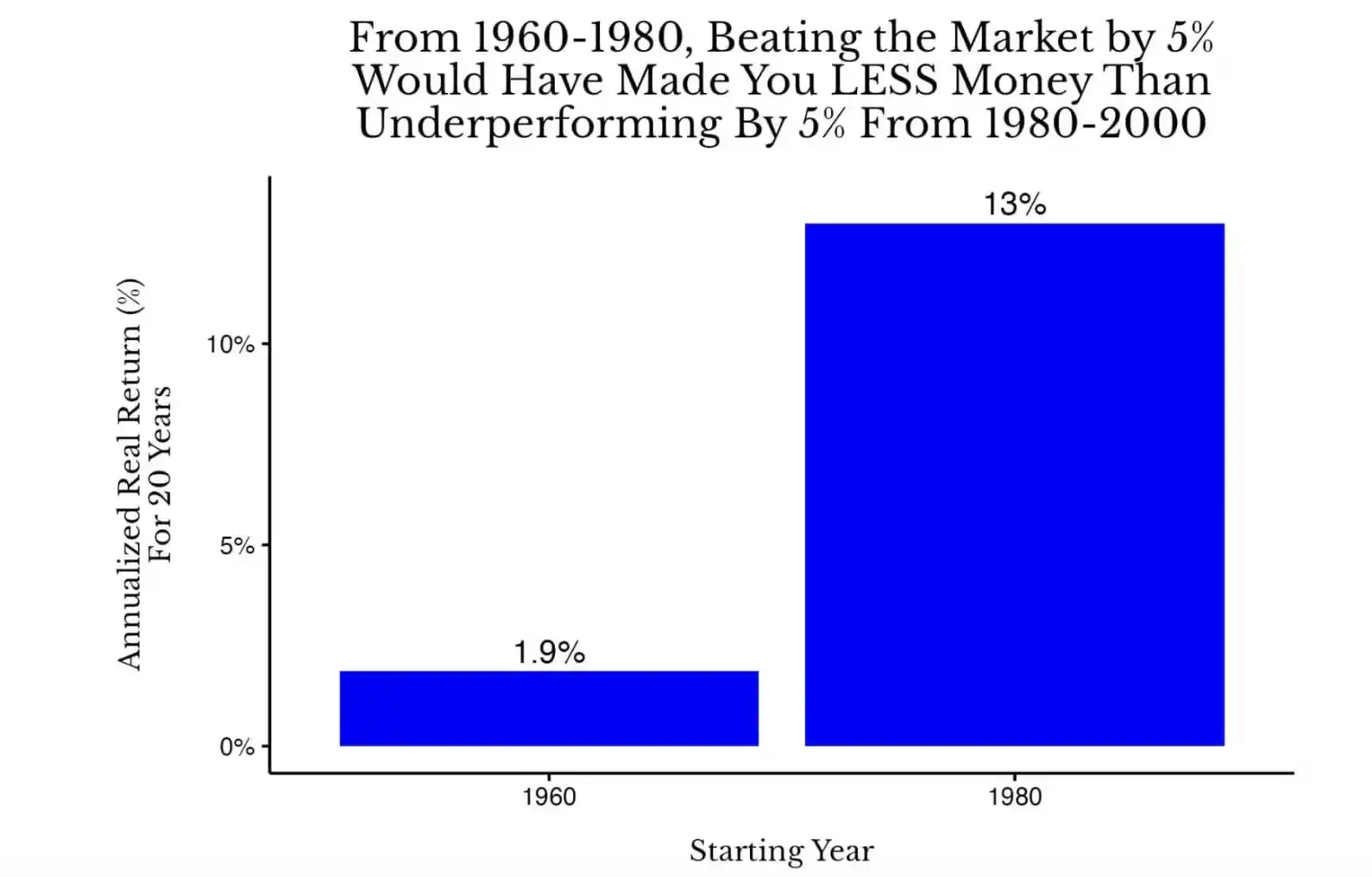
20-Year Annualized Actual Total Return Comparison of US Stocks from 1960 to 1980 and 1980 to 2000
In this case, Alex's annual return from 1960 to 1980 is 6.9% (1.9% + 5%), while Pat's annual return from 1980 to 2000 is 8% (13% - 5%). Despite Pat's inferior investment ability to Alex, Pat's performance is more outstanding in terms of total return adjusted for inflation.
But what if Alex's opponent is a true investor? Currently, let's assume Alex's competitor is Pat, a person who lags behind the market by 5% annually. But in reality, Alex's true opponent should be an index investor who matches the market's annual return.
In this scenario, even though Alex outperformed the market by 10% annually from 1960-1980, he would still lag behind the index investor from 1980-2000.
While this is an extreme example (i.e., an outlier), you would be surprised to find that having Alpha leads to a high frequency of underperformance relative to historical performance. As shown in the graph below:
Probability of Alpha size underperforming the index in all 20-year periods in the U.S. stock market from 1871 to 2005
As you can see, when you have no Alpha (0%), the probability of outperforming the market is essentially equivalent to flipping a coin (about 50%). However, as Alpha returns increase, while the compounding effect of returns does reduce the frequency of underperforming the index, the magnitude of the increase is not as significant as imagined. For example, even with an annual alpha return of 3% over a 20-year period, there is still a 25% probability of underperforming the index fund during other periods in U.S. market history.
Of course, some may argue that relative returns are the most important, but I do not subscribe to this view. Ask yourself, would you prefer to receive market average returns during normal times or would you rather "lose slightly less money" than others during a depression period (i.e., receive positive Alpha returns)? I, for one, would choose index returns.
After all, most of the time, index returns bring quite decent gains. As shown in the chart below, the real annualized return of the U.S. stock market fluctuates by decade but is mostly positive (Note: Data for the 2020s only shows returns up to 2025):
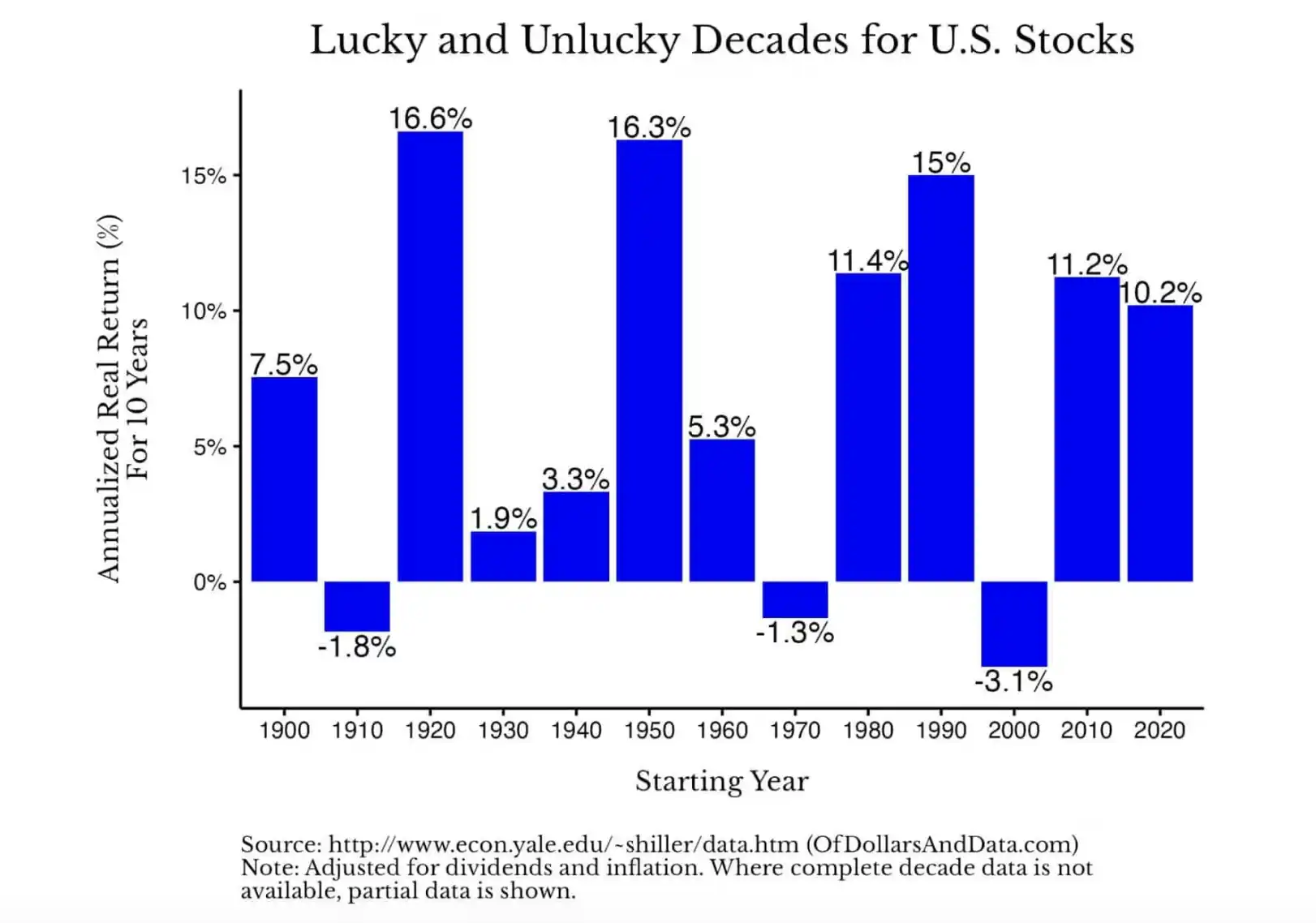
All of this indicates that while investment skill is important, many times market performance is key. In other words, hail Beta, not Alpha.
Technically, β (Beta) measures the magnitude of an asset's return relative to market movement. If a stock has a Beta of 2, it is expected to increase by 2% when the market rises by 1% (and vice versa). But for simplicity, market returns are usually referred to as Beta (i.e., Beta coefficient of 1).
The good news is, if the market does not provide enough "Beta" in a period, it may make up for it in the next cycle. You can see this in the chart below, which shows the 20-year rolling real annualized returns of U.S. stocks from 1871 to 2025:
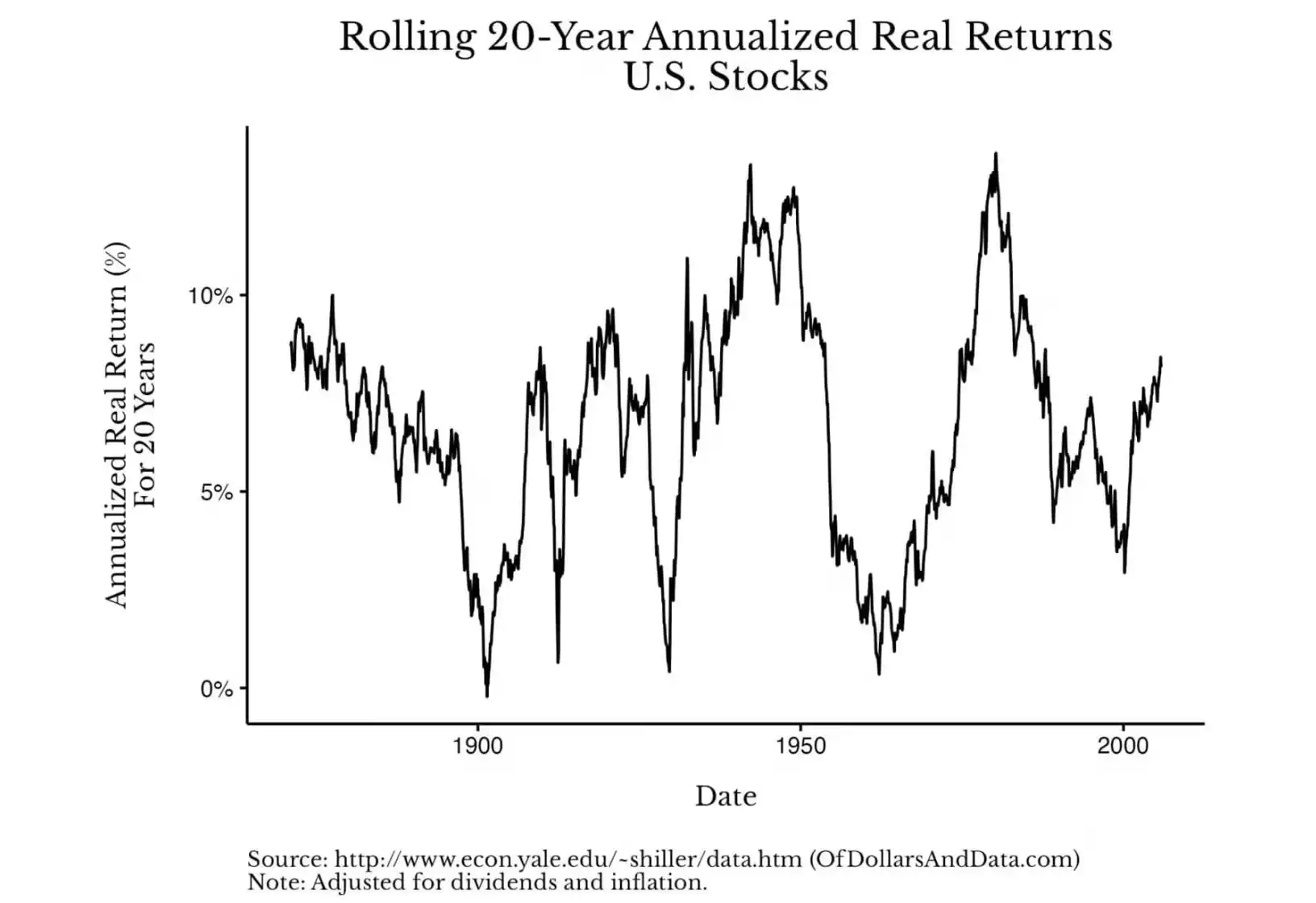
This chart vividly illustrates how returns can strongly rebound after a period of underperformance. Taking U.S. stock market history as an example, if you invested in U.S. stocks in the year 1900, your annualized real return for the next 20 years would be close to 0%. However, if you invested in 1910, your annualized real return for the next 20 years would be around 7%. Similarly, if you invested at the end of 1929, the annualized return would be about 1%; but if you invested in the summer of 1932, the annualized return would be as high as 10%.
This significant difference in returns once again confirms the importance of overall market performance (Beta) compared to investment skill (Alpha). You might ask, "I can't control how the market behaves, so why is this important?"
It is important because it is a form of liberation. It frees you from the pressure of "beating the market," allowing you to focus on things that are truly within your control. Instead of feeling anxious that the market is beyond your command, consider it as one less thing to worry about. See it as a variable you don't need to optimize because you can't optimize it at all.
So what should you optimize instead? Optimize your career, savings rate, health, family, and so on. Over the long arc of life, the value created in these areas is far more meaningful than agonizing over a few percentage points of excess return in your investment portfolio.
Do the math: a 5% raise or a strategic career move can increase your lifetime earnings by six figures or more. Likewise, maintaining good health is an effective risk management strategy that can significantly offset future medical expenses. Providing companionship to your family sets a positive example for their future. The benefits of these decisions far outweigh what most investors can reasonably expect to gain by trying to outperform the market.
In 2026, focus your energy on the right things, pursue Beta, not Alpha.
You may also like

Why Is Gold, US Stocks, Bitcoin All Falling?

Key Market Intelligence for February 5th, how much did you miss out on?

Wintermute: By 2026, crypto had gradually become the settlement layer of the Internet economy

Tether Q4 2025 Report: USDT Market Cap Nears $190 Billion, Multiple Metrics Reach All-Time Highs

Kyle Samani's about-face, one of the biggest believers in web3, has also left the industry

Bhutan Quietly Sells Over $22M in Bitcoin, Drawing Speculation Over Possible Moves
Key Takeaways Bhutan has transferred over $22 million in Bitcoin from sovereign wallets in the past week. The…

BitMine Endures a $7B Unrealized Loss as Ethereum Dips Below $2,100
Key Takeaways BitMine is facing a significant financial challenge with an unrealized loss of over $7 billion in…

Trump-Linked World Liberty Financial Under Scrutiny Following $500 Million UAE Stake
Key Takeaways A U.S. House investigation is examining a $500 million UAE stake in Trump-related World Liberty Financial.…

Asia Market Open: Bitcoin Tumbles as Asian Equities Reflect Global Tech Retreat
Key Takeaways: Bitcoin’s price plunged by 6% to $72,000, reflecting the spillover effects from the global tech sector’s…

Crypto Firms Propose Concessions to Banks as Stablecoin Disputes Stall Key Crypto Bill
Key Takeaways: Crypto companies are attempting to navigate stablecoin disputes with banks but agreements remain elusive. Industry representatives…
CoolWallet Introduces TRON Energy Rental to Minimize TRX Transaction Costs
Key Takeaways CoolWallet has integrated TRON’s energy rental services, offering users lower transaction fees while maintaining asset security.…

CFTC Officially Withdraws Biden-Era Proposal to Ban Political and Sports Prediction Markets
Key Takeaways: The CFTC has rescinded a 2024 proposal and subsequent 2025 advisory that aimed to prohibit event…

Binance Says Assets Rose Amid Alleged Bank Run Attempt
Key Takeaways: Binance reported an unexpected increase in assets during a community-driven withdrawal campaign, challenging conventional expectations of…

Same Macro Tape, Different Bid – Gold Absorbs Flows as Bitcoin Swings
Key Takeaways: Gold is experiencing significant demand growth, especially via ETFs and central banks, projecting a robust performance…
Crypto Price Prediction Today, February 4 – Focus on XRP, Cardano, and Dogecoin
Key Takeaways Bitcoin is facing significant pressure, affecting the entire cryptocurrency market, including heavyweights like XRP, Cardano, and…

Vitalik Buterin Urges Ethereum Builders to Innovate Beyond Clone Chains
Key Takeaways Vitalik Buterin criticizes the trend of creating copy-paste EVM chains, encouraging developers to focus on truly…
Best Crypto to Buy Now February 4: XRP, Solana, Hyperliquid Picks
Key Takeaways XRP remains one of the top picks for cross-border transactions due to its high speed and…
XRP Price Prediction: Ripple Quietly Unlocks a Billion Tokens – Is a Price Shock Coming in the Next Few Hours?
Key Takeaways Ripple has released one billion XRP tokens into the market, potentially causing a shift in XRP…
Why Is Gold, US Stocks, Bitcoin All Falling?
Key Market Intelligence for February 5th, how much did you miss out on?
Wintermute: By 2026, crypto had gradually become the settlement layer of the Internet economy
Tether Q4 2025 Report: USDT Market Cap Nears $190 Billion, Multiple Metrics Reach All-Time Highs
Kyle Samani's about-face, one of the biggest believers in web3, has also left the industry
Bhutan Quietly Sells Over $22M in Bitcoin, Drawing Speculation Over Possible Moves
Key Takeaways Bhutan has transferred over $22 million in Bitcoin from sovereign wallets in the past week. The…


 App
App