
- Buy Crypto
- Markets
 Futures
- Spot
- Copy Trade
 Earn
Earn- More
Stock Market Inflow into <code>Bitcoin Fentanyl</code>

Imagine this scenario: when your company is facing a crisis of closure, all you need to do is issue more shares for purchase, or simply announce that Bitcoin will be used as an asset reserve, easily defeating the annoying short sellers, and transitioning from the brink of liquidation back to the center of market attention. If this were true, would you do it?
As $MSTR once again became a buzzword in the investment circle, Bitcoin is rapidly taking over the balance sheets of global enterprises. In this new capital game centered around Bitcoin, some are chasing trends, some are poorly imitating, and some are finding new business opportunities, transforming into orchestrators behind the scenes creating "price miracles."
The Journey of MSTR
In 2024, MSTR's stock price soared by 477%, ranking second among US tech companies with a market value exceeding $5 billion, second only to AppLovin. The Bitcoin investment also brought the company a staggering $13.14 billion in unrealized gains, driving the market cap to surpass $100 billion, becoming a star enterprise in the US stock market.
As of April 2025, the company holds a total of 528,185 BTC, with a cost basis of approximately $33.14 billion, an average purchase price of $66,385 per Bitcoin. At the current Bitcoin price of around $81,400, the total market value is about $43 billion, accounting for over 2.5% of the global circulation.
Related Read: "The strategy of "issuing debt to buy coins" remains the same, why did MSTR's premium suddenly soar?"
As early as August 2020, at the end of the bear market in the crypto market, MicroStrategy first purchased 21,454 BTC in the $10,000 range, initiating the "Bitcoin Treasury Reserve Strategy" and becoming the first publicly traded company to allocate a significant portion of its treasury to Bitcoin.
Subsequently, the company continued to accumulate during downturns from 2020 to 2022 and steadily increased its holdings in 2023. With Bitcoin entering a bull market from 2024 to 2025, MicroStrategy further accelerated its accumulation, forming a clear operational path of "building a bottom during the bear market and accelerating during the bull market." The frenzy of the stock price is like a stone thrown into a pond, creating ripples. Enterprises all began to ask themselves: if we can't outperform Bitcoin, why not just buy it?
Bitcoin Fentanyl" src="https://image.theblockbeats.info/file_v6/20250418/1c8cb3c8-d1b5-4a90-9a44-43919270332f.png?x-oss-process=image/quality,q_50/format,webp" alt="" data-href="" style="" >
According to data from Bitcointreasuries, as of April 16, 2025, a total of 178 entities hold over 3.16 million BTC, with public companies holding approximately 665,636 BTC, and this number is rapidly increasing. This "Micro" trend is sweeping the globe, involving 26 US-listed companies, 22 Canadian-listed companies, and 8 Chinese (including Hong Kong) listed companies, including some previously undervalued, seldom-noticed edge companies.
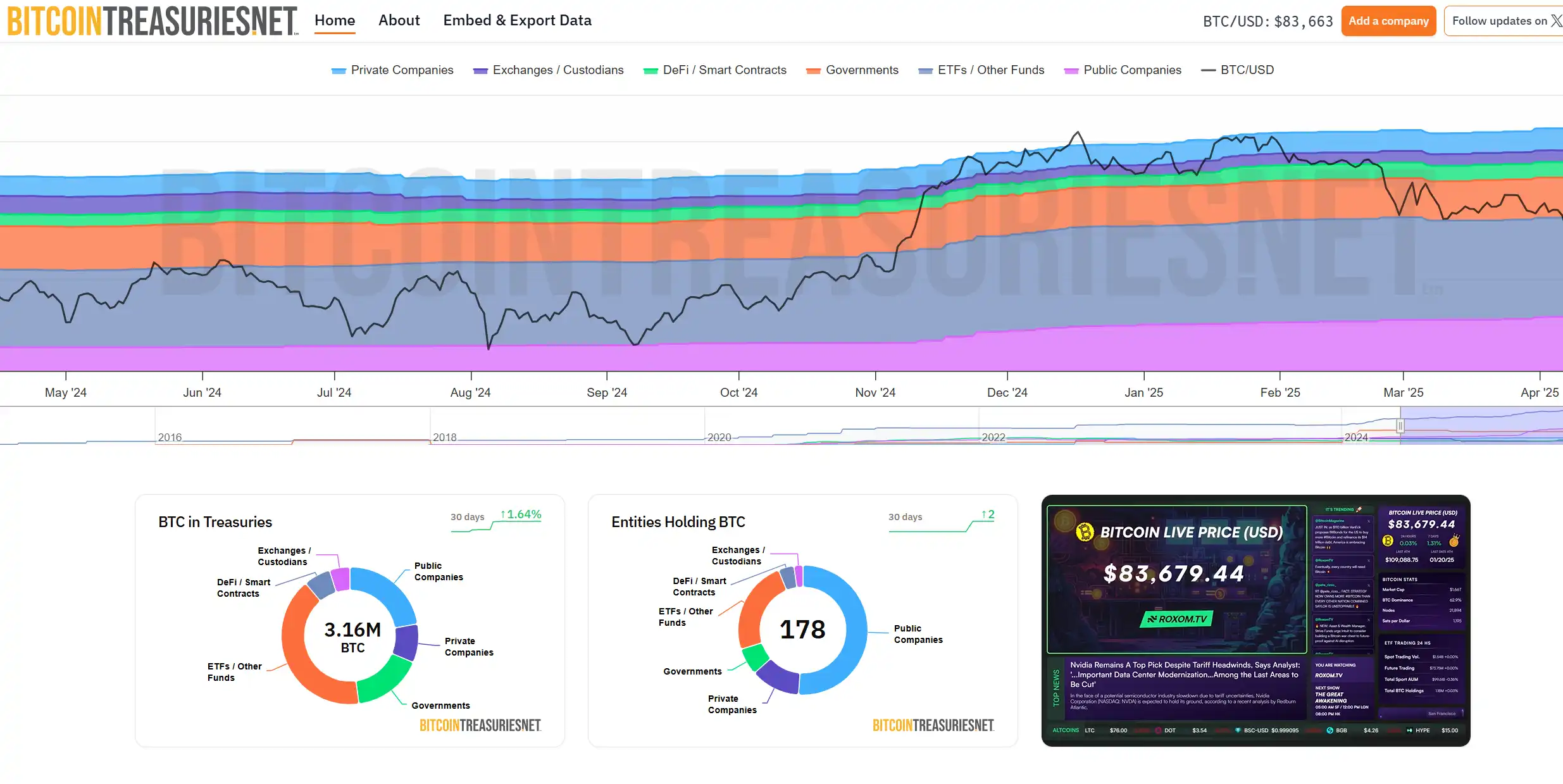
Image Source: bitcointreasuries.net
Represented by Hongya Holdings, a group of traditional businesses that were originally on the fringes are undergoing a narrative shift by incorporating Bitcoin into their operations.
Previously a low-profile fringe company mainly engaged in wholesale and retail of prepaid products (such as SIM cards and vouchers), the company made its first Bitcoin purchase in February 2025, spending $96,150 on 1 Bitcoin. Following this news, the company's stock price surged by 93%.
Having tasted success, Hongya Holdings continued to accumulate Bitcoin for three consecutive days, becoming the first listed company in Greater China to officially include Bitcoin in its balance sheet.
GameStop, the retail giant that gained fame during the 2021 "retail investor battle," announced on March 27, 2025, that it would issue $1.3 billion in zero-coupon convertible bonds to purchase Bitcoin. Prior to the announcement, its stock price surged over 18% in pre-market trading due to related rumors. Following MicroStrategy's lead, a Japanese company named Metaplanet saw its stock price soar by approximately 4000% after purchasing Bitcoin in April 2024, setting a 2025 target of holding 10,000 Bitcoins.
Aside from GameStop, Hongya Holdings, and Metaplanet, other publicly traded companies worldwide, originally unrelated to the crypto sector, are stealthily emulating the MicroStrategy model. They are making a bold bet on Bitcoin to hedge against inflation and speculate on the future.
For instance, Eric Semler, CEO of the U.S. medical company Semler Scientific, stated, "Not holding Bitcoin is irresponsible to shareholders." In India, the board of directors of Jerking company has approved a significant Bitcoin purchase. KULR Technology directly allocated 90% of its corporate cash reserves to gradually buy Bitcoin, while Canadian cannabis company LEEF Brands issued a $5 million bond to support Bitcoin. Boyaa in Hong Kong swapped $50 million worth of Ethereum for Bitcoin.
Related Reading: "Publicly Listed Companies Flock to Buy BTC: Revealing the Top 15 Profit Leaders, Who Grew Nearly 30 Times?"
From healthcare to cannabis, from North America to Asia, companies from different industries seem to be swept up by the same trend, diving headfirst into a field they may have been completely unfamiliar with. Since then, Bitcoin is becoming an increasingly prominent figure on many companies' balance sheets.
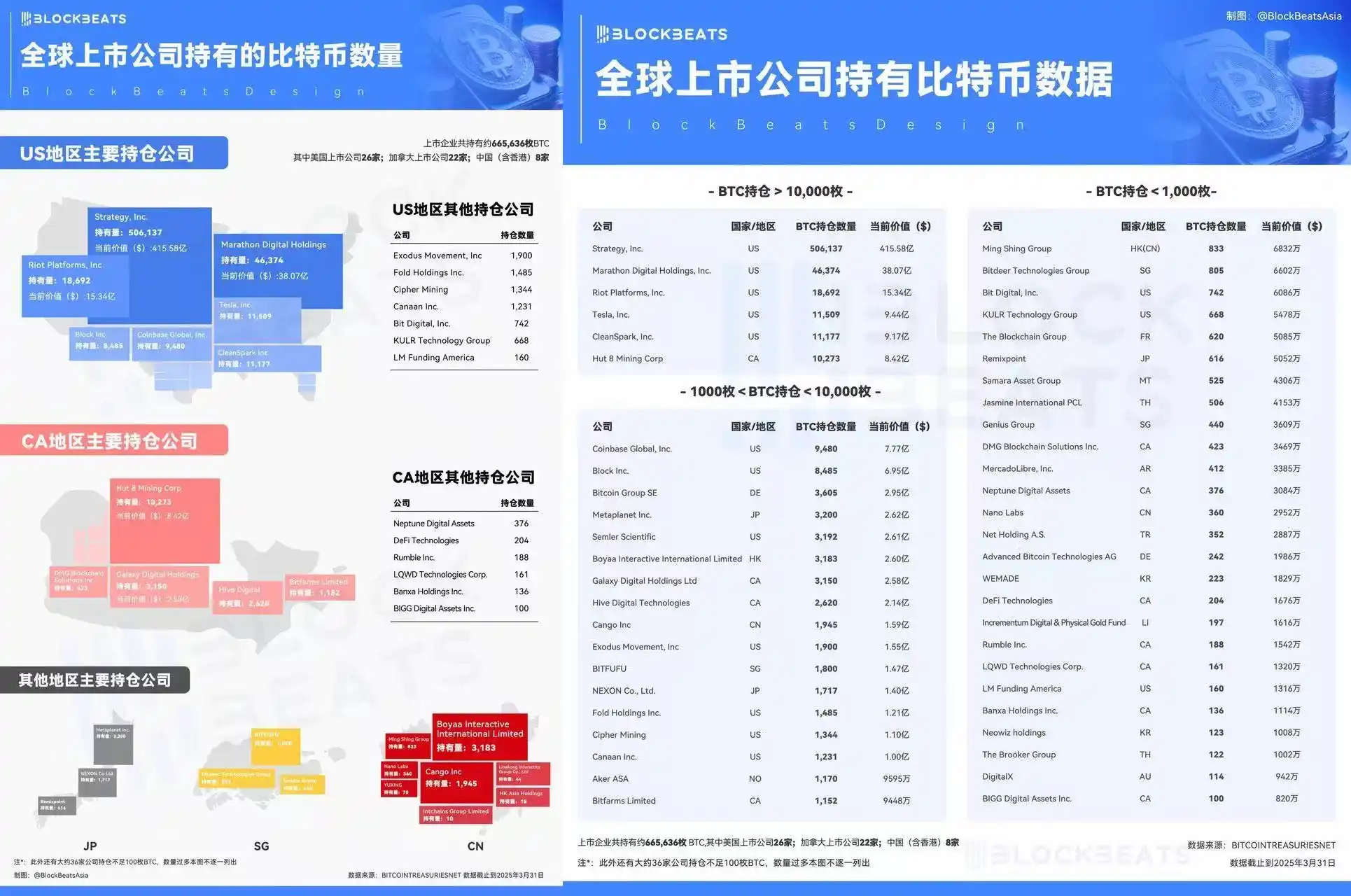
The "Golden Finger" Behind the Price Miracle: Market Makers, White Gloves, and Eric Trump
When capital meets political leverage, it always leads to many "price miracles." This wave, represented by MicroStrategy, is far more complex than it appears on the surface. Starting from the market frenzy sparked by the re-election of the "crypto president" Trump, everything began to heat up rapidly.
With the Trump administration pushing forward the Bitcoin Strategic Reserve Plan and the SEC's repeated relaxation of crypto regulations, these policies acted as a tailwind, propelling the Bitcoin price to nearly $110,000, nearing its all-time high. As the crypto industry and politicians take advantage of each other, the underlying currents are often unknown to many.
In this global stock market surge intertwined with crypto market frenzy, UTXO Management and Sora Ventures seized the opportunity, transforming into market makers in the capital market, successively pushing various "meme stocks" to the center stage.
Leverage Effect
If you have recently been paying attention to the Hong Kong or Japanese stock markets, you may be puzzled by the sudden skyrocketing of some strange companies.
A budget hotel operator, a game developer relying on Texas Hold'em, and an old telecom company selling data cards, despite having almost no outstanding business points, managed to see their stock prices surge several times or even thousands of percentage points in a short period. What kind of magic potion have these originally failing "distressed stocks" drunk?
Let's first look at the most typical case, Metaplanet. This company originally named Red Planet was a budget hotel operator. In 2024, CEO Simon, a Harvard graduate and former Tokyo Goldman Sachs executive, renamed the company to Metaplanet after selling most of the hotel business. This CEO also serves as Chairman of Red Planet Hotels and the head of a real estate company in Thailand.
In addition to its core BTC strategy, Metaplanet is redeveloping its remaining hotel into "The Bitcoin Hotel," set to open in the third quarter of 2025, aiming to provide companies with a one-stop service from finance, operations to Bitcoin education.
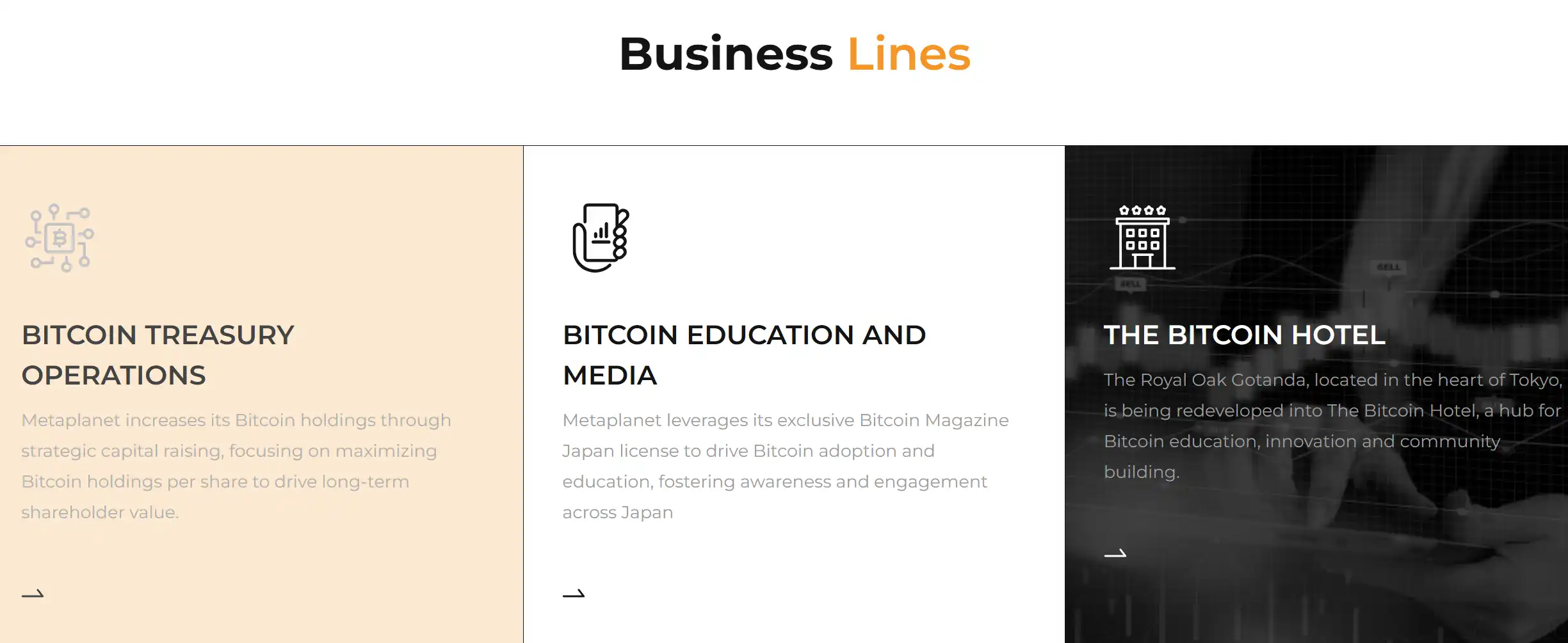
Metaplanet Business Scope (holding btc, btc education, btc-themed hotel), Image Source: Metaplanet
Through this series of capital operations, Metaplanet became the "first publicly traded Japanese company holding Bitcoin," accumulating approximately 3050 BTC in a short period of time and issuing a 2 billion yen bond in 2024 to continue building its position. Its stock price also skyrocketed over 4000% from a long-term low of below 50 yen.
In April 2024, Jason Fang, the founder of Sora Ventures, wrote on his personal Twitter account that Metaplanet is the "first MicroStrategy in Asia" and, through collaborations with UTXO Management, Mark Yusko, and others, helped Metaplanet integrate Bitcoin into its balance sheet, becoming Japan's first publicly traded company holding Bitcoin.
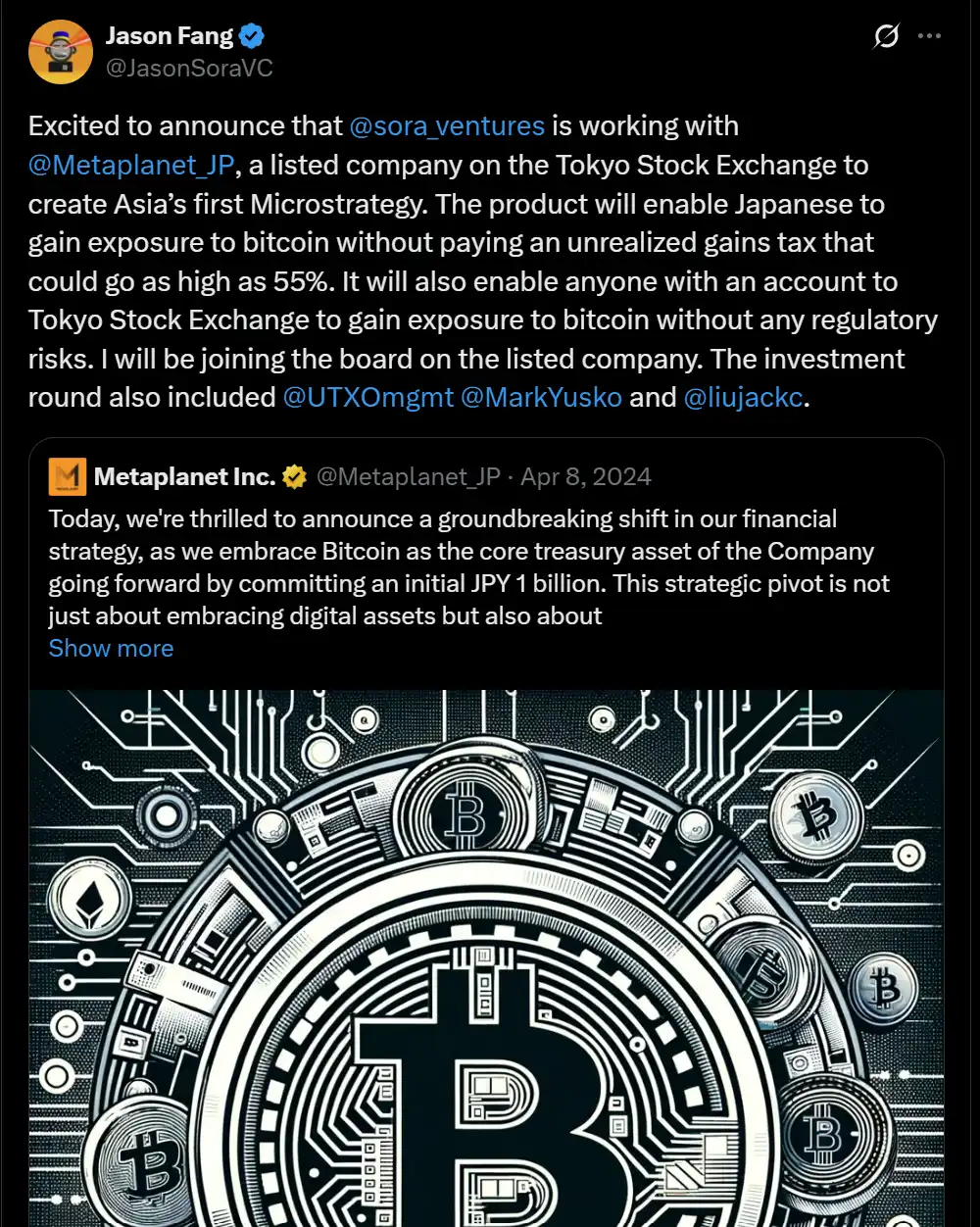
This is the first time Jason Fang, as a board member of Metaplanet, has brought Sora Ventures to the forefront. In fact, Sora has been very aggressive along the path of "replicating MicroStrategy."
A similar operation seemed to have also taken place in the same year with the Hong Kong-listed gaming company Boyaa Interactive.
Founded in 2004, Boyaa focuses on card games such as Texas Hold'em. The founder, Zhang Wei, a graduate of Shenzhen University, saw the stock price rise from 5.35 Hong Kong dollars to 15.16 Hong Kong dollars fueled by Chinese gamers' enthusiasm. However, as the hype faded, the company quickly fell to the bottom, lingering below 1 Hong Kong dollar for years. On November 14, 2023, Boyaa announced a $100 million investment to enter the cryptocurrency space, focusing on Bitcoin and Ethereum.
In November 2024, the company suddenly and prominently announced the conversion of 14,200 ETH from its asset sheet into 515 BTC, increasing its total holdings to 3,183 BTC, surpassing Japan's Metaplanet in one fell swoop, causing its stock price to surge 9 times within a year. Subsequently, in December, Sora Ventures announced the establishment of a $150 million fund dedicated to promoting the adoption of Bitcoin treasury strategies by Asian publicly traded companies, with Boyaa Interactive as its first pilot.
Another noteworthy detail is that in July 2024, Boyaa publicly announced a $1 million investment in the UTXO Management Bitcoin Ecosystem Fund, aiming to increase Boyaa's transitional exposure through BTC Inc.'s resources such as Bitcoin Magazine.
It's not just Sora Venture walking the "Replication Road." In the two cases mentioned above, we can also see the shadow of another "good helper" – UTXO Management.
Behind the push to adopt a Bitcoin strategy for Metaplanet, UTXO Management also played a crucial role. Its partner, Dylan LeClair, served as Metaplanet's Bitcoin Strategy Director, Tyler Evans as an independent director for Metaplanet, and UTXO is a major investment institution for Metaplanet.
This year, the two institutions once again joined forces to orchestrate another "price miracle" in the Hong Kong stock market.
In early 2025, Sora Ventures and UTXO Management teamed up to spend approximately HK$126 million to acquire more than 70% of Hong Asia Holdings' equity, taking over the company.
Hong Asia Holdings was originally a company that relied on selling data cards and running traditional distribution, with extremely low profits. It had long been relegated to the category of "penny stocks" in the Hong Kong stock market (stock price below 1 Hong Kong dollar). After the acquisition, the company was renamed Moon Inc., underwent a thorough "encryption" overhaul from the board to management, and promptly established a "Bitcoin-centric" financial strategy.
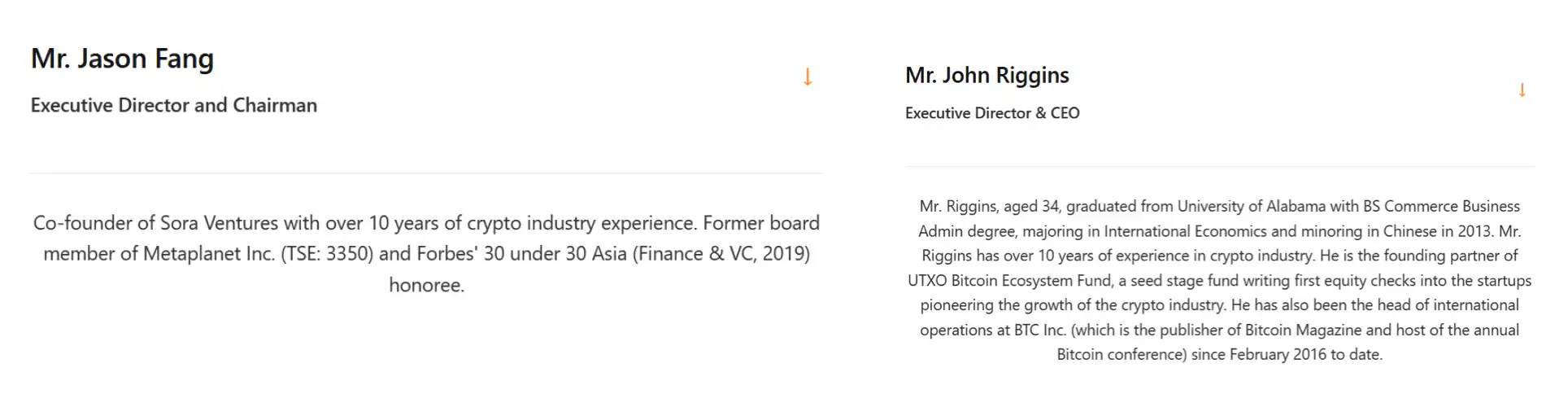
Image Source: http://1723.HK
However, as of the time of the draft, the company only held 28.88 BTC in its account. Hong Kong financial commentator Li Ming bluntly stated, "With such a small position, it doesn't even qualify as probing." Nonetheless, after the company initially announced the purchase of 1 BTC, the stock price quickly rose from 0.29 Hong Kong dollars to 0.38 Hong Kong dollars, an increase of approximately 31%. As of April 17, 2025, it closed at 4.84 Hong Kong dollars, down 32.5% from its 52-week high, but still up approximately 1669% from the year's start of 0.29 Hong Kong dollars.
A terminally ill company is often a low-cost, high-return target for transformation. "Trash shell companies" like Metaplanet and Hongya Holdings had long been trading at a low price before the Bitcoin strategy was implemented. What Sora and UTXO were interested in was not the business of these companies, but rather their cheap shell resources and the potential for capital magnification.
Trump Family's "Bitcoin Operator"
In the global stock market of 2024, Sora Ventures and UTXO Management acted like two highly skilled chess players, making moves frequently.
In 2024, Sora Ventures, in collaboration with UTXO Management, launched the $2 million Sora TTP Fund, betting on the TTP ecosystem under the Ordinals protocol, becoming the world's first decentralized index fund based on Ordinals. It attracted participation from founders of BTSE and Origin Protocol. With the help of UTXO and Bitcoin Magazine's promotion, the $PIPE token skyrocketed by 150% within a month.
Sora Ventures' story began in Hong Kong in 2017, where founder Jason Fang accumulated rich experience at the BTSE exchange and established this investment firm focused on the Bitcoin ecosystem. Initially, Sora mainly focused on early-stage Web3 investments, with assets under management exceeding $1 billion. By 2024, the company's ambitions began to emerge: driving Asian listed companies to adopt Bitcoin as a core treasury strategy on a large scale.
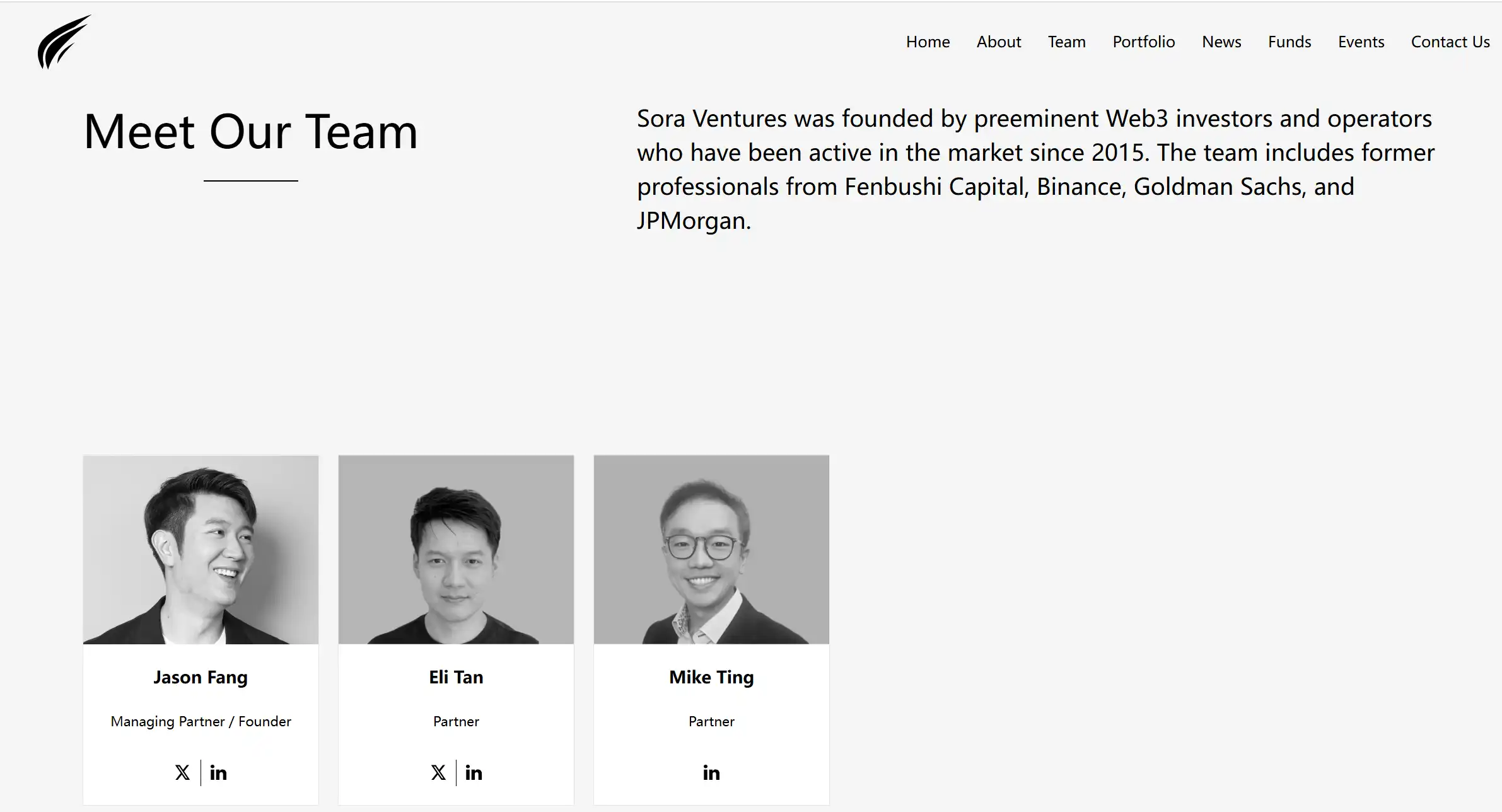
Behind Sora's expansion lies the close collaboration with UTXO. In the case of Metaplanet, UTXO brought in Eric Trump, the son of Trump, to serve as an advisor. Over the past period, this crypto believer has been giving the green light to the Trump family's crypto empire through World Liberty Financial.
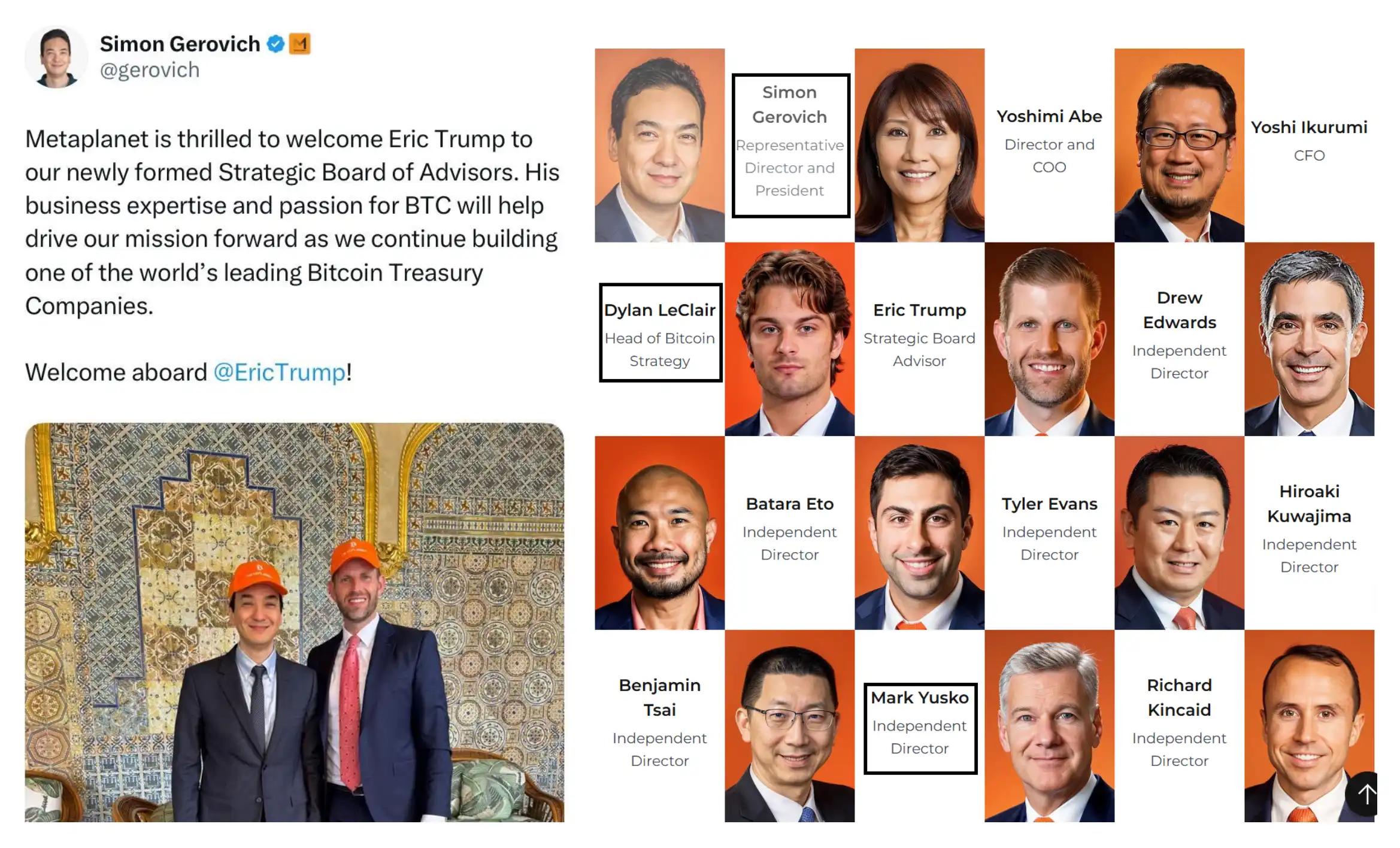
Left: Eric and Simon's group photo, Right: Metaplanet core members; Image source: X, Metaplanet
So, what is UTXO's background?
The story of UTXO Management begins in the state of Tennessee, USA, as part of BTC Inc. (publisher of "Bitcoin Magazine" and organizer of Bitcoin conferences). They initially focused on allocating Bitcoin assets for high-net-worth clients and had invested in over 60 mining and early-stage project companies as early as 2013.
As the Bitcoin ETF was approved in 2024 (with BlackRock recommending a 5% allocation, signaling to traditional capital that Bitcoin was now "allocatable"), UTXO quickly saw the opportunity of institutional capital and began to transition. UTXO's hedge fund, 210k Capital, emerged as a newcomer in this transformation, achieving a 164% annual return with a heavy Strategy and Metaplanet investment, placing them in the top five of the HFR.
Their Chief Investment Officer, Tyler Evans, proudly stated, "80% of our portfolio is concentrated in Bitcoin-related stocks, with Metaplanet and Strategy being the main sources of returns." These companies, through "securitizing Bitcoin," provided the most comfortable entry for institutional investors (such as the Wisconsin Teachers' Pension Fund and the Abu Dhabi Sovereign Wealth Fund) to enter the Bitcoin market with significant capital.
At the same time, The Smarter Web Company, invested in by UTXO Management, plans to IPO on the UK's Aquis Exchange, being dubbed the "UK version of Metaplanet," with its Bitcoin finance model penetrating the European market. This series of moves by UTXO, all trace back to the well-resourced parent company, BTC Inc., and are not devoid of the implicit assistance of the Trump family's political resources.
The relationship between BTC Inc. and the Trump family goes far beyond surface-level cooperation, deeply rooted in the intertwining of business interests and political resources.
As BTC Inc., publisher of "Bitcoin Magazine" and the world's largest Bitcoin conference organizer, leveraged its strong industry influence to provide a platform for the Trump family's public opinion control and, through a series of business collaborations, supported the Trump family.
This relationship can be traced back to Trump's 2024 election campaign, where, during the Bitcoin 2024 conference hosted by BTC Inc., Trump publicly endorsed the cryptocurrency industry for the first time as a presidential candidate. BTC Inc. CEO David Bailey personally organized a high-profile fundraising dinner with a ticket price as high as $846,000 per person, raising $25 million in campaign funds.
During his speech, Trump repeatedly mentioned the support of BTC Inc. and praised it as the "backbone of the Bitcoin community." During the campaign, BTC Inc. continuously reported on Trump's crypto policy stance through Bitcoin Magazine, garnering support from a significant portion of the crypto industry voters.
After a successful campaign, BTC Inc. continued to provide a platform for the Trump family's crypto policy through its hosted conferences. From December 9 to 10, 2024, at the Abu Dhabi Bitcoin MENA Conference, Trump's son Eric Trump served as a keynote speaker, predicting that Bitcoin would reach $1 million and emphasizing that his father would become the "most crypto-supportive president in history."

The relationship between BTC Inc. and the Trump family is primarily based on a mutually beneficial exchange of public opinion control and political resources. Bitcoin Magazine under BTC Inc. continuously endorsed the Trump family's crypto projects, such as reporting on the establishment of American Bitcoin and the progress of World Liberty Financial.
From financial support during the campaign to policy promotion at conferences, and to the commercial layout of mining companies, the two are inseparable. This "duet" inevitably triggers many external associations with their political influence and business ambitions.
"More and More MicroStrategy-Like Companies in the US Stock Market"
As Michael Saylor put it, the US stock market is also seeing more and more "MicroStrategy-like" companies. Upon closer examination of these "MicroStrategy-like" companies, it is evident that their motivations are not the same. Not every company is deeply integrating with Sora and UTXO like Metaplanet; some companies are more like "acting on loans," optimizing their balance sheets by holding Bitcoin, or doing so for market value management considerations.
Why Are US Stock Market Companies Buying Bitcoin?
Among the US stock market companies buying Bitcoin, GameStop may be a typical representative. The former offline gaming retail giant is attempting to prolong its life through a "hodl transformation", using Bitcoin as a hedge to alleviate inflation pressure and unsightly data on financial statements, more so out of "wanting to buy" rather than "having to buy."
Announcing the purchase of $1.5 billion in convertible bonds to buy Bitcoin and CEO Ryan Cohen's $10.7 million additional stock purchase both stimulated a short-term price surge, which quickly reversed. While the $1.5 billion investment is not insignificant, compared to GameStop's over $100 million loss in the 2024 financial report, it still seems like a drop in the bucket.
The GameStop saga seems more like an attempt to recreate the 2021 meme stock craze through the Bitcoin frenzy, with a strategy leaning more towards capital market maneuvers rather than business transformation.
Cohen's increased stake seems more like a short-term stimulus. Based on his experience of selling pet e-commerce Chewy for $3.2 billion, Ryan Cohen has always carried a strong e-commerce marketing flavor in his style.
According to media reports, although GameStop's total assets amount to $5.875 billion, nearly 81% of it is in cash reserves, and the operating cash flow is only $146 million, highlighting the company's profitability dilemma in its core business. Allocating a quarter of its assets to Bitcoin actually underscores GameStop's reliance on speculative strategies, showing a lack of resolution to its core business.
Another company facing a similar situation of stock price stagnation and ample cash is Semler Scientific. Chairman Eric Semler joined the board two years ago, calling himself a "boardroom radical." He described Semler at that time as a "money-making zombie company that was not recognized by the market," with an asset structure very similar to MicroStrategy in 2020: high cash reserves, low growth, and low valuation.
Semler chose not to pursue acquisitions or drastic business reforms but instead drove the company to incorporate Bitcoin into its treasury strategy, becoming the second publicly listed U.S. company to do so after MicroStrategy. This move triggered a reassessment of its value by the market and brought long-lost attention to its previously overlooked business.
However, not all companies blindly follow the "MicroStrategy-style" Bitcoin treasury operation trend. In October 2024, Microsoft seriously discussed whether to include Bitcoin in its balance sheet at a shareholder meeting but ultimately resoundingly voted against the proposal. The main concern was the high volatility of Bitcoin, which could disrupt the company's financial stability. Microsoft's CFO Amy Hood also clearly stated, "Our capital allocation is more focused on core growth areas such as AI and cloud computing, rather than speculative assets."
Can Anyone Be Like MicroStrategy?
Comparing these companies, it's easy to see that MicroStrategy deeply integrates Bitcoin into its financial structure for the long term. On the other hand, some companies are trying to use Bitcoin for self-rescue (Kongya), some see it as a financial hedge (Metaplanet), and some may just be seeking alpha (GameStop).
It's not accurate to call them "underachievers" imitating top performers. A more precise statement would be: they all want to do something with Bitcoin, just in different directions.
Currently, MicroStrategy's position is 27,987 times that of HKEX Holdings, 125 times that of Metaplanet, 30 times that of GameStop, and the positions of a series of other small companies are also very small. There is a significant gap in positions between MicroStrategy and these companies, and small-scale positions cannot really generate effective hedging effects.
The key difference lies in the overwhelming financing capability. MicroStrategy is like having unlimited ammunition, with the ability to issue bonds and super low borrowing rates, resulting in a relatively low blended cost of Bitcoin.
Since 2020, through debt issuance and stock offerings, a total of over $10 billion has been raised. In 2024, $1 billion in new shares will continue to increase the position. In the first quarter of 2025, a total of $7.69 billion was raised, with $4.4 billion used to purchase coins. This continuous financing capability has enabled MicroStrategy to continuously increase its position in the face of Bitcoin price fluctuations.
In contrast, HKEX Holdings sourced its coin purchase funds only from the acquisition by Sora Ventures and UTXO Management (at a cost of $126 million), with almost zero subsequent financing capability. Although Metaplanet raised funds through the issuance of zero-coupon bonds, the total investment is only about $250 million, far below MicroStrategy's scale. GameStop issued $1.5 billion in convertible bonds but announced a 22.1% stock price plunge thereafter, clearly demonstrating the market's lack of confidence in its financing.
From the stock market's perspective, the U.S. stock market has high liquidity, and Saylor's operations often quickly reflect in stock prices. HKEX Holdings is limited by the low liquidity of the Hong Kong stock market, where small-cap stocks are easily manipulated, and trends are more driven by retail investor sentiment. Metaplanet is constrained by the ceiling of the Japanese market itself, with relatively limited growth potential.
From the perspective of company ownership, Metaplanet, HKEX Holdings, and GameStop exhibit a highly dispersed ownership structure, with a large number of small and medium-sized investors in the shareholder composition, rather than being dominated by a single or a few large shareholders. Around 40% of GameStop's shares are held by retail investors, and a single post on Reddit or Twitter can cause its stock price to jump by a dozen or twenty points. Emotions come and go quickly, naturally leading to rapid price movements.
For secondary market investors, perhaps they are more like a leveraged BTC concept stock.
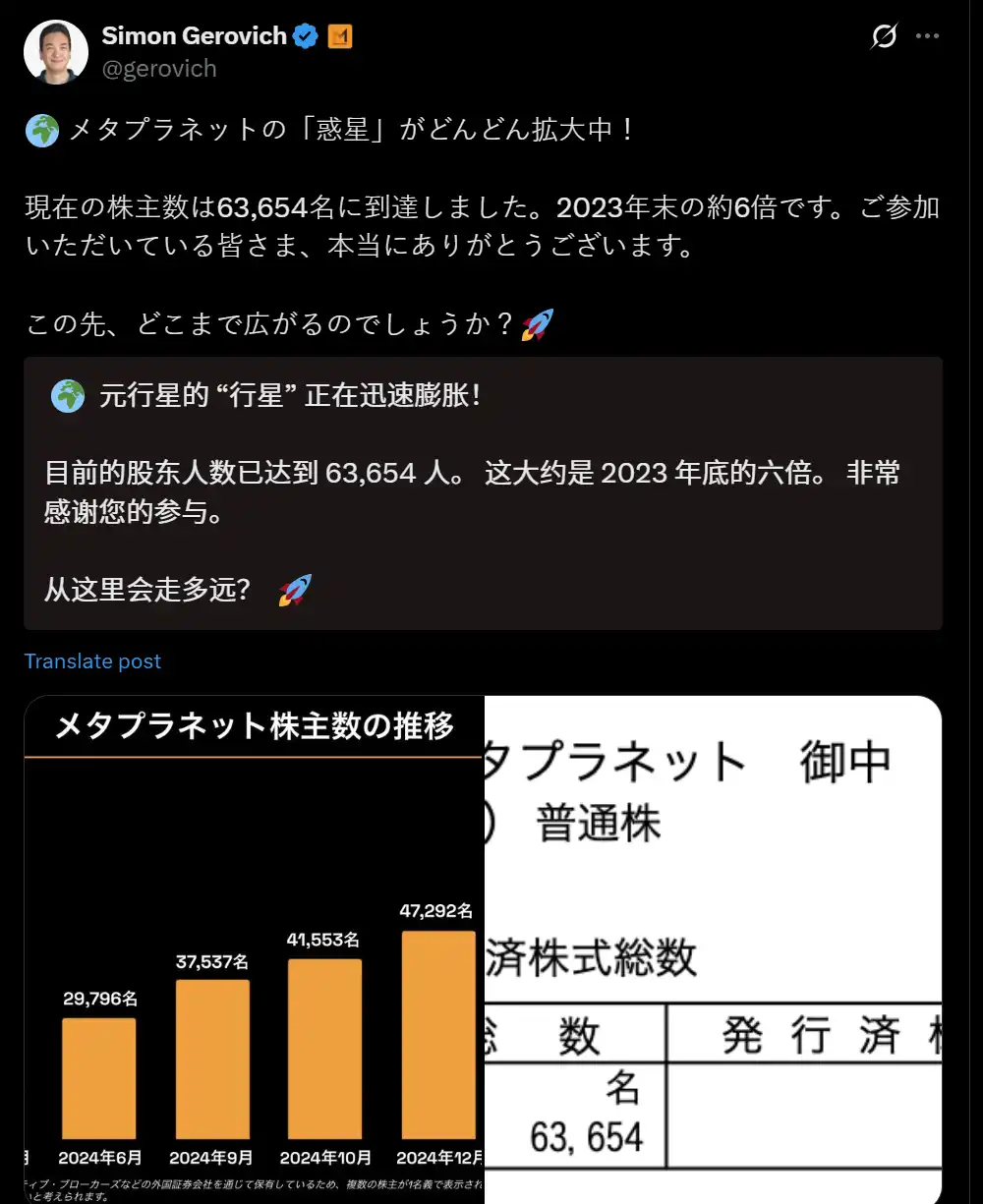
Chart: Metaplanet Shareholder Count Continues to Soar
Behind MicroStrategy stand stable large asset management companies such as BlackRock and Vanguard, with founder Saylor holding 20% of the company's shares, making it much more stable. One is like a cryptocurrency trading group, and the other is like a bond fund. It's not about which one is better, but about whether you want to chase a trend or play a long-term game.
In terms of market attention and importance, by 2024, MicroStrategy was included in the Nasdaq 100 Index, institutional ownership rose to 60%, Defiance and T-REX successively launched 2x long and short MicroStrategy leveraged ETFs (such as MSTX, SMST, MSTU). As of now, MicroStrategy is held by 216 ETFs, with VanEck having the heaviest allocation to it. The ETF halo is comparable to the "Big Seven" of the US stock market.
On the other hand, companies like GameStop, Metaplanet, and Kong Asia Holdings, among other "followers," do not have exclusive ETF products, and have not even been widely included in mainstream ETFs. In this exclusive club, without the backing of a stock index like Nasdaq, it is also difficult to receive the "golden touch" of the capital market.
“Fentanyl Addiction”: Risk of Stock Market Systemic Collapse
As of April 7, 2025, due to Trump's announcement of tariff increases, global markets experienced severe volatility, with the fallback in Bitcoin prices feeling like a cold wind blowing through. The stock prices of Hong Kong Stock 1723 (Kong Asia Holdings), GameStop, Metaplanet, and MicroStrategy all fell in response.
The highly correlated stock prices of these companies with the price of Bitcoin revealed an obvious risk: they are like the same type of tree planted on the same mountain, inevitably falling together when a storm hits. This “copycat” Bitcoin strategy may seem to bring short-term prosperity, but it also lays the groundwork for systemic collapse.
Companies that have bet their fate on a single Bitcoin asset, lacking diversification support, may face a series of events such as a breakdown in the funding chain, debt pressures, and a collapse of market confidence once Bitcoin market sentiment shifts or regulations tighten, triggering a chain reaction.
Although MicroStrategy appears somewhat stable due to its scale and first-mover advantage, the holding of over 440,000 BTC is backed by high leverage financing, and the risk of debt default cannot be ignored. On the other hand, Kong Asia Holdings 1723, GameStop, and Metaplanet have smaller capital bases and almost zero risk resistance. The essence of this strategy is to magnify speculation to the extreme, yet it has failed to build a moat around its core business.
Related Reading: "If MicroStrategy is forced to sell BTC, how much selling pressure will it bring to the market?"
The deeper issue is that most of these companies are not doing anything "real." HongYa Holdings' SIM card business is stagnant, GameStop's physical retail is on the decline, Metaplanet's Web3 transformation is all talk and no action, and even MicroStrategy's software business has long been marginalized.
They choose Bitcoin not because it synergizes with their core business, but because they see it as a "life-saving straw" in the capital markets. If companies in the stock market all give up on real business and instead chase speculative trends like BTC, one can't help but imagine that the entire economic ecosystem may become imbalanced.
Imagine if giants like Microsoft and Apple also gave up on technological innovation to hoard Bitcoin, where would the foundation of the global industry be? The real economy is the cornerstone of the economy; it creates value, addresses needs, and does not rely solely on financial leverage to create bubbles.
In summary, now that the tide is receding due to tariff shocks, those companies without solid business support are destined to be caught swimming naked. The capital markets should reward those who are down-to-earth and create long-term value, rather than blindly chasing speculative stories. After all, a healthy forest requires a diverse range of tree species, not just a single speculative tree.
You may also like

Token Cannot Compound, Where Is the Real Investment Opportunity?

February 6th Market Key Intelligence, How Much Did You Miss?

China's Central Bank and Eight Other Departments' Latest Regulatory Focus: Key Attention to RWA Tokenized Asset Risk
Foreword: Today, the People's Bank of China's website published the "Notice of the People's Bank of China, National Development and Reform Commission, Ministry of Industry and Information Technology, Ministry of Public Security, State Administration for Market Regulation, China Banking and Insurance Regulatory Commission, China Securities Regulatory Commission, State Administration of Foreign Exchange on Further Preventing and Dealing with Risks Related to Virtual Currency and Others (Yinfa [2026] No. 42)", the latest regulatory requirements from the eight departments including the central bank, which are basically consistent with the regulatory requirements of recent years. The main focus of the regulation is on speculative activities such as virtual currency trading, exchanges, ICOs, overseas platform services, and this time, regulatory oversight of RWA has been added, explicitly prohibiting RWA tokenization, stablecoins (especially those pegged to the RMB). The following is the full text:
To the people's governments of all provinces, autonomous regions, and municipalities directly under the Central Government, the Xinjiang Production and Construction Corps:
Recently, there have been speculative activities related to virtual currency and Real-World Assets (RWA) tokenization, disrupting the economic and financial order and jeopardizing the property security of the people. In order to further prevent and address the risks related to virtual currency and Real-World Assets tokenization, effectively safeguard national security and social stability, in accordance with the "Law of the People's Republic of China on the People's Bank of China," "Law of the People's Republic of China on Commercial Banks," "Securities Law of the People's Republic of China," "Law of the People's Republic of China on Securities Investment Funds," "Law of the People's Republic of China on Futures and Derivatives," "Cybersecurity Law of the People's Republic of China," "Regulations of the People's Republic of China on the Administration of Renminbi," "Regulations on Prevention and Disposal of Illegal Fundraising," "Regulations of the People's Republic of China on Foreign Exchange Administration," "Telecommunications Regulations of the People's Republic of China," and other provisions, after reaching consensus with the Cyberspace Administration of China, the Supreme People's Court, and the Supreme People's Procuratorate, and with the approval of the State Council, the relevant matters are notified as follows:
(I) Virtual currency does not possess the legal status equivalent to fiat currency. Virtual currencies such as Bitcoin, Ether, Tether, etc., have the main characteristics of being issued by non-monetary authorities, using encryption technology and distributed ledger or similar technology, existing in digital form, etc. They do not have legal tender status, should not and cannot be circulated and used as currency in the market.
The business activities related to virtual currency are classified as illegal financial activities. The exchange of fiat currency and virtual currency within the territory, exchange of virtual currencies, acting as a central counterparty in buying and selling virtual currencies, providing information intermediary and pricing services for virtual currency transactions, token issuance financing, and trading of virtual currency-related financial products, etc., fall under illegal financial activities, such as suspected illegal issuance of token vouchers, unauthorized public issuance of securities, illegal operation of securities and futures business, illegal fundraising, etc., are strictly prohibited across the board and resolutely banned in accordance with the law. Overseas entities and individuals are not allowed to provide virtual currency-related services to domestic entities in any form.
A stablecoin pegged to a fiat currency indirectly fulfills some functions of the fiat currency in circulation. Without the consent of relevant authorities in accordance with the law and regulations, any domestic or foreign entity or individual is not allowed to issue a RMB-pegged stablecoin overseas.
(II)Tokenization of Real-World Assets refers to the use of encryption technology and distributed ledger or similar technologies to transform ownership rights, income rights, etc., of assets into tokens (tokens) or other interests or bond certificates with token (token) characteristics, and carry out issuance and trading activities.
Engaging in the tokenization of real-world assets domestically, as well as providing related intermediary, information technology services, etc., which are suspected of illegal issuance of token vouchers, unauthorized public offering of securities, illegal operation of securities and futures business, illegal fundraising, and other illegal financial activities, shall be prohibited; except for relevant business activities carried out with the approval of the competent authorities in accordance with the law and regulations and relying on specific financial infrastructures. Overseas entities and individuals are not allowed to illegally provide services related to the tokenization of real-world assets to domestic entities in any form.
(III) Inter-agency Coordination. The People's Bank of China, together with the National Development and Reform Commission, the Ministry of Industry and Information Technology, the Ministry of Public Security, the State Administration for Market Regulation, the China Banking and Insurance Regulatory Commission, the China Securities Regulatory Commission, the State Administration of Foreign Exchange, and other departments, will improve the work mechanism, strengthen coordination with the Cyberspace Administration of China, the Supreme People's Court, and the Supreme People's Procuratorate, coordinate efforts, and overall guide regions to carry out risk prevention and disposal of virtual currency-related illegal financial activities.
The China Securities Regulatory Commission, together with the National Development and Reform Commission, the Ministry of Industry and Information Technology, the Ministry of Public Security, the People's Bank of China, the State Administration for Market Regulation, the China Banking and Insurance Regulatory Commission, the State Administration of Foreign Exchange, and other departments, will improve the work mechanism, strengthen coordination with the Cyberspace Administration of China, the Supreme People's Court, and the Supreme People's Procuratorate, coordinate efforts, and overall guide regions to carry out risk prevention and disposal of illegal financial activities related to the tokenization of real-world assets.
(IV) Strengthening Local Implementation. The people's governments at the provincial level are overall responsible for the prevention and disposal of risks related to virtual currencies and the tokenization of real-world assets in their respective administrative regions. The specific leading department is the local financial regulatory department, with participation from branches and dispatched institutions of the State Council's financial regulatory department, telecommunications regulators, public security, market supervision, and other departments, in coordination with cyberspace departments, courts, and procuratorates, to improve the normalization of the work mechanism, effectively connect with the relevant work mechanisms of central departments, form a cooperative and coordinated working pattern between central and local governments, effectively prevent and properly handle risks related to virtual currencies and the tokenization of real-world assets, and maintain economic and financial order and social stability.
(5) Enhanced Risk Monitoring. The People's Bank of China, China Securities Regulatory Commission, National Development and Reform Commission, Ministry of Industry and Information Technology, Ministry of Public Security, State Administration of Foreign Exchange, Cyberspace Administration of China, and other departments continue to improve monitoring techniques and system support, enhance cross-departmental data analysis and sharing, establish sound information sharing and cross-validation mechanisms, promptly grasp the risk situation of activities related to virtual currency and real-world asset tokenization. Local governments at all levels give full play to the role of local monitoring and early warning mechanisms. Local financial regulatory authorities, together with branches and agencies of the State Council's financial regulatory authorities, as well as departments of cyberspace and public security, ensure effective connection between online monitoring, offline investigation, and fund tracking, efficiently and accurately identify activities related to virtual currency and real-world asset tokenization, promptly share risk information, improve early warning information dissemination, verification, and rapid response mechanisms.
(6) Strengthened Oversight of Financial Institutions, Intermediaries, and Technology Service Providers. Financial institutions (including non-bank payment institutions) are prohibited from providing account opening, fund transfer, and clearing services for virtual currency-related business activities, issuing and selling financial products related to virtual currency, including virtual currency and related financial products in the scope of collateral, conducting insurance business related to virtual currency, or including virtual currency in the scope of insurance liability. Financial institutions (including non-bank payment institutions) are prohibited from providing custody, clearing, and settlement services for unauthorized real-world asset tokenization-related business and related financial products. Relevant intermediary institutions and information technology service providers are prohibited from providing intermediary, technical, or other services for unauthorized real-world asset tokenization-related businesses and related financial products.
(7) Enhanced Management of Internet Information Content and Access. Internet enterprises are prohibited from providing online business venues, commercial displays, marketing, advertising, or paid traffic diversion services for virtual currency and real-world asset tokenization-related business activities. Upon discovering clues of illegal activities, they should promptly report to relevant departments and provide technical support and assistance for related investigations and inquiries. Based on the clues transferred by the financial regulatory authorities, the cyberspace administration, telecommunications authorities, and public security departments should promptly close and deal with websites, mobile applications (including mini-programs), and public accounts engaged in virtual currency and real-world asset tokenization-related business activities in accordance with the law.
(8) Strengthened Entity Registration and Advertisement Management. Market supervision departments strengthen entity registration and management, and enterprise and individual business registrations must not contain terms such as "virtual currency," "virtual asset," "cryptocurrency," "crypto asset," "stablecoin," "real-world asset tokenization," or "RWA" in their names or business scopes. Market supervision departments, together with financial regulatory authorities, legally enhance the supervision of advertisements related to virtual currency and real-world asset tokenization, promptly investigating and handling relevant illegal advertisements.
(IX) Continued Rectification of Virtual Currency Mining Activities. The National Development and Reform Commission, together with relevant departments, strictly controls virtual currency mining activities, continuously promotes the rectification of virtual currency mining activities. The people's governments of various provinces take overall responsibility for the rectification of "mining" within their respective administrative regions. In accordance with the requirements of the National Development and Reform Commission and other departments in the "Notice on the Rectification of Virtual Currency Mining Activities" (NDRC Energy-saving Building [2021] No. 1283) and the provisions of the "Guidance Catalog for Industrial Structure Adjustment (2024 Edition)," a comprehensive review, investigation, and closure of existing virtual currency mining projects are conducted, new mining projects are strictly prohibited, and mining machine production enterprises are strictly prohibited from providing mining machine sales and other services within the country.
(X) Severe Crackdown on Related Illegal Financial Activities. Upon discovering clues to illegal financial activities related to virtual currency and the tokenization of real-world assets, local financial regulatory authorities, branches of the State Council's financial regulatory authorities, and other relevant departments promptly investigate, determine, and properly handle the issues in accordance with the law, and seriously hold the relevant entities and individuals legally responsible. Those suspected of crimes are transferred to the judicial authorities for processing according to the law.
(XI) Severe Crackdown on Related Illegal and Criminal Activities. The Ministry of Public Security, the People's Bank of China, the State Administration for Market Regulation, the China Banking and Insurance Regulatory Commission, the China Securities Regulatory Commission, as well as judicial and procuratorial organs, in accordance with their respective responsibilities, rigorously crack down on illegal and criminal activities related to virtual currency, the tokenization of real-world assets, such as fraud, money laundering, illegal business operations, pyramid schemes, illegal fundraising, and other illegal and criminal activities carried out under the guise of virtual currency, the tokenization of real-world assets, etc.
(XII) Strengthen Industry Self-discipline. Relevant industry associations should enhance membership management and policy advocacy, based on their own responsibilities, advocate and urge member units to resist illegal financial activities related to virtual currency and the tokenization of real-world assets. Member units that violate regulatory policies and industry self-discipline rules are to be disciplined in accordance with relevant self-regulatory management regulations. By leveraging various industry infrastructure, conduct risk monitoring related to virtual currency, the tokenization of real-world assets, and promptly transfer issue clues to relevant departments.
(XIII) Without the approval of relevant departments in accordance with the law and regulations, domestic entities and foreign entities controlled by them may not issue virtual currency overseas.
(XIV) Domestic entities engaging directly or indirectly in overseas external debt-based tokenization of real-world assets, or conducting asset securitization activities abroad based on domestic ownership rights, income rights, etc. (hereinafter referred to as domestic equity), should be strictly regulated in accordance with the principles of "same business, same risk, same rules." The National Development and Reform Commission, the China Securities Regulatory Commission, the State Administration of Foreign Exchange, and other relevant departments regulate it according to their respective responsibilities. For other forms of overseas real-world asset tokenization activities based on domestic equity by domestic entities, the China Securities Regulatory Commission, together with relevant departments, supervise according to their division of responsibilities. Without the consent and filing of relevant departments, no unit or individual may engage in the above-mentioned business.
(15) Overseas subsidiaries and branches of domestic financial institutions providing Real World Asset Tokenization-related services overseas shall do so legally and prudently. They shall have professional personnel and systems in place to effectively mitigate business risks, strictly implement customer onboarding, suitability management, anti-money laundering requirements, and incorporate them into the domestic financial institutions' compliance and risk management system. Intermediaries and information technology service providers offering Real World Asset Tokenization services abroad based on domestic equity or conducting Real World Asset Tokenization business in the form of overseas debt for domestic entities directly or indirectly venturing abroad must strictly comply with relevant laws and regulations. They should establish and improve relevant compliance and internal control systems in accordance with relevant normative requirements, strengthen business and risk control, and report the business developments to the relevant regulatory authorities for approval or filing.
(16) Strengthen organizational leadership and overall coordination. All departments and regions should attach great importance to the prevention of risks related to virtual currencies and Real World Asset Tokenization, strengthen organizational leadership, clarify work responsibilities, form a long-term effective working mechanism with centralized coordination, local implementation, and shared responsibilities, maintain high pressure, dynamically monitor risks, effectively prevent and mitigate risks in an orderly and efficient manner, legally protect the property security of the people, and make every effort to maintain economic and financial order and social stability.
(17) Widely carry out publicity and education. All departments, regions, and industry associations should make full use of various media and other communication channels to disseminate information through legal and policy interpretation, analysis of typical cases, and education on investment risks, etc. They should promote the illegality and harm of virtual currencies and Real World Asset Tokenization-related businesses and their manifestations, fully alert to potential risks and hidden dangers, and enhance public awareness and identification capabilities for risk prevention.
(18) Engaging in illegal financial activities related to virtual currencies and Real World Asset Tokenization in violation of this notice, as well as providing services for virtual currencies and Real World Asset Tokenization-related businesses, shall be punished in accordance with relevant regulations. If it constitutes a crime, criminal liability shall be pursued according to the law. For domestic entities and individuals who knowingly or should have known that overseas entities illegally provided virtual currency or Real World Asset Tokenization-related services to domestic entities and still assisted them, relevant responsibilities shall be pursued according to the law. If it constitutes a crime, criminal liability shall be pursued according to the law.
(19) If any unit or individual invests in virtual currencies, Real World Asset Tokens, and related financial products against public order and good customs, the relevant civil legal actions shall be invalid, and any resulting losses shall be borne by them. If there are suspicions of disrupting financial order and jeopardizing financial security, the relevant departments shall deal with them according to the law.
This notice shall enter into force upon the date of its issuance. The People's Bank of China and ten other departments' "Notice on Further Preventing and Dealing with the Risks of Virtual Currency Trading Speculation" (Yinfa [2021] No. 237) is hereby repealed.

Former Partner's Perspective on Multicoin: Kyle's Exit, But the Game He Left Behind Just Getting Started
Why Bitcoin Is Falling Now: The Real Reasons Behind BTC's Crash & WEEX's Smart Profit Playbook
Bitcoin's ongoing crash explained: Discover the 5 hidden triggers behind BTC's plunge & how WEEX's Auto Earn and Trade to Earn strategies help traders profit from crypto market volatility.

Wall Street's Hottest Trades See Exodus

Vitalik Discusses Ethereum Scaling Path, Circle Announces Partnership with Polymarket, What's the Overseas Crypto Community Talking About Today?

Believing in the Capital Markets - The Essence and Core Value of Cryptocurrency

Polymarket's 'Weatherman': Predict Temperature, Win Million-Dollar Payout

$15K+ Profits: The 4 AI Trading Secrets WEEX Hackathon Prelim Winners Used to Dominate Volatile Crypto Markets
How WEEX Hackathon's top AI trading strategies made $15K+ in crypto markets: 4 proven rules for ETH/BTC trading, market structure analysis, and risk management in volatile conditions.

A nearly 20% one-day plunge, how long has it been since you last saw a $60,000 Bitcoin?

Raoul Pal: I've seen every single panic, and they are never the end.

Key Market Information Discrepancy on February 6th - A Must-Read! | Alpha Morning Report

2026 Crypto Industry's First Snowfall
The Harsh Reality Behind the $26 Billion Crypto Liquidation: Liquidity Is Killing the Market
Why Is Gold, US Stocks, Bitcoin All Falling?

Key Market Intelligence for February 5th, how much did you miss out on?

Wintermute: By 2026, crypto had gradually become the settlement layer of the Internet economy
Token Cannot Compound, Where Is the Real Investment Opportunity?
February 6th Market Key Intelligence, How Much Did You Miss?
China's Central Bank and Eight Other Departments' Latest Regulatory Focus: Key Attention to RWA Tokenized Asset Risk
Foreword: Today, the People's Bank of China's website published the "Notice of the People's Bank of China, National Development and Reform Commission, Ministry of Industry and Information Technology, Ministry of Public Security, State Administration for Market Regulation, China Banking and Insurance Regulatory Commission, China Securities Regulatory Commission, State Administration of Foreign Exchange on Further Preventing and Dealing with Risks Related to Virtual Currency and Others (Yinfa [2026] No. 42)", the latest regulatory requirements from the eight departments including the central bank, which are basically consistent with the regulatory requirements of recent years. The main focus of the regulation is on speculative activities such as virtual currency trading, exchanges, ICOs, overseas platform services, and this time, regulatory oversight of RWA has been added, explicitly prohibiting RWA tokenization, stablecoins (especially those pegged to the RMB). The following is the full text:
To the people's governments of all provinces, autonomous regions, and municipalities directly under the Central Government, the Xinjiang Production and Construction Corps:
Recently, there have been speculative activities related to virtual currency and Real-World Assets (RWA) tokenization, disrupting the economic and financial order and jeopardizing the property security of the people. In order to further prevent and address the risks related to virtual currency and Real-World Assets tokenization, effectively safeguard national security and social stability, in accordance with the "Law of the People's Republic of China on the People's Bank of China," "Law of the People's Republic of China on Commercial Banks," "Securities Law of the People's Republic of China," "Law of the People's Republic of China on Securities Investment Funds," "Law of the People's Republic of China on Futures and Derivatives," "Cybersecurity Law of the People's Republic of China," "Regulations of the People's Republic of China on the Administration of Renminbi," "Regulations on Prevention and Disposal of Illegal Fundraising," "Regulations of the People's Republic of China on Foreign Exchange Administration," "Telecommunications Regulations of the People's Republic of China," and other provisions, after reaching consensus with the Cyberspace Administration of China, the Supreme People's Court, and the Supreme People's Procuratorate, and with the approval of the State Council, the relevant matters are notified as follows:
(I) Virtual currency does not possess the legal status equivalent to fiat currency. Virtual currencies such as Bitcoin, Ether, Tether, etc., have the main characteristics of being issued by non-monetary authorities, using encryption technology and distributed ledger or similar technology, existing in digital form, etc. They do not have legal tender status, should not and cannot be circulated and used as currency in the market.
The business activities related to virtual currency are classified as illegal financial activities. The exchange of fiat currency and virtual currency within the territory, exchange of virtual currencies, acting as a central counterparty in buying and selling virtual currencies, providing information intermediary and pricing services for virtual currency transactions, token issuance financing, and trading of virtual currency-related financial products, etc., fall under illegal financial activities, such as suspected illegal issuance of token vouchers, unauthorized public issuance of securities, illegal operation of securities and futures business, illegal fundraising, etc., are strictly prohibited across the board and resolutely banned in accordance with the law. Overseas entities and individuals are not allowed to provide virtual currency-related services to domestic entities in any form.
A stablecoin pegged to a fiat currency indirectly fulfills some functions of the fiat currency in circulation. Without the consent of relevant authorities in accordance with the law and regulations, any domestic or foreign entity or individual is not allowed to issue a RMB-pegged stablecoin overseas.
(II)Tokenization of Real-World Assets refers to the use of encryption technology and distributed ledger or similar technologies to transform ownership rights, income rights, etc., of assets into tokens (tokens) or other interests or bond certificates with token (token) characteristics, and carry out issuance and trading activities.
Engaging in the tokenization of real-world assets domestically, as well as providing related intermediary, information technology services, etc., which are suspected of illegal issuance of token vouchers, unauthorized public offering of securities, illegal operation of securities and futures business, illegal fundraising, and other illegal financial activities, shall be prohibited; except for relevant business activities carried out with the approval of the competent authorities in accordance with the law and regulations and relying on specific financial infrastructures. Overseas entities and individuals are not allowed to illegally provide services related to the tokenization of real-world assets to domestic entities in any form.
(III) Inter-agency Coordination. The People's Bank of China, together with the National Development and Reform Commission, the Ministry of Industry and Information Technology, the Ministry of Public Security, the State Administration for Market Regulation, the China Banking and Insurance Regulatory Commission, the China Securities Regulatory Commission, the State Administration of Foreign Exchange, and other departments, will improve the work mechanism, strengthen coordination with the Cyberspace Administration of China, the Supreme People's Court, and the Supreme People's Procuratorate, coordinate efforts, and overall guide regions to carry out risk prevention and disposal of virtual currency-related illegal financial activities.
The China Securities Regulatory Commission, together with the National Development and Reform Commission, the Ministry of Industry and Information Technology, the Ministry of Public Security, the People's Bank of China, the State Administration for Market Regulation, the China Banking and Insurance Regulatory Commission, the State Administration of Foreign Exchange, and other departments, will improve the work mechanism, strengthen coordination with the Cyberspace Administration of China, the Supreme People's Court, and the Supreme People's Procuratorate, coordinate efforts, and overall guide regions to carry out risk prevention and disposal of illegal financial activities related to the tokenization of real-world assets.
(IV) Strengthening Local Implementation. The people's governments at the provincial level are overall responsible for the prevention and disposal of risks related to virtual currencies and the tokenization of real-world assets in their respective administrative regions. The specific leading department is the local financial regulatory department, with participation from branches and dispatched institutions of the State Council's financial regulatory department, telecommunications regulators, public security, market supervision, and other departments, in coordination with cyberspace departments, courts, and procuratorates, to improve the normalization of the work mechanism, effectively connect with the relevant work mechanisms of central departments, form a cooperative and coordinated working pattern between central and local governments, effectively prevent and properly handle risks related to virtual currencies and the tokenization of real-world assets, and maintain economic and financial order and social stability.
(5) Enhanced Risk Monitoring. The People's Bank of China, China Securities Regulatory Commission, National Development and Reform Commission, Ministry of Industry and Information Technology, Ministry of Public Security, State Administration of Foreign Exchange, Cyberspace Administration of China, and other departments continue to improve monitoring techniques and system support, enhance cross-departmental data analysis and sharing, establish sound information sharing and cross-validation mechanisms, promptly grasp the risk situation of activities related to virtual currency and real-world asset tokenization. Local governments at all levels give full play to the role of local monitoring and early warning mechanisms. Local financial regulatory authorities, together with branches and agencies of the State Council's financial regulatory authorities, as well as departments of cyberspace and public security, ensure effective connection between online monitoring, offline investigation, and fund tracking, efficiently and accurately identify activities related to virtual currency and real-world asset tokenization, promptly share risk information, improve early warning information dissemination, verification, and rapid response mechanisms.
(6) Strengthened Oversight of Financial Institutions, Intermediaries, and Technology Service Providers. Financial institutions (including non-bank payment institutions) are prohibited from providing account opening, fund transfer, and clearing services for virtual currency-related business activities, issuing and selling financial products related to virtual currency, including virtual currency and related financial products in the scope of collateral, conducting insurance business related to virtual currency, or including virtual currency in the scope of insurance liability. Financial institutions (including non-bank payment institutions) are prohibited from providing custody, clearing, and settlement services for unauthorized real-world asset tokenization-related business and related financial products. Relevant intermediary institutions and information technology service providers are prohibited from providing intermediary, technical, or other services for unauthorized real-world asset tokenization-related businesses and related financial products.
(7) Enhanced Management of Internet Information Content and Access. Internet enterprises are prohibited from providing online business venues, commercial displays, marketing, advertising, or paid traffic diversion services for virtual currency and real-world asset tokenization-related business activities. Upon discovering clues of illegal activities, they should promptly report to relevant departments and provide technical support and assistance for related investigations and inquiries. Based on the clues transferred by the financial regulatory authorities, the cyberspace administration, telecommunications authorities, and public security departments should promptly close and deal with websites, mobile applications (including mini-programs), and public accounts engaged in virtual currency and real-world asset tokenization-related business activities in accordance with the law.
(8) Strengthened Entity Registration and Advertisement Management. Market supervision departments strengthen entity registration and management, and enterprise and individual business registrations must not contain terms such as "virtual currency," "virtual asset," "cryptocurrency," "crypto asset," "stablecoin," "real-world asset tokenization," or "RWA" in their names or business scopes. Market supervision departments, together with financial regulatory authorities, legally enhance the supervision of advertisements related to virtual currency and real-world asset tokenization, promptly investigating and handling relevant illegal advertisements.
(IX) Continued Rectification of Virtual Currency Mining Activities. The National Development and Reform Commission, together with relevant departments, strictly controls virtual currency mining activities, continuously promotes the rectification of virtual currency mining activities. The people's governments of various provinces take overall responsibility for the rectification of "mining" within their respective administrative regions. In accordance with the requirements of the National Development and Reform Commission and other departments in the "Notice on the Rectification of Virtual Currency Mining Activities" (NDRC Energy-saving Building [2021] No. 1283) and the provisions of the "Guidance Catalog for Industrial Structure Adjustment (2024 Edition)," a comprehensive review, investigation, and closure of existing virtual currency mining projects are conducted, new mining projects are strictly prohibited, and mining machine production enterprises are strictly prohibited from providing mining machine sales and other services within the country.
(X) Severe Crackdown on Related Illegal Financial Activities. Upon discovering clues to illegal financial activities related to virtual currency and the tokenization of real-world assets, local financial regulatory authorities, branches of the State Council's financial regulatory authorities, and other relevant departments promptly investigate, determine, and properly handle the issues in accordance with the law, and seriously hold the relevant entities and individuals legally responsible. Those suspected of crimes are transferred to the judicial authorities for processing according to the law.
(XI) Severe Crackdown on Related Illegal and Criminal Activities. The Ministry of Public Security, the People's Bank of China, the State Administration for Market Regulation, the China Banking and Insurance Regulatory Commission, the China Securities Regulatory Commission, as well as judicial and procuratorial organs, in accordance with their respective responsibilities, rigorously crack down on illegal and criminal activities related to virtual currency, the tokenization of real-world assets, such as fraud, money laundering, illegal business operations, pyramid schemes, illegal fundraising, and other illegal and criminal activities carried out under the guise of virtual currency, the tokenization of real-world assets, etc.
(XII) Strengthen Industry Self-discipline. Relevant industry associations should enhance membership management and policy advocacy, based on their own responsibilities, advocate and urge member units to resist illegal financial activities related to virtual currency and the tokenization of real-world assets. Member units that violate regulatory policies and industry self-discipline rules are to be disciplined in accordance with relevant self-regulatory management regulations. By leveraging various industry infrastructure, conduct risk monitoring related to virtual currency, the tokenization of real-world assets, and promptly transfer issue clues to relevant departments.
(XIII) Without the approval of relevant departments in accordance with the law and regulations, domestic entities and foreign entities controlled by them may not issue virtual currency overseas.
(XIV) Domestic entities engaging directly or indirectly in overseas external debt-based tokenization of real-world assets, or conducting asset securitization activities abroad based on domestic ownership rights, income rights, etc. (hereinafter referred to as domestic equity), should be strictly regulated in accordance with the principles of "same business, same risk, same rules." The National Development and Reform Commission, the China Securities Regulatory Commission, the State Administration of Foreign Exchange, and other relevant departments regulate it according to their respective responsibilities. For other forms of overseas real-world asset tokenization activities based on domestic equity by domestic entities, the China Securities Regulatory Commission, together with relevant departments, supervise according to their division of responsibilities. Without the consent and filing of relevant departments, no unit or individual may engage in the above-mentioned business.
(15) Overseas subsidiaries and branches of domestic financial institutions providing Real World Asset Tokenization-related services overseas shall do so legally and prudently. They shall have professional personnel and systems in place to effectively mitigate business risks, strictly implement customer onboarding, suitability management, anti-money laundering requirements, and incorporate them into the domestic financial institutions' compliance and risk management system. Intermediaries and information technology service providers offering Real World Asset Tokenization services abroad based on domestic equity or conducting Real World Asset Tokenization business in the form of overseas debt for domestic entities directly or indirectly venturing abroad must strictly comply with relevant laws and regulations. They should establish and improve relevant compliance and internal control systems in accordance with relevant normative requirements, strengthen business and risk control, and report the business developments to the relevant regulatory authorities for approval or filing.
(16) Strengthen organizational leadership and overall coordination. All departments and regions should attach great importance to the prevention of risks related to virtual currencies and Real World Asset Tokenization, strengthen organizational leadership, clarify work responsibilities, form a long-term effective working mechanism with centralized coordination, local implementation, and shared responsibilities, maintain high pressure, dynamically monitor risks, effectively prevent and mitigate risks in an orderly and efficient manner, legally protect the property security of the people, and make every effort to maintain economic and financial order and social stability.
(17) Widely carry out publicity and education. All departments, regions, and industry associations should make full use of various media and other communication channels to disseminate information through legal and policy interpretation, analysis of typical cases, and education on investment risks, etc. They should promote the illegality and harm of virtual currencies and Real World Asset Tokenization-related businesses and their manifestations, fully alert to potential risks and hidden dangers, and enhance public awareness and identification capabilities for risk prevention.
(18) Engaging in illegal financial activities related to virtual currencies and Real World Asset Tokenization in violation of this notice, as well as providing services for virtual currencies and Real World Asset Tokenization-related businesses, shall be punished in accordance with relevant regulations. If it constitutes a crime, criminal liability shall be pursued according to the law. For domestic entities and individuals who knowingly or should have known that overseas entities illegally provided virtual currency or Real World Asset Tokenization-related services to domestic entities and still assisted them, relevant responsibilities shall be pursued according to the law. If it constitutes a crime, criminal liability shall be pursued according to the law.
(19) If any unit or individual invests in virtual currencies, Real World Asset Tokens, and related financial products against public order and good customs, the relevant civil legal actions shall be invalid, and any resulting losses shall be borne by them. If there are suspicions of disrupting financial order and jeopardizing financial security, the relevant departments shall deal with them according to the law.
This notice shall enter into force upon the date of its issuance. The People's Bank of China and ten other departments' "Notice on Further Preventing and Dealing with the Risks of Virtual Currency Trading Speculation" (Yinfa [2021] No. 237) is hereby repealed.
Former Partner's Perspective on Multicoin: Kyle's Exit, But the Game He Left Behind Just Getting Started
Why Bitcoin Is Falling Now: The Real Reasons Behind BTC's Crash & WEEX's Smart Profit Playbook
Bitcoin's ongoing crash explained: Discover the 5 hidden triggers behind BTC's plunge & how WEEX's Auto Earn and Trade to Earn strategies help traders profit from crypto market volatility.


 App
App