
- Buy Crypto
- Markets
 Futures
- Spot
- Copy Trade
 Earn
Earn- More
Sentient In-Depth Research Report: Secures $85 Million in Funding to Build a Decentralized AGI New Paradigm

Original Article Title: "AI L1 Deep Research Report Series: Sentient: Building an Open AI Platform with $85 Million"
Original Article Authors: 0xjacobzhao, Biteye
1. Project Introduction:
Sentient is dedicated to building a decentralized artificial intelligence economy open-source protocol platform. Its core objective is to establish ownership structures for AI models, provide on-chain invocation mechanisms, and build a composable, revenue-sharing AI Agent network. Through the "OML" framework (Open, Monetizable, Loyal) and model fingerprinting technology, Sentient addresses the fundamental issues of "unclear model ownership, untraceable invocation, and unfair value distribution" in the current centralized LLM market.
The project is driven by the Sentient Foundation, focusing on open-source AGI and protocol incentive mechanism construction. The advocated "Loyal AI" refers to an open AI model ecosystem that serves the community, practices fair governance, and can evolve autonomously in the long term.
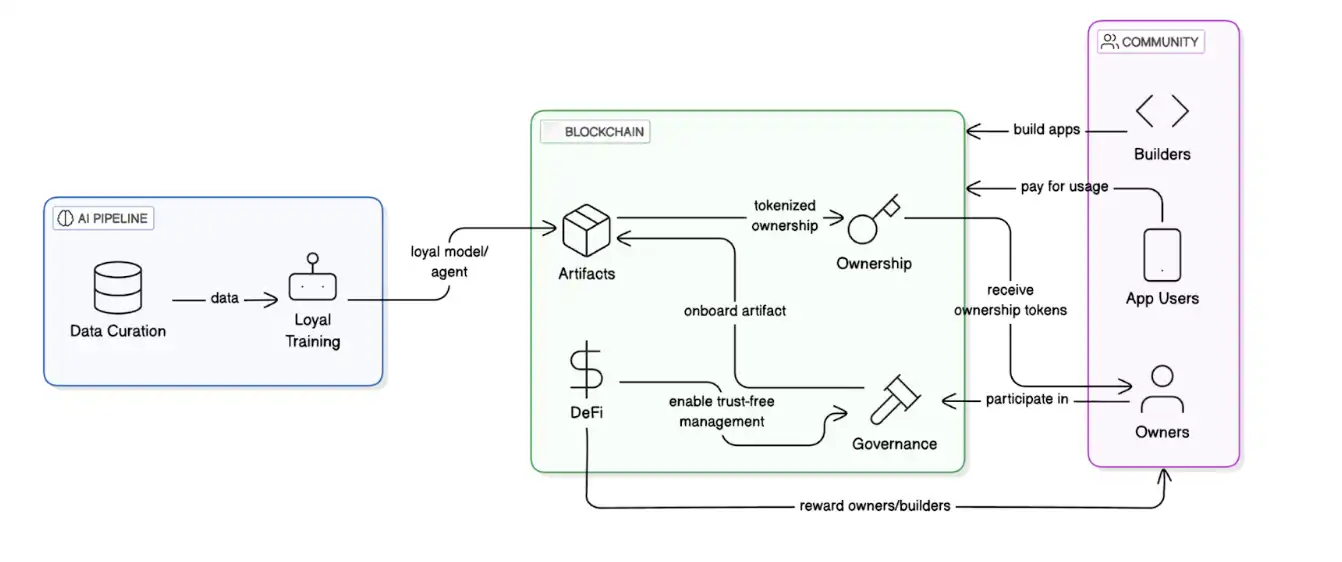
Figure 1: The architecture of the Sentient Protocol consists of two core components: the blockchain system and the AI pipeline
The AI Pipeline is the foundation for developing and training "Loyal AI" artifacts, consisting of two core processes:
· Data Curation: A community-driven data selection process for model alignment.
· Loyalty Training: Ensuring the model undergoes training consistent with the community's intent.
The blockchain system provides transparency and decentralized control to the protocol, ensuring ownership and governance of AI artifacts, with key modules including:
· Governance: Controlled and decided by a decentralized autonomous organization (DAO).
· Ownership: Representing AI artifact ownership through tokenization.
· Decentralized Finance (DeFi): Providing financial tools that support open, decentralized, fair governance, and rewards.
2. Technical Architecture and Model Resentment Mechanism:
1. OML Model Framework
The Sentient: Loyal AI Whitepaper proposes the OML framework Open, Monetizable, and Loyal AI, which starts with model resentment and first systematically proposes the concept of "AI-native Cryptography," aiming to provide encryption-level ownership protection mechanisms for open-source models.
· Open: The model must be open source, with transparent code and data structures that support community replication, auditing, and forking;
· Monetizable: Each model invocation triggers revenue flow, which is allocated to trainers, deployers, and validators through on-chain contracts;
· Loyal: The model does not belong to a company but to the contributor community, with the model upgrade direction and governance determined by a DAO. Model ownership is verifiable, modifications are restricted, and usage is controlled.
OML, through on-chain mechanisms and cryptographic means, ensures that open-source models maintain openness while having economic and governance sovereignty. It constructs an AI-native protocol layer of usage rights and revenue rights to ensure model transparency, clear ownership, economic incentives, and behavioral governance.
Core Concept: AI-native Cryptography
AI-native cryptography leverages the continuity of AI models, low-dimensional manifold structure, and model differentiability to develop a "verifiable but non-removable" lightweight security mechanism. Its core technologies are:
· Fingerprint Embedding: Inserting a set of hidden query-response key-value pairs during training to form a unique model signature;
· Ownership Verification Protocol: Verifying whether the fingerprint is retained in query form by a third-party detector (Prover);
· Permissioned Invocation Mechanism: Prior to invocation, obtaining a "permission credential" issued by the model owner to authorize the system to decode the input and return the correct answer.
This approach can achieve "behavior-based authorization call + ownership verification" at no additional encryption cost.
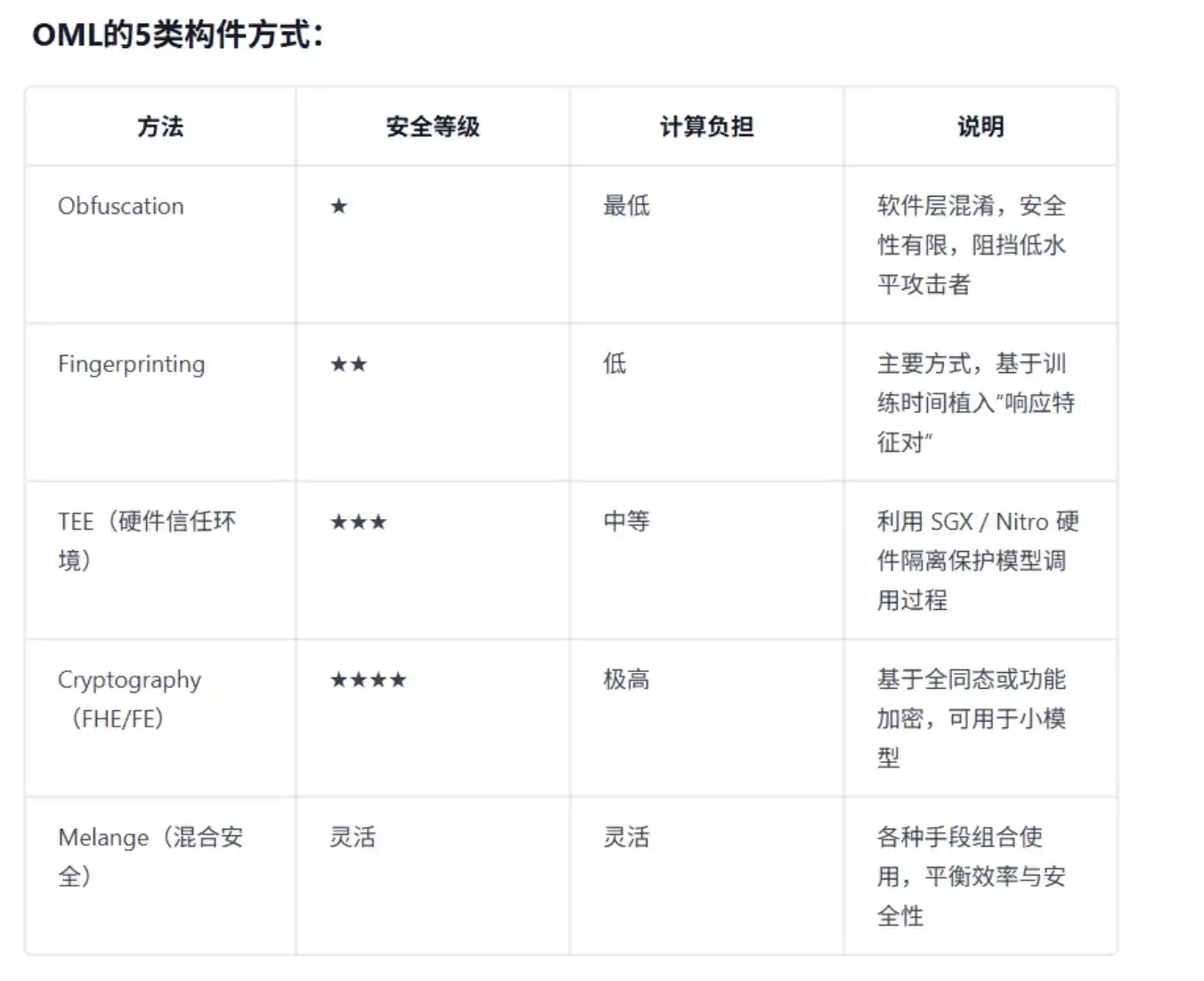
Sentient currently adopts Melange hybrid security: combining fingerprint resentment, TEE execution, and on-chain contract revenue sharing. The fingerprint methodology is the mainstream implementation of OML 1.0, emphasizing the "Optimistic Security" concept, where default compliance is assumed, and violations are detectable and punishable.
OML and Sentient Protocol Protocol Architecture
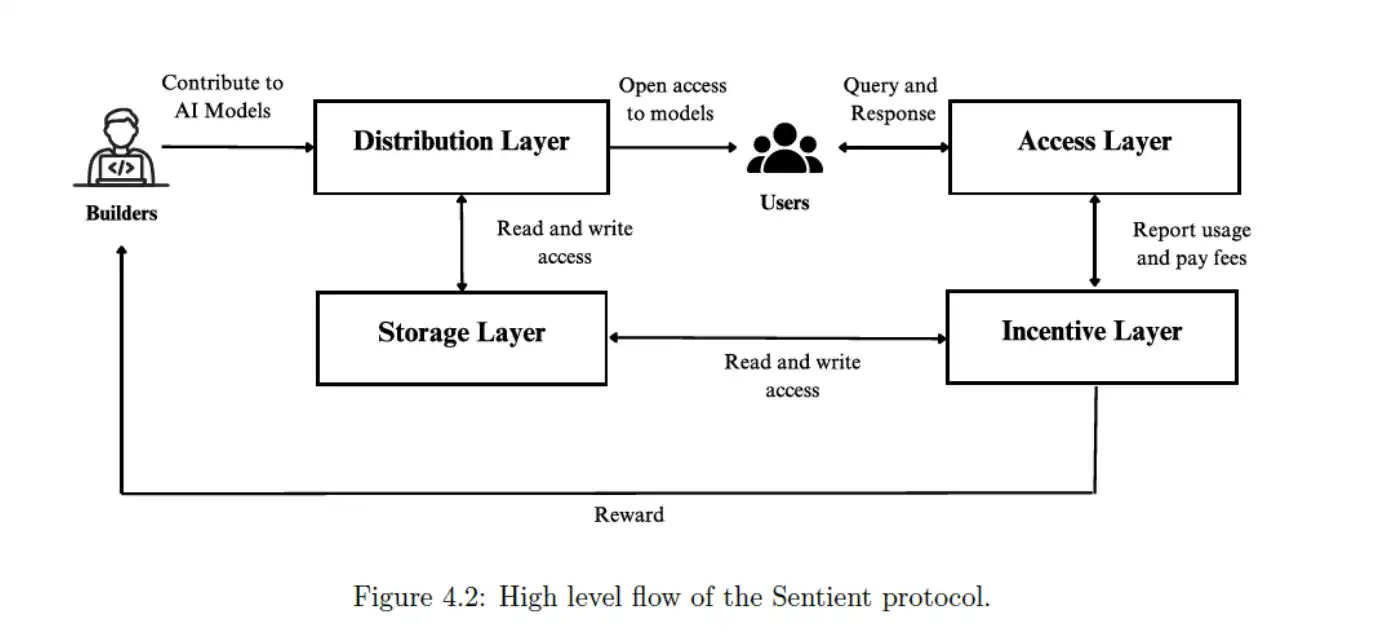
The final chapter of the paper proposes a complete on-chain protocol (Sentient Protocol) to support OML:
· Storage Layer: Stores model weights and fingerprint registration information;
· Execution Layer: Authorization contract controls model invocation entry points;
· Access Layer: Verifies user authorization through proof of permission;
· Incentive Layer: Profit routing contract allocates payment for each invocation to trainers, deployers, and validators.
2. Fingerprinting and Model Ownership Mechanism
GitHub: https://github.com/sentient-agi/oml-1.0-fingerprinting
This repository is the first implementation of the Sentient fingerprinting mechanism, providing a fingerprint injection and verification interface that can be embedded in the training process. Its purpose is to ensure verifiability of model ownership and traceability of usage behavior, preventing unauthorized copying and commercialization. This is a specific engineering implementation of the OML framework.
The essence of the fingerprinting mechanism is: by fine-tuning the model, embedding a set of unique "key-response" pairs, the model owner can verify if the model belongs to them through specific queries, thus creating a "cryptographic signature" for the model.
3. Enclave TEE Computing Framework
GitHub: https://github.com/sentient-agi/Sentient-Enclaves-Framework
The Sentient Enclaves Framework is an open-source framework that leverages trusted execution environments (TEEs) such as AWS Nitro Enclaves to achieve secure deployment of model inference, fine-tuning, and proxy services. This framework emphasizes the "loyalty" of the model, ensuring that the model only responds to authorized requests, preventing unauthorized access and usage.
The TEE (Sentient Enclaves Framework) excels in high performance and cloud integration, suitable for real-time AI and sensitive data processing, but is limited by hardware dependencies and side-channel attacks. Compared to other encryption technologies, FHE provides hardware-independent and post-quantum secure strong privacy guarantees, but with significant performance overhead, making it challenging to directly replace TEE for high-performance tasks. ZK performs excellently in verifiability and decentralization scenarios and can serve as a complement to TEE (this module is planned to integrate zkML in the future).
4. Sentient Agent Framework
GitHub: https://github.com/sentient-agi/Sentient-Agent-Framework
The Sentient Agent Framework is a lightweight open-source framework that focuses on using an AI agent to control the browser for Web task automation (such as search and video playback). It combines natural language instructions to provide a concise development experience (claiming 3 lines of code). This architecture supports building an intelligent agent with a complete "perceive-plan-execute-feedback" loop. Compared to traditional AI Agent Frameworks, the Sentient Agent Framework is limited in functionality, lightweight, and concise, making it more suitable for off-chain Web tasks.
5. Sentient Social Agent
GitHub: https://github.com/sentient-agi/Sentient-Social-Agent
The Sentient Social Agent is aimed at building an AI system for automating interactions on social platforms (Twitter, Discord, and Telegram). It can understand the social context, generate content, interact with users, and engage in social exchanges through multi-agent collaboration. This system can be integrated with the Sentient Agent Framework.
6. Open Deep Search (Not Launched Yet)
On the Sentient official website, Open Deep Search is defined as a search agent that surpasses ChatGPT and Perplexity Pro. Team member Sewoong Oh revealed part of the roadmap at the EthDenver 2025 Open AGI Summit:
Open Deep Search consists of two main parts: Sensient's search functionalities (including query rephrasing, URL and document handling, etc.) and the reasoning agent. The reasoning agent leverages open-source Large Language Models (LLMs) like Llama 3.1 and DeepSeek, enhancing search quality through tools like search, calculators, and self-reflection. On the Frames Benchmark, Open Deep Search outperforms other open-source models and can even rival some closed-source models. However, as its functionality is not yet launched, we currently cannot assess its real capabilities.
3. Product Form, Implementation, and Planning
The products currently showcased on the Sentient official website are primarily Sentient Chat, a chat conversation platform, and the open-source Dobby LLMs model:
Sentient Chat:
Sentient Chat is a decentralized AI chat platform launched by the Sentient Foundation. This platform integrates open-source large language models (such as the Dobby series) with an advanced reasoning agent framework. Its core features include:
1. Open Reasoning Agent: The built-in reasoning agent in Sentient Chat can perform complex tasks, supporting tools like an Ontology-driven Search (ODS), calculator, and code execution.
2. Multi-Agent Integration: The platform supports integrating multiple AI agents, allowing users to interact with different agents as needed. This is similar to a Web3 version of POE or an open, agent-driven Perplexity alternative.
Sentient Chat is currently in the testing phase and is only accessible through invitation codes distributed via email or community activities. According to official public information, over 5,000 users have successfully obtained access to Sentient Chat, with over 100,000 user queries processed. As the author is not currently a white-listed tester, the true capabilities of its models cannot be evaluated at this time.
Dobby LLM Model Series:
1. Dobby-Unhinged Series
· Dobby-Unhinged-Llama-3.3-70B: Based on the Llama 3.3-70B-Instruct fine-tuning, emphasizing personal freedom and a stance on cryptocurrency, with a direct, humorous, and personable conversational style.
· Dobby-Mini-Unhinged-Llama-3.1-8B: An 8B parameter version suitable for resource-constrained devices.
2. Dobby-Mini-Leashed-Llama-3.1-8B: A milder tone suitable for applications requiring more robust outputs.
Since the Dobby LLM model is a fine-tuned version based on Llama 3.1 and 3.3, we believe its main applications lie in building chatbots, content generation and creation, role-playing agents, etc. Its advantages include flexible style generation, enhanced reasoning, and low resource requirements, making it suitable for quick deployment and flexible customization in resource-constrained environments. Compared to more powerful closed-source models like GPT-4, there is still a gap in Dobby LLM when handling tasks involving advanced logic, cross-domain knowledge reasoning, and deep reasoning.
IV. Ecosystem Collaboration and Real-World Scenarios
The Sentient Builder Program currently offers $1 million in funding to support developers in building an AI Agent to run within the Sentient Chat ecosystem. Developers are required to use Sentient's development kit and integrate with its Agent API.
Simultaneously, the ecosystem partners announced on the Sentient official website cover projects in various Crypto AI domains, as follows:
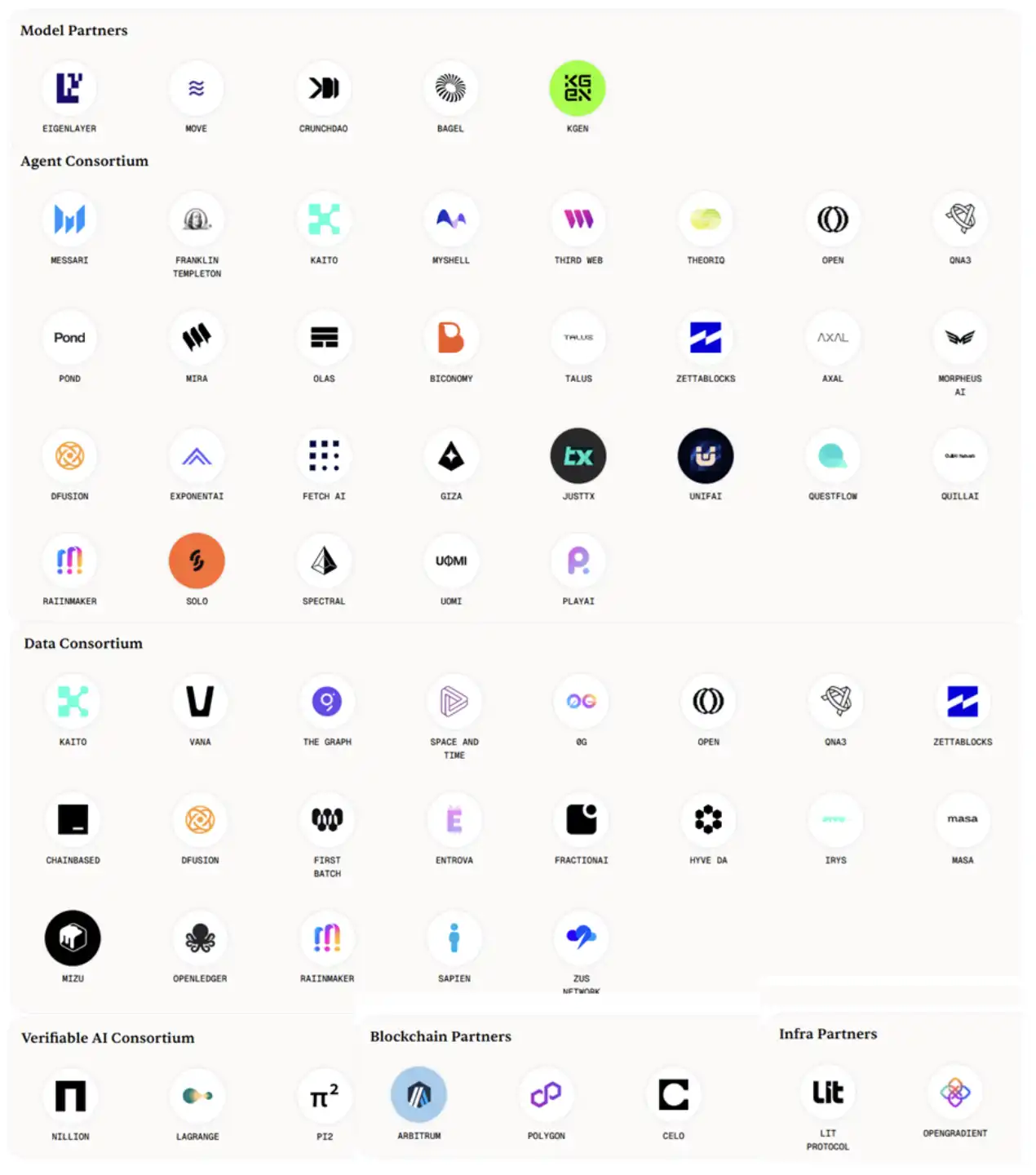
Figure 2: Sentient's AI Ecosystem Partners
As a leading project in the Crypto AI field, Sentient's resource integration capabilities can encompass any star startup within the industry. However, it should be noted that the prevalence of "marketing-oriented" partnerships in the Crypto sector has created an illusion of industry prosperity. The contribution and loyalty of Sentient's ecosystem partners still require our continuous observation.
The Open AGI Summit is an internationally oriented conference initiated by the Sentient team dedicated to exploring the integration of Artificial Intelligence (AI) and cryptographic technology (Crypto). I had the privilege to attend its summits during ETH Denver in 2024 and ETHcc in 2025. The Sentient team has the ability to gather top-tier institutional investors and project entrepreneurs from the industry, making it a highlight.
V. Team Structure and Research Background
The Sentient Foundation has brought together top academic experts, crypto industry entrepreneurs, and engineers worldwide, committed to building a community-driven, open-source, and verifiable AGI platform. According to the official information released, the team members are primarily:
Core Leadership Team (Steering Committee)
· Pramod Viswanath – Forrest G. Hamrick Professor at Princeton University, with long-term research in information theory and communication systems, leading Sentient's AI security and theoretical foundation development.
· Himanshu Tyagi – Professor at the Indian Institute of Science, specializing in privacy protection and decentralized learning algorithms, providing academic support for model training and privacy collaboration.
· Sandeep Nailwal – Co-Founder of Polygon, responsible for blockchain strategy and global ecosystem development, is a key figure in connecting the crypto community with AI architecture.
· Sensys Team – Web3-native product studio, leading user experience optimization and developer infrastructure development, driving the adoption of the Sentient product.
Core Engineering and Development Team: Comprised of team members from renowned tech and blockchain companies such as Meta, Coinbase, Circle, Polygon, Binance, as well as researchers from top universities such as Princeton University, University of Washington, and Indian Institutes of Technology. AI Research and Model Training Team: The research team covers AI/ML, NLP, computer vision, and reinforcement learning, with members having practical experience at institutions like Google Research, Daimon Labs, Fetch.ai, and more.
It is worth noting that Sentient was founded with the successful track record of Polygon's co-founder Sandeep Nailwal. As a key scaling solution within the Ethereum ecosystem, Matic initially relied on Plasma, a technology that was not cutting-edge but was "cheap and fast" enough, to build Polygon's moat in areas such as NFTs and social, while also integrating ZK technology into its blockchain scaling solutions through acquisitions like Mir Protocol and Hermez Network and the launch of Polygon zkEVM. Sentient, as Sandeep Nailwal's second entrepreneurial endeavor, benefits from his experience, funding, network, and market recognition, allowing it to raise significant funding in 2024 based on an imperfect project concept. However, the AI field is inherently different from Crypto, and Sentient still faces challenges in adapting to changes in the new market environment, increased competition, technological advancements, and more.
Six, Funding Status and Token Model
In 2024, Sentient raised an $85 million seed round led by Founders Fund, Pantera, and Framework Ventures. The token has not been released yet. The current Agent incentive points can be mapped to tokens in the future. The token can be used for proposal voting on model version management, staking to validate Agent outputs' authenticity, governance signaling, and more.
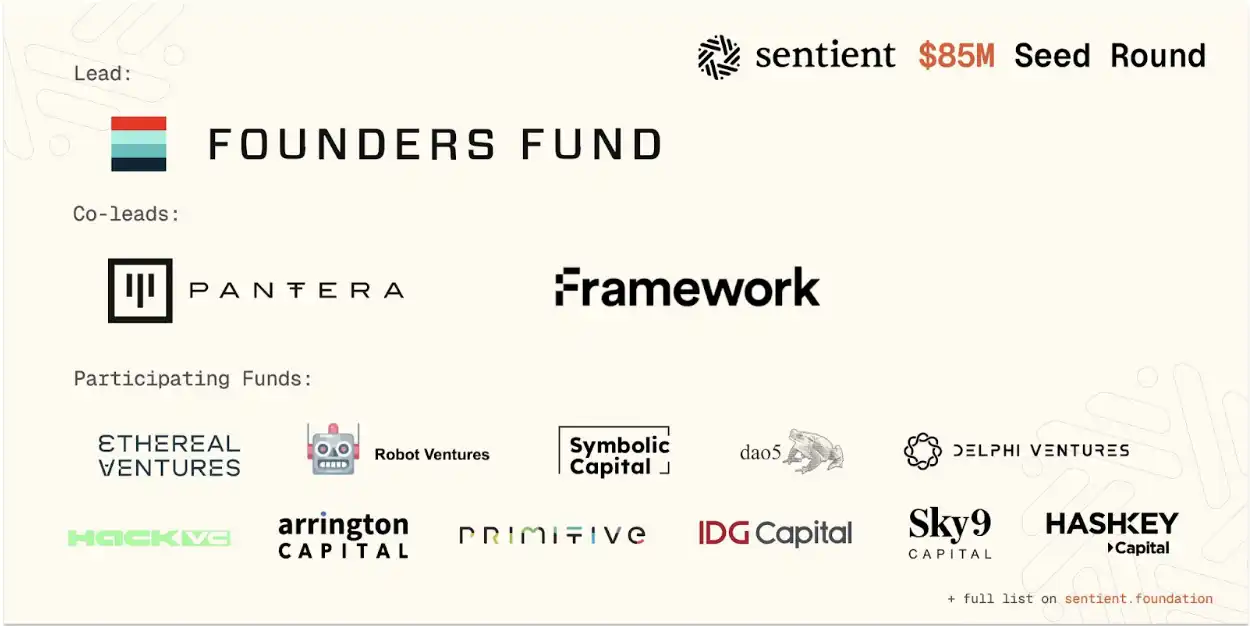
Figure 3: Sentient Funding Status
Sentient is a kingpin project born with a silver spoon, with its investor background, funding scale, and valuation setting the bar high for most Crypto AI projects in the market. On one hand, its strong resource endorsement can more easily integrate resources from various industries, a high funding amount can more easily recruit top talents to join its team, and a solid capital base can support the project's development through industry cycles. However, on the other hand, the current Crypto industry generally demystifies high-valued projects with VC endorsements. Furthermore, VC-backed projects tend to prioritize price appreciation through capital operations and are severely disconnected from fundamentals. Assuming that Sentient fails to deliver impactful Crypto AI products and instead chooses to issue tokens at a high valuation, it will ultimately harm the Crypto community, which is in urgent need of rebuilding trust. How the team responds to the current industry predicament is worth our continuous observation.
Seven, Competitor Analysis and Market Positioning
Most Crypto AI projects in the market mostly focus on a single area such as data, models, computation, training, or inference, or develop consumer-level applications such as AI Agents. Projects positioning themselves as AI Chains include projects focusing on the transformation of public chains with AI (such as Near and ICP) or decentralized resource sharing coordination and token incentive protocols like Bittensor, a positioning that does not fully match Sentient's. On the model training side, Sentient is more like an integration platform and has a cooperative relationship with open-source AI models on the market. On the Agent side, Sentient competes with projects like Talus, Olas, or Theoriq in terms of multi-agent systems and reasoning capability, but each project still has different core goals and application scenarios, maintaining complementarity.
Eight, Conclusion
Sentient, as a decentralized Artificial General Intelligence (AGI) protocol platform, aims to provide clear ownership structure for AI models and enable on-chain mechanism for invocation and value distribution, addressing the current ambiguity and unfairness in ownership in the centralized Large Language Model (LLM) market. The core framework OML (Open, Monetizable, Loyal) ensures ownership, transparency, and fair revenue sharing for open-source models through model fingerprinting and blockchain technology. With the support of top VCs and AI ecosystem partners under the backing of Polygon co-founder Sandeep Nailwal, Sentient, despite facing uncertainties, controversies, and competition, still aims to become one of the standard protocols for decentralized AI ownership, driving the decentralized development of AGI.
This article is a contributed piece and does not represent the views of BlockBeats.
You may also like

Token Cannot Compound, Where Is the Real Investment Opportunity?

February 6th Market Key Intelligence, How Much Did You Miss?

China's Central Bank and Eight Other Departments' Latest Regulatory Focus: Key Attention to RWA Tokenized Asset Risk
Foreword: Today, the People's Bank of China's website published the "Notice of the People's Bank of China, National Development and Reform Commission, Ministry of Industry and Information Technology, Ministry of Public Security, State Administration for Market Regulation, China Banking and Insurance Regulatory Commission, China Securities Regulatory Commission, State Administration of Foreign Exchange on Further Preventing and Dealing with Risks Related to Virtual Currency and Others (Yinfa [2026] No. 42)", the latest regulatory requirements from the eight departments including the central bank, which are basically consistent with the regulatory requirements of recent years. The main focus of the regulation is on speculative activities such as virtual currency trading, exchanges, ICOs, overseas platform services, and this time, regulatory oversight of RWA has been added, explicitly prohibiting RWA tokenization, stablecoins (especially those pegged to the RMB). The following is the full text:
To the people's governments of all provinces, autonomous regions, and municipalities directly under the Central Government, the Xinjiang Production and Construction Corps:
Recently, there have been speculative activities related to virtual currency and Real-World Assets (RWA) tokenization, disrupting the economic and financial order and jeopardizing the property security of the people. In order to further prevent and address the risks related to virtual currency and Real-World Assets tokenization, effectively safeguard national security and social stability, in accordance with the "Law of the People's Republic of China on the People's Bank of China," "Law of the People's Republic of China on Commercial Banks," "Securities Law of the People's Republic of China," "Law of the People's Republic of China on Securities Investment Funds," "Law of the People's Republic of China on Futures and Derivatives," "Cybersecurity Law of the People's Republic of China," "Regulations of the People's Republic of China on the Administration of Renminbi," "Regulations on Prevention and Disposal of Illegal Fundraising," "Regulations of the People's Republic of China on Foreign Exchange Administration," "Telecommunications Regulations of the People's Republic of China," and other provisions, after reaching consensus with the Cyberspace Administration of China, the Supreme People's Court, and the Supreme People's Procuratorate, and with the approval of the State Council, the relevant matters are notified as follows:
(I) Virtual currency does not possess the legal status equivalent to fiat currency. Virtual currencies such as Bitcoin, Ether, Tether, etc., have the main characteristics of being issued by non-monetary authorities, using encryption technology and distributed ledger or similar technology, existing in digital form, etc. They do not have legal tender status, should not and cannot be circulated and used as currency in the market.
The business activities related to virtual currency are classified as illegal financial activities. The exchange of fiat currency and virtual currency within the territory, exchange of virtual currencies, acting as a central counterparty in buying and selling virtual currencies, providing information intermediary and pricing services for virtual currency transactions, token issuance financing, and trading of virtual currency-related financial products, etc., fall under illegal financial activities, such as suspected illegal issuance of token vouchers, unauthorized public issuance of securities, illegal operation of securities and futures business, illegal fundraising, etc., are strictly prohibited across the board and resolutely banned in accordance with the law. Overseas entities and individuals are not allowed to provide virtual currency-related services to domestic entities in any form.
A stablecoin pegged to a fiat currency indirectly fulfills some functions of the fiat currency in circulation. Without the consent of relevant authorities in accordance with the law and regulations, any domestic or foreign entity or individual is not allowed to issue a RMB-pegged stablecoin overseas.
(II)Tokenization of Real-World Assets refers to the use of encryption technology and distributed ledger or similar technologies to transform ownership rights, income rights, etc., of assets into tokens (tokens) or other interests or bond certificates with token (token) characteristics, and carry out issuance and trading activities.
Engaging in the tokenization of real-world assets domestically, as well as providing related intermediary, information technology services, etc., which are suspected of illegal issuance of token vouchers, unauthorized public offering of securities, illegal operation of securities and futures business, illegal fundraising, and other illegal financial activities, shall be prohibited; except for relevant business activities carried out with the approval of the competent authorities in accordance with the law and regulations and relying on specific financial infrastructures. Overseas entities and individuals are not allowed to illegally provide services related to the tokenization of real-world assets to domestic entities in any form.
(III) Inter-agency Coordination. The People's Bank of China, together with the National Development and Reform Commission, the Ministry of Industry and Information Technology, the Ministry of Public Security, the State Administration for Market Regulation, the China Banking and Insurance Regulatory Commission, the China Securities Regulatory Commission, the State Administration of Foreign Exchange, and other departments, will improve the work mechanism, strengthen coordination with the Cyberspace Administration of China, the Supreme People's Court, and the Supreme People's Procuratorate, coordinate efforts, and overall guide regions to carry out risk prevention and disposal of virtual currency-related illegal financial activities.
The China Securities Regulatory Commission, together with the National Development and Reform Commission, the Ministry of Industry and Information Technology, the Ministry of Public Security, the People's Bank of China, the State Administration for Market Regulation, the China Banking and Insurance Regulatory Commission, the State Administration of Foreign Exchange, and other departments, will improve the work mechanism, strengthen coordination with the Cyberspace Administration of China, the Supreme People's Court, and the Supreme People's Procuratorate, coordinate efforts, and overall guide regions to carry out risk prevention and disposal of illegal financial activities related to the tokenization of real-world assets.
(IV) Strengthening Local Implementation. The people's governments at the provincial level are overall responsible for the prevention and disposal of risks related to virtual currencies and the tokenization of real-world assets in their respective administrative regions. The specific leading department is the local financial regulatory department, with participation from branches and dispatched institutions of the State Council's financial regulatory department, telecommunications regulators, public security, market supervision, and other departments, in coordination with cyberspace departments, courts, and procuratorates, to improve the normalization of the work mechanism, effectively connect with the relevant work mechanisms of central departments, form a cooperative and coordinated working pattern between central and local governments, effectively prevent and properly handle risks related to virtual currencies and the tokenization of real-world assets, and maintain economic and financial order and social stability.
(5) Enhanced Risk Monitoring. The People's Bank of China, China Securities Regulatory Commission, National Development and Reform Commission, Ministry of Industry and Information Technology, Ministry of Public Security, State Administration of Foreign Exchange, Cyberspace Administration of China, and other departments continue to improve monitoring techniques and system support, enhance cross-departmental data analysis and sharing, establish sound information sharing and cross-validation mechanisms, promptly grasp the risk situation of activities related to virtual currency and real-world asset tokenization. Local governments at all levels give full play to the role of local monitoring and early warning mechanisms. Local financial regulatory authorities, together with branches and agencies of the State Council's financial regulatory authorities, as well as departments of cyberspace and public security, ensure effective connection between online monitoring, offline investigation, and fund tracking, efficiently and accurately identify activities related to virtual currency and real-world asset tokenization, promptly share risk information, improve early warning information dissemination, verification, and rapid response mechanisms.
(6) Strengthened Oversight of Financial Institutions, Intermediaries, and Technology Service Providers. Financial institutions (including non-bank payment institutions) are prohibited from providing account opening, fund transfer, and clearing services for virtual currency-related business activities, issuing and selling financial products related to virtual currency, including virtual currency and related financial products in the scope of collateral, conducting insurance business related to virtual currency, or including virtual currency in the scope of insurance liability. Financial institutions (including non-bank payment institutions) are prohibited from providing custody, clearing, and settlement services for unauthorized real-world asset tokenization-related business and related financial products. Relevant intermediary institutions and information technology service providers are prohibited from providing intermediary, technical, or other services for unauthorized real-world asset tokenization-related businesses and related financial products.
(7) Enhanced Management of Internet Information Content and Access. Internet enterprises are prohibited from providing online business venues, commercial displays, marketing, advertising, or paid traffic diversion services for virtual currency and real-world asset tokenization-related business activities. Upon discovering clues of illegal activities, they should promptly report to relevant departments and provide technical support and assistance for related investigations and inquiries. Based on the clues transferred by the financial regulatory authorities, the cyberspace administration, telecommunications authorities, and public security departments should promptly close and deal with websites, mobile applications (including mini-programs), and public accounts engaged in virtual currency and real-world asset tokenization-related business activities in accordance with the law.
(8) Strengthened Entity Registration and Advertisement Management. Market supervision departments strengthen entity registration and management, and enterprise and individual business registrations must not contain terms such as "virtual currency," "virtual asset," "cryptocurrency," "crypto asset," "stablecoin," "real-world asset tokenization," or "RWA" in their names or business scopes. Market supervision departments, together with financial regulatory authorities, legally enhance the supervision of advertisements related to virtual currency and real-world asset tokenization, promptly investigating and handling relevant illegal advertisements.
(IX) Continued Rectification of Virtual Currency Mining Activities. The National Development and Reform Commission, together with relevant departments, strictly controls virtual currency mining activities, continuously promotes the rectification of virtual currency mining activities. The people's governments of various provinces take overall responsibility for the rectification of "mining" within their respective administrative regions. In accordance with the requirements of the National Development and Reform Commission and other departments in the "Notice on the Rectification of Virtual Currency Mining Activities" (NDRC Energy-saving Building [2021] No. 1283) and the provisions of the "Guidance Catalog for Industrial Structure Adjustment (2024 Edition)," a comprehensive review, investigation, and closure of existing virtual currency mining projects are conducted, new mining projects are strictly prohibited, and mining machine production enterprises are strictly prohibited from providing mining machine sales and other services within the country.
(X) Severe Crackdown on Related Illegal Financial Activities. Upon discovering clues to illegal financial activities related to virtual currency and the tokenization of real-world assets, local financial regulatory authorities, branches of the State Council's financial regulatory authorities, and other relevant departments promptly investigate, determine, and properly handle the issues in accordance with the law, and seriously hold the relevant entities and individuals legally responsible. Those suspected of crimes are transferred to the judicial authorities for processing according to the law.
(XI) Severe Crackdown on Related Illegal and Criminal Activities. The Ministry of Public Security, the People's Bank of China, the State Administration for Market Regulation, the China Banking and Insurance Regulatory Commission, the China Securities Regulatory Commission, as well as judicial and procuratorial organs, in accordance with their respective responsibilities, rigorously crack down on illegal and criminal activities related to virtual currency, the tokenization of real-world assets, such as fraud, money laundering, illegal business operations, pyramid schemes, illegal fundraising, and other illegal and criminal activities carried out under the guise of virtual currency, the tokenization of real-world assets, etc.
(XII) Strengthen Industry Self-discipline. Relevant industry associations should enhance membership management and policy advocacy, based on their own responsibilities, advocate and urge member units to resist illegal financial activities related to virtual currency and the tokenization of real-world assets. Member units that violate regulatory policies and industry self-discipline rules are to be disciplined in accordance with relevant self-regulatory management regulations. By leveraging various industry infrastructure, conduct risk monitoring related to virtual currency, the tokenization of real-world assets, and promptly transfer issue clues to relevant departments.
(XIII) Without the approval of relevant departments in accordance with the law and regulations, domestic entities and foreign entities controlled by them may not issue virtual currency overseas.
(XIV) Domestic entities engaging directly or indirectly in overseas external debt-based tokenization of real-world assets, or conducting asset securitization activities abroad based on domestic ownership rights, income rights, etc. (hereinafter referred to as domestic equity), should be strictly regulated in accordance with the principles of "same business, same risk, same rules." The National Development and Reform Commission, the China Securities Regulatory Commission, the State Administration of Foreign Exchange, and other relevant departments regulate it according to their respective responsibilities. For other forms of overseas real-world asset tokenization activities based on domestic equity by domestic entities, the China Securities Regulatory Commission, together with relevant departments, supervise according to their division of responsibilities. Without the consent and filing of relevant departments, no unit or individual may engage in the above-mentioned business.
(15) Overseas subsidiaries and branches of domestic financial institutions providing Real World Asset Tokenization-related services overseas shall do so legally and prudently. They shall have professional personnel and systems in place to effectively mitigate business risks, strictly implement customer onboarding, suitability management, anti-money laundering requirements, and incorporate them into the domestic financial institutions' compliance and risk management system. Intermediaries and information technology service providers offering Real World Asset Tokenization services abroad based on domestic equity or conducting Real World Asset Tokenization business in the form of overseas debt for domestic entities directly or indirectly venturing abroad must strictly comply with relevant laws and regulations. They should establish and improve relevant compliance and internal control systems in accordance with relevant normative requirements, strengthen business and risk control, and report the business developments to the relevant regulatory authorities for approval or filing.
(16) Strengthen organizational leadership and overall coordination. All departments and regions should attach great importance to the prevention of risks related to virtual currencies and Real World Asset Tokenization, strengthen organizational leadership, clarify work responsibilities, form a long-term effective working mechanism with centralized coordination, local implementation, and shared responsibilities, maintain high pressure, dynamically monitor risks, effectively prevent and mitigate risks in an orderly and efficient manner, legally protect the property security of the people, and make every effort to maintain economic and financial order and social stability.
(17) Widely carry out publicity and education. All departments, regions, and industry associations should make full use of various media and other communication channels to disseminate information through legal and policy interpretation, analysis of typical cases, and education on investment risks, etc. They should promote the illegality and harm of virtual currencies and Real World Asset Tokenization-related businesses and their manifestations, fully alert to potential risks and hidden dangers, and enhance public awareness and identification capabilities for risk prevention.
(18) Engaging in illegal financial activities related to virtual currencies and Real World Asset Tokenization in violation of this notice, as well as providing services for virtual currencies and Real World Asset Tokenization-related businesses, shall be punished in accordance with relevant regulations. If it constitutes a crime, criminal liability shall be pursued according to the law. For domestic entities and individuals who knowingly or should have known that overseas entities illegally provided virtual currency or Real World Asset Tokenization-related services to domestic entities and still assisted them, relevant responsibilities shall be pursued according to the law. If it constitutes a crime, criminal liability shall be pursued according to the law.
(19) If any unit or individual invests in virtual currencies, Real World Asset Tokens, and related financial products against public order and good customs, the relevant civil legal actions shall be invalid, and any resulting losses shall be borne by them. If there are suspicions of disrupting financial order and jeopardizing financial security, the relevant departments shall deal with them according to the law.
This notice shall enter into force upon the date of its issuance. The People's Bank of China and ten other departments' "Notice on Further Preventing and Dealing with the Risks of Virtual Currency Trading Speculation" (Yinfa [2021] No. 237) is hereby repealed.

Former Partner's Perspective on Multicoin: Kyle's Exit, But the Game He Left Behind Just Getting Started

Why Bitcoin Is Falling Now: The Real Reasons Behind BTC's Crash & WEEX's Smart Profit Playbook
Bitcoin's ongoing crash explained: Discover the 5 hidden triggers behind BTC's plunge & how WEEX's Auto Earn and Trade to Earn strategies help traders profit from crypto market volatility.

Wall Street's Hottest Trades See Exodus

Vitalik Discusses Ethereum Scaling Path, Circle Announces Partnership with Polymarket, What's the Overseas Crypto Community Talking About Today?

Believing in the Capital Markets - The Essence and Core Value of Cryptocurrency

Polymarket's 'Weatherman': Predict Temperature, Win Million-Dollar Payout

$15K+ Profits: The 4 AI Trading Secrets WEEX Hackathon Prelim Winners Used to Dominate Volatile Crypto Markets
How WEEX Hackathon's top AI trading strategies made $15K+ in crypto markets: 4 proven rules for ETH/BTC trading, market structure analysis, and risk management in volatile conditions.

A nearly 20% one-day plunge, how long has it been since you last saw a $60,000 Bitcoin?

Raoul Pal: I've seen every single panic, and they are never the end.

Key Market Information Discrepancy on February 6th - A Must-Read! | Alpha Morning Report

2026 Crypto Industry's First Snowfall
The Harsh Reality Behind the $26 Billion Crypto Liquidation: Liquidity Is Killing the Market
Why Is Gold, US Stocks, Bitcoin All Falling?

Key Market Intelligence for February 5th, how much did you miss out on?

Wintermute: By 2026, crypto had gradually become the settlement layer of the Internet economy
Token Cannot Compound, Where Is the Real Investment Opportunity?
February 6th Market Key Intelligence, How Much Did You Miss?
China's Central Bank and Eight Other Departments' Latest Regulatory Focus: Key Attention to RWA Tokenized Asset Risk
Foreword: Today, the People's Bank of China's website published the "Notice of the People's Bank of China, National Development and Reform Commission, Ministry of Industry and Information Technology, Ministry of Public Security, State Administration for Market Regulation, China Banking and Insurance Regulatory Commission, China Securities Regulatory Commission, State Administration of Foreign Exchange on Further Preventing and Dealing with Risks Related to Virtual Currency and Others (Yinfa [2026] No. 42)", the latest regulatory requirements from the eight departments including the central bank, which are basically consistent with the regulatory requirements of recent years. The main focus of the regulation is on speculative activities such as virtual currency trading, exchanges, ICOs, overseas platform services, and this time, regulatory oversight of RWA has been added, explicitly prohibiting RWA tokenization, stablecoins (especially those pegged to the RMB). The following is the full text:
To the people's governments of all provinces, autonomous regions, and municipalities directly under the Central Government, the Xinjiang Production and Construction Corps:
Recently, there have been speculative activities related to virtual currency and Real-World Assets (RWA) tokenization, disrupting the economic and financial order and jeopardizing the property security of the people. In order to further prevent and address the risks related to virtual currency and Real-World Assets tokenization, effectively safeguard national security and social stability, in accordance with the "Law of the People's Republic of China on the People's Bank of China," "Law of the People's Republic of China on Commercial Banks," "Securities Law of the People's Republic of China," "Law of the People's Republic of China on Securities Investment Funds," "Law of the People's Republic of China on Futures and Derivatives," "Cybersecurity Law of the People's Republic of China," "Regulations of the People's Republic of China on the Administration of Renminbi," "Regulations on Prevention and Disposal of Illegal Fundraising," "Regulations of the People's Republic of China on Foreign Exchange Administration," "Telecommunications Regulations of the People's Republic of China," and other provisions, after reaching consensus with the Cyberspace Administration of China, the Supreme People's Court, and the Supreme People's Procuratorate, and with the approval of the State Council, the relevant matters are notified as follows:
(I) Virtual currency does not possess the legal status equivalent to fiat currency. Virtual currencies such as Bitcoin, Ether, Tether, etc., have the main characteristics of being issued by non-monetary authorities, using encryption technology and distributed ledger or similar technology, existing in digital form, etc. They do not have legal tender status, should not and cannot be circulated and used as currency in the market.
The business activities related to virtual currency are classified as illegal financial activities. The exchange of fiat currency and virtual currency within the territory, exchange of virtual currencies, acting as a central counterparty in buying and selling virtual currencies, providing information intermediary and pricing services for virtual currency transactions, token issuance financing, and trading of virtual currency-related financial products, etc., fall under illegal financial activities, such as suspected illegal issuance of token vouchers, unauthorized public issuance of securities, illegal operation of securities and futures business, illegal fundraising, etc., are strictly prohibited across the board and resolutely banned in accordance with the law. Overseas entities and individuals are not allowed to provide virtual currency-related services to domestic entities in any form.
A stablecoin pegged to a fiat currency indirectly fulfills some functions of the fiat currency in circulation. Without the consent of relevant authorities in accordance with the law and regulations, any domestic or foreign entity or individual is not allowed to issue a RMB-pegged stablecoin overseas.
(II)Tokenization of Real-World Assets refers to the use of encryption technology and distributed ledger or similar technologies to transform ownership rights, income rights, etc., of assets into tokens (tokens) or other interests or bond certificates with token (token) characteristics, and carry out issuance and trading activities.
Engaging in the tokenization of real-world assets domestically, as well as providing related intermediary, information technology services, etc., which are suspected of illegal issuance of token vouchers, unauthorized public offering of securities, illegal operation of securities and futures business, illegal fundraising, and other illegal financial activities, shall be prohibited; except for relevant business activities carried out with the approval of the competent authorities in accordance with the law and regulations and relying on specific financial infrastructures. Overseas entities and individuals are not allowed to illegally provide services related to the tokenization of real-world assets to domestic entities in any form.
(III) Inter-agency Coordination. The People's Bank of China, together with the National Development and Reform Commission, the Ministry of Industry and Information Technology, the Ministry of Public Security, the State Administration for Market Regulation, the China Banking and Insurance Regulatory Commission, the China Securities Regulatory Commission, the State Administration of Foreign Exchange, and other departments, will improve the work mechanism, strengthen coordination with the Cyberspace Administration of China, the Supreme People's Court, and the Supreme People's Procuratorate, coordinate efforts, and overall guide regions to carry out risk prevention and disposal of virtual currency-related illegal financial activities.
The China Securities Regulatory Commission, together with the National Development and Reform Commission, the Ministry of Industry and Information Technology, the Ministry of Public Security, the People's Bank of China, the State Administration for Market Regulation, the China Banking and Insurance Regulatory Commission, the State Administration of Foreign Exchange, and other departments, will improve the work mechanism, strengthen coordination with the Cyberspace Administration of China, the Supreme People's Court, and the Supreme People's Procuratorate, coordinate efforts, and overall guide regions to carry out risk prevention and disposal of illegal financial activities related to the tokenization of real-world assets.
(IV) Strengthening Local Implementation. The people's governments at the provincial level are overall responsible for the prevention and disposal of risks related to virtual currencies and the tokenization of real-world assets in their respective administrative regions. The specific leading department is the local financial regulatory department, with participation from branches and dispatched institutions of the State Council's financial regulatory department, telecommunications regulators, public security, market supervision, and other departments, in coordination with cyberspace departments, courts, and procuratorates, to improve the normalization of the work mechanism, effectively connect with the relevant work mechanisms of central departments, form a cooperative and coordinated working pattern between central and local governments, effectively prevent and properly handle risks related to virtual currencies and the tokenization of real-world assets, and maintain economic and financial order and social stability.
(5) Enhanced Risk Monitoring. The People's Bank of China, China Securities Regulatory Commission, National Development and Reform Commission, Ministry of Industry and Information Technology, Ministry of Public Security, State Administration of Foreign Exchange, Cyberspace Administration of China, and other departments continue to improve monitoring techniques and system support, enhance cross-departmental data analysis and sharing, establish sound information sharing and cross-validation mechanisms, promptly grasp the risk situation of activities related to virtual currency and real-world asset tokenization. Local governments at all levels give full play to the role of local monitoring and early warning mechanisms. Local financial regulatory authorities, together with branches and agencies of the State Council's financial regulatory authorities, as well as departments of cyberspace and public security, ensure effective connection between online monitoring, offline investigation, and fund tracking, efficiently and accurately identify activities related to virtual currency and real-world asset tokenization, promptly share risk information, improve early warning information dissemination, verification, and rapid response mechanisms.
(6) Strengthened Oversight of Financial Institutions, Intermediaries, and Technology Service Providers. Financial institutions (including non-bank payment institutions) are prohibited from providing account opening, fund transfer, and clearing services for virtual currency-related business activities, issuing and selling financial products related to virtual currency, including virtual currency and related financial products in the scope of collateral, conducting insurance business related to virtual currency, or including virtual currency in the scope of insurance liability. Financial institutions (including non-bank payment institutions) are prohibited from providing custody, clearing, and settlement services for unauthorized real-world asset tokenization-related business and related financial products. Relevant intermediary institutions and information technology service providers are prohibited from providing intermediary, technical, or other services for unauthorized real-world asset tokenization-related businesses and related financial products.
(7) Enhanced Management of Internet Information Content and Access. Internet enterprises are prohibited from providing online business venues, commercial displays, marketing, advertising, or paid traffic diversion services for virtual currency and real-world asset tokenization-related business activities. Upon discovering clues of illegal activities, they should promptly report to relevant departments and provide technical support and assistance for related investigations and inquiries. Based on the clues transferred by the financial regulatory authorities, the cyberspace administration, telecommunications authorities, and public security departments should promptly close and deal with websites, mobile applications (including mini-programs), and public accounts engaged in virtual currency and real-world asset tokenization-related business activities in accordance with the law.
(8) Strengthened Entity Registration and Advertisement Management. Market supervision departments strengthen entity registration and management, and enterprise and individual business registrations must not contain terms such as "virtual currency," "virtual asset," "cryptocurrency," "crypto asset," "stablecoin," "real-world asset tokenization," or "RWA" in their names or business scopes. Market supervision departments, together with financial regulatory authorities, legally enhance the supervision of advertisements related to virtual currency and real-world asset tokenization, promptly investigating and handling relevant illegal advertisements.
(IX) Continued Rectification of Virtual Currency Mining Activities. The National Development and Reform Commission, together with relevant departments, strictly controls virtual currency mining activities, continuously promotes the rectification of virtual currency mining activities. The people's governments of various provinces take overall responsibility for the rectification of "mining" within their respective administrative regions. In accordance with the requirements of the National Development and Reform Commission and other departments in the "Notice on the Rectification of Virtual Currency Mining Activities" (NDRC Energy-saving Building [2021] No. 1283) and the provisions of the "Guidance Catalog for Industrial Structure Adjustment (2024 Edition)," a comprehensive review, investigation, and closure of existing virtual currency mining projects are conducted, new mining projects are strictly prohibited, and mining machine production enterprises are strictly prohibited from providing mining machine sales and other services within the country.
(X) Severe Crackdown on Related Illegal Financial Activities. Upon discovering clues to illegal financial activities related to virtual currency and the tokenization of real-world assets, local financial regulatory authorities, branches of the State Council's financial regulatory authorities, and other relevant departments promptly investigate, determine, and properly handle the issues in accordance with the law, and seriously hold the relevant entities and individuals legally responsible. Those suspected of crimes are transferred to the judicial authorities for processing according to the law.
(XI) Severe Crackdown on Related Illegal and Criminal Activities. The Ministry of Public Security, the People's Bank of China, the State Administration for Market Regulation, the China Banking and Insurance Regulatory Commission, the China Securities Regulatory Commission, as well as judicial and procuratorial organs, in accordance with their respective responsibilities, rigorously crack down on illegal and criminal activities related to virtual currency, the tokenization of real-world assets, such as fraud, money laundering, illegal business operations, pyramid schemes, illegal fundraising, and other illegal and criminal activities carried out under the guise of virtual currency, the tokenization of real-world assets, etc.
(XII) Strengthen Industry Self-discipline. Relevant industry associations should enhance membership management and policy advocacy, based on their own responsibilities, advocate and urge member units to resist illegal financial activities related to virtual currency and the tokenization of real-world assets. Member units that violate regulatory policies and industry self-discipline rules are to be disciplined in accordance with relevant self-regulatory management regulations. By leveraging various industry infrastructure, conduct risk monitoring related to virtual currency, the tokenization of real-world assets, and promptly transfer issue clues to relevant departments.
(XIII) Without the approval of relevant departments in accordance with the law and regulations, domestic entities and foreign entities controlled by them may not issue virtual currency overseas.
(XIV) Domestic entities engaging directly or indirectly in overseas external debt-based tokenization of real-world assets, or conducting asset securitization activities abroad based on domestic ownership rights, income rights, etc. (hereinafter referred to as domestic equity), should be strictly regulated in accordance with the principles of "same business, same risk, same rules." The National Development and Reform Commission, the China Securities Regulatory Commission, the State Administration of Foreign Exchange, and other relevant departments regulate it according to their respective responsibilities. For other forms of overseas real-world asset tokenization activities based on domestic equity by domestic entities, the China Securities Regulatory Commission, together with relevant departments, supervise according to their division of responsibilities. Without the consent and filing of relevant departments, no unit or individual may engage in the above-mentioned business.
(15) Overseas subsidiaries and branches of domestic financial institutions providing Real World Asset Tokenization-related services overseas shall do so legally and prudently. They shall have professional personnel and systems in place to effectively mitigate business risks, strictly implement customer onboarding, suitability management, anti-money laundering requirements, and incorporate them into the domestic financial institutions' compliance and risk management system. Intermediaries and information technology service providers offering Real World Asset Tokenization services abroad based on domestic equity or conducting Real World Asset Tokenization business in the form of overseas debt for domestic entities directly or indirectly venturing abroad must strictly comply with relevant laws and regulations. They should establish and improve relevant compliance and internal control systems in accordance with relevant normative requirements, strengthen business and risk control, and report the business developments to the relevant regulatory authorities for approval or filing.
(16) Strengthen organizational leadership and overall coordination. All departments and regions should attach great importance to the prevention of risks related to virtual currencies and Real World Asset Tokenization, strengthen organizational leadership, clarify work responsibilities, form a long-term effective working mechanism with centralized coordination, local implementation, and shared responsibilities, maintain high pressure, dynamically monitor risks, effectively prevent and mitigate risks in an orderly and efficient manner, legally protect the property security of the people, and make every effort to maintain economic and financial order and social stability.
(17) Widely carry out publicity and education. All departments, regions, and industry associations should make full use of various media and other communication channels to disseminate information through legal and policy interpretation, analysis of typical cases, and education on investment risks, etc. They should promote the illegality and harm of virtual currencies and Real World Asset Tokenization-related businesses and their manifestations, fully alert to potential risks and hidden dangers, and enhance public awareness and identification capabilities for risk prevention.
(18) Engaging in illegal financial activities related to virtual currencies and Real World Asset Tokenization in violation of this notice, as well as providing services for virtual currencies and Real World Asset Tokenization-related businesses, shall be punished in accordance with relevant regulations. If it constitutes a crime, criminal liability shall be pursued according to the law. For domestic entities and individuals who knowingly or should have known that overseas entities illegally provided virtual currency or Real World Asset Tokenization-related services to domestic entities and still assisted them, relevant responsibilities shall be pursued according to the law. If it constitutes a crime, criminal liability shall be pursued according to the law.
(19) If any unit or individual invests in virtual currencies, Real World Asset Tokens, and related financial products against public order and good customs, the relevant civil legal actions shall be invalid, and any resulting losses shall be borne by them. If there are suspicions of disrupting financial order and jeopardizing financial security, the relevant departments shall deal with them according to the law.
This notice shall enter into force upon the date of its issuance. The People's Bank of China and ten other departments' "Notice on Further Preventing and Dealing with the Risks of Virtual Currency Trading Speculation" (Yinfa [2021] No. 237) is hereby repealed.
Former Partner's Perspective on Multicoin: Kyle's Exit, But the Game He Left Behind Just Getting Started
Why Bitcoin Is Falling Now: The Real Reasons Behind BTC's Crash & WEEX's Smart Profit Playbook
Bitcoin's ongoing crash explained: Discover the 5 hidden triggers behind BTC's plunge & how WEEX's Auto Earn and Trade to Earn strategies help traders profit from crypto market volatility.


 App
App