
- Buy Crypto
- Markets
 Futures
- Spot
- Copy Trade
 Earn
Earn- More
Selling Assets While Snagging a Banking License: What's PayPal Up To?

Original Title: "Selling Assets While Rushing for a Bank Charter, What Is PayPal Up To?"
Original Author: Sleepy.txt, Real Vision
PayPal is getting into banking.
On December 15, the global payment giant with 430 million active users officially submitted applications to the Federal Deposit Insurance Corporation (FDIC) and the Utah Department of Financial Institutions to establish an Industrial Loan Company (ILC) named "PayPal Bank."
However, just three months ago on September 24, PayPal announced a major deal where it sold its up to $7 billion "buy now, pay later" loan assets to the asset management company Blue Owl.
During the conference call at that time, CFO John Rainey emphatically emphasized to Wall Street that PayPal's strategy was to "maintain a light asset balance sheet," aiming to release capital and improve efficiency.
These two events are highly contradictory. While pursuing a "light" strategy, they are simultaneously applying for a bank charter. It's important to note that running a bank is one of the most "heavy" businesses in the world, requiring substantial capital deposits, facing rigorous regulations, and bearing the risk of deposits and loans.
Behind this conflicting decision, there must be a compromise made out of some urgent reason. This is by no means a conventional business expansion but more like a storming of the regulatory red line.
Regarding the reason for entering banking, PayPal officially stated it was "to provide lower-cost loan funds to small businesses," but this reason simply does not hold up to scrutiny.
Data shows that since 2013, PayPal has already provided over $30 billion in loans to over 420,000 small businesses globally. In other words, over these 12 years without a bank charter, PayPal's loan business has been thriving. If that's the case, why apply for a bank charter at this particular juncture?
To answer this question, we first need to understand: who actually issued these $30 billion in loans over the past years?
Lending Out Funds, PayPal Is Just an "Indirect Lender"
While the lending data in PayPal's official press releases looks impressive, there's a core fact that is often conveniently obscured. Every single one of these $30 billion loans was not actually issued by PayPal but by a bank based in Salt Lake City, Utah—WebBank.
The vast majority of people have probably never heard of WebBank. This bank is extremely mysterious; it does not have consumer-facing branches, does not advertise, and even keeps its official website very simple. However, in the hidden corner of U.S. financial technology, it is an unavoidable behemoth.
PayPal's Working Capital and Business Loan, the installment payments of star company Affirm, and the personal loan platform Upgrade, all have WebBank as the lender behind the scenes.
This involves a business model called "Banking as a Service (BaaS)": PayPal is responsible for acquiring customers, conducting risk management, and ensuring user experience, while WebBank is only responsible for one thing—holding the license.
Using a more common analogy, in this business, PayPal is just a "sublandlord," and the actual property deed is in the hands of WebBank.
For tech companies like PayPal, this was once a perfect solution. Acquiring a banking license is too difficult, too slow, too expensive, and obtaining lending licenses in each of the 50 states in the U.S. is an extremely tedious administrative nightmare. Leasing WebBank's license is equivalent to a VIP fast lane.
However, the biggest risk of "renting a house" for business is that the landlord may decide not to rent anymore at any time, or even sell or demolish the house.
In April 2024, a black swan event occurred that sent chills down the spines of all U.S. fintech companies. A BaaS intermediary company named Synapse suddenly filed for bankruptcy, directly leading to over 100,000 users having $265 million frozen, with $96 million even going missing, causing some to lose their life savings.
This disaster made everyone realize that the "sublandlord" model actually has significant vulnerabilities. Once a link in the middle fails, the user trust you have painstakingly built up can collapse overnight. As a result, regulatory authorities began a rigorous review of the BaaS model, and multiple banks were fined and had their business operations restricted due to BaaS compliance issues.
For PayPal, although they partner with WebBank and not Synapse, the risk logic is the same. If WebBank encounters issues, PayPal's lending business will be paralyzed; if WebBank adjusts the partnership terms, PayPal has no bargaining power; if regulators require WebBank to tighten cooperation, PayPal can only passively accept. This is the dilemma of the "sublandlord"—you work hard to run your business, but the lifeline is still in someone else's hands.
In addition, another more naked temptation that drives senior management to go solo is the windfall of the high-interest era.
Over the past decade of near-zero interest rates, running a bank hasn't been considered a glamorous business because the net interest margin has been too thin. But today, the situation is completely different.
Even though the Federal Reserve has started cutting interest rates, the U.S. benchmark interest rate still sits at historically high levels around 4.5%. This means that deposits themselves are a gold mine.
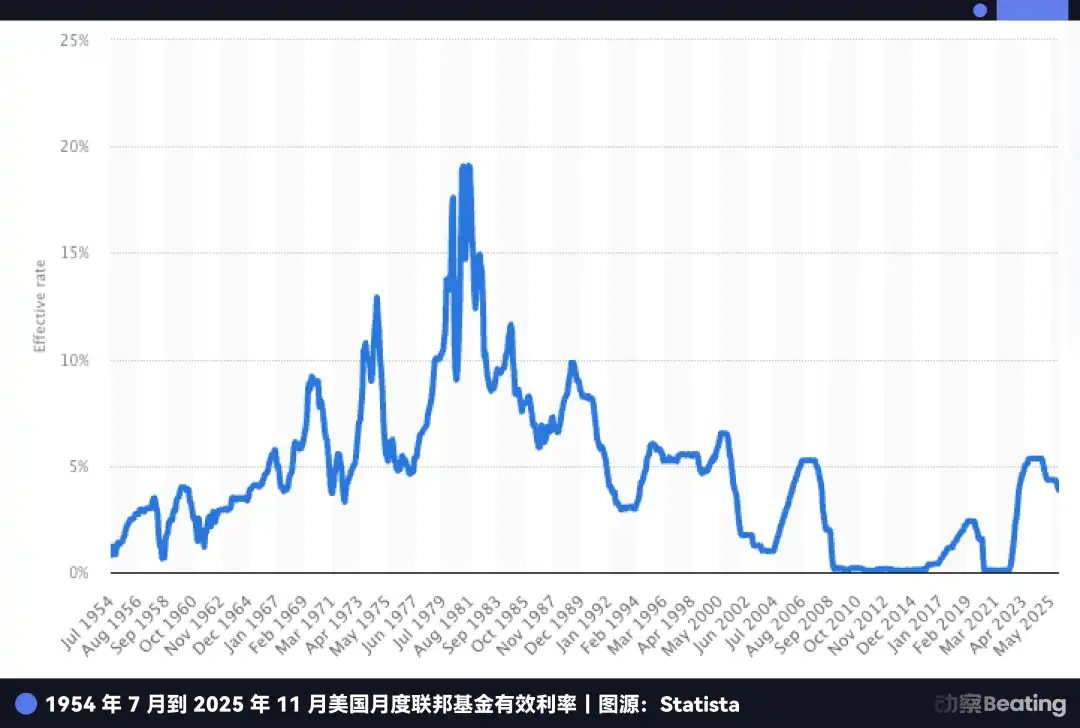
Look at PayPal's current embarrassing situation: it has a massive pool of 430 million active users' funds sitting in users' PayPal accounts, which PayPal then has to deposit into partner banks.
The partner banks take this low-cost money, use it to buy 5% yielding U.S. Treasury bonds or issue higher-interest loans, raking in profits, while PayPal can only get a small piece of the pie.
If PayPal were to obtain its own banking license, it could directly turn the idle funds of these 430 million users into its low-cost deposits, then use one hand to buy government bonds and the other hand to issue loans with higher interest rates, keeping all the interest rate spreads for itself. During these years of the high-interest rate window, this represents a profit gap of billions of dollars.
However, if PayPal only wanted to get rid of WebBank, it should have done so long ago, so why wait until 2025?
This brings us to another more urgent and deadly anxiety in the depths of PayPal’s heart: stablecoins.
Issuing Stablecoins, PayPal Remains a "Second Landlord"
If the "second landlord" status in the lending business only meant that PayPal earned less money and took on more stress, then in the stablecoin battlefield, this dependency is evolving into a real survival crisis.
In 2025, PayPal's stablecoin PYUSD saw explosive growth, tripling its market value in three months to reach $3.8 billion, with even YouTube announcing the integration of PYUSD payments in December.
Behind all these exciting reports, there is one fact that PayPal also won't emphasize in their press releases: PYUSD is not issued by PayPal itself but through a partnership with New York-based Paxos company.
This is another familiar "white-label" story, where PayPal is just the brand authorizer, much like how Nike doesn't manufacture shoes itself but licenses its logo to contract factories.
In the past, this was more like business division of labor, with PayPal holding the product and traffic while Paxos was responsible for compliance and issuance, each doing their own thing.
However, on December 12, 2025, this division of labor began to sour. The Office of the Comptroller of the Currency (OCC) granted a "conditionally approved" national trust bank charter to several institutions, including Paxos.
While not a "commercial bank" in the traditional sense that can attract deposits and hold FDIC insurance, this means Paxos is transitioning from a contract factory to an issuer with credentials that can take the center stage.
Adding the framework of the GENIUS Act, you can understand why PayPal is in a hurry. The act allows regulated banking systems to issue payment-type stablecoins through subsidiaries, and the issuance and revenue chain will increasingly concentrate in the hands of the "licensed individuals."
Before, PayPal could treat stablecoins as an outsourced module, but now, once the outsourcer has a stronger regulatory identity, it is no longer just a supplier; it can also become a replacement partner or even a potential competitor.
PayPal's dilemma is that it neither holds the issuance base nor the regulatory identity.
The advancement of USDC and the OCC's approval of trust-type licenses are all reminders of one thing to PayPal: in the stablecoin battle, the ultimate competition is not about who issues stablecoins first, but about who can control the strings of issuance, custody, clearance, and compliance.
Therefore, rather than saying PayPal wants to be a bank, it is more like obtaining a ticket; otherwise, it can only forever stay on the sidelines.
What's even more deadly is that stablecoins have dealt a blow to PayPal's core business.
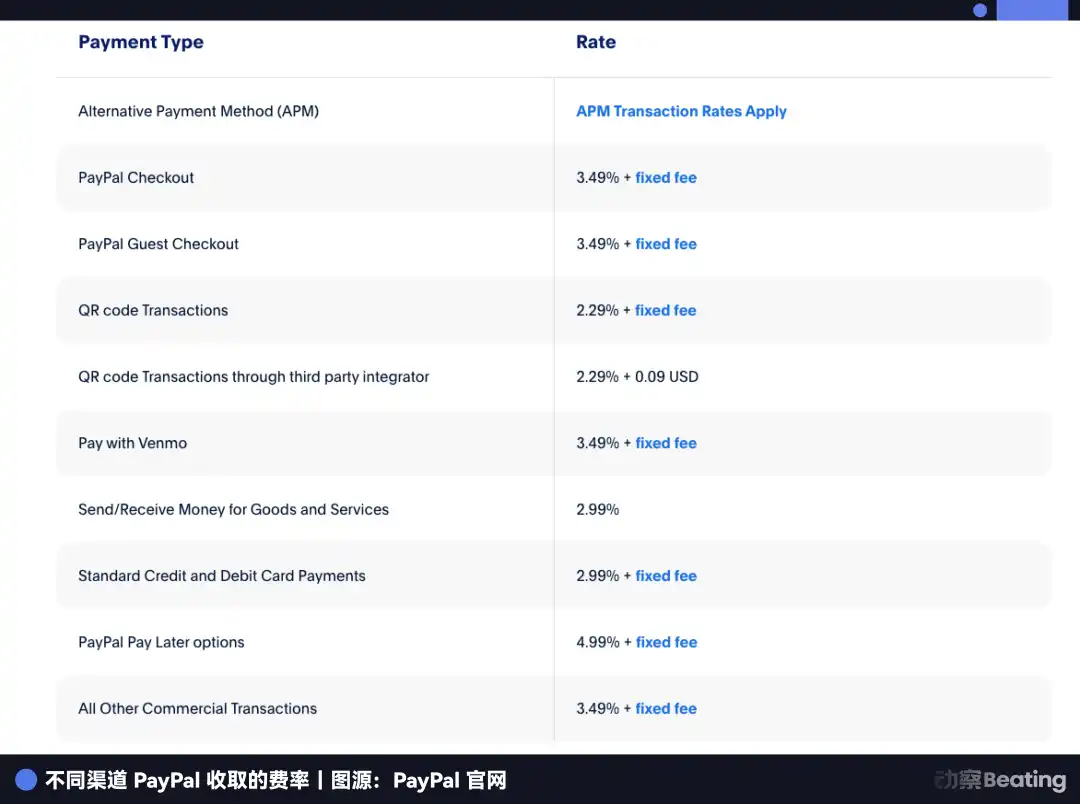
PayPal's most profitable business is e-commerce payments, relying on charging a 2.29-3.49% transaction fee per transaction. However, stablecoins operate on a completely different logic, hardly charging any transaction fees but earning money through users' funds held in government bonds for interest.
As Amazon starts accepting USDC and Shopify launches stablecoin payments, merchants will face a simple arithmetic question: if they can use a near-zero-cost stablecoin, why should they pay PayPal a 2.5% toll?
Currently, e-commerce payments account for over half of PayPal's business revenue. Over the past two years, it has seen its market share drop from 54.8% to 40%. If it does not take control of stablecoins soon, PayPal's moat will be completely filled in.
PayPal's current situation is reminiscent of Apple when it launched the Apple Pay Later service. In 2024, Apple, lacking a banking license, was heavily constrained by Goldman Sachs and eventually shut down the business, reverting to its core competency in hardware. Apple could retreat because finance was merely a bonus for them, with hardware being their main competitive advantage.
However, PayPal has no retreat.
It has no phone, no operating system, no hardware ecosystem. Finance is everything to PayPal; it is its only breadbasket. Apple's retreat was a strategic contraction, but if PayPal dares to retreat, death awaits it.
Therefore, PayPal must move forward. It must obtain that banking license, seizing control of stablecoin issuance, control, and revenue.
Yet, how easy is it to open a bank in the United States? Especially for a technology company burdened with $70 billion in loan assets, the regulatory approval process is incredibly daunting.
Thus, in order to secure this ticket to the future, PayPal has carefully orchestrated a brilliant capital magic trick.
PayPal's Transformation
Now, let's refocus on the initial contradiction mentioned at the beginning of the article.
On September 24, PayPal announced that it had sold $70 billion in "buy now, pay later" loans to Blue Owl, with the CFO boldly stating they are looking to "lighten the load." At that time, most Wall Street analysts believed this was just a means to spruce up the financial statements and make the cash flow look more attractive.
However, when you consider this event alongside the bank license application three months later, you'll realize this was not a contradiction but a carefully designed one-two punch.
If they had not sold these $70 billion in receivables, PayPal's chances of obtaining a banking license would be nearly zero.
Why? Because in the U.S., applying for a bank charter requires undergoing an extremely strict "check-up," with the regulatory authority (FDIC) holding a ruler known as the "capital adequacy ratio."
Its logic is simple: for every high-risk asset (such as a loan) lounging on your balance sheet, you must set aside a corresponding proportion of collateral to fend off risk.
Imagine this: if PayPal showed up at the FDIC's door carrying a $70 billion loan on its back, the regulator would immediately spot this heavy burden and ask, "With so many risky assets on your back, what if they go bad? Do you have enough money to cover the losses?" Not only would this mean PayPal needing to post an astronomical amount of collateral, but it could also lead to the approval being outright denied.
Therefore, PayPal must undergo a comprehensive slimming down before the check-up.
This transaction sold to Blue Owl is known in financial jargon as a forward flow agreement. This design is extremely clever. PayPal threw all future two-year newly originated loan receivables (i.e., "money already printed") and default risks at Blue Owl; however, it astutely retained the underwriting rights and customer relationships, essentially keeping the "money printer" for itself.
In the eyes of users, they are still borrowing from PayPal, still repaying within PayPal's App, with no changes in the experience. But on the FDIC's check-up report, PayPal's balance sheet instantly becomes extremely clean and refreshing.
Through this sleight of hand, PayPal completed an identity transformation, evolving from a lender burdened with heavy bad debt risks into a passerby who only earns risk-free service fees.
This deliberate large-scale asset reshuffling to pass regulatory approval is not unheard of on Wall Street, but being executed so decisively and on such a grand scale is rare. This clearly demonstrates the determination of PayPal's management, willing to share the existing fat (loan interest) with others in exchange for a more sustainable ticket.
Moreover, the time window for this bold move is rapidly closing. PayPal is so urgent because the "backdoor" it's eyeing is being shut by regulators, and possibly welded shut.
Closing Backdoor
The license PayPal applied for is called an Industrial Loan Company (ILC). If you are not a deep financial professional, you probably haven't heard of this name. However, it is one of the most bizarre and coveted entities in the U.S. financial regulatory system.
Looking at the list of companies holding an ILC license, you will feel a strong sense of dissonance: BMW, Toyota, Harley-Davidson, Target…
You might ask: Why would these car dealerships, grocery stores, open a bank?
That's the magic of ILC. It is the only “regulatory loophole” in the U.S. legal system that allows non-financial giants to legitimately open banks.
This loophole stems from the 1987 Competitive Equality Banking Act (CEBA). Despite the law's name suggesting “equality,” it left an extremely unequal privilege: it exempted the ILC's parent company from the obligation to register as a “bank holding company.”
If you apply for a regular bank charter, the parent company must undergo the Federal Reserve's comprehensive oversight. But if you hold an ILC charter, the parent company (such as PayPal) is not under the Federal Reserve's jurisdiction and only needs to comply with FDIC and Utah-level regulation.
This means that you get to enjoy both the national privileges of deposit absorption and access to the federal payment system and completely avoid the Federal Reserve's interference in your business landscape.
This is what is known as regulatory arbitrage, and what's even more enticing is that it allows for “conglomerate operations.” This is the play of BMW and Harley-Davidson, vertical integration of the supply chain.
BMW Bank doesn’t need physical branches because its business is perfectly integrated into the car buying process. When you decide to buy a BMW, the sales system automatically connects to BMW Bank's loan service.
For BMW, it not only profits from your car purchase but also earns interest on the car loan. Harley-Davidson does even better; its bank can even provide loans to motorcyclists rejected by traditional banks because only Harley knows that the default rate of these die-hard fans is actually very low.
This is exactly what PayPal dreams of as the ultimate form: left hand for payments, right hand for banking, stablecoin in between, with no outsider interference in any step.
By this point, you must be wondering, since this loophole is so useful, why don’t Walmart, Amazon apply for this charter and open their own bank?
Because the traditional banking industry despises this backdoor.
Bankers believe that allowing business giants with massive user data to open banks is a direct blow. In 2005, Walmart applied for an ILC charter, triggering a collective riot in the entire American banking industry. The Bankers Association aggressively lobbied Congress, arguing that if Walmart Bank used the supermarket's data advantage to only provide cheap loans to Walmart shoppers, how would community banks survive?
Under enormous public pressure, Walmart was forced to withdraw its application in 2007. This event directly led to the “freezing” of ILC by regulators. From 2006 to 2019, a full 13 years, FDIC did not approve any commercial company's application. It wasn’t until 2020 that Square (now Block) finally managed to break the deadlock.
But now, this newly reopened back door faces the risk of being permanently closed.
In July 2025, the FDIC suddenly issued a request for information on the ILC framework, which was seen as a strong signal of regulatory tightening. Meanwhile, relevant legislative proposals in Congress have never stopped.
As a result, everyone started rushing to obtain licenses. In 2025, the number of U.S. bank charter applications reached a historical peak of 20, with OCC alone receiving 14 applications, equivalent to the total of the past four years.
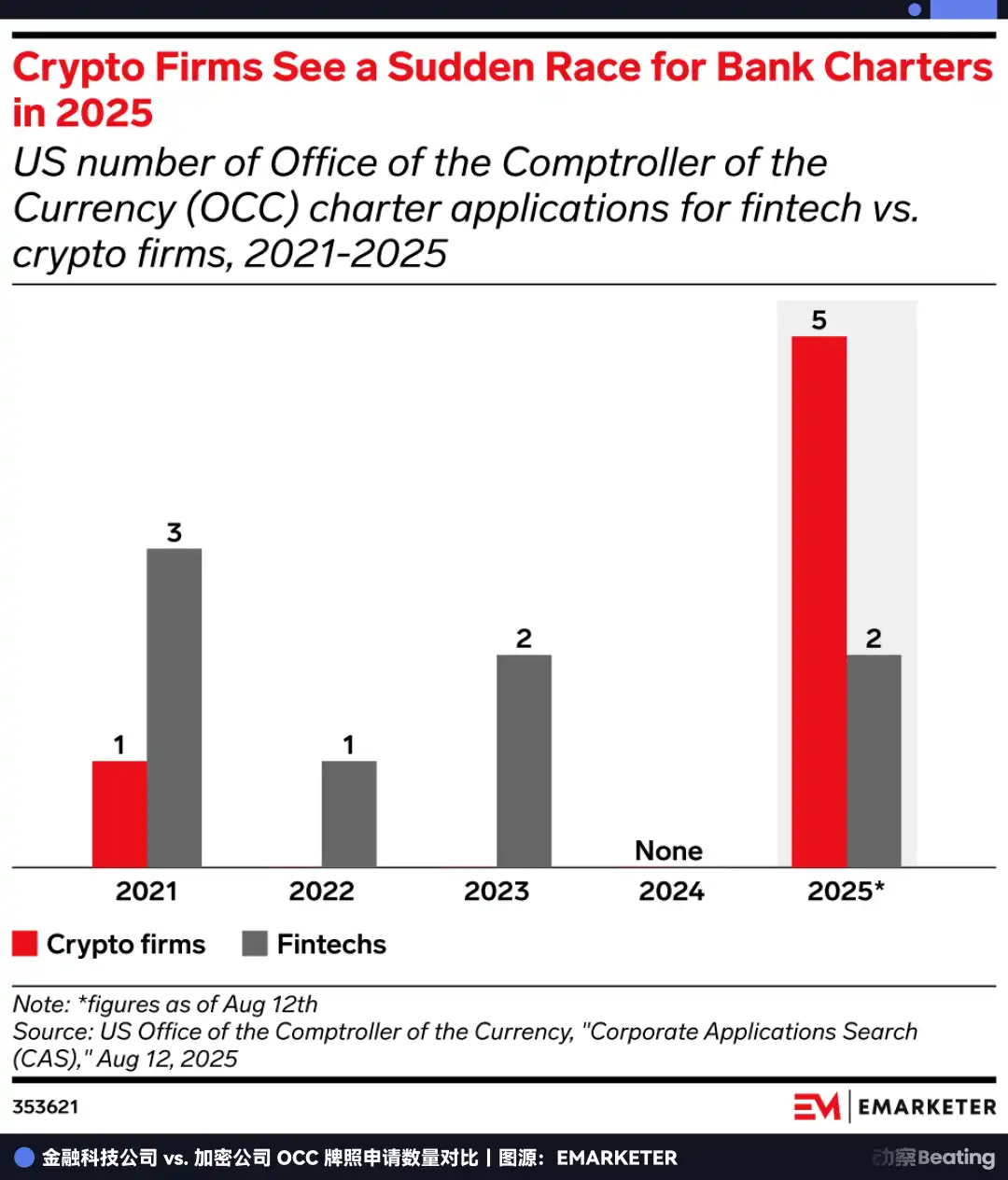
Everyone was clear that this was the last chance before the door closed. This time, PayPal was racing against regulatory agencies. If you don't rush in before the loophole is completely sealed by law, this door may be closed forever.
Life and Death Escape
The license that PayPal fought for so hard is actually an "option."
Its current value is certain: issuing loans independently and earning the interest rate spread in a high-interest environment. But its future value lies in granting PayPal the eligibility to enter those currently prohibited but imaginatively fertile territories.
What is Wall Street's most enviable business? It's not payments, but asset management.
Before obtaining a bank charter, PayPal could only play the role of a simple money mover, helping users transfer funds. But once it has the ILC license, it will have a legitimate custodial identity.
This means PayPal can legitimately custody Bitcoin, Ethereum, and even future RWA assets for 430 million users. Furthermore, under the future "GENIUS Act" framework, banks may be the only entities allowed to connect to DeFi protocols as a legal gateway.
Imagine a scenario where the PayPal app in the future may feature a "High-Yield Savings" button, with the backend connected to on-chain protocols like Aave or Compound, and the unbridgeable compliance barrier in between being facilitated by PayPal Bank. This will completely break down the wall between Web2 payments and Web3 finance.
In this dimension, PayPal is no longer competing with Stripe on transaction fees but is building a financial operating system for the crypto age. It is attempting to evolve from transaction processing to asset management. Transactions are linear, with a ceiling, while asset management is an endless game.
Only by understanding this layer can you grasp why PayPal is launching this charge at the end of 2025.
It is acutely aware that it is being squeezed in the crack of time. Behind it lies the fear of stablecoins erasing the profits of traditional payment businesses; ahead lies the imminent permanent sealing of the regulatory backdoor known as the ILC.
To squeeze through this door, it must sell off $7 billion in assets in September to undergo a drastic overhaul, all for the sake of obtaining that ticket that will determine its survival.
If you extend the timeline by 27 years, you will witness a cycle full of inevitability.
In 1998, when Peter Thiel and Elon Musk founded the precursor to PayPal, their mission was to "challenge banks" and use digital currency to eliminate those outdated, inefficient financial institutions.
27 years later, this once "dragon-slaying youth" is exerting all efforts to "become a bank."
In the business world, there are no fairy tales, only survival. On the eve of cryptocurrency restructuring the financial order, continuing to be an "ex-giant" outside the system is a dead end. Only by obtaining that status, even if through a "backdoor" approach, can one survive into the next era.
This is a life-or-death breakout that must be completed before the window closes.
If it wins the bet, it will be the JPMorgan of the Web3 era; if it loses, it will be nothing more than a relic of the previous generation of the Internet.
PayPal's time is running out.
You may also like

Token Cannot Compound, Where Is the Real Investment Opportunity?

February 6th Market Key Intelligence, How Much Did You Miss?

China's Central Bank and Eight Other Departments' Latest Regulatory Focus: Key Attention to RWA Tokenized Asset Risk
Foreword: Today, the People's Bank of China's website published the "Notice of the People's Bank of China, National Development and Reform Commission, Ministry of Industry and Information Technology, Ministry of Public Security, State Administration for Market Regulation, China Banking and Insurance Regulatory Commission, China Securities Regulatory Commission, State Administration of Foreign Exchange on Further Preventing and Dealing with Risks Related to Virtual Currency and Others (Yinfa [2026] No. 42)", the latest regulatory requirements from the eight departments including the central bank, which are basically consistent with the regulatory requirements of recent years. The main focus of the regulation is on speculative activities such as virtual currency trading, exchanges, ICOs, overseas platform services, and this time, regulatory oversight of RWA has been added, explicitly prohibiting RWA tokenization, stablecoins (especially those pegged to the RMB). The following is the full text:
To the people's governments of all provinces, autonomous regions, and municipalities directly under the Central Government, the Xinjiang Production and Construction Corps:
Recently, there have been speculative activities related to virtual currency and Real-World Assets (RWA) tokenization, disrupting the economic and financial order and jeopardizing the property security of the people. In order to further prevent and address the risks related to virtual currency and Real-World Assets tokenization, effectively safeguard national security and social stability, in accordance with the "Law of the People's Republic of China on the People's Bank of China," "Law of the People's Republic of China on Commercial Banks," "Securities Law of the People's Republic of China," "Law of the People's Republic of China on Securities Investment Funds," "Law of the People's Republic of China on Futures and Derivatives," "Cybersecurity Law of the People's Republic of China," "Regulations of the People's Republic of China on the Administration of Renminbi," "Regulations on Prevention and Disposal of Illegal Fundraising," "Regulations of the People's Republic of China on Foreign Exchange Administration," "Telecommunications Regulations of the People's Republic of China," and other provisions, after reaching consensus with the Cyberspace Administration of China, the Supreme People's Court, and the Supreme People's Procuratorate, and with the approval of the State Council, the relevant matters are notified as follows:
(I) Virtual currency does not possess the legal status equivalent to fiat currency. Virtual currencies such as Bitcoin, Ether, Tether, etc., have the main characteristics of being issued by non-monetary authorities, using encryption technology and distributed ledger or similar technology, existing in digital form, etc. They do not have legal tender status, should not and cannot be circulated and used as currency in the market.
The business activities related to virtual currency are classified as illegal financial activities. The exchange of fiat currency and virtual currency within the territory, exchange of virtual currencies, acting as a central counterparty in buying and selling virtual currencies, providing information intermediary and pricing services for virtual currency transactions, token issuance financing, and trading of virtual currency-related financial products, etc., fall under illegal financial activities, such as suspected illegal issuance of token vouchers, unauthorized public issuance of securities, illegal operation of securities and futures business, illegal fundraising, etc., are strictly prohibited across the board and resolutely banned in accordance with the law. Overseas entities and individuals are not allowed to provide virtual currency-related services to domestic entities in any form.
A stablecoin pegged to a fiat currency indirectly fulfills some functions of the fiat currency in circulation. Without the consent of relevant authorities in accordance with the law and regulations, any domestic or foreign entity or individual is not allowed to issue a RMB-pegged stablecoin overseas.
(II)Tokenization of Real-World Assets refers to the use of encryption technology and distributed ledger or similar technologies to transform ownership rights, income rights, etc., of assets into tokens (tokens) or other interests or bond certificates with token (token) characteristics, and carry out issuance and trading activities.
Engaging in the tokenization of real-world assets domestically, as well as providing related intermediary, information technology services, etc., which are suspected of illegal issuance of token vouchers, unauthorized public offering of securities, illegal operation of securities and futures business, illegal fundraising, and other illegal financial activities, shall be prohibited; except for relevant business activities carried out with the approval of the competent authorities in accordance with the law and regulations and relying on specific financial infrastructures. Overseas entities and individuals are not allowed to illegally provide services related to the tokenization of real-world assets to domestic entities in any form.
(III) Inter-agency Coordination. The People's Bank of China, together with the National Development and Reform Commission, the Ministry of Industry and Information Technology, the Ministry of Public Security, the State Administration for Market Regulation, the China Banking and Insurance Regulatory Commission, the China Securities Regulatory Commission, the State Administration of Foreign Exchange, and other departments, will improve the work mechanism, strengthen coordination with the Cyberspace Administration of China, the Supreme People's Court, and the Supreme People's Procuratorate, coordinate efforts, and overall guide regions to carry out risk prevention and disposal of virtual currency-related illegal financial activities.
The China Securities Regulatory Commission, together with the National Development and Reform Commission, the Ministry of Industry and Information Technology, the Ministry of Public Security, the People's Bank of China, the State Administration for Market Regulation, the China Banking and Insurance Regulatory Commission, the State Administration of Foreign Exchange, and other departments, will improve the work mechanism, strengthen coordination with the Cyberspace Administration of China, the Supreme People's Court, and the Supreme People's Procuratorate, coordinate efforts, and overall guide regions to carry out risk prevention and disposal of illegal financial activities related to the tokenization of real-world assets.
(IV) Strengthening Local Implementation. The people's governments at the provincial level are overall responsible for the prevention and disposal of risks related to virtual currencies and the tokenization of real-world assets in their respective administrative regions. The specific leading department is the local financial regulatory department, with participation from branches and dispatched institutions of the State Council's financial regulatory department, telecommunications regulators, public security, market supervision, and other departments, in coordination with cyberspace departments, courts, and procuratorates, to improve the normalization of the work mechanism, effectively connect with the relevant work mechanisms of central departments, form a cooperative and coordinated working pattern between central and local governments, effectively prevent and properly handle risks related to virtual currencies and the tokenization of real-world assets, and maintain economic and financial order and social stability.
(5) Enhanced Risk Monitoring. The People's Bank of China, China Securities Regulatory Commission, National Development and Reform Commission, Ministry of Industry and Information Technology, Ministry of Public Security, State Administration of Foreign Exchange, Cyberspace Administration of China, and other departments continue to improve monitoring techniques and system support, enhance cross-departmental data analysis and sharing, establish sound information sharing and cross-validation mechanisms, promptly grasp the risk situation of activities related to virtual currency and real-world asset tokenization. Local governments at all levels give full play to the role of local monitoring and early warning mechanisms. Local financial regulatory authorities, together with branches and agencies of the State Council's financial regulatory authorities, as well as departments of cyberspace and public security, ensure effective connection between online monitoring, offline investigation, and fund tracking, efficiently and accurately identify activities related to virtual currency and real-world asset tokenization, promptly share risk information, improve early warning information dissemination, verification, and rapid response mechanisms.
(6) Strengthened Oversight of Financial Institutions, Intermediaries, and Technology Service Providers. Financial institutions (including non-bank payment institutions) are prohibited from providing account opening, fund transfer, and clearing services for virtual currency-related business activities, issuing and selling financial products related to virtual currency, including virtual currency and related financial products in the scope of collateral, conducting insurance business related to virtual currency, or including virtual currency in the scope of insurance liability. Financial institutions (including non-bank payment institutions) are prohibited from providing custody, clearing, and settlement services for unauthorized real-world asset tokenization-related business and related financial products. Relevant intermediary institutions and information technology service providers are prohibited from providing intermediary, technical, or other services for unauthorized real-world asset tokenization-related businesses and related financial products.
(7) Enhanced Management of Internet Information Content and Access. Internet enterprises are prohibited from providing online business venues, commercial displays, marketing, advertising, or paid traffic diversion services for virtual currency and real-world asset tokenization-related business activities. Upon discovering clues of illegal activities, they should promptly report to relevant departments and provide technical support and assistance for related investigations and inquiries. Based on the clues transferred by the financial regulatory authorities, the cyberspace administration, telecommunications authorities, and public security departments should promptly close and deal with websites, mobile applications (including mini-programs), and public accounts engaged in virtual currency and real-world asset tokenization-related business activities in accordance with the law.
(8) Strengthened Entity Registration and Advertisement Management. Market supervision departments strengthen entity registration and management, and enterprise and individual business registrations must not contain terms such as "virtual currency," "virtual asset," "cryptocurrency," "crypto asset," "stablecoin," "real-world asset tokenization," or "RWA" in their names or business scopes. Market supervision departments, together with financial regulatory authorities, legally enhance the supervision of advertisements related to virtual currency and real-world asset tokenization, promptly investigating and handling relevant illegal advertisements.
(IX) Continued Rectification of Virtual Currency Mining Activities. The National Development and Reform Commission, together with relevant departments, strictly controls virtual currency mining activities, continuously promotes the rectification of virtual currency mining activities. The people's governments of various provinces take overall responsibility for the rectification of "mining" within their respective administrative regions. In accordance with the requirements of the National Development and Reform Commission and other departments in the "Notice on the Rectification of Virtual Currency Mining Activities" (NDRC Energy-saving Building [2021] No. 1283) and the provisions of the "Guidance Catalog for Industrial Structure Adjustment (2024 Edition)," a comprehensive review, investigation, and closure of existing virtual currency mining projects are conducted, new mining projects are strictly prohibited, and mining machine production enterprises are strictly prohibited from providing mining machine sales and other services within the country.
(X) Severe Crackdown on Related Illegal Financial Activities. Upon discovering clues to illegal financial activities related to virtual currency and the tokenization of real-world assets, local financial regulatory authorities, branches of the State Council's financial regulatory authorities, and other relevant departments promptly investigate, determine, and properly handle the issues in accordance with the law, and seriously hold the relevant entities and individuals legally responsible. Those suspected of crimes are transferred to the judicial authorities for processing according to the law.
(XI) Severe Crackdown on Related Illegal and Criminal Activities. The Ministry of Public Security, the People's Bank of China, the State Administration for Market Regulation, the China Banking and Insurance Regulatory Commission, the China Securities Regulatory Commission, as well as judicial and procuratorial organs, in accordance with their respective responsibilities, rigorously crack down on illegal and criminal activities related to virtual currency, the tokenization of real-world assets, such as fraud, money laundering, illegal business operations, pyramid schemes, illegal fundraising, and other illegal and criminal activities carried out under the guise of virtual currency, the tokenization of real-world assets, etc.
(XII) Strengthen Industry Self-discipline. Relevant industry associations should enhance membership management and policy advocacy, based on their own responsibilities, advocate and urge member units to resist illegal financial activities related to virtual currency and the tokenization of real-world assets. Member units that violate regulatory policies and industry self-discipline rules are to be disciplined in accordance with relevant self-regulatory management regulations. By leveraging various industry infrastructure, conduct risk monitoring related to virtual currency, the tokenization of real-world assets, and promptly transfer issue clues to relevant departments.
(XIII) Without the approval of relevant departments in accordance with the law and regulations, domestic entities and foreign entities controlled by them may not issue virtual currency overseas.
(XIV) Domestic entities engaging directly or indirectly in overseas external debt-based tokenization of real-world assets, or conducting asset securitization activities abroad based on domestic ownership rights, income rights, etc. (hereinafter referred to as domestic equity), should be strictly regulated in accordance with the principles of "same business, same risk, same rules." The National Development and Reform Commission, the China Securities Regulatory Commission, the State Administration of Foreign Exchange, and other relevant departments regulate it according to their respective responsibilities. For other forms of overseas real-world asset tokenization activities based on domestic equity by domestic entities, the China Securities Regulatory Commission, together with relevant departments, supervise according to their division of responsibilities. Without the consent and filing of relevant departments, no unit or individual may engage in the above-mentioned business.
(15) Overseas subsidiaries and branches of domestic financial institutions providing Real World Asset Tokenization-related services overseas shall do so legally and prudently. They shall have professional personnel and systems in place to effectively mitigate business risks, strictly implement customer onboarding, suitability management, anti-money laundering requirements, and incorporate them into the domestic financial institutions' compliance and risk management system. Intermediaries and information technology service providers offering Real World Asset Tokenization services abroad based on domestic equity or conducting Real World Asset Tokenization business in the form of overseas debt for domestic entities directly or indirectly venturing abroad must strictly comply with relevant laws and regulations. They should establish and improve relevant compliance and internal control systems in accordance with relevant normative requirements, strengthen business and risk control, and report the business developments to the relevant regulatory authorities for approval or filing.
(16) Strengthen organizational leadership and overall coordination. All departments and regions should attach great importance to the prevention of risks related to virtual currencies and Real World Asset Tokenization, strengthen organizational leadership, clarify work responsibilities, form a long-term effective working mechanism with centralized coordination, local implementation, and shared responsibilities, maintain high pressure, dynamically monitor risks, effectively prevent and mitigate risks in an orderly and efficient manner, legally protect the property security of the people, and make every effort to maintain economic and financial order and social stability.
(17) Widely carry out publicity and education. All departments, regions, and industry associations should make full use of various media and other communication channels to disseminate information through legal and policy interpretation, analysis of typical cases, and education on investment risks, etc. They should promote the illegality and harm of virtual currencies and Real World Asset Tokenization-related businesses and their manifestations, fully alert to potential risks and hidden dangers, and enhance public awareness and identification capabilities for risk prevention.
(18) Engaging in illegal financial activities related to virtual currencies and Real World Asset Tokenization in violation of this notice, as well as providing services for virtual currencies and Real World Asset Tokenization-related businesses, shall be punished in accordance with relevant regulations. If it constitutes a crime, criminal liability shall be pursued according to the law. For domestic entities and individuals who knowingly or should have known that overseas entities illegally provided virtual currency or Real World Asset Tokenization-related services to domestic entities and still assisted them, relevant responsibilities shall be pursued according to the law. If it constitutes a crime, criminal liability shall be pursued according to the law.
(19) If any unit or individual invests in virtual currencies, Real World Asset Tokens, and related financial products against public order and good customs, the relevant civil legal actions shall be invalid, and any resulting losses shall be borne by them. If there are suspicions of disrupting financial order and jeopardizing financial security, the relevant departments shall deal with them according to the law.
This notice shall enter into force upon the date of its issuance. The People's Bank of China and ten other departments' "Notice on Further Preventing and Dealing with the Risks of Virtual Currency Trading Speculation" (Yinfa [2021] No. 237) is hereby repealed.

Former Partner's Perspective on Multicoin: Kyle's Exit, But the Game He Left Behind Just Getting Started
Why Bitcoin Is Falling Now: The Real Reasons Behind BTC's Crash & WEEX's Smart Profit Playbook
Bitcoin's ongoing crash explained: Discover the 5 hidden triggers behind BTC's plunge & how WEEX's Auto Earn and Trade to Earn strategies help traders profit from crypto market volatility.

Wall Street's Hottest Trades See Exodus

Vitalik Discusses Ethereum Scaling Path, Circle Announces Partnership with Polymarket, What's the Overseas Crypto Community Talking About Today?

Believing in the Capital Markets - The Essence and Core Value of Cryptocurrency

Polymarket's 'Weatherman': Predict Temperature, Win Million-Dollar Payout

$15K+ Profits: The 4 AI Trading Secrets WEEX Hackathon Prelim Winners Used to Dominate Volatile Crypto Markets
How WEEX Hackathon's top AI trading strategies made $15K+ in crypto markets: 4 proven rules for ETH/BTC trading, market structure analysis, and risk management in volatile conditions.

A nearly 20% one-day plunge, how long has it been since you last saw a $60,000 Bitcoin?

Raoul Pal: I've seen every single panic, and they are never the end.

Key Market Information Discrepancy on February 6th - A Must-Read! | Alpha Morning Report

2026 Crypto Industry's First Snowfall
The Harsh Reality Behind the $26 Billion Crypto Liquidation: Liquidity Is Killing the Market
Why Is Gold, US Stocks, Bitcoin All Falling?

Key Market Intelligence for February 5th, how much did you miss out on?

Wintermute: By 2026, crypto had gradually become the settlement layer of the Internet economy
Token Cannot Compound, Where Is the Real Investment Opportunity?
February 6th Market Key Intelligence, How Much Did You Miss?
China's Central Bank and Eight Other Departments' Latest Regulatory Focus: Key Attention to RWA Tokenized Asset Risk
Foreword: Today, the People's Bank of China's website published the "Notice of the People's Bank of China, National Development and Reform Commission, Ministry of Industry and Information Technology, Ministry of Public Security, State Administration for Market Regulation, China Banking and Insurance Regulatory Commission, China Securities Regulatory Commission, State Administration of Foreign Exchange on Further Preventing and Dealing with Risks Related to Virtual Currency and Others (Yinfa [2026] No. 42)", the latest regulatory requirements from the eight departments including the central bank, which are basically consistent with the regulatory requirements of recent years. The main focus of the regulation is on speculative activities such as virtual currency trading, exchanges, ICOs, overseas platform services, and this time, regulatory oversight of RWA has been added, explicitly prohibiting RWA tokenization, stablecoins (especially those pegged to the RMB). The following is the full text:
To the people's governments of all provinces, autonomous regions, and municipalities directly under the Central Government, the Xinjiang Production and Construction Corps:
Recently, there have been speculative activities related to virtual currency and Real-World Assets (RWA) tokenization, disrupting the economic and financial order and jeopardizing the property security of the people. In order to further prevent and address the risks related to virtual currency and Real-World Assets tokenization, effectively safeguard national security and social stability, in accordance with the "Law of the People's Republic of China on the People's Bank of China," "Law of the People's Republic of China on Commercial Banks," "Securities Law of the People's Republic of China," "Law of the People's Republic of China on Securities Investment Funds," "Law of the People's Republic of China on Futures and Derivatives," "Cybersecurity Law of the People's Republic of China," "Regulations of the People's Republic of China on the Administration of Renminbi," "Regulations on Prevention and Disposal of Illegal Fundraising," "Regulations of the People's Republic of China on Foreign Exchange Administration," "Telecommunications Regulations of the People's Republic of China," and other provisions, after reaching consensus with the Cyberspace Administration of China, the Supreme People's Court, and the Supreme People's Procuratorate, and with the approval of the State Council, the relevant matters are notified as follows:
(I) Virtual currency does not possess the legal status equivalent to fiat currency. Virtual currencies such as Bitcoin, Ether, Tether, etc., have the main characteristics of being issued by non-monetary authorities, using encryption technology and distributed ledger or similar technology, existing in digital form, etc. They do not have legal tender status, should not and cannot be circulated and used as currency in the market.
The business activities related to virtual currency are classified as illegal financial activities. The exchange of fiat currency and virtual currency within the territory, exchange of virtual currencies, acting as a central counterparty in buying and selling virtual currencies, providing information intermediary and pricing services for virtual currency transactions, token issuance financing, and trading of virtual currency-related financial products, etc., fall under illegal financial activities, such as suspected illegal issuance of token vouchers, unauthorized public issuance of securities, illegal operation of securities and futures business, illegal fundraising, etc., are strictly prohibited across the board and resolutely banned in accordance with the law. Overseas entities and individuals are not allowed to provide virtual currency-related services to domestic entities in any form.
A stablecoin pegged to a fiat currency indirectly fulfills some functions of the fiat currency in circulation. Without the consent of relevant authorities in accordance with the law and regulations, any domestic or foreign entity or individual is not allowed to issue a RMB-pegged stablecoin overseas.
(II)Tokenization of Real-World Assets refers to the use of encryption technology and distributed ledger or similar technologies to transform ownership rights, income rights, etc., of assets into tokens (tokens) or other interests or bond certificates with token (token) characteristics, and carry out issuance and trading activities.
Engaging in the tokenization of real-world assets domestically, as well as providing related intermediary, information technology services, etc., which are suspected of illegal issuance of token vouchers, unauthorized public offering of securities, illegal operation of securities and futures business, illegal fundraising, and other illegal financial activities, shall be prohibited; except for relevant business activities carried out with the approval of the competent authorities in accordance with the law and regulations and relying on specific financial infrastructures. Overseas entities and individuals are not allowed to illegally provide services related to the tokenization of real-world assets to domestic entities in any form.
(III) Inter-agency Coordination. The People's Bank of China, together with the National Development and Reform Commission, the Ministry of Industry and Information Technology, the Ministry of Public Security, the State Administration for Market Regulation, the China Banking and Insurance Regulatory Commission, the China Securities Regulatory Commission, the State Administration of Foreign Exchange, and other departments, will improve the work mechanism, strengthen coordination with the Cyberspace Administration of China, the Supreme People's Court, and the Supreme People's Procuratorate, coordinate efforts, and overall guide regions to carry out risk prevention and disposal of virtual currency-related illegal financial activities.
The China Securities Regulatory Commission, together with the National Development and Reform Commission, the Ministry of Industry and Information Technology, the Ministry of Public Security, the People's Bank of China, the State Administration for Market Regulation, the China Banking and Insurance Regulatory Commission, the State Administration of Foreign Exchange, and other departments, will improve the work mechanism, strengthen coordination with the Cyberspace Administration of China, the Supreme People's Court, and the Supreme People's Procuratorate, coordinate efforts, and overall guide regions to carry out risk prevention and disposal of illegal financial activities related to the tokenization of real-world assets.
(IV) Strengthening Local Implementation. The people's governments at the provincial level are overall responsible for the prevention and disposal of risks related to virtual currencies and the tokenization of real-world assets in their respective administrative regions. The specific leading department is the local financial regulatory department, with participation from branches and dispatched institutions of the State Council's financial regulatory department, telecommunications regulators, public security, market supervision, and other departments, in coordination with cyberspace departments, courts, and procuratorates, to improve the normalization of the work mechanism, effectively connect with the relevant work mechanisms of central departments, form a cooperative and coordinated working pattern between central and local governments, effectively prevent and properly handle risks related to virtual currencies and the tokenization of real-world assets, and maintain economic and financial order and social stability.
(5) Enhanced Risk Monitoring. The People's Bank of China, China Securities Regulatory Commission, National Development and Reform Commission, Ministry of Industry and Information Technology, Ministry of Public Security, State Administration of Foreign Exchange, Cyberspace Administration of China, and other departments continue to improve monitoring techniques and system support, enhance cross-departmental data analysis and sharing, establish sound information sharing and cross-validation mechanisms, promptly grasp the risk situation of activities related to virtual currency and real-world asset tokenization. Local governments at all levels give full play to the role of local monitoring and early warning mechanisms. Local financial regulatory authorities, together with branches and agencies of the State Council's financial regulatory authorities, as well as departments of cyberspace and public security, ensure effective connection between online monitoring, offline investigation, and fund tracking, efficiently and accurately identify activities related to virtual currency and real-world asset tokenization, promptly share risk information, improve early warning information dissemination, verification, and rapid response mechanisms.
(6) Strengthened Oversight of Financial Institutions, Intermediaries, and Technology Service Providers. Financial institutions (including non-bank payment institutions) are prohibited from providing account opening, fund transfer, and clearing services for virtual currency-related business activities, issuing and selling financial products related to virtual currency, including virtual currency and related financial products in the scope of collateral, conducting insurance business related to virtual currency, or including virtual currency in the scope of insurance liability. Financial institutions (including non-bank payment institutions) are prohibited from providing custody, clearing, and settlement services for unauthorized real-world asset tokenization-related business and related financial products. Relevant intermediary institutions and information technology service providers are prohibited from providing intermediary, technical, or other services for unauthorized real-world asset tokenization-related businesses and related financial products.
(7) Enhanced Management of Internet Information Content and Access. Internet enterprises are prohibited from providing online business venues, commercial displays, marketing, advertising, or paid traffic diversion services for virtual currency and real-world asset tokenization-related business activities. Upon discovering clues of illegal activities, they should promptly report to relevant departments and provide technical support and assistance for related investigations and inquiries. Based on the clues transferred by the financial regulatory authorities, the cyberspace administration, telecommunications authorities, and public security departments should promptly close and deal with websites, mobile applications (including mini-programs), and public accounts engaged in virtual currency and real-world asset tokenization-related business activities in accordance with the law.
(8) Strengthened Entity Registration and Advertisement Management. Market supervision departments strengthen entity registration and management, and enterprise and individual business registrations must not contain terms such as "virtual currency," "virtual asset," "cryptocurrency," "crypto asset," "stablecoin," "real-world asset tokenization," or "RWA" in their names or business scopes. Market supervision departments, together with financial regulatory authorities, legally enhance the supervision of advertisements related to virtual currency and real-world asset tokenization, promptly investigating and handling relevant illegal advertisements.
(IX) Continued Rectification of Virtual Currency Mining Activities. The National Development and Reform Commission, together with relevant departments, strictly controls virtual currency mining activities, continuously promotes the rectification of virtual currency mining activities. The people's governments of various provinces take overall responsibility for the rectification of "mining" within their respective administrative regions. In accordance with the requirements of the National Development and Reform Commission and other departments in the "Notice on the Rectification of Virtual Currency Mining Activities" (NDRC Energy-saving Building [2021] No. 1283) and the provisions of the "Guidance Catalog for Industrial Structure Adjustment (2024 Edition)," a comprehensive review, investigation, and closure of existing virtual currency mining projects are conducted, new mining projects are strictly prohibited, and mining machine production enterprises are strictly prohibited from providing mining machine sales and other services within the country.
(X) Severe Crackdown on Related Illegal Financial Activities. Upon discovering clues to illegal financial activities related to virtual currency and the tokenization of real-world assets, local financial regulatory authorities, branches of the State Council's financial regulatory authorities, and other relevant departments promptly investigate, determine, and properly handle the issues in accordance with the law, and seriously hold the relevant entities and individuals legally responsible. Those suspected of crimes are transferred to the judicial authorities for processing according to the law.
(XI) Severe Crackdown on Related Illegal and Criminal Activities. The Ministry of Public Security, the People's Bank of China, the State Administration for Market Regulation, the China Banking and Insurance Regulatory Commission, the China Securities Regulatory Commission, as well as judicial and procuratorial organs, in accordance with their respective responsibilities, rigorously crack down on illegal and criminal activities related to virtual currency, the tokenization of real-world assets, such as fraud, money laundering, illegal business operations, pyramid schemes, illegal fundraising, and other illegal and criminal activities carried out under the guise of virtual currency, the tokenization of real-world assets, etc.
(XII) Strengthen Industry Self-discipline. Relevant industry associations should enhance membership management and policy advocacy, based on their own responsibilities, advocate and urge member units to resist illegal financial activities related to virtual currency and the tokenization of real-world assets. Member units that violate regulatory policies and industry self-discipline rules are to be disciplined in accordance with relevant self-regulatory management regulations. By leveraging various industry infrastructure, conduct risk monitoring related to virtual currency, the tokenization of real-world assets, and promptly transfer issue clues to relevant departments.
(XIII) Without the approval of relevant departments in accordance with the law and regulations, domestic entities and foreign entities controlled by them may not issue virtual currency overseas.
(XIV) Domestic entities engaging directly or indirectly in overseas external debt-based tokenization of real-world assets, or conducting asset securitization activities abroad based on domestic ownership rights, income rights, etc. (hereinafter referred to as domestic equity), should be strictly regulated in accordance with the principles of "same business, same risk, same rules." The National Development and Reform Commission, the China Securities Regulatory Commission, the State Administration of Foreign Exchange, and other relevant departments regulate it according to their respective responsibilities. For other forms of overseas real-world asset tokenization activities based on domestic equity by domestic entities, the China Securities Regulatory Commission, together with relevant departments, supervise according to their division of responsibilities. Without the consent and filing of relevant departments, no unit or individual may engage in the above-mentioned business.
(15) Overseas subsidiaries and branches of domestic financial institutions providing Real World Asset Tokenization-related services overseas shall do so legally and prudently. They shall have professional personnel and systems in place to effectively mitigate business risks, strictly implement customer onboarding, suitability management, anti-money laundering requirements, and incorporate them into the domestic financial institutions' compliance and risk management system. Intermediaries and information technology service providers offering Real World Asset Tokenization services abroad based on domestic equity or conducting Real World Asset Tokenization business in the form of overseas debt for domestic entities directly or indirectly venturing abroad must strictly comply with relevant laws and regulations. They should establish and improve relevant compliance and internal control systems in accordance with relevant normative requirements, strengthen business and risk control, and report the business developments to the relevant regulatory authorities for approval or filing.
(16) Strengthen organizational leadership and overall coordination. All departments and regions should attach great importance to the prevention of risks related to virtual currencies and Real World Asset Tokenization, strengthen organizational leadership, clarify work responsibilities, form a long-term effective working mechanism with centralized coordination, local implementation, and shared responsibilities, maintain high pressure, dynamically monitor risks, effectively prevent and mitigate risks in an orderly and efficient manner, legally protect the property security of the people, and make every effort to maintain economic and financial order and social stability.
(17) Widely carry out publicity and education. All departments, regions, and industry associations should make full use of various media and other communication channels to disseminate information through legal and policy interpretation, analysis of typical cases, and education on investment risks, etc. They should promote the illegality and harm of virtual currencies and Real World Asset Tokenization-related businesses and their manifestations, fully alert to potential risks and hidden dangers, and enhance public awareness and identification capabilities for risk prevention.
(18) Engaging in illegal financial activities related to virtual currencies and Real World Asset Tokenization in violation of this notice, as well as providing services for virtual currencies and Real World Asset Tokenization-related businesses, shall be punished in accordance with relevant regulations. If it constitutes a crime, criminal liability shall be pursued according to the law. For domestic entities and individuals who knowingly or should have known that overseas entities illegally provided virtual currency or Real World Asset Tokenization-related services to domestic entities and still assisted them, relevant responsibilities shall be pursued according to the law. If it constitutes a crime, criminal liability shall be pursued according to the law.
(19) If any unit or individual invests in virtual currencies, Real World Asset Tokens, and related financial products against public order and good customs, the relevant civil legal actions shall be invalid, and any resulting losses shall be borne by them. If there are suspicions of disrupting financial order and jeopardizing financial security, the relevant departments shall deal with them according to the law.
This notice shall enter into force upon the date of its issuance. The People's Bank of China and ten other departments' "Notice on Further Preventing and Dealing with the Risks of Virtual Currency Trading Speculation" (Yinfa [2021] No. 237) is hereby repealed.
Former Partner's Perspective on Multicoin: Kyle's Exit, But the Game He Left Behind Just Getting Started
Why Bitcoin Is Falling Now: The Real Reasons Behind BTC's Crash & WEEX's Smart Profit Playbook
Bitcoin's ongoing crash explained: Discover the 5 hidden triggers behind BTC's plunge & how WEEX's Auto Earn and Trade to Earn strategies help traders profit from crypto market volatility.


 App
App