
- Buy Crypto
- Markets
 Futures
- Spot
- Copy Trade
 Earn
Earn- More
Industry Watch: A DePIN Empire Is Quietly Emerging on Solana

Original Title: "Industry Insight: A DePIN Empire Is Quietly Emerging on Solana"
Original Source: DePINone Labs
Abstract
This month, Solana's DePIN ecosystem welcomed two new major players. ROAM, based on shared WiFi, went live on March 6 on mainstream exchanges such as Bybit and Kucoin, reaching the fourth position in the DePIN track with its hardware devices achieving a network-wide first. Former Strategic Lead at the Solana Foundation, Austin Federa, led a $28 million funding round joined by Solana's co-founders and A-list VCs like Dragonfly and Multicoin to launch the DoubleZero distributed bandwidth project. This project aims to create a communication highway based on web2 infrastructure for web3, potentially addressing the network latency issues currently faced by web3.
Furthermore, as of March 14, 2025, the Solana-based DePIN ecosystem has seen significant growth, with a total market cap of over $25 billion. There are approximately 78 DePIN projects covering various subfields such as wireless communication (e.g., Helium), computing resources (e.g., Render Network), geolocation (e.g., Hivemapper), and cloud storage (e.g., GenesysGo SHDWDrive).
Solana, with its high throughput, low transaction costs, mature developer ecosystem, and a large user base, has become the preferred platform for DePIN projects. We are witnessing the emergence of a DePIN empire ecosystem nurtured on Solana.
1. Key Analysis of DePIN Track Major Projects
1. DoubleZero—Building a High-speed Highway for web3 on Solana
On March 10, amidst a weak overall crypto market performance, another DePIN dark horse project, DoubleZero Foundation, secured a massive $28 million investment from A-list VCs.
Who exactly is the DoubleZero Foundation, and how were they able to secure such a substantial investment in the midst of a market downturn?
I have summarized the key points as follows:
(1) The founding team has rich experience in blockchain projects and has been successful in the past. Furthermore, the founder has abundant resources within the industry and possesses a luxurious ecosystem.
The founder of DoubleZero, Austin Federa, previously served as the Head of Strategy at the Solana Foundation and can be considered a key driver of Solana's early ecosystem growth. During his time at the Solana Foundation, he was not only responsible for global market strategy but also directly involved in the implementation of several key projects, such as driving the integration of USDC and USDT on Solana, and even deeply involved in ecosystem partnerships during the FTX era.
Simultaneously, Austin Federa has a deep relationship with the Solana core team (including Anatoly Yakovenko and Raj Gokal). It is this relationship that allowed DoubleZero to receive early support from the Solana ecosystem and market recognition.
(2) The investment team is high-profile, with Solana founders co-investing and explicitly supporting Solana's DePIN strategic layout.
The following image shows DoubleZero's investment team. If you are familiar with the investment landscape in the crypto community, you will know the significant influence of Dragonfly and Multicoin. They are not only long-term supporters of the Solana ecosystem but have also played crucial roles in several key projects (e.g., Multicoin's early bet on Solana and Dragonfly's involvement in Serum).
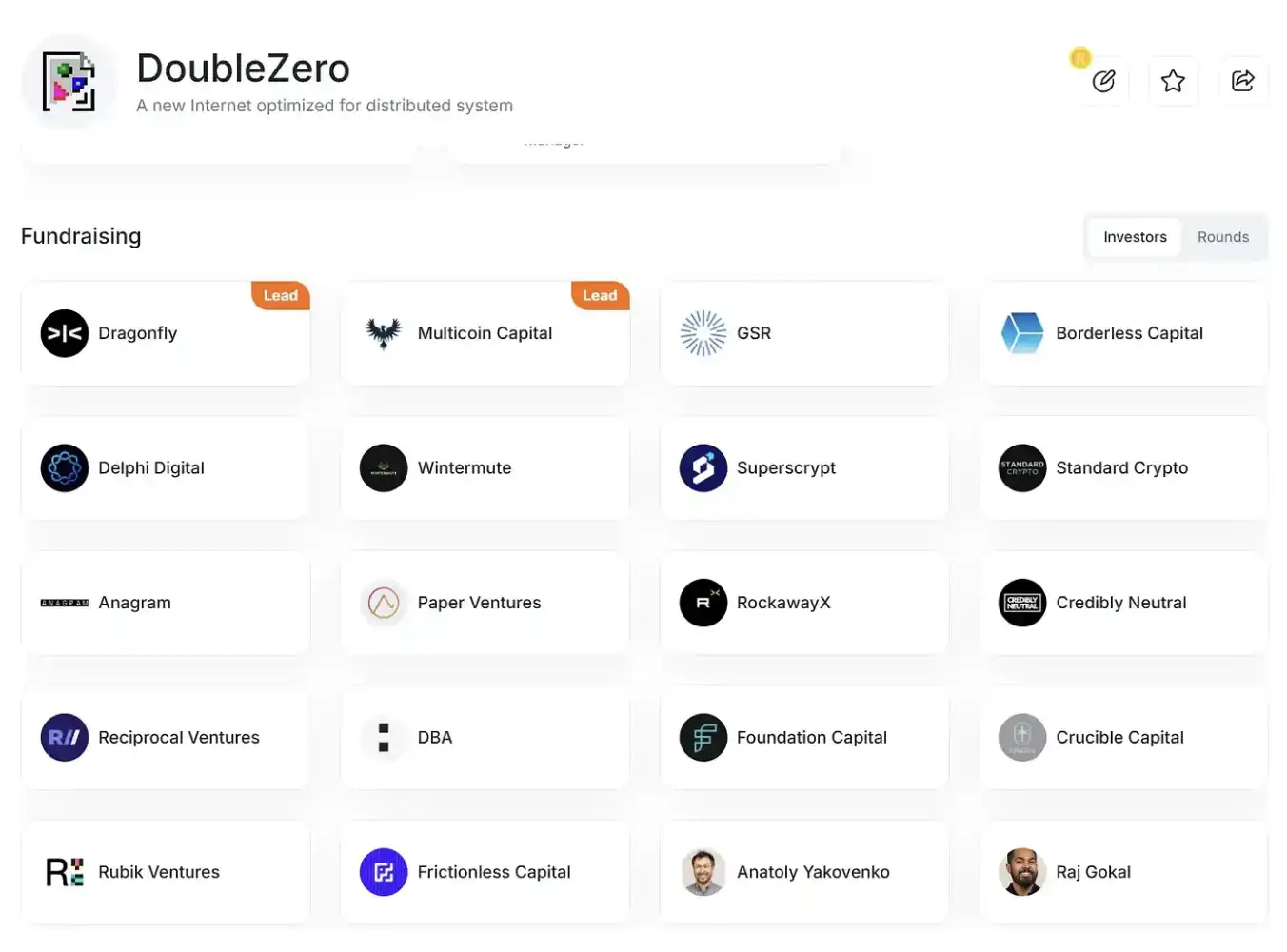
Furthermore, in addition to top-tier VCs, the financial power within the Solana ecosystem also played a core role in this funding round. Solana Ventures and the co-founders of Solana Labs, Anatoly Yakovenko and Raj Gokal, also participated as angel investors.
From a somewhat irrational perspective, this is almost equivalent to declaring to others, "This is my own flesh and blood."
It is worth noting that DoubleZero's investment came just after the Solana Foundation announced its DePIN ecosystem strategy, being the first project to receive explicit investment support.
So we believe that, with Solana's official on-site support, Austin is not acting alone, but is entering the field with the entire Solana resource pool, a comprehensive tilt of funds, technology, and market resources. For the entire DeFi PIN track, this is undoubtedly an important signal: the Solana ecosystem is actively laying out the physical infrastructure network, and Double Zero may be the "vanguard" leading the charge.
(3) Leading Technical Solution, building a web3 track highway to make web3 projects run as smoothly as web2;
We know that the Web3 track is currently facing many issues, among which, at the infrastructure layer, due to public internet bandwidth limitations and issues such as non-deterministic routing, Web3 projects often cannot run as smoothly as Web2; and even if public bandwidth restrictions and non-deterministic routing issues are addressed, if the delay issue between validators is not resolved, then Web3 projects still cannot run as smoothly as Web2.
Double Zero was created to address these infrastructure layer issues in Web3.
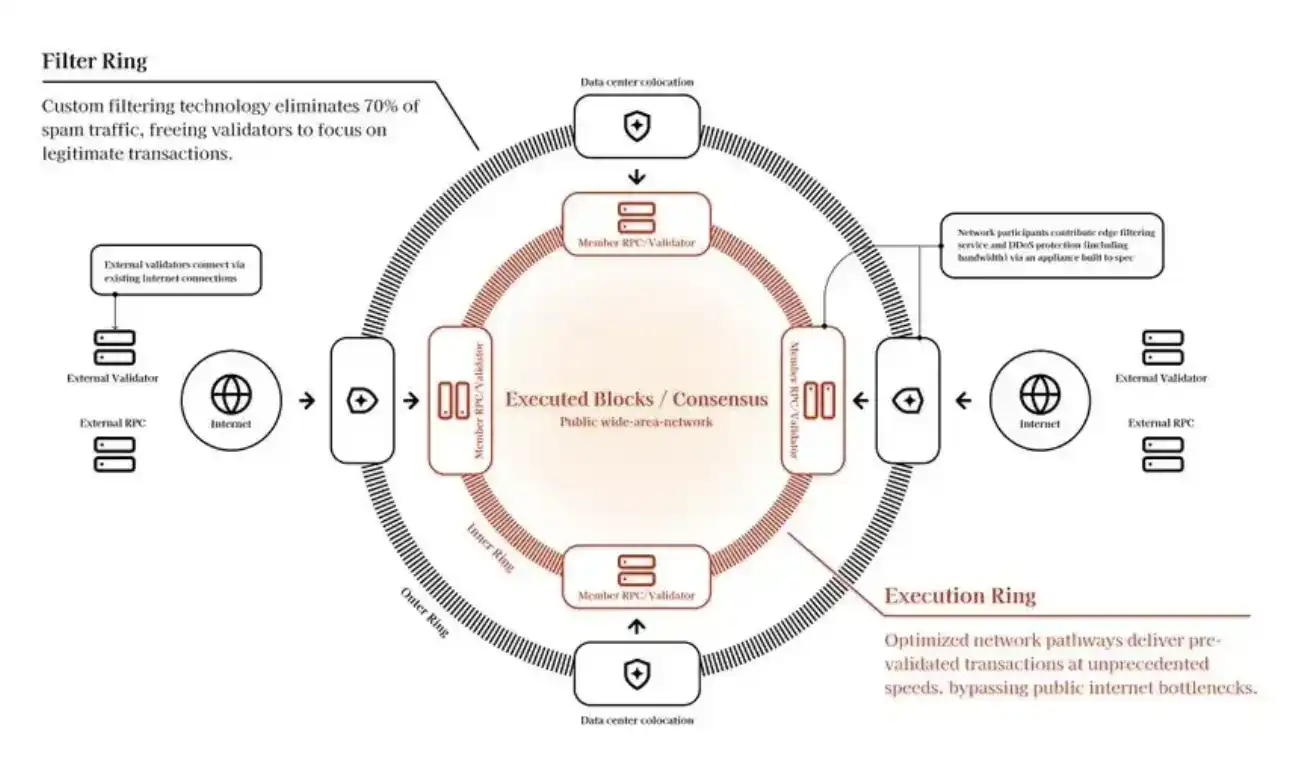
From the architecture diagram above, we can see Double Zero's unique Two-Ring Architecture, where the Outer Ring connects to the public internet, using hardware (such as FPGA) for attack protection, signature verification, and transaction filtering; the Inner Ring then handles this filtered traffic through a dedicated bandwidth line and performs consensus building.
Firstly, the Outer Ring connects to the public internet, using hardware (such as FPGA) for attack protection, signature verification, and transaction filtering;
The benefit of this is that by pre-filtering incoming spam and duplicate transactions with dedicated hardware, the burden on validators is reduced, allowing the blockchain to share filtering resources without each validator needing to provide them separately.
Secondly, the Inner Ring processes this filtered traffic through a dedicated bandwidth line and performs consensus building. This can improve communication efficiency through explicit message routing, tracking, and priority management.
Regarding the specific technical processing flow, the information disclosed by the official is as follows:
(1) The Outer Ring, as the first line of defense, is mainly responsible for filtering out spam transactions, DDoS attacks, malicious contract invocations, and other invalid traffic. It uses an adaptive traffic filtering mechanism to real-time analyze transaction patterns using machine learning and heuristic rules, precisely identify and intercept malicious traffic, ensuring that only valid transactions can enter the blockchain mainnet.
At the same time, Outer Ring also relies on decentralized zero-permission fiber contributions, where independent contributors from the network provide physical infrastructure, further ensuring the authenticity and priority of data packets. All transactions must undergo basic validity checks in Outer Ring before entering the Inner Ring, reducing the entry of invalid transactions into the core network and improving overall processing efficiency.
(2) Transactions entering the Inner Ring have undergone strict screening, allowing it to focus on efficient transaction processing. The Inner Ring adopts a high-performance architecture similar to Solana, supporting ultra-high TPS (transactions per second), ensuring extremely short transaction confirmation times to meet the demand for a large number of transactions.
To further enhance network fluidity, Double Zero also adopts a stateless verification model. This lightweight transaction processing method, compared to the traditional state storage model of blockchain, makes the entire network run more smoothly and efficiently.
2. Roam - Web3 Version of Starchain Built on Solana
On March 6, Roam, another decentralized wireless network project built on the Solana public chain, was listed on Kucoin and Bybit, with a circulating market value of over $60 million. In the DePIN track, Solana has gained another strong contender.
(1) What is the Roam project?
ROAM is a decentralized wireless network project based on the Solana blockchain, aiming to provide seamless and secure global WiFi and eSIM connections, with the goal of building a global open wireless network. It achieves automatic network switching and secure connections through blockchain technology, supporting individuals, smart devices, and AI agents.
Currently, with over 2.3 million users and 2 million WiFi nodes covering 190+ countries, it ranks high in the DePIN field.
The $ROAM token has a total supply of 1 billion, with 600 million allocated for mining and community activities. Users can earn tokens by providing WiFi or validating the network.
According to the 2024 Messari report, ROAM ranks fourth in DePIN projects with over 1 million active nodes and first in hardware node count. Competitors include Helium and DIMO, but ROAM's global coverage and user base provide it with a competitive advantage.
If we say Musk's Starlink has built a space-based communication system, I would like to refer to Roam as the ground-based communication network's web3 version of the Starlink system.
(2) Technological Advantages
ROAM utilizes OpenRoaming™ WiFi and eSIM technology, allowing users to provide WiFi access or share network performance data. Meanwhile, ROAM employs decentralized identities (DID) and verifiable credentials (VC) to ensure that users do not risk data leakage while sharing WiFi or using WiFi, ensuring privacy and security.
The specific architecture and functions of the technology are as follows:
· OpenRoaming™ Wi-Fi: Following the Wireless Broadband Alliance (WBA) standard, it supports users in seamless switching between different WiFi networks, ensuring continuous connectivity.
· eSIM Service: Providing smart eSIM services in over 160 countries, allowing users to access data networks without a traditional SIM card.
· Blockchain Incentive Mechanism: Utilizing the Proof-of-Service mining algorithm, users earn ROAM tokens by providing WiFi services or validating network performance.
· Decentralized Identity (DID) and Verifiable Credentials (VC): Using blockchain technology to protect user privacy, eliminate reliance on centralized validators, and enhance security and decentralization.
In this system design, OpenRoaming™ Wi-Fi addresses the linking protocol issue of communication systems in different countries and regions, eSIM addresses the lack of SIM services in many regions, particularly helping create communication conditions in some impoverished areas, while DID and VC technologies solve data security and privacy issues during communication. By introducing a web3 economic system, it can quickly stimulate early network deployment challenges.
The reason why ROAM has rapidly grown since its redesign 24 years ago, becoming a leading player in the DePIN track, is not only due to the synergetic effect of the Solana ecosystem but also its own technological and track accumulation.
(3) Operational Advantages
The project team has been deeply involved in the web3 field for many years, well-versed in web3 project strategies. Through web3 mechanisms such as staking and referral rewards, they quickly accumulated network effects and onboarded early users.
ROAM encourages users to participate in network building through a mobile app, such as adding WiFi nodes, daily check-ins, or inviting friends, to earn Roam Points. These points can be redeemed for ROAM tokens after the Token Generation Event (TGE).
Upon researching the project team's information, it is evident that although the ROAM project started on April 2, 2024, its previous name was MetaBlox. From the data, we discovered that MetaBlox was established as early as 2018 but remained dormant for several years until it rebranded to ROAM in 2024 and migrated to the Solana mainnet.
From this, it can be seen that the success of any project is the result of years of dedication to the field. Therefore, even in the current market downturn, a good project can still withstand the test of time and bloom when the time is right.
In summary, ROAM offers a compelling wireless network sharing project and has already established a strong network effect. With a current circulating market capitalization of only around $15 million, it is far behind Grass's $360 million. If we see more users join the ROAM network in the future, we may witness the project's takeoff and rise in the next bull market.
II. Ecosystem Observation
As of March 14, 2025, we have observed significant development in the DePIN ecosystem based on Solana, with a market valuation exceeding $25 billion. This surpasses the scale of other DePIN projects' ecosystems, indicating the emergence of a DePIN empire ecosystem on Solana.
According to public data, there are approximately 78 DePIN projects on Solana (data referenced from platforms such as Messari and DePIN Scan up to 2024), covering various subfields such as wireless communication (e.g., Helium), computing resources (e.g., Render Network), geolocation (e.g., Hivemapper), cloud storage (e.g., GenesysGo SHDWDrive), among others. Solana's high throughput (theoretically up to 50,000 TPS), low transaction costs (about $0.00025 per transaction), and mature developer ecosystem make it the preferred platform for DePIN projects.
Key DePIN projects currently on Solana include:
· Helium: The world's largest decentralized wireless network, which, after migrating to Solana, has deployed nearly 1 million hotspots covering 192 countries, providing IoT and 5G services.
· Render Network: A decentralized GPU computing platform that migrated from Ethereum to Solana, processing tens of millions of image frames to support AI and media rendering.
· Hivemapper: A decentralized digital mapping network challenging Google Maps using user-contributed dashcam data, with coverage in multiple cities.
· GenesysGo SHDWDrive: A decentralized cloud storage solution aiming to fill the storage gap in the Solana ecosystem.
· Dabba Network (Emerging Project): Focused on the Indian broadband market, aiming to increase network coverage in a decentralized manner.
The total market capitalization of Solana's DePIN projects reached approximately $25.6 billion in June 2024 (DePIN Scan data), which may vary in 2025 due to market fluctuations and project growth. Top projects such as Helium, Render, and Hivemapper have fully diluted valuations (FDV) exceeding $10 billion.
Comparison Summary of Solana's DePIN Ecosystem with Other Public Chains
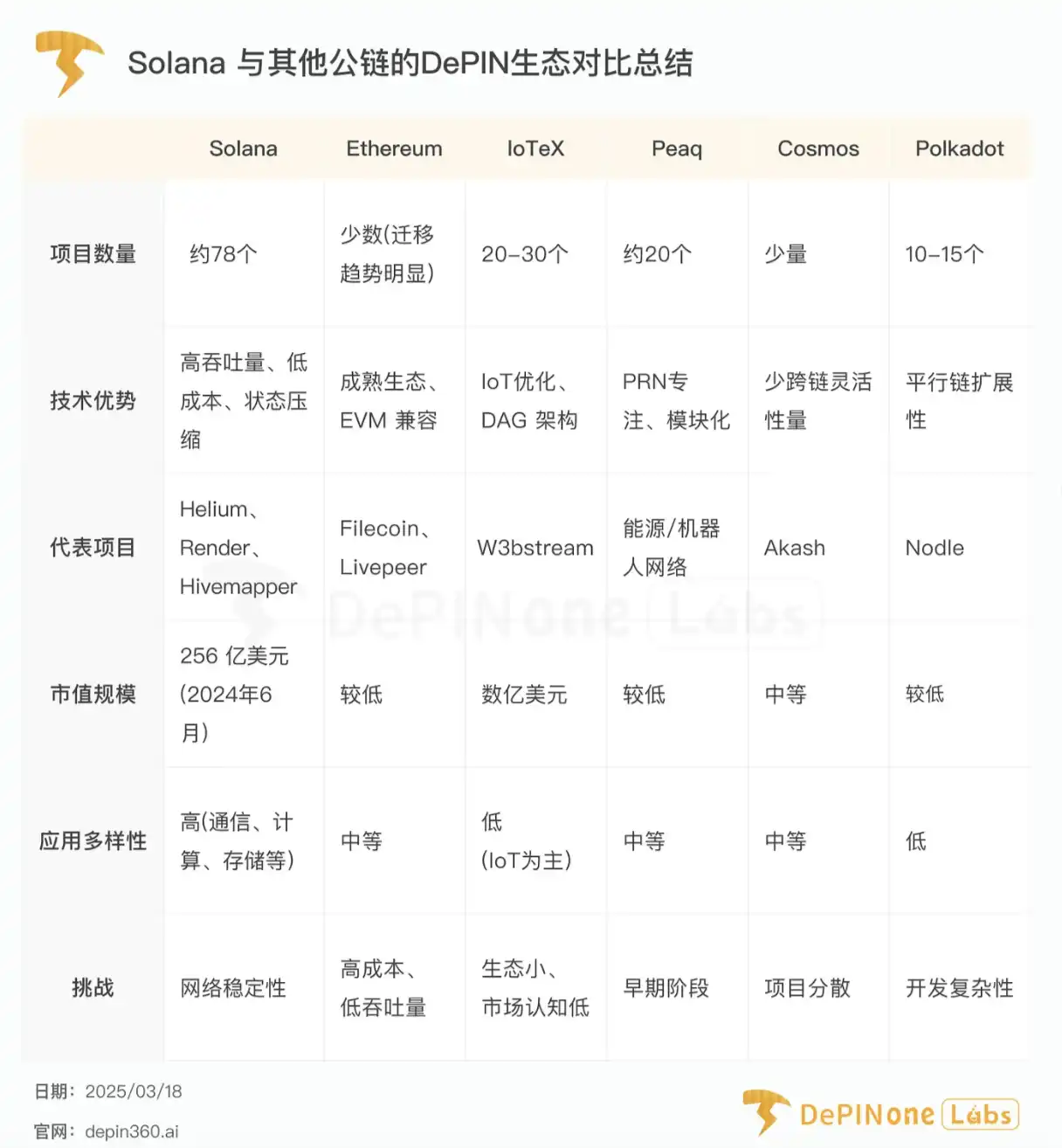
From the table above, it is evident that Solana has a significant advantage in the DePIN track compared to other public chains in the DePIN track:
In terms of technical performance and cost advantage, Solana's high performance and low cost, especially its low Gas fees compared to chains like Ethereum, are particularly friendly to DePIN projects that require frequent transactions (such as micro-payment incentives); Proof of History (PoH) and parallel processing capabilities enable Solana to handle large amounts of real-time data for DePIN projects (such as IoT device communication, map data uploads), allowing DePIN projects to operate smoothly and provide a comfortable user experience similar to web2 projects.
In the public blockchain ecosystem, the Solana Foundation actively promotes the development of the DePIN project through funding and hackathons (such as collaboration with Multicoin Capital). Recently, the Solana DePIN Special Fund was established specifically to help Solana nurture more high-quality projects, with the first project on it, DoubleZero, being the most well-known one at present.
Therefore, we optimistically believe that Solana is not merely a Memecoin public chain. Its journey to today is definitely not solely due to its MEME effect, but rather its strong ecosystem foundation, technical advocacy, and robust support for the community and projects. We optimistically anticipate that the next DePIN empire's ecosystem may emerge on Solana.
III. Other Recent Important Events in the DePIN Track
1. On February 1, IoTeX, a DePIN and AI fully chain-compatible modular infrastructure, announced its 2025 development roadmap focusing on the DePIN + AI ecosystem:
Physical Perception AI Empowered by DePIN
IoTeX has launched the open-source framework QuickSilver, which combines Large Language Models (LLMs) with DePIN network data to create advanced AI applications. In the first quarter, IoTeX plans to launch the QuickSilver testnet, enabling developers to utilize QuickSilver to bridge the existing DePIN world with the emerging AI world, creating a wave of new "perceptual AI applications."
Establishing a DePIN + AI Strategic Reserve
IoTeX will create an initial BTC-based DePIN + AI asset strategic reserve for IOTX holders. This reserve will serve as a "store of value" for long-term quality tokens and assets, safeguarding the interests of IOTX holders.
Community First
A comprehensive community empowerment plan, combined with a DAO-based governance model, allows the community to directly participate in IoTeX's development.
2. On March 3, during the ETHDenver 2025 event, the DePIN + AI R3al World Summit, Blockchain Association's Policy Director Salah and IoTeX's Ecosystem Lead Larry engaged in forward-looking discussions on cryptocurrency and DePIN + AI regulatory frameworks, sparking industry-wide contemplation on the fusion of technology and policy trends.
Salah emphasized: "The current US regulatory agencies are accelerating the exploration of how to incorporate innovative technologies that bridge the physical and digital worlds, such as DePIN, into the national strategic framework. The future regulatory framework must balance technological innovation with the public interest, and the transparency of DePIN and the explainability of AI may become key to solving regulatory challenges."
Larry shared IoTeX's practical experience: "From compliance collaborations with Grayscale and Coinbase to serving as Co-Chair of the Blockchain Association's DePIN Working Group, we have always been centered on 'verifiable physical data,' driving the alignment of DePIN + AI with real-world economic needs."
3. On March 6, the Solana Foundation and the Solana Chinese community Solar will hold a DePIN Day event on March 8 in Shenzhen, the hardware capital.
Solana's emerging DePIN projects such as Cudis, Starpower, Geodnet, Roam, Aethir, Gradient, and DeGlass will attend and conduct on-site showcases and sharing.
IV. Recent Industry Funding Events
1. On February 27, the Solana ecosystem DePIN project Shaga completed a $4 million seed round of financing, led by IOSG Ventures, with participation from Everyrealm, Amber Group, and multiple angel investors.
Shaga aims to reshape the gaming industry—break through hardware limitations, bring ultra-low latency, and make high-performance gaming accessible to all.
BlockBeats previously reported that on June 25, 2024, Shaga completed a $1 million angel round of financing, led by Arca, with participation from MARIN DIGITAL VENTURES, Skybridge20 Ventures, Aurory, Quotient Ventures, as well as angel investors such as Solana co-founder Anatoly Yakovenko and Helium founder Amir Haleem.
2. On February 25, the DePIN project Geodnet completed an $8 million token financing, led by Multicoin.
Geodnet provides financial incentives for startups to encourage ordinary people to host physical infrastructure. Due to the strong demand for Geodnet's services, the project's token (and its incentive mechanism) has more than doubled in value in the past 12 months.
In April of last year, the GEODNET Foundation announced the completion of over $2 million in strategic funding, with participation from CoinFund, Pantera Capital, VanEck, and Santiago R. Santos. The additional funds raised will support the foundation in achieving its short-term goals, including decentralization and developer usability.
On February 5, DePIN Game Infrastructure Platform Beamable completed a $13.5 million Series A funding round, led by Bitkraft Ventures.
The Beamable Network aims to transform the way game backend infrastructure is built and operated.
The DoubleZero Foundation announced a $28 million investment led by Dragonfly and Multicoin Capital.
Double Zero is a project based on the DePIN track, allowing anyone to contribute independently provisioned fiber-optic links without permission. This is essentially laying the "information superhighway" for the Web3 world. The project's key feature lies in its hardware-driven nature, targeting the infrastructure layer directly. DoubleZero's goal is simple: to increase bandwidth and reduce latency for all high-performance blockchains.
You may also like

Token Cannot Compound, Where Is the Real Investment Opportunity?

February 6th Market Key Intelligence, How Much Did You Miss?

China's Central Bank and Eight Other Departments' Latest Regulatory Focus: Key Attention to RWA Tokenized Asset Risk
Foreword: Today, the People's Bank of China's website published the "Notice of the People's Bank of China, National Development and Reform Commission, Ministry of Industry and Information Technology, Ministry of Public Security, State Administration for Market Regulation, China Banking and Insurance Regulatory Commission, China Securities Regulatory Commission, State Administration of Foreign Exchange on Further Preventing and Dealing with Risks Related to Virtual Currency and Others (Yinfa [2026] No. 42)", the latest regulatory requirements from the eight departments including the central bank, which are basically consistent with the regulatory requirements of recent years. The main focus of the regulation is on speculative activities such as virtual currency trading, exchanges, ICOs, overseas platform services, and this time, regulatory oversight of RWA has been added, explicitly prohibiting RWA tokenization, stablecoins (especially those pegged to the RMB). The following is the full text:
To the people's governments of all provinces, autonomous regions, and municipalities directly under the Central Government, the Xinjiang Production and Construction Corps:
Recently, there have been speculative activities related to virtual currency and Real-World Assets (RWA) tokenization, disrupting the economic and financial order and jeopardizing the property security of the people. In order to further prevent and address the risks related to virtual currency and Real-World Assets tokenization, effectively safeguard national security and social stability, in accordance with the "Law of the People's Republic of China on the People's Bank of China," "Law of the People's Republic of China on Commercial Banks," "Securities Law of the People's Republic of China," "Law of the People's Republic of China on Securities Investment Funds," "Law of the People's Republic of China on Futures and Derivatives," "Cybersecurity Law of the People's Republic of China," "Regulations of the People's Republic of China on the Administration of Renminbi," "Regulations on Prevention and Disposal of Illegal Fundraising," "Regulations of the People's Republic of China on Foreign Exchange Administration," "Telecommunications Regulations of the People's Republic of China," and other provisions, after reaching consensus with the Cyberspace Administration of China, the Supreme People's Court, and the Supreme People's Procuratorate, and with the approval of the State Council, the relevant matters are notified as follows:
(I) Virtual currency does not possess the legal status equivalent to fiat currency. Virtual currencies such as Bitcoin, Ether, Tether, etc., have the main characteristics of being issued by non-monetary authorities, using encryption technology and distributed ledger or similar technology, existing in digital form, etc. They do not have legal tender status, should not and cannot be circulated and used as currency in the market.
The business activities related to virtual currency are classified as illegal financial activities. The exchange of fiat currency and virtual currency within the territory, exchange of virtual currencies, acting as a central counterparty in buying and selling virtual currencies, providing information intermediary and pricing services for virtual currency transactions, token issuance financing, and trading of virtual currency-related financial products, etc., fall under illegal financial activities, such as suspected illegal issuance of token vouchers, unauthorized public issuance of securities, illegal operation of securities and futures business, illegal fundraising, etc., are strictly prohibited across the board and resolutely banned in accordance with the law. Overseas entities and individuals are not allowed to provide virtual currency-related services to domestic entities in any form.
A stablecoin pegged to a fiat currency indirectly fulfills some functions of the fiat currency in circulation. Without the consent of relevant authorities in accordance with the law and regulations, any domestic or foreign entity or individual is not allowed to issue a RMB-pegged stablecoin overseas.
(II)Tokenization of Real-World Assets refers to the use of encryption technology and distributed ledger or similar technologies to transform ownership rights, income rights, etc., of assets into tokens (tokens) or other interests or bond certificates with token (token) characteristics, and carry out issuance and trading activities.
Engaging in the tokenization of real-world assets domestically, as well as providing related intermediary, information technology services, etc., which are suspected of illegal issuance of token vouchers, unauthorized public offering of securities, illegal operation of securities and futures business, illegal fundraising, and other illegal financial activities, shall be prohibited; except for relevant business activities carried out with the approval of the competent authorities in accordance with the law and regulations and relying on specific financial infrastructures. Overseas entities and individuals are not allowed to illegally provide services related to the tokenization of real-world assets to domestic entities in any form.
(III) Inter-agency Coordination. The People's Bank of China, together with the National Development and Reform Commission, the Ministry of Industry and Information Technology, the Ministry of Public Security, the State Administration for Market Regulation, the China Banking and Insurance Regulatory Commission, the China Securities Regulatory Commission, the State Administration of Foreign Exchange, and other departments, will improve the work mechanism, strengthen coordination with the Cyberspace Administration of China, the Supreme People's Court, and the Supreme People's Procuratorate, coordinate efforts, and overall guide regions to carry out risk prevention and disposal of virtual currency-related illegal financial activities.
The China Securities Regulatory Commission, together with the National Development and Reform Commission, the Ministry of Industry and Information Technology, the Ministry of Public Security, the People's Bank of China, the State Administration for Market Regulation, the China Banking and Insurance Regulatory Commission, the State Administration of Foreign Exchange, and other departments, will improve the work mechanism, strengthen coordination with the Cyberspace Administration of China, the Supreme People's Court, and the Supreme People's Procuratorate, coordinate efforts, and overall guide regions to carry out risk prevention and disposal of illegal financial activities related to the tokenization of real-world assets.
(IV) Strengthening Local Implementation. The people's governments at the provincial level are overall responsible for the prevention and disposal of risks related to virtual currencies and the tokenization of real-world assets in their respective administrative regions. The specific leading department is the local financial regulatory department, with participation from branches and dispatched institutions of the State Council's financial regulatory department, telecommunications regulators, public security, market supervision, and other departments, in coordination with cyberspace departments, courts, and procuratorates, to improve the normalization of the work mechanism, effectively connect with the relevant work mechanisms of central departments, form a cooperative and coordinated working pattern between central and local governments, effectively prevent and properly handle risks related to virtual currencies and the tokenization of real-world assets, and maintain economic and financial order and social stability.
(5) Enhanced Risk Monitoring. The People's Bank of China, China Securities Regulatory Commission, National Development and Reform Commission, Ministry of Industry and Information Technology, Ministry of Public Security, State Administration of Foreign Exchange, Cyberspace Administration of China, and other departments continue to improve monitoring techniques and system support, enhance cross-departmental data analysis and sharing, establish sound information sharing and cross-validation mechanisms, promptly grasp the risk situation of activities related to virtual currency and real-world asset tokenization. Local governments at all levels give full play to the role of local monitoring and early warning mechanisms. Local financial regulatory authorities, together with branches and agencies of the State Council's financial regulatory authorities, as well as departments of cyberspace and public security, ensure effective connection between online monitoring, offline investigation, and fund tracking, efficiently and accurately identify activities related to virtual currency and real-world asset tokenization, promptly share risk information, improve early warning information dissemination, verification, and rapid response mechanisms.
(6) Strengthened Oversight of Financial Institutions, Intermediaries, and Technology Service Providers. Financial institutions (including non-bank payment institutions) are prohibited from providing account opening, fund transfer, and clearing services for virtual currency-related business activities, issuing and selling financial products related to virtual currency, including virtual currency and related financial products in the scope of collateral, conducting insurance business related to virtual currency, or including virtual currency in the scope of insurance liability. Financial institutions (including non-bank payment institutions) are prohibited from providing custody, clearing, and settlement services for unauthorized real-world asset tokenization-related business and related financial products. Relevant intermediary institutions and information technology service providers are prohibited from providing intermediary, technical, or other services for unauthorized real-world asset tokenization-related businesses and related financial products.
(7) Enhanced Management of Internet Information Content and Access. Internet enterprises are prohibited from providing online business venues, commercial displays, marketing, advertising, or paid traffic diversion services for virtual currency and real-world asset tokenization-related business activities. Upon discovering clues of illegal activities, they should promptly report to relevant departments and provide technical support and assistance for related investigations and inquiries. Based on the clues transferred by the financial regulatory authorities, the cyberspace administration, telecommunications authorities, and public security departments should promptly close and deal with websites, mobile applications (including mini-programs), and public accounts engaged in virtual currency and real-world asset tokenization-related business activities in accordance with the law.
(8) Strengthened Entity Registration and Advertisement Management. Market supervision departments strengthen entity registration and management, and enterprise and individual business registrations must not contain terms such as "virtual currency," "virtual asset," "cryptocurrency," "crypto asset," "stablecoin," "real-world asset tokenization," or "RWA" in their names or business scopes. Market supervision departments, together with financial regulatory authorities, legally enhance the supervision of advertisements related to virtual currency and real-world asset tokenization, promptly investigating and handling relevant illegal advertisements.
(IX) Continued Rectification of Virtual Currency Mining Activities. The National Development and Reform Commission, together with relevant departments, strictly controls virtual currency mining activities, continuously promotes the rectification of virtual currency mining activities. The people's governments of various provinces take overall responsibility for the rectification of "mining" within their respective administrative regions. In accordance with the requirements of the National Development and Reform Commission and other departments in the "Notice on the Rectification of Virtual Currency Mining Activities" (NDRC Energy-saving Building [2021] No. 1283) and the provisions of the "Guidance Catalog for Industrial Structure Adjustment (2024 Edition)," a comprehensive review, investigation, and closure of existing virtual currency mining projects are conducted, new mining projects are strictly prohibited, and mining machine production enterprises are strictly prohibited from providing mining machine sales and other services within the country.
(X) Severe Crackdown on Related Illegal Financial Activities. Upon discovering clues to illegal financial activities related to virtual currency and the tokenization of real-world assets, local financial regulatory authorities, branches of the State Council's financial regulatory authorities, and other relevant departments promptly investigate, determine, and properly handle the issues in accordance with the law, and seriously hold the relevant entities and individuals legally responsible. Those suspected of crimes are transferred to the judicial authorities for processing according to the law.
(XI) Severe Crackdown on Related Illegal and Criminal Activities. The Ministry of Public Security, the People's Bank of China, the State Administration for Market Regulation, the China Banking and Insurance Regulatory Commission, the China Securities Regulatory Commission, as well as judicial and procuratorial organs, in accordance with their respective responsibilities, rigorously crack down on illegal and criminal activities related to virtual currency, the tokenization of real-world assets, such as fraud, money laundering, illegal business operations, pyramid schemes, illegal fundraising, and other illegal and criminal activities carried out under the guise of virtual currency, the tokenization of real-world assets, etc.
(XII) Strengthen Industry Self-discipline. Relevant industry associations should enhance membership management and policy advocacy, based on their own responsibilities, advocate and urge member units to resist illegal financial activities related to virtual currency and the tokenization of real-world assets. Member units that violate regulatory policies and industry self-discipline rules are to be disciplined in accordance with relevant self-regulatory management regulations. By leveraging various industry infrastructure, conduct risk monitoring related to virtual currency, the tokenization of real-world assets, and promptly transfer issue clues to relevant departments.
(XIII) Without the approval of relevant departments in accordance with the law and regulations, domestic entities and foreign entities controlled by them may not issue virtual currency overseas.
(XIV) Domestic entities engaging directly or indirectly in overseas external debt-based tokenization of real-world assets, or conducting asset securitization activities abroad based on domestic ownership rights, income rights, etc. (hereinafter referred to as domestic equity), should be strictly regulated in accordance with the principles of "same business, same risk, same rules." The National Development and Reform Commission, the China Securities Regulatory Commission, the State Administration of Foreign Exchange, and other relevant departments regulate it according to their respective responsibilities. For other forms of overseas real-world asset tokenization activities based on domestic equity by domestic entities, the China Securities Regulatory Commission, together with relevant departments, supervise according to their division of responsibilities. Without the consent and filing of relevant departments, no unit or individual may engage in the above-mentioned business.
(15) Overseas subsidiaries and branches of domestic financial institutions providing Real World Asset Tokenization-related services overseas shall do so legally and prudently. They shall have professional personnel and systems in place to effectively mitigate business risks, strictly implement customer onboarding, suitability management, anti-money laundering requirements, and incorporate them into the domestic financial institutions' compliance and risk management system. Intermediaries and information technology service providers offering Real World Asset Tokenization services abroad based on domestic equity or conducting Real World Asset Tokenization business in the form of overseas debt for domestic entities directly or indirectly venturing abroad must strictly comply with relevant laws and regulations. They should establish and improve relevant compliance and internal control systems in accordance with relevant normative requirements, strengthen business and risk control, and report the business developments to the relevant regulatory authorities for approval or filing.
(16) Strengthen organizational leadership and overall coordination. All departments and regions should attach great importance to the prevention of risks related to virtual currencies and Real World Asset Tokenization, strengthen organizational leadership, clarify work responsibilities, form a long-term effective working mechanism with centralized coordination, local implementation, and shared responsibilities, maintain high pressure, dynamically monitor risks, effectively prevent and mitigate risks in an orderly and efficient manner, legally protect the property security of the people, and make every effort to maintain economic and financial order and social stability.
(17) Widely carry out publicity and education. All departments, regions, and industry associations should make full use of various media and other communication channels to disseminate information through legal and policy interpretation, analysis of typical cases, and education on investment risks, etc. They should promote the illegality and harm of virtual currencies and Real World Asset Tokenization-related businesses and their manifestations, fully alert to potential risks and hidden dangers, and enhance public awareness and identification capabilities for risk prevention.
(18) Engaging in illegal financial activities related to virtual currencies and Real World Asset Tokenization in violation of this notice, as well as providing services for virtual currencies and Real World Asset Tokenization-related businesses, shall be punished in accordance with relevant regulations. If it constitutes a crime, criminal liability shall be pursued according to the law. For domestic entities and individuals who knowingly or should have known that overseas entities illegally provided virtual currency or Real World Asset Tokenization-related services to domestic entities and still assisted them, relevant responsibilities shall be pursued according to the law. If it constitutes a crime, criminal liability shall be pursued according to the law.
(19) If any unit or individual invests in virtual currencies, Real World Asset Tokens, and related financial products against public order and good customs, the relevant civil legal actions shall be invalid, and any resulting losses shall be borne by them. If there are suspicions of disrupting financial order and jeopardizing financial security, the relevant departments shall deal with them according to the law.
This notice shall enter into force upon the date of its issuance. The People's Bank of China and ten other departments' "Notice on Further Preventing and Dealing with the Risks of Virtual Currency Trading Speculation" (Yinfa [2021] No. 237) is hereby repealed.

Former Partner's Perspective on Multicoin: Kyle's Exit, But the Game He Left Behind Just Getting Started

Why Bitcoin Is Falling Now: The Real Reasons Behind BTC's Crash & WEEX's Smart Profit Playbook
Bitcoin's ongoing crash explained: Discover the 5 hidden triggers behind BTC's plunge & how WEEX's Auto Earn and Trade to Earn strategies help traders profit from crypto market volatility.

Wall Street's Hottest Trades See Exodus

Vitalik Discusses Ethereum Scaling Path, Circle Announces Partnership with Polymarket, What's the Overseas Crypto Community Talking About Today?

Believing in the Capital Markets - The Essence and Core Value of Cryptocurrency

Polymarket's 'Weatherman': Predict Temperature, Win Million-Dollar Payout

$15K+ Profits: The 4 AI Trading Secrets WEEX Hackathon Prelim Winners Used to Dominate Volatile Crypto Markets
How WEEX Hackathon's top AI trading strategies made $15K+ in crypto markets: 4 proven rules for ETH/BTC trading, market structure analysis, and risk management in volatile conditions.

A nearly 20% one-day plunge, how long has it been since you last saw a $60,000 Bitcoin?

Raoul Pal: I've seen every single panic, and they are never the end.

Key Market Information Discrepancy on February 6th - A Must-Read! | Alpha Morning Report

2026 Crypto Industry's First Snowfall
The Harsh Reality Behind the $26 Billion Crypto Liquidation: Liquidity Is Killing the Market
Why Is Gold, US Stocks, Bitcoin All Falling?

Key Market Intelligence for February 5th, how much did you miss out on?

Wintermute: By 2026, crypto had gradually become the settlement layer of the Internet economy
Token Cannot Compound, Where Is the Real Investment Opportunity?
February 6th Market Key Intelligence, How Much Did You Miss?
China's Central Bank and Eight Other Departments' Latest Regulatory Focus: Key Attention to RWA Tokenized Asset Risk
Foreword: Today, the People's Bank of China's website published the "Notice of the People's Bank of China, National Development and Reform Commission, Ministry of Industry and Information Technology, Ministry of Public Security, State Administration for Market Regulation, China Banking and Insurance Regulatory Commission, China Securities Regulatory Commission, State Administration of Foreign Exchange on Further Preventing and Dealing with Risks Related to Virtual Currency and Others (Yinfa [2026] No. 42)", the latest regulatory requirements from the eight departments including the central bank, which are basically consistent with the regulatory requirements of recent years. The main focus of the regulation is on speculative activities such as virtual currency trading, exchanges, ICOs, overseas platform services, and this time, regulatory oversight of RWA has been added, explicitly prohibiting RWA tokenization, stablecoins (especially those pegged to the RMB). The following is the full text:
To the people's governments of all provinces, autonomous regions, and municipalities directly under the Central Government, the Xinjiang Production and Construction Corps:
Recently, there have been speculative activities related to virtual currency and Real-World Assets (RWA) tokenization, disrupting the economic and financial order and jeopardizing the property security of the people. In order to further prevent and address the risks related to virtual currency and Real-World Assets tokenization, effectively safeguard national security and social stability, in accordance with the "Law of the People's Republic of China on the People's Bank of China," "Law of the People's Republic of China on Commercial Banks," "Securities Law of the People's Republic of China," "Law of the People's Republic of China on Securities Investment Funds," "Law of the People's Republic of China on Futures and Derivatives," "Cybersecurity Law of the People's Republic of China," "Regulations of the People's Republic of China on the Administration of Renminbi," "Regulations on Prevention and Disposal of Illegal Fundraising," "Regulations of the People's Republic of China on Foreign Exchange Administration," "Telecommunications Regulations of the People's Republic of China," and other provisions, after reaching consensus with the Cyberspace Administration of China, the Supreme People's Court, and the Supreme People's Procuratorate, and with the approval of the State Council, the relevant matters are notified as follows:
(I) Virtual currency does not possess the legal status equivalent to fiat currency. Virtual currencies such as Bitcoin, Ether, Tether, etc., have the main characteristics of being issued by non-monetary authorities, using encryption technology and distributed ledger or similar technology, existing in digital form, etc. They do not have legal tender status, should not and cannot be circulated and used as currency in the market.
The business activities related to virtual currency are classified as illegal financial activities. The exchange of fiat currency and virtual currency within the territory, exchange of virtual currencies, acting as a central counterparty in buying and selling virtual currencies, providing information intermediary and pricing services for virtual currency transactions, token issuance financing, and trading of virtual currency-related financial products, etc., fall under illegal financial activities, such as suspected illegal issuance of token vouchers, unauthorized public issuance of securities, illegal operation of securities and futures business, illegal fundraising, etc., are strictly prohibited across the board and resolutely banned in accordance with the law. Overseas entities and individuals are not allowed to provide virtual currency-related services to domestic entities in any form.
A stablecoin pegged to a fiat currency indirectly fulfills some functions of the fiat currency in circulation. Without the consent of relevant authorities in accordance with the law and regulations, any domestic or foreign entity or individual is not allowed to issue a RMB-pegged stablecoin overseas.
(II)Tokenization of Real-World Assets refers to the use of encryption technology and distributed ledger or similar technologies to transform ownership rights, income rights, etc., of assets into tokens (tokens) or other interests or bond certificates with token (token) characteristics, and carry out issuance and trading activities.
Engaging in the tokenization of real-world assets domestically, as well as providing related intermediary, information technology services, etc., which are suspected of illegal issuance of token vouchers, unauthorized public offering of securities, illegal operation of securities and futures business, illegal fundraising, and other illegal financial activities, shall be prohibited; except for relevant business activities carried out with the approval of the competent authorities in accordance with the law and regulations and relying on specific financial infrastructures. Overseas entities and individuals are not allowed to illegally provide services related to the tokenization of real-world assets to domestic entities in any form.
(III) Inter-agency Coordination. The People's Bank of China, together with the National Development and Reform Commission, the Ministry of Industry and Information Technology, the Ministry of Public Security, the State Administration for Market Regulation, the China Banking and Insurance Regulatory Commission, the China Securities Regulatory Commission, the State Administration of Foreign Exchange, and other departments, will improve the work mechanism, strengthen coordination with the Cyberspace Administration of China, the Supreme People's Court, and the Supreme People's Procuratorate, coordinate efforts, and overall guide regions to carry out risk prevention and disposal of virtual currency-related illegal financial activities.
The China Securities Regulatory Commission, together with the National Development and Reform Commission, the Ministry of Industry and Information Technology, the Ministry of Public Security, the People's Bank of China, the State Administration for Market Regulation, the China Banking and Insurance Regulatory Commission, the State Administration of Foreign Exchange, and other departments, will improve the work mechanism, strengthen coordination with the Cyberspace Administration of China, the Supreme People's Court, and the Supreme People's Procuratorate, coordinate efforts, and overall guide regions to carry out risk prevention and disposal of illegal financial activities related to the tokenization of real-world assets.
(IV) Strengthening Local Implementation. The people's governments at the provincial level are overall responsible for the prevention and disposal of risks related to virtual currencies and the tokenization of real-world assets in their respective administrative regions. The specific leading department is the local financial regulatory department, with participation from branches and dispatched institutions of the State Council's financial regulatory department, telecommunications regulators, public security, market supervision, and other departments, in coordination with cyberspace departments, courts, and procuratorates, to improve the normalization of the work mechanism, effectively connect with the relevant work mechanisms of central departments, form a cooperative and coordinated working pattern between central and local governments, effectively prevent and properly handle risks related to virtual currencies and the tokenization of real-world assets, and maintain economic and financial order and social stability.
(5) Enhanced Risk Monitoring. The People's Bank of China, China Securities Regulatory Commission, National Development and Reform Commission, Ministry of Industry and Information Technology, Ministry of Public Security, State Administration of Foreign Exchange, Cyberspace Administration of China, and other departments continue to improve monitoring techniques and system support, enhance cross-departmental data analysis and sharing, establish sound information sharing and cross-validation mechanisms, promptly grasp the risk situation of activities related to virtual currency and real-world asset tokenization. Local governments at all levels give full play to the role of local monitoring and early warning mechanisms. Local financial regulatory authorities, together with branches and agencies of the State Council's financial regulatory authorities, as well as departments of cyberspace and public security, ensure effective connection between online monitoring, offline investigation, and fund tracking, efficiently and accurately identify activities related to virtual currency and real-world asset tokenization, promptly share risk information, improve early warning information dissemination, verification, and rapid response mechanisms.
(6) Strengthened Oversight of Financial Institutions, Intermediaries, and Technology Service Providers. Financial institutions (including non-bank payment institutions) are prohibited from providing account opening, fund transfer, and clearing services for virtual currency-related business activities, issuing and selling financial products related to virtual currency, including virtual currency and related financial products in the scope of collateral, conducting insurance business related to virtual currency, or including virtual currency in the scope of insurance liability. Financial institutions (including non-bank payment institutions) are prohibited from providing custody, clearing, and settlement services for unauthorized real-world asset tokenization-related business and related financial products. Relevant intermediary institutions and information technology service providers are prohibited from providing intermediary, technical, or other services for unauthorized real-world asset tokenization-related businesses and related financial products.
(7) Enhanced Management of Internet Information Content and Access. Internet enterprises are prohibited from providing online business venues, commercial displays, marketing, advertising, or paid traffic diversion services for virtual currency and real-world asset tokenization-related business activities. Upon discovering clues of illegal activities, they should promptly report to relevant departments and provide technical support and assistance for related investigations and inquiries. Based on the clues transferred by the financial regulatory authorities, the cyberspace administration, telecommunications authorities, and public security departments should promptly close and deal with websites, mobile applications (including mini-programs), and public accounts engaged in virtual currency and real-world asset tokenization-related business activities in accordance with the law.
(8) Strengthened Entity Registration and Advertisement Management. Market supervision departments strengthen entity registration and management, and enterprise and individual business registrations must not contain terms such as "virtual currency," "virtual asset," "cryptocurrency," "crypto asset," "stablecoin," "real-world asset tokenization," or "RWA" in their names or business scopes. Market supervision departments, together with financial regulatory authorities, legally enhance the supervision of advertisements related to virtual currency and real-world asset tokenization, promptly investigating and handling relevant illegal advertisements.
(IX) Continued Rectification of Virtual Currency Mining Activities. The National Development and Reform Commission, together with relevant departments, strictly controls virtual currency mining activities, continuously promotes the rectification of virtual currency mining activities. The people's governments of various provinces take overall responsibility for the rectification of "mining" within their respective administrative regions. In accordance with the requirements of the National Development and Reform Commission and other departments in the "Notice on the Rectification of Virtual Currency Mining Activities" (NDRC Energy-saving Building [2021] No. 1283) and the provisions of the "Guidance Catalog for Industrial Structure Adjustment (2024 Edition)," a comprehensive review, investigation, and closure of existing virtual currency mining projects are conducted, new mining projects are strictly prohibited, and mining machine production enterprises are strictly prohibited from providing mining machine sales and other services within the country.
(X) Severe Crackdown on Related Illegal Financial Activities. Upon discovering clues to illegal financial activities related to virtual currency and the tokenization of real-world assets, local financial regulatory authorities, branches of the State Council's financial regulatory authorities, and other relevant departments promptly investigate, determine, and properly handle the issues in accordance with the law, and seriously hold the relevant entities and individuals legally responsible. Those suspected of crimes are transferred to the judicial authorities for processing according to the law.
(XI) Severe Crackdown on Related Illegal and Criminal Activities. The Ministry of Public Security, the People's Bank of China, the State Administration for Market Regulation, the China Banking and Insurance Regulatory Commission, the China Securities Regulatory Commission, as well as judicial and procuratorial organs, in accordance with their respective responsibilities, rigorously crack down on illegal and criminal activities related to virtual currency, the tokenization of real-world assets, such as fraud, money laundering, illegal business operations, pyramid schemes, illegal fundraising, and other illegal and criminal activities carried out under the guise of virtual currency, the tokenization of real-world assets, etc.
(XII) Strengthen Industry Self-discipline. Relevant industry associations should enhance membership management and policy advocacy, based on their own responsibilities, advocate and urge member units to resist illegal financial activities related to virtual currency and the tokenization of real-world assets. Member units that violate regulatory policies and industry self-discipline rules are to be disciplined in accordance with relevant self-regulatory management regulations. By leveraging various industry infrastructure, conduct risk monitoring related to virtual currency, the tokenization of real-world assets, and promptly transfer issue clues to relevant departments.
(XIII) Without the approval of relevant departments in accordance with the law and regulations, domestic entities and foreign entities controlled by them may not issue virtual currency overseas.
(XIV) Domestic entities engaging directly or indirectly in overseas external debt-based tokenization of real-world assets, or conducting asset securitization activities abroad based on domestic ownership rights, income rights, etc. (hereinafter referred to as domestic equity), should be strictly regulated in accordance with the principles of "same business, same risk, same rules." The National Development and Reform Commission, the China Securities Regulatory Commission, the State Administration of Foreign Exchange, and other relevant departments regulate it according to their respective responsibilities. For other forms of overseas real-world asset tokenization activities based on domestic equity by domestic entities, the China Securities Regulatory Commission, together with relevant departments, supervise according to their division of responsibilities. Without the consent and filing of relevant departments, no unit or individual may engage in the above-mentioned business.
(15) Overseas subsidiaries and branches of domestic financial institutions providing Real World Asset Tokenization-related services overseas shall do so legally and prudently. They shall have professional personnel and systems in place to effectively mitigate business risks, strictly implement customer onboarding, suitability management, anti-money laundering requirements, and incorporate them into the domestic financial institutions' compliance and risk management system. Intermediaries and information technology service providers offering Real World Asset Tokenization services abroad based on domestic equity or conducting Real World Asset Tokenization business in the form of overseas debt for domestic entities directly or indirectly venturing abroad must strictly comply with relevant laws and regulations. They should establish and improve relevant compliance and internal control systems in accordance with relevant normative requirements, strengthen business and risk control, and report the business developments to the relevant regulatory authorities for approval or filing.
(16) Strengthen organizational leadership and overall coordination. All departments and regions should attach great importance to the prevention of risks related to virtual currencies and Real World Asset Tokenization, strengthen organizational leadership, clarify work responsibilities, form a long-term effective working mechanism with centralized coordination, local implementation, and shared responsibilities, maintain high pressure, dynamically monitor risks, effectively prevent and mitigate risks in an orderly and efficient manner, legally protect the property security of the people, and make every effort to maintain economic and financial order and social stability.
(17) Widely carry out publicity and education. All departments, regions, and industry associations should make full use of various media and other communication channels to disseminate information through legal and policy interpretation, analysis of typical cases, and education on investment risks, etc. They should promote the illegality and harm of virtual currencies and Real World Asset Tokenization-related businesses and their manifestations, fully alert to potential risks and hidden dangers, and enhance public awareness and identification capabilities for risk prevention.
(18) Engaging in illegal financial activities related to virtual currencies and Real World Asset Tokenization in violation of this notice, as well as providing services for virtual currencies and Real World Asset Tokenization-related businesses, shall be punished in accordance with relevant regulations. If it constitutes a crime, criminal liability shall be pursued according to the law. For domestic entities and individuals who knowingly or should have known that overseas entities illegally provided virtual currency or Real World Asset Tokenization-related services to domestic entities and still assisted them, relevant responsibilities shall be pursued according to the law. If it constitutes a crime, criminal liability shall be pursued according to the law.
(19) If any unit or individual invests in virtual currencies, Real World Asset Tokens, and related financial products against public order and good customs, the relevant civil legal actions shall be invalid, and any resulting losses shall be borne by them. If there are suspicions of disrupting financial order and jeopardizing financial security, the relevant departments shall deal with them according to the law.
This notice shall enter into force upon the date of its issuance. The People's Bank of China and ten other departments' "Notice on Further Preventing and Dealing with the Risks of Virtual Currency Trading Speculation" (Yinfa [2021] No. 237) is hereby repealed.
Former Partner's Perspective on Multicoin: Kyle's Exit, But the Game He Left Behind Just Getting Started
Why Bitcoin Is Falling Now: The Real Reasons Behind BTC's Crash & WEEX's Smart Profit Playbook
Bitcoin's ongoing crash explained: Discover the 5 hidden triggers behind BTC's plunge & how WEEX's Auto Earn and Trade to Earn strategies help traders profit from crypto market volatility.


 App
App