
- Buy Crypto
- Markets
 Futures
- Spot
- Copy Trade
 Earn
Earn- More
Galaxy Crypto Lending Market Report: As DeFi Grows 959%, CeFi Still Can't Shake Off the FTX Shadow

Original Title: The State of Crypto Lending
Original Author: Zack Pokorny, Galaxy Digital Researcher
Original Translation: Aiying Compliance
GalaxyResearch released a full year data summary on April 14, 2025, titled "The State of Crypto Lending in 2024." Below is the full report: Lending is an application scenario of cryptocurrency that has found strong market fit both on-chain and off-chain. At the peak of the market, the size of the lending market exceeded $64 billion. The lending market has played a vital role in building a digital asset-based financial ecosystem, allowing users to access liquidity by borrowing against their holdings, enabling deployment in decentralized finance (DeFi), or trading on on-chain and off-chain platforms.
This report explores both on-chain and off-chain cryptocurrency lending markets in two parts: The first part reviews the history of the crypto lending market, market participants, historical sizes (including on-chain and off-chain), and some key moments in this field. The second part delves into the operational mechanisms of some lending products and other leverage sources in both on-chain and off-chain environments, who is utilizing these products, and the risks associated with each product. The report comprehensively presents the landscape of the crypto lending market, unveiling one of the most widely used yet opaque areas in the crypto economy. Importantly, the report provides a rare view of the scale of the off-chain lending market, historically a relatively opaque part of the crypto industry.
I. Key Findings
The overall size of the crypto lending market remains significantly below the peak of the late 2020-2021 crypto bull market. As of Q4 2024, the size of the crypto lending market, including crypto collateralized debt positions (CDPs) stablecoins, was $36.5 billion, a 43% decline from the historical high of $64.4 billion recorded in Q4 2021. This decline can be attributed to a breakdown in lending supply-side and a contraction in funding, individual, and corporate demand on the demand side.
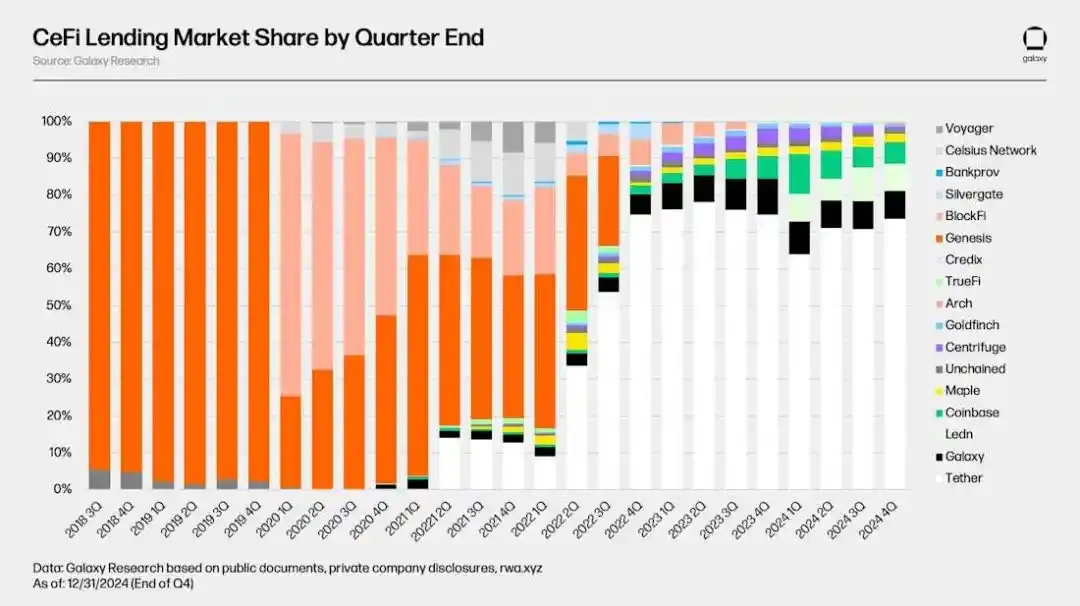
As of Q4 2024, the total size of the crypto lending market is $36.5 billion, with the top 3 Centralized Finance (CeFi) lending institutions being Tether, Galaxy, and Ledn. These three companies had a combined loan book size of $9.9 billion at the end of Q4 2024, accounting for 88.6% of the CeFi lending market (Tether alone having approximately 73% at $8.2 billion), with the market size composition as follows:
· Centralized Finance (CeFi) Lending: $112 billion,
· Decentralized Finance (DeFi) Lending: $191 billion
· Crypto Asset Collateralized Debt Position (CDP) Stablecoins: $62 billion
Since the cryptocurrency market bear market low point in the fourth quarter of 2022 (with an on-chain lending scale of $18 billion), on-chain lending applications have experienced strong growth. As of the fourth quarter of 2024, the total lending volume for 20 lending applications and 12 blockchains is $191 billion. This means that over eight quarters, DeFi lending has grown by 959%.
II. Market Overview
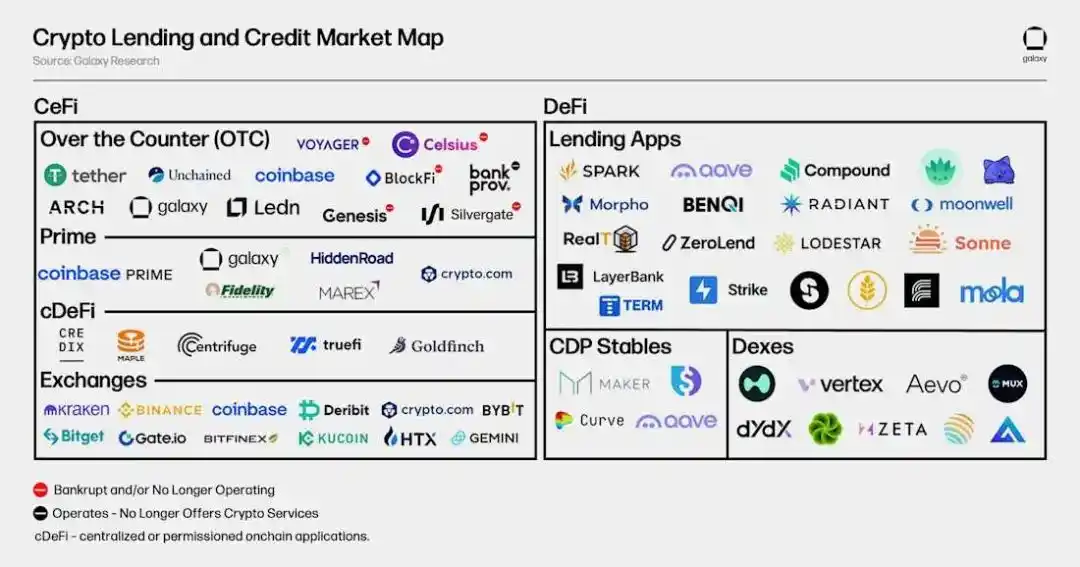
The provision of crypto lending services is mainly through two channels: Decentralized Finance (DeFi) and Centralized Finance (CeFi). Each of these has its own unique characteristics and products. Here is a brief overview of CeFi and DeFi lending services:
1. Centralized Finance (CeFi)
CeFi is the provision of cryptocurrency and related asset lending services by centralized off-chain financial companies. Some CeFi entities utilize on-chain infrastructure, or their entire business is built on-chain. CeFi lending can broadly be divided into three categories:
a. Over-the-Counter (OTC) Trading
OTC trading is provided by centralized institutions, offering a range of customized lending solutions and products. OTC trading is bilateral, allowing personalized agreements between the lending parties, with loan terms including interest rates, tenures, and loan-to-value ratios (LTV). These products are usually aimed at qualified investors and institutions.
b. Prime Brokerage
Prime brokerage platforms offer margin financing, trade execution, and custody services. Users can withdraw margin financing from prime brokers for use elsewhere or on the platform for trading activities. Prime brokers typically provide limited financing for crypto assets and crypto ETFs.
c. On-Chain Private Credit
Allows users to aggregate funds on-chain and deploy them through off-chain protocols and accounts. In this model, the underlying blockchain effectively becomes a crowdfunding and accounting platform to meet off-chain credit needs. Debts are usually tokenized, either as collateralized debt position (CDP) stablecoins or directly tokenized through tokens representing debt pool shares. The use of funds is usually more limited.
2. Decentralized Finance (DeFi)
DeFi is an application driven by smart contracts, running on the blockchain, allowing users to borrow against cryptocurrency collateral, lend to earn interest, or use leverage in trading. DeFi lending and borrowing have the following notable characteristics: operates 24/7, offers a wide range of borrowable and collateral assets, and is fully transparent, allowing anyone to perform audits. Lending applications, collateralized debt positions stablecoins, and decentralized exchanges all enable users to access leverage on-chain.
a. Lending Applications
These on-chain applications allow users to deposit collateral assets (such as Bitcoin and Ethereum) to borrow other cryptocurrencies. Loan terms are predefined by the application through risk assessment and adjust based on the collateral asset provided and the borrowed asset. On-chain lending and borrowing are similar to traditional overcollateralized lending.
b. Collateralized Debt Position Stablecoin
These stablecoins are backed by individual cryptocurrencies or a basket of cryptocurrencies, overcollateralized. The principle is similar to overcollateralized lending and borrowing, but the collateral deposited by users mints synthetic assets.
c. Decentralized Exchange
Some decentralized exchanges allow users to access leverage to amplify their trading positions. Although the functionalities of decentralized exchanges vary, the role of providing leverage is similar to CeFi prime brokers. Leverage funds are usually non-transferable from decentralized exchanges, but they serve a similar function as CeFi's financing services.
III. Market Development and History
The following figure shows the key historical participants in the CeFi and DeFi crypto lending market. In 2022 and 2023, as cryptocurrency prices fell and market liquidity dried up, many major CeFi lending platforms collapsed, notably Genesis, Celsius Network, BlockFi, and Voyager filing for bankruptcy in these two years. This led to an estimated 78% contraction in both the CeFi and DeFi lending markets from the 2022 peak to the bear market trough, with open lending in CeFi decreasing by 82%. The next section will delve into the historical evolution and scale of the crypto lending market.
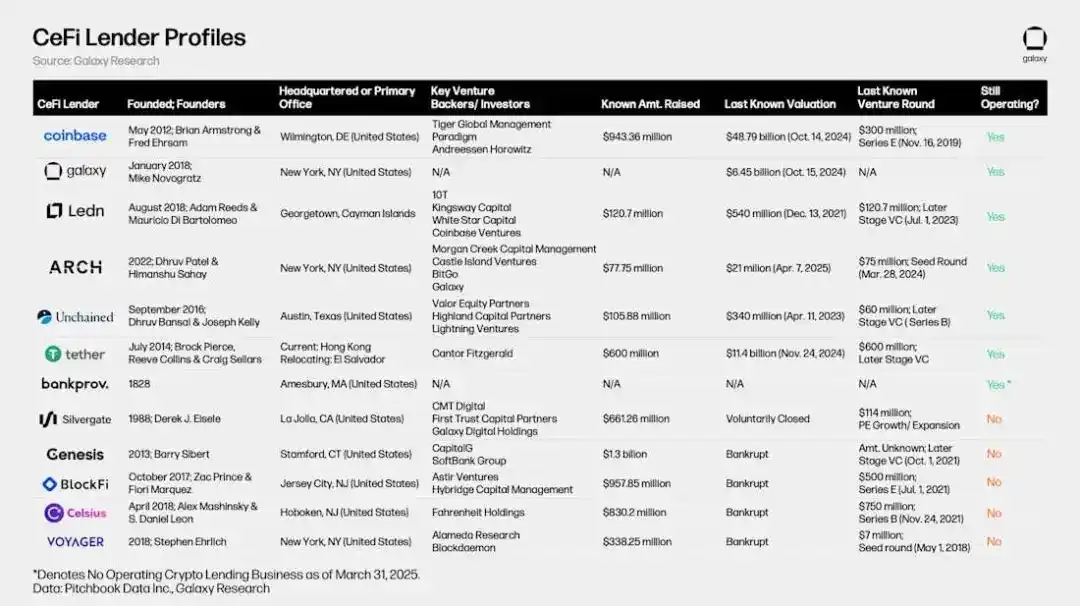
The table below compares some of the largest historical CeFi crypto lending institutions. Some of the listed companies offer various services to investors, such as Coinbase, which, although primarily operating as a cryptocurrency exchange, provides credit services to investors through over-the-counter (OTC) cryptocurrency loans and margin financing.
IV. History of Crypto Lending
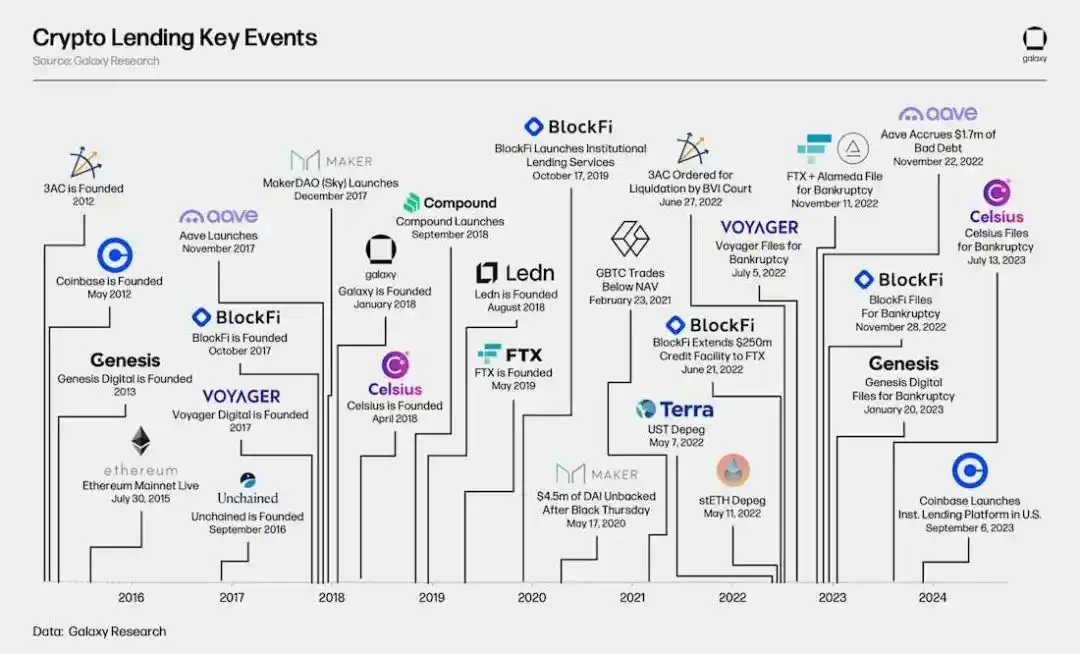
Although on-chain and off-chain crypto lending did not see widespread adoption until the end of 2019/early 2020, some key current and historical players were established as early as 2012. Notably, Genesis was founded in 2013, with its loan book peaking at $14.6 billion. On-chain lending and CDP stablecoin giants like Aave, Sky (formerly MakerDAO), and Compound Finance were launched on the Ethereum platform between 2017 and 2018. The emergence of these on-chain lending/borrowing solutions was made possible by the advent of Ethereum and its smart contracts, with Ethereum smart contracts officially going live in July 2015.
The end of the 2020-2021 crypto bull market marked the beginning of a turbulent 18-month period for the crypto lending market, during which the market was plagued by insolvency events. Some major events that occurred during this time include: Terra's stablecoin UST decoupling, eventually becoming worthless alongside LUNA; Ethereum's largest liquidity staking token (LST) stETH decoupling; and Grayscale's Bitcoin Trust Fund (GBTC) transitioning from years of trading at a premium to trading at a discount to Net Asset Value (NAV).
V. Market Size
The total size of the DeFi and CeFi crypto lending markets remains significantly below the peak levels seen in the first quarter of 2022 (based on end-of-quarter data). This is primarily due to the lackluster recovery of the CeFi lending market post the 2022 bear market, as well as the collapse of the largest lenders and borrowers in the market. The following analysis looks at the size of the crypto lending market from the perspective of CeFi and on-chain platforms.
During the market peak, Galaxy Research estimated that the total loan book size of CeFi lending platforms with available data was $34.8 billion, while at market trough, the size of the CeFi lending market dropped to $6.4 billion (an 82% decrease). By the end of the fourth quarter of 2024, the total size of the CeFi lending market was $11.2 billion, a 68% drop from its all-time high but a 73% increase from the bear market low.
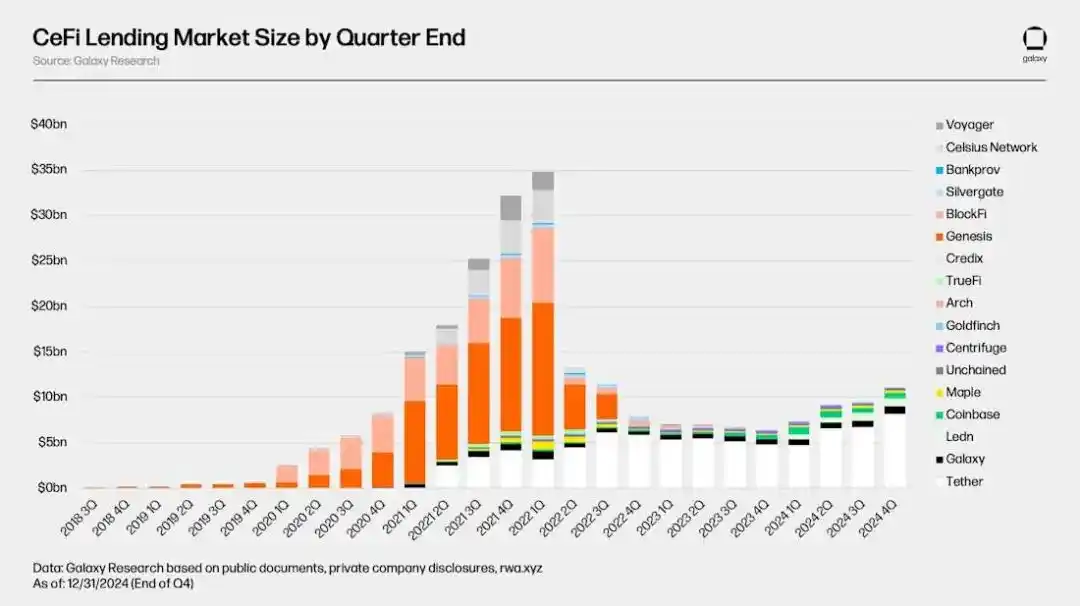
With the contraction of the CeFi lending market over the past three years, the amount of outstanding loans has become concentrated on fewer lending platforms. During the peak of the CeFi lending market in the first quarter of 2022, the top three lending platforms (Genesis, BlockFi, and Celsius) held 76% of the market, collectively holding $26.4 billion of the $34.8 billion in loans. Today, the top three lending platforms (Tether, Galaxy, and Ledn) still maintain an 89% market share. The chart above shows Tether accounts for approximately 73% of that.
When assessing the market dominance of one lending platform over another, it is important to consider the differences between each platform, as not all CeFi lending platforms are the same. Some platforms only offer certain types of loans (e.g., loans secured only by Bitcoin, products limited to altcoin collateral, or cash loans excluding stablecoins), cater to specific types of clients (e.g., institutional clients vs. retail clients), and operate only in specific jurisdictions. It is the combination of these factors that allows certain lending platforms to scale larger than others.
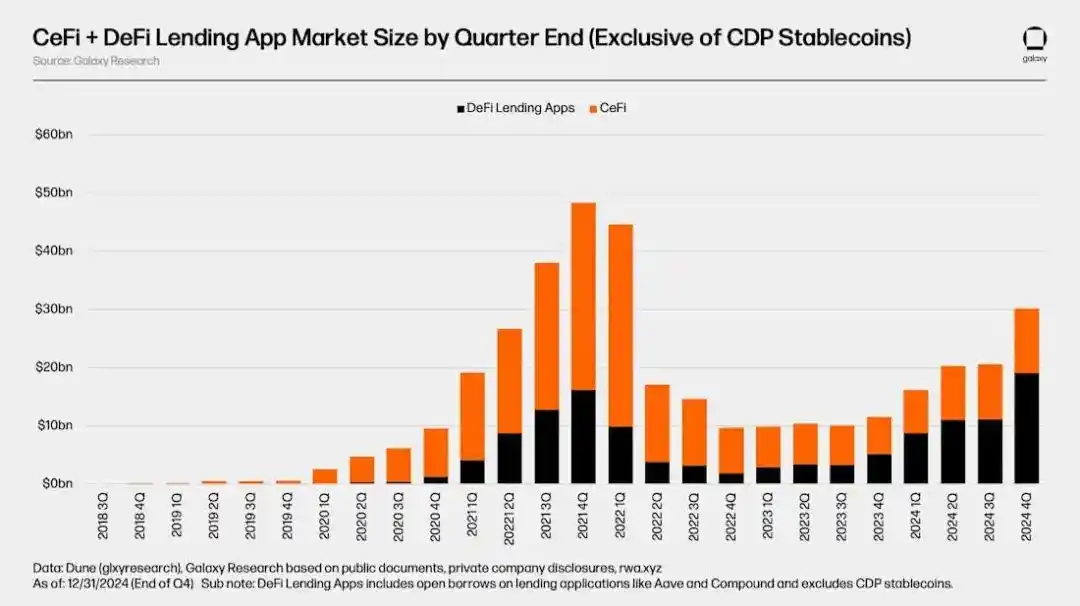
As shown in the chart below, on-chain applications (such as Aave and Compound) saw robust growth through DeFi lending, rebounding from an $18 billion outstanding loan low at the bear market bottom to a total of $191 billion across 20 lending apps and 12 on-chain outstanding loans by the end of Q4 2024. This represents a 959% growth in DeFi lending over the past eight quarters from the bottom. By the end of Q4 2024, the total outstanding loan amount in on-chain lending applications had grown by 18% from the historical high of $16.2 billion during the 2020-2021 bull market.
The recovery pace of DeFi lending has been faster than that of CeFi lending. This can be attributed to the permissionless nature of blockchain-based applications, with DeFi lending apps surviving the bear market turbulence while many major CeFi lending platforms declared bankruptcy and ceased operations. Unlike those CeFi lending platforms that went bankrupt and ceased operations, many DeFi lending apps and markets were not forced to shut down and continue to operate. This fact demonstrates the design and risk management practices of large-scale on-chain lending applications, as well as the advantages of algorithmic, overcollateralized, and demand-based lending models.
Excluding the CDP stablecoin market cap collateralized by crypto, the crypto lending market peaked at $48.4 billion in outstanding loans in Q4 2021. After four quarters, it hit a low of $9.6 billion in Q4 2022, marking an 80% decline from the peak. Since then, the market has expanded to $30.2 billion, primarily driven by the growth of DeFi lending apps, a 214% increase from the historical low point in Q4 2024.
It is important to note there may be a potential double-counting issue between the CeFi lending book size and the DeFi borrowing figures. This is because some CeFi platforms rely on DeFi lending apps to provide loans to their off-chain clients. For example, suppose a CeFi platform may borrow USDC on-chain using idle Bitcoin and then lend the same USDC to off-chain clients. In this scenario, the CeFi platform's on-chain borrowing would appear both in DeFi's outstanding loans and in the platform's financial statements as outstanding loans to its clients. Due to a lack of disclosure and clear attribution on-chain, filtering out this double-counting is very challenging.
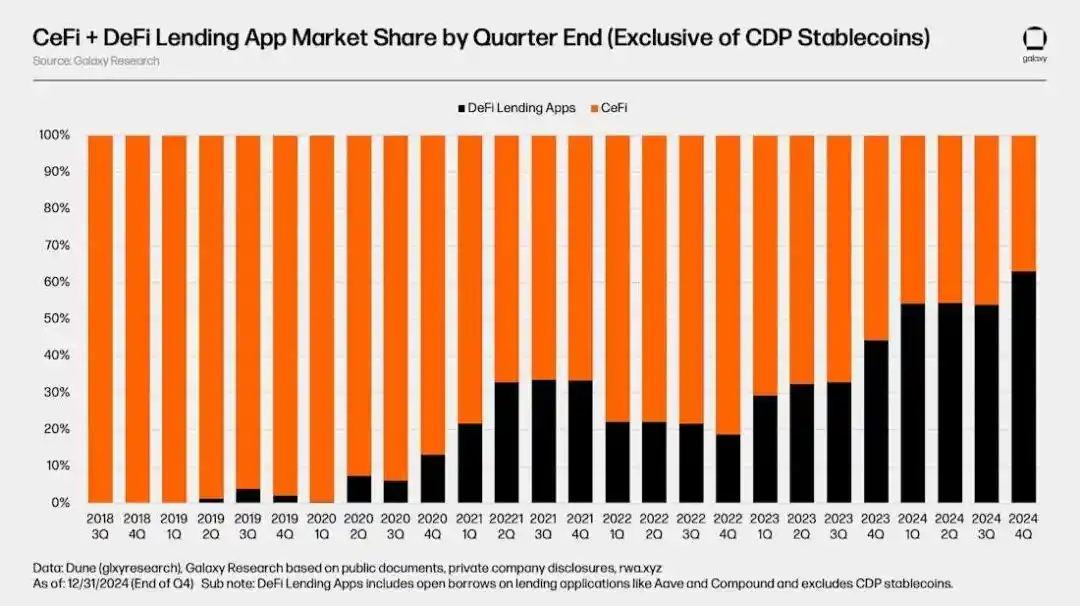
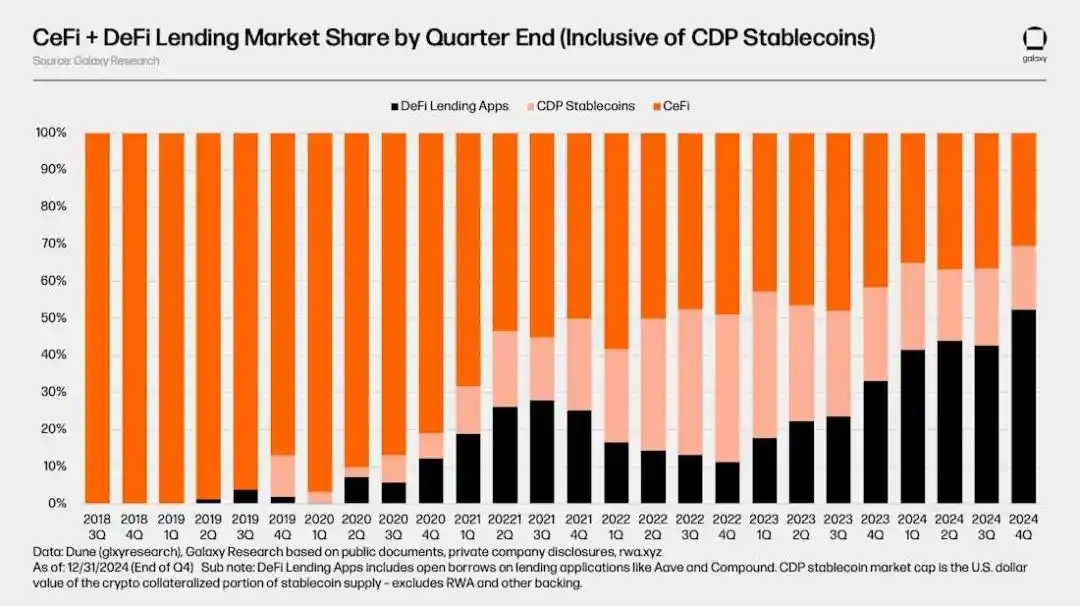
A notable shift in the crypto lending market is that DeFi lending applications demonstrated stronger dominance than CeFi platforms during the bear market and continued to expand during the market recovery. During the bull market cycle of 2020-2021, excluding market capitalization of crypto-collateralized CDP stablecoins, DeFi lending applications accounted for only 34% of the total crypto borrowing, whereas by the fourth quarter of 2024, DeFi lending applications' market share had increased to 63%, nearly doubling its original share.
Including the market capitalization of crypto-collateralized CDP stablecoins, the total size of the entire crypto lending market surpassed $6.44 billion in the fourth quarter of 2021. During the bear market bottom in the third quarter of 2023, the market size was only $1.42 billion, a 78% decrease from the peak of the bull market. By the fourth quarter of 2024, the market had rebounded 157% from the third quarter of 2023 low, reaching a total size of $3.65 billion.
It is worth noting that similar to borrowing through DeFi lending applications, there may also be a double-counting issue between the book size of CeFi loans and the supply of CDP stablecoins. This is because some CeFi entities rely on minting crypto-collateralized CDP stablecoins to provide borrowing services to off-chain customers.
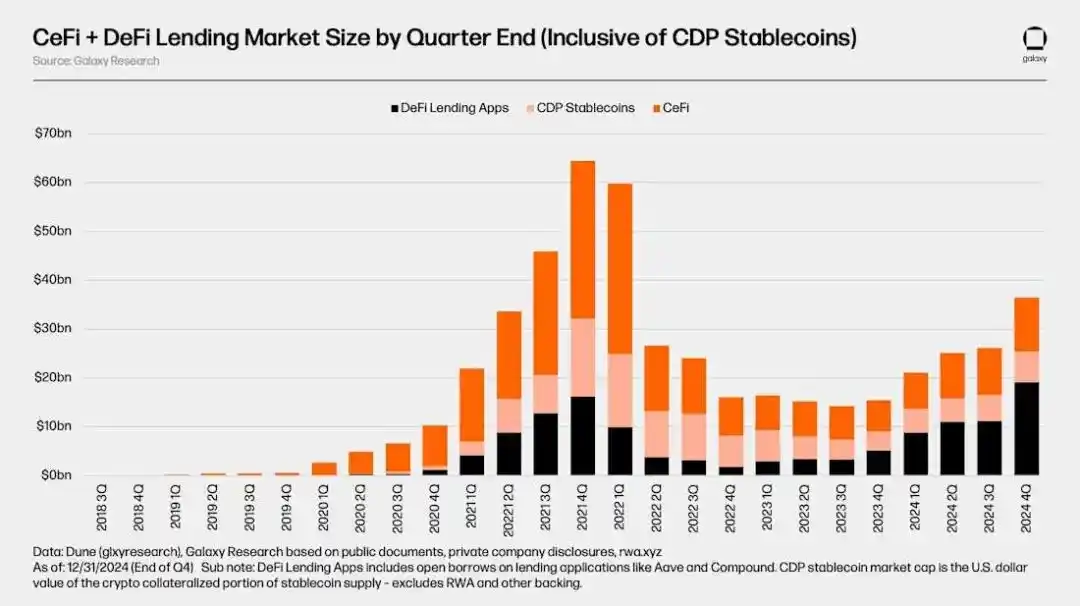
When including crypto-collateralized CDP stablecoins, a significant growth in on-chain lending and borrowing market share can be observed. By the fourth quarter of 2024, DeFi lending applications and CDP stablecoins occupied 69% of the entire market. Since the fourth quarter of 2022, their share has been steadily increasing. A noteworthy trend is the gradual decline in the dominance of CDP stablecoins as collateral leverage in the crypto market. This can be partially attributed to increased stablecoin liquidity, improvements in lending application parameters, and the introduction of neutral stablecoins like Ethena.
Six, Market Data Logic and Sources
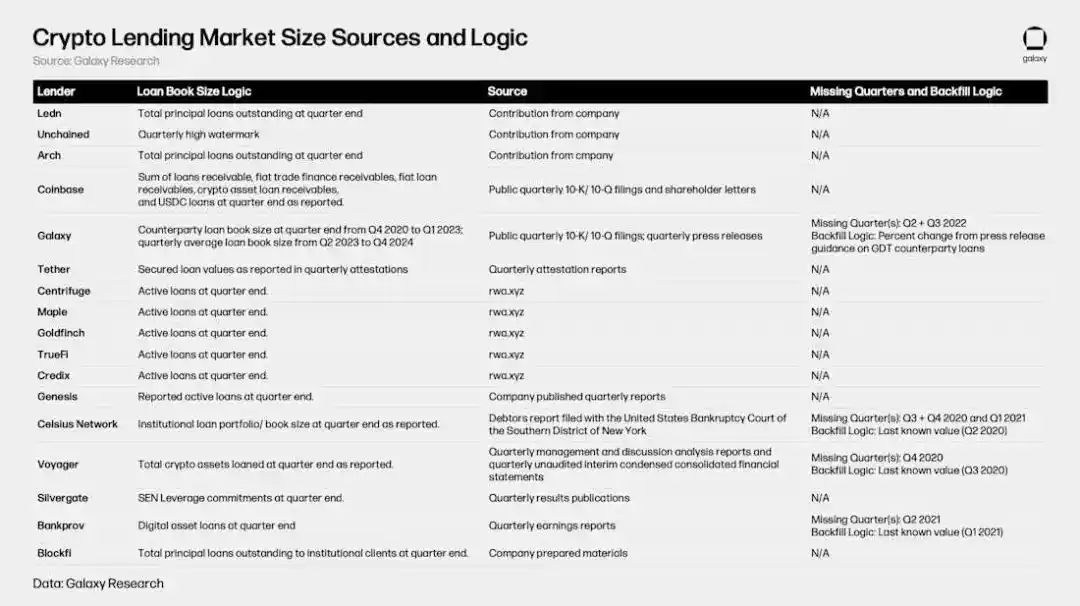
The table below shows the sources and logic used to compile the aforementioned DeFi and CeFi lending market data. While data for DeFi and cDeFi can be retrieved through on-chain data, which is transparent and easily accessible, obtaining CeFi data is more complex and less available. This is due to inconsistencies in how CeFi lending platforms record outstanding loans, differences in the frequency of their public disclosures, and the general difficulty in accessing their information.
7. Venture Capital and Crypto Lending
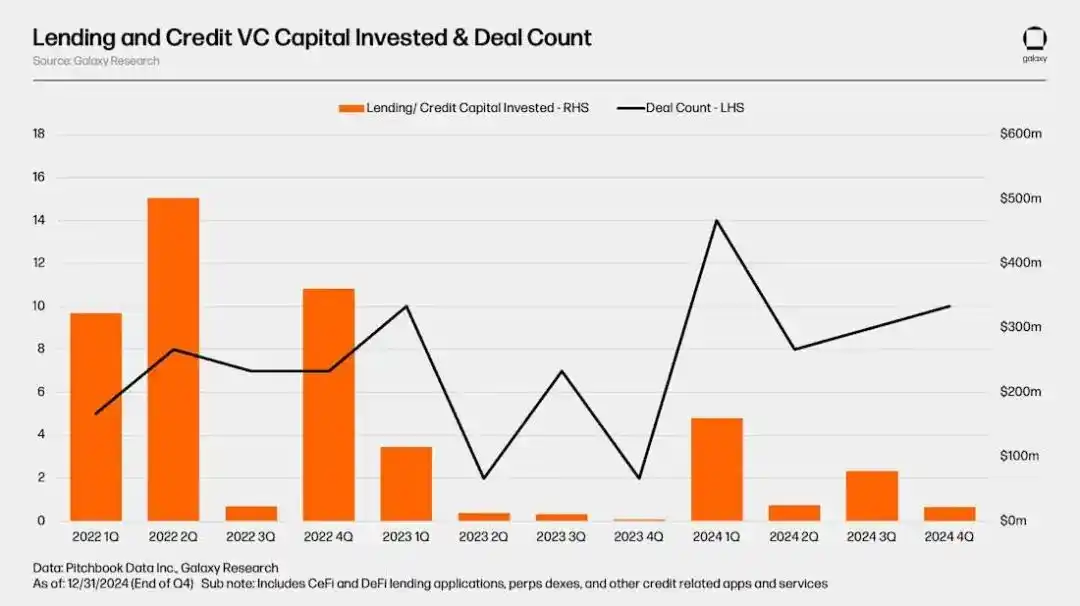
CeFi and DeFi lending/credit platforms raised a total of $16.3 billion through 89 transactions conducted between the first quarter of 2022 and the fourth quarter of 2024. Among these transactions, the second quarter of 2022 saw the highest capital raise, with eight transactions collectively raising at least $5.02 billion. The fourth quarter of 2023 was the lowest, with a total fundraising of only $2.2 million.
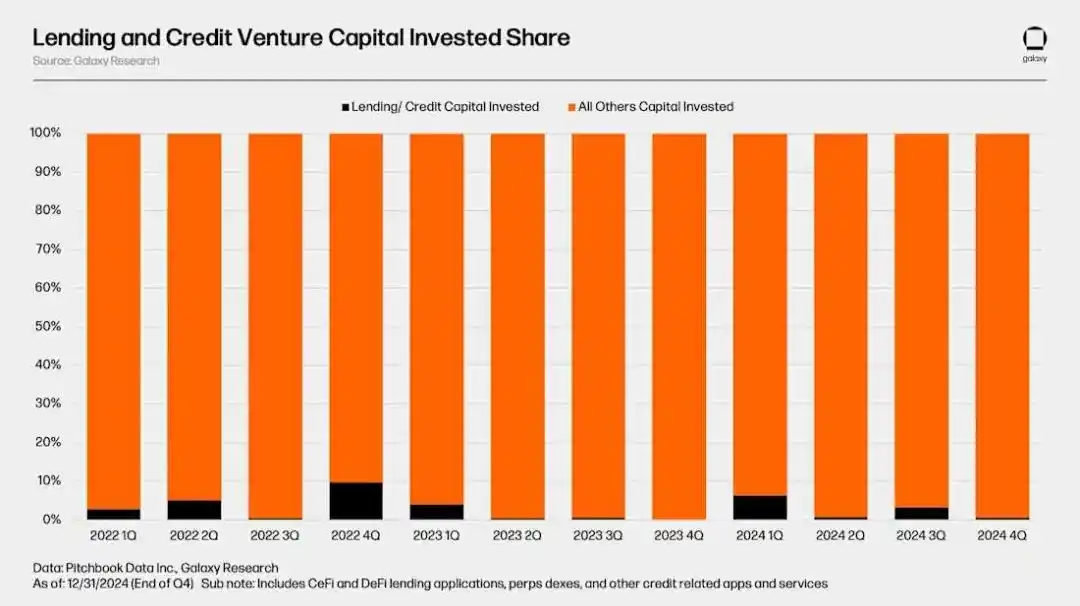
For the crypto economy, venture capital investment in lending and credit applications accounted for only a small portion of total investment. From the first quarter of 2022 to the fourth quarter of 2024, lending and credit applications averaged only 2.8% of venture capital funding each quarter. Lending and credit applications had their largest share of total quarterly funding in the fourth quarter of 2022, at 9.75%; however, in the most recent fourth quarter of 2024, this share was only 0.62%.
8. Historical Review and Future Outlook of the Crypto Lending Market
Root Causes
The core reasons for the collapse of the crypto lending market in 2022-2023 include:
1. Asset Price Plummet:
Except for Bitcoin and mainstream stablecoins, the total crypto market cap shrank by 77% (approximately $1.3 trillion), with the Terra ecosystem (UST and LUNA) losing $57.7 billion. Collateral values plummeted, leading to liquidity crises and debt defaults.
2. Toxic Collaterals:
stETH and GBTC: Due to the inability to redeem underlying assets, illiquidity caused significant discounts in trading (stETH at a 6.25% discount, GBTC at a 48.9% discount). Miner collateral: With Bitcoin's price drop compounded by increased mining difficulty, miner revenues fell by 86%, causing collateral values to shrink by 85-91%, and some miners were unable to liquidate their assets.
3. Risk Management Failures:
Liquidity Mismatch: CeFi platforms engaged in long-term lending but relied on short-term funds, leaving them unable to withstand runs during market collapses. Unsecured Loans Proliferation: Examples include Celsius with 36.6% of loans being uncollateralized and BlockFi providing uncollateralized loans to FTX. Risk Controls Absence: Lack of standardized risk assessments, lax loan approvals, and some platforms lacking risk limits.
9. Future Trends
1. The Institutionalization of CeFi Lending:
Traditional financial institutions (such as Cantor Fitzgerald, banks) will enter the space, leveraging low-cost funds and regulatory loosening (such as the SEC's repeal of SAB-121) to expand services. Bitcoin ETFs will drive leverage trading growth as collateral.
2. Rise of On-Chain Private Credit:
Tokenized debt instruments enhance transparency, reduce management costs, and attract venture capital. Use cases expand to include on-chain collateral, CDP stablecoin minting, etc.
3. The Institutionalization and Innovation of DeFi:
Institutions are accelerating their adoption of DeFi due to regulatory clarity improvements and on-chain liquidity advantages. Centralized companies are building on DeFi protocols (such as Ondo Finance forking Compound), driving on-chain ecosystem integration.
10. Conclusion
Market Differentiation: DeFi has shown resilience in a bear market, increasing its market share from 34% to 63%, strengthening its dominant position. CeFi sees institutional entry or recovery, but concentration remains high (top three platforms hold 89%).
Risks and Opportunities Coexist: Traditional financial entry brings compliance and liquidity, but beware of collateral volatility and regulatory uncertainty.
The On-Chain Future: Tokenization, automated risk management, and institutional participation will drive cryptographic lending towards transparency and scalability, becoming a core component of the digital financial infrastructure.
You may also like

Token Cannot Compound, Where Is the Real Investment Opportunity?

February 6th Market Key Intelligence, How Much Did You Miss?

China's Central Bank and Eight Other Departments' Latest Regulatory Focus: Key Attention to RWA Tokenized Asset Risk
Foreword: Today, the People's Bank of China's website published the "Notice of the People's Bank of China, National Development and Reform Commission, Ministry of Industry and Information Technology, Ministry of Public Security, State Administration for Market Regulation, China Banking and Insurance Regulatory Commission, China Securities Regulatory Commission, State Administration of Foreign Exchange on Further Preventing and Dealing with Risks Related to Virtual Currency and Others (Yinfa [2026] No. 42)", the latest regulatory requirements from the eight departments including the central bank, which are basically consistent with the regulatory requirements of recent years. The main focus of the regulation is on speculative activities such as virtual currency trading, exchanges, ICOs, overseas platform services, and this time, regulatory oversight of RWA has been added, explicitly prohibiting RWA tokenization, stablecoins (especially those pegged to the RMB). The following is the full text:
To the people's governments of all provinces, autonomous regions, and municipalities directly under the Central Government, the Xinjiang Production and Construction Corps:
Recently, there have been speculative activities related to virtual currency and Real-World Assets (RWA) tokenization, disrupting the economic and financial order and jeopardizing the property security of the people. In order to further prevent and address the risks related to virtual currency and Real-World Assets tokenization, effectively safeguard national security and social stability, in accordance with the "Law of the People's Republic of China on the People's Bank of China," "Law of the People's Republic of China on Commercial Banks," "Securities Law of the People's Republic of China," "Law of the People's Republic of China on Securities Investment Funds," "Law of the People's Republic of China on Futures and Derivatives," "Cybersecurity Law of the People's Republic of China," "Regulations of the People's Republic of China on the Administration of Renminbi," "Regulations on Prevention and Disposal of Illegal Fundraising," "Regulations of the People's Republic of China on Foreign Exchange Administration," "Telecommunications Regulations of the People's Republic of China," and other provisions, after reaching consensus with the Cyberspace Administration of China, the Supreme People's Court, and the Supreme People's Procuratorate, and with the approval of the State Council, the relevant matters are notified as follows:
(I) Virtual currency does not possess the legal status equivalent to fiat currency. Virtual currencies such as Bitcoin, Ether, Tether, etc., have the main characteristics of being issued by non-monetary authorities, using encryption technology and distributed ledger or similar technology, existing in digital form, etc. They do not have legal tender status, should not and cannot be circulated and used as currency in the market.
The business activities related to virtual currency are classified as illegal financial activities. The exchange of fiat currency and virtual currency within the territory, exchange of virtual currencies, acting as a central counterparty in buying and selling virtual currencies, providing information intermediary and pricing services for virtual currency transactions, token issuance financing, and trading of virtual currency-related financial products, etc., fall under illegal financial activities, such as suspected illegal issuance of token vouchers, unauthorized public issuance of securities, illegal operation of securities and futures business, illegal fundraising, etc., are strictly prohibited across the board and resolutely banned in accordance with the law. Overseas entities and individuals are not allowed to provide virtual currency-related services to domestic entities in any form.
A stablecoin pegged to a fiat currency indirectly fulfills some functions of the fiat currency in circulation. Without the consent of relevant authorities in accordance with the law and regulations, any domestic or foreign entity or individual is not allowed to issue a RMB-pegged stablecoin overseas.
(II)Tokenization of Real-World Assets refers to the use of encryption technology and distributed ledger or similar technologies to transform ownership rights, income rights, etc., of assets into tokens (tokens) or other interests or bond certificates with token (token) characteristics, and carry out issuance and trading activities.
Engaging in the tokenization of real-world assets domestically, as well as providing related intermediary, information technology services, etc., which are suspected of illegal issuance of token vouchers, unauthorized public offering of securities, illegal operation of securities and futures business, illegal fundraising, and other illegal financial activities, shall be prohibited; except for relevant business activities carried out with the approval of the competent authorities in accordance with the law and regulations and relying on specific financial infrastructures. Overseas entities and individuals are not allowed to illegally provide services related to the tokenization of real-world assets to domestic entities in any form.
(III) Inter-agency Coordination. The People's Bank of China, together with the National Development and Reform Commission, the Ministry of Industry and Information Technology, the Ministry of Public Security, the State Administration for Market Regulation, the China Banking and Insurance Regulatory Commission, the China Securities Regulatory Commission, the State Administration of Foreign Exchange, and other departments, will improve the work mechanism, strengthen coordination with the Cyberspace Administration of China, the Supreme People's Court, and the Supreme People's Procuratorate, coordinate efforts, and overall guide regions to carry out risk prevention and disposal of virtual currency-related illegal financial activities.
The China Securities Regulatory Commission, together with the National Development and Reform Commission, the Ministry of Industry and Information Technology, the Ministry of Public Security, the People's Bank of China, the State Administration for Market Regulation, the China Banking and Insurance Regulatory Commission, the State Administration of Foreign Exchange, and other departments, will improve the work mechanism, strengthen coordination with the Cyberspace Administration of China, the Supreme People's Court, and the Supreme People's Procuratorate, coordinate efforts, and overall guide regions to carry out risk prevention and disposal of illegal financial activities related to the tokenization of real-world assets.
(IV) Strengthening Local Implementation. The people's governments at the provincial level are overall responsible for the prevention and disposal of risks related to virtual currencies and the tokenization of real-world assets in their respective administrative regions. The specific leading department is the local financial regulatory department, with participation from branches and dispatched institutions of the State Council's financial regulatory department, telecommunications regulators, public security, market supervision, and other departments, in coordination with cyberspace departments, courts, and procuratorates, to improve the normalization of the work mechanism, effectively connect with the relevant work mechanisms of central departments, form a cooperative and coordinated working pattern between central and local governments, effectively prevent and properly handle risks related to virtual currencies and the tokenization of real-world assets, and maintain economic and financial order and social stability.
(5) Enhanced Risk Monitoring. The People's Bank of China, China Securities Regulatory Commission, National Development and Reform Commission, Ministry of Industry and Information Technology, Ministry of Public Security, State Administration of Foreign Exchange, Cyberspace Administration of China, and other departments continue to improve monitoring techniques and system support, enhance cross-departmental data analysis and sharing, establish sound information sharing and cross-validation mechanisms, promptly grasp the risk situation of activities related to virtual currency and real-world asset tokenization. Local governments at all levels give full play to the role of local monitoring and early warning mechanisms. Local financial regulatory authorities, together with branches and agencies of the State Council's financial regulatory authorities, as well as departments of cyberspace and public security, ensure effective connection between online monitoring, offline investigation, and fund tracking, efficiently and accurately identify activities related to virtual currency and real-world asset tokenization, promptly share risk information, improve early warning information dissemination, verification, and rapid response mechanisms.
(6) Strengthened Oversight of Financial Institutions, Intermediaries, and Technology Service Providers. Financial institutions (including non-bank payment institutions) are prohibited from providing account opening, fund transfer, and clearing services for virtual currency-related business activities, issuing and selling financial products related to virtual currency, including virtual currency and related financial products in the scope of collateral, conducting insurance business related to virtual currency, or including virtual currency in the scope of insurance liability. Financial institutions (including non-bank payment institutions) are prohibited from providing custody, clearing, and settlement services for unauthorized real-world asset tokenization-related business and related financial products. Relevant intermediary institutions and information technology service providers are prohibited from providing intermediary, technical, or other services for unauthorized real-world asset tokenization-related businesses and related financial products.
(7) Enhanced Management of Internet Information Content and Access. Internet enterprises are prohibited from providing online business venues, commercial displays, marketing, advertising, or paid traffic diversion services for virtual currency and real-world asset tokenization-related business activities. Upon discovering clues of illegal activities, they should promptly report to relevant departments and provide technical support and assistance for related investigations and inquiries. Based on the clues transferred by the financial regulatory authorities, the cyberspace administration, telecommunications authorities, and public security departments should promptly close and deal with websites, mobile applications (including mini-programs), and public accounts engaged in virtual currency and real-world asset tokenization-related business activities in accordance with the law.
(8) Strengthened Entity Registration and Advertisement Management. Market supervision departments strengthen entity registration and management, and enterprise and individual business registrations must not contain terms such as "virtual currency," "virtual asset," "cryptocurrency," "crypto asset," "stablecoin," "real-world asset tokenization," or "RWA" in their names or business scopes. Market supervision departments, together with financial regulatory authorities, legally enhance the supervision of advertisements related to virtual currency and real-world asset tokenization, promptly investigating and handling relevant illegal advertisements.
(IX) Continued Rectification of Virtual Currency Mining Activities. The National Development and Reform Commission, together with relevant departments, strictly controls virtual currency mining activities, continuously promotes the rectification of virtual currency mining activities. The people's governments of various provinces take overall responsibility for the rectification of "mining" within their respective administrative regions. In accordance with the requirements of the National Development and Reform Commission and other departments in the "Notice on the Rectification of Virtual Currency Mining Activities" (NDRC Energy-saving Building [2021] No. 1283) and the provisions of the "Guidance Catalog for Industrial Structure Adjustment (2024 Edition)," a comprehensive review, investigation, and closure of existing virtual currency mining projects are conducted, new mining projects are strictly prohibited, and mining machine production enterprises are strictly prohibited from providing mining machine sales and other services within the country.
(X) Severe Crackdown on Related Illegal Financial Activities. Upon discovering clues to illegal financial activities related to virtual currency and the tokenization of real-world assets, local financial regulatory authorities, branches of the State Council's financial regulatory authorities, and other relevant departments promptly investigate, determine, and properly handle the issues in accordance with the law, and seriously hold the relevant entities and individuals legally responsible. Those suspected of crimes are transferred to the judicial authorities for processing according to the law.
(XI) Severe Crackdown on Related Illegal and Criminal Activities. The Ministry of Public Security, the People's Bank of China, the State Administration for Market Regulation, the China Banking and Insurance Regulatory Commission, the China Securities Regulatory Commission, as well as judicial and procuratorial organs, in accordance with their respective responsibilities, rigorously crack down on illegal and criminal activities related to virtual currency, the tokenization of real-world assets, such as fraud, money laundering, illegal business operations, pyramid schemes, illegal fundraising, and other illegal and criminal activities carried out under the guise of virtual currency, the tokenization of real-world assets, etc.
(XII) Strengthen Industry Self-discipline. Relevant industry associations should enhance membership management and policy advocacy, based on their own responsibilities, advocate and urge member units to resist illegal financial activities related to virtual currency and the tokenization of real-world assets. Member units that violate regulatory policies and industry self-discipline rules are to be disciplined in accordance with relevant self-regulatory management regulations. By leveraging various industry infrastructure, conduct risk monitoring related to virtual currency, the tokenization of real-world assets, and promptly transfer issue clues to relevant departments.
(XIII) Without the approval of relevant departments in accordance with the law and regulations, domestic entities and foreign entities controlled by them may not issue virtual currency overseas.
(XIV) Domestic entities engaging directly or indirectly in overseas external debt-based tokenization of real-world assets, or conducting asset securitization activities abroad based on domestic ownership rights, income rights, etc. (hereinafter referred to as domestic equity), should be strictly regulated in accordance with the principles of "same business, same risk, same rules." The National Development and Reform Commission, the China Securities Regulatory Commission, the State Administration of Foreign Exchange, and other relevant departments regulate it according to their respective responsibilities. For other forms of overseas real-world asset tokenization activities based on domestic equity by domestic entities, the China Securities Regulatory Commission, together with relevant departments, supervise according to their division of responsibilities. Without the consent and filing of relevant departments, no unit or individual may engage in the above-mentioned business.
(15) Overseas subsidiaries and branches of domestic financial institutions providing Real World Asset Tokenization-related services overseas shall do so legally and prudently. They shall have professional personnel and systems in place to effectively mitigate business risks, strictly implement customer onboarding, suitability management, anti-money laundering requirements, and incorporate them into the domestic financial institutions' compliance and risk management system. Intermediaries and information technology service providers offering Real World Asset Tokenization services abroad based on domestic equity or conducting Real World Asset Tokenization business in the form of overseas debt for domestic entities directly or indirectly venturing abroad must strictly comply with relevant laws and regulations. They should establish and improve relevant compliance and internal control systems in accordance with relevant normative requirements, strengthen business and risk control, and report the business developments to the relevant regulatory authorities for approval or filing.
(16) Strengthen organizational leadership and overall coordination. All departments and regions should attach great importance to the prevention of risks related to virtual currencies and Real World Asset Tokenization, strengthen organizational leadership, clarify work responsibilities, form a long-term effective working mechanism with centralized coordination, local implementation, and shared responsibilities, maintain high pressure, dynamically monitor risks, effectively prevent and mitigate risks in an orderly and efficient manner, legally protect the property security of the people, and make every effort to maintain economic and financial order and social stability.
(17) Widely carry out publicity and education. All departments, regions, and industry associations should make full use of various media and other communication channels to disseminate information through legal and policy interpretation, analysis of typical cases, and education on investment risks, etc. They should promote the illegality and harm of virtual currencies and Real World Asset Tokenization-related businesses and their manifestations, fully alert to potential risks and hidden dangers, and enhance public awareness and identification capabilities for risk prevention.
(18) Engaging in illegal financial activities related to virtual currencies and Real World Asset Tokenization in violation of this notice, as well as providing services for virtual currencies and Real World Asset Tokenization-related businesses, shall be punished in accordance with relevant regulations. If it constitutes a crime, criminal liability shall be pursued according to the law. For domestic entities and individuals who knowingly or should have known that overseas entities illegally provided virtual currency or Real World Asset Tokenization-related services to domestic entities and still assisted them, relevant responsibilities shall be pursued according to the law. If it constitutes a crime, criminal liability shall be pursued according to the law.
(19) If any unit or individual invests in virtual currencies, Real World Asset Tokens, and related financial products against public order and good customs, the relevant civil legal actions shall be invalid, and any resulting losses shall be borne by them. If there are suspicions of disrupting financial order and jeopardizing financial security, the relevant departments shall deal with them according to the law.
This notice shall enter into force upon the date of its issuance. The People's Bank of China and ten other departments' "Notice on Further Preventing and Dealing with the Risks of Virtual Currency Trading Speculation" (Yinfa [2021] No. 237) is hereby repealed.

Former Partner's Perspective on Multicoin: Kyle's Exit, But the Game He Left Behind Just Getting Started
Why Bitcoin Is Falling Now: The Real Reasons Behind BTC's Crash & WEEX's Smart Profit Playbook
Bitcoin's ongoing crash explained: Discover the 5 hidden triggers behind BTC's plunge & how WEEX's Auto Earn and Trade to Earn strategies help traders profit from crypto market volatility.

Wall Street's Hottest Trades See Exodus

Vitalik Discusses Ethereum Scaling Path, Circle Announces Partnership with Polymarket, What's the Overseas Crypto Community Talking About Today?

Believing in the Capital Markets - The Essence and Core Value of Cryptocurrency

Polymarket's 'Weatherman': Predict Temperature, Win Million-Dollar Payout

$15K+ Profits: The 4 AI Trading Secrets WEEX Hackathon Prelim Winners Used to Dominate Volatile Crypto Markets
How WEEX Hackathon's top AI trading strategies made $15K+ in crypto markets: 4 proven rules for ETH/BTC trading, market structure analysis, and risk management in volatile conditions.

A nearly 20% one-day plunge, how long has it been since you last saw a $60,000 Bitcoin?

Raoul Pal: I've seen every single panic, and they are never the end.

Key Market Information Discrepancy on February 6th - A Must-Read! | Alpha Morning Report

2026 Crypto Industry's First Snowfall
The Harsh Reality Behind the $26 Billion Crypto Liquidation: Liquidity Is Killing the Market
Why Is Gold, US Stocks, Bitcoin All Falling?

Key Market Intelligence for February 5th, how much did you miss out on?

Wintermute: By 2026, crypto had gradually become the settlement layer of the Internet economy
Token Cannot Compound, Where Is the Real Investment Opportunity?
February 6th Market Key Intelligence, How Much Did You Miss?
China's Central Bank and Eight Other Departments' Latest Regulatory Focus: Key Attention to RWA Tokenized Asset Risk
Foreword: Today, the People's Bank of China's website published the "Notice of the People's Bank of China, National Development and Reform Commission, Ministry of Industry and Information Technology, Ministry of Public Security, State Administration for Market Regulation, China Banking and Insurance Regulatory Commission, China Securities Regulatory Commission, State Administration of Foreign Exchange on Further Preventing and Dealing with Risks Related to Virtual Currency and Others (Yinfa [2026] No. 42)", the latest regulatory requirements from the eight departments including the central bank, which are basically consistent with the regulatory requirements of recent years. The main focus of the regulation is on speculative activities such as virtual currency trading, exchanges, ICOs, overseas platform services, and this time, regulatory oversight of RWA has been added, explicitly prohibiting RWA tokenization, stablecoins (especially those pegged to the RMB). The following is the full text:
To the people's governments of all provinces, autonomous regions, and municipalities directly under the Central Government, the Xinjiang Production and Construction Corps:
Recently, there have been speculative activities related to virtual currency and Real-World Assets (RWA) tokenization, disrupting the economic and financial order and jeopardizing the property security of the people. In order to further prevent and address the risks related to virtual currency and Real-World Assets tokenization, effectively safeguard national security and social stability, in accordance with the "Law of the People's Republic of China on the People's Bank of China," "Law of the People's Republic of China on Commercial Banks," "Securities Law of the People's Republic of China," "Law of the People's Republic of China on Securities Investment Funds," "Law of the People's Republic of China on Futures and Derivatives," "Cybersecurity Law of the People's Republic of China," "Regulations of the People's Republic of China on the Administration of Renminbi," "Regulations on Prevention and Disposal of Illegal Fundraising," "Regulations of the People's Republic of China on Foreign Exchange Administration," "Telecommunications Regulations of the People's Republic of China," and other provisions, after reaching consensus with the Cyberspace Administration of China, the Supreme People's Court, and the Supreme People's Procuratorate, and with the approval of the State Council, the relevant matters are notified as follows:
(I) Virtual currency does not possess the legal status equivalent to fiat currency. Virtual currencies such as Bitcoin, Ether, Tether, etc., have the main characteristics of being issued by non-monetary authorities, using encryption technology and distributed ledger or similar technology, existing in digital form, etc. They do not have legal tender status, should not and cannot be circulated and used as currency in the market.
The business activities related to virtual currency are classified as illegal financial activities. The exchange of fiat currency and virtual currency within the territory, exchange of virtual currencies, acting as a central counterparty in buying and selling virtual currencies, providing information intermediary and pricing services for virtual currency transactions, token issuance financing, and trading of virtual currency-related financial products, etc., fall under illegal financial activities, such as suspected illegal issuance of token vouchers, unauthorized public issuance of securities, illegal operation of securities and futures business, illegal fundraising, etc., are strictly prohibited across the board and resolutely banned in accordance with the law. Overseas entities and individuals are not allowed to provide virtual currency-related services to domestic entities in any form.
A stablecoin pegged to a fiat currency indirectly fulfills some functions of the fiat currency in circulation. Without the consent of relevant authorities in accordance with the law and regulations, any domestic or foreign entity or individual is not allowed to issue a RMB-pegged stablecoin overseas.
(II)Tokenization of Real-World Assets refers to the use of encryption technology and distributed ledger or similar technologies to transform ownership rights, income rights, etc., of assets into tokens (tokens) or other interests or bond certificates with token (token) characteristics, and carry out issuance and trading activities.
Engaging in the tokenization of real-world assets domestically, as well as providing related intermediary, information technology services, etc., which are suspected of illegal issuance of token vouchers, unauthorized public offering of securities, illegal operation of securities and futures business, illegal fundraising, and other illegal financial activities, shall be prohibited; except for relevant business activities carried out with the approval of the competent authorities in accordance with the law and regulations and relying on specific financial infrastructures. Overseas entities and individuals are not allowed to illegally provide services related to the tokenization of real-world assets to domestic entities in any form.
(III) Inter-agency Coordination. The People's Bank of China, together with the National Development and Reform Commission, the Ministry of Industry and Information Technology, the Ministry of Public Security, the State Administration for Market Regulation, the China Banking and Insurance Regulatory Commission, the China Securities Regulatory Commission, the State Administration of Foreign Exchange, and other departments, will improve the work mechanism, strengthen coordination with the Cyberspace Administration of China, the Supreme People's Court, and the Supreme People's Procuratorate, coordinate efforts, and overall guide regions to carry out risk prevention and disposal of virtual currency-related illegal financial activities.
The China Securities Regulatory Commission, together with the National Development and Reform Commission, the Ministry of Industry and Information Technology, the Ministry of Public Security, the People's Bank of China, the State Administration for Market Regulation, the China Banking and Insurance Regulatory Commission, the State Administration of Foreign Exchange, and other departments, will improve the work mechanism, strengthen coordination with the Cyberspace Administration of China, the Supreme People's Court, and the Supreme People's Procuratorate, coordinate efforts, and overall guide regions to carry out risk prevention and disposal of illegal financial activities related to the tokenization of real-world assets.
(IV) Strengthening Local Implementation. The people's governments at the provincial level are overall responsible for the prevention and disposal of risks related to virtual currencies and the tokenization of real-world assets in their respective administrative regions. The specific leading department is the local financial regulatory department, with participation from branches and dispatched institutions of the State Council's financial regulatory department, telecommunications regulators, public security, market supervision, and other departments, in coordination with cyberspace departments, courts, and procuratorates, to improve the normalization of the work mechanism, effectively connect with the relevant work mechanisms of central departments, form a cooperative and coordinated working pattern between central and local governments, effectively prevent and properly handle risks related to virtual currencies and the tokenization of real-world assets, and maintain economic and financial order and social stability.
(5) Enhanced Risk Monitoring. The People's Bank of China, China Securities Regulatory Commission, National Development and Reform Commission, Ministry of Industry and Information Technology, Ministry of Public Security, State Administration of Foreign Exchange, Cyberspace Administration of China, and other departments continue to improve monitoring techniques and system support, enhance cross-departmental data analysis and sharing, establish sound information sharing and cross-validation mechanisms, promptly grasp the risk situation of activities related to virtual currency and real-world asset tokenization. Local governments at all levels give full play to the role of local monitoring and early warning mechanisms. Local financial regulatory authorities, together with branches and agencies of the State Council's financial regulatory authorities, as well as departments of cyberspace and public security, ensure effective connection between online monitoring, offline investigation, and fund tracking, efficiently and accurately identify activities related to virtual currency and real-world asset tokenization, promptly share risk information, improve early warning information dissemination, verification, and rapid response mechanisms.
(6) Strengthened Oversight of Financial Institutions, Intermediaries, and Technology Service Providers. Financial institutions (including non-bank payment institutions) are prohibited from providing account opening, fund transfer, and clearing services for virtual currency-related business activities, issuing and selling financial products related to virtual currency, including virtual currency and related financial products in the scope of collateral, conducting insurance business related to virtual currency, or including virtual currency in the scope of insurance liability. Financial institutions (including non-bank payment institutions) are prohibited from providing custody, clearing, and settlement services for unauthorized real-world asset tokenization-related business and related financial products. Relevant intermediary institutions and information technology service providers are prohibited from providing intermediary, technical, or other services for unauthorized real-world asset tokenization-related businesses and related financial products.
(7) Enhanced Management of Internet Information Content and Access. Internet enterprises are prohibited from providing online business venues, commercial displays, marketing, advertising, or paid traffic diversion services for virtual currency and real-world asset tokenization-related business activities. Upon discovering clues of illegal activities, they should promptly report to relevant departments and provide technical support and assistance for related investigations and inquiries. Based on the clues transferred by the financial regulatory authorities, the cyberspace administration, telecommunications authorities, and public security departments should promptly close and deal with websites, mobile applications (including mini-programs), and public accounts engaged in virtual currency and real-world asset tokenization-related business activities in accordance with the law.
(8) Strengthened Entity Registration and Advertisement Management. Market supervision departments strengthen entity registration and management, and enterprise and individual business registrations must not contain terms such as "virtual currency," "virtual asset," "cryptocurrency," "crypto asset," "stablecoin," "real-world asset tokenization," or "RWA" in their names or business scopes. Market supervision departments, together with financial regulatory authorities, legally enhance the supervision of advertisements related to virtual currency and real-world asset tokenization, promptly investigating and handling relevant illegal advertisements.
(IX) Continued Rectification of Virtual Currency Mining Activities. The National Development and Reform Commission, together with relevant departments, strictly controls virtual currency mining activities, continuously promotes the rectification of virtual currency mining activities. The people's governments of various provinces take overall responsibility for the rectification of "mining" within their respective administrative regions. In accordance with the requirements of the National Development and Reform Commission and other departments in the "Notice on the Rectification of Virtual Currency Mining Activities" (NDRC Energy-saving Building [2021] No. 1283) and the provisions of the "Guidance Catalog for Industrial Structure Adjustment (2024 Edition)," a comprehensive review, investigation, and closure of existing virtual currency mining projects are conducted, new mining projects are strictly prohibited, and mining machine production enterprises are strictly prohibited from providing mining machine sales and other services within the country.
(X) Severe Crackdown on Related Illegal Financial Activities. Upon discovering clues to illegal financial activities related to virtual currency and the tokenization of real-world assets, local financial regulatory authorities, branches of the State Council's financial regulatory authorities, and other relevant departments promptly investigate, determine, and properly handle the issues in accordance with the law, and seriously hold the relevant entities and individuals legally responsible. Those suspected of crimes are transferred to the judicial authorities for processing according to the law.
(XI) Severe Crackdown on Related Illegal and Criminal Activities. The Ministry of Public Security, the People's Bank of China, the State Administration for Market Regulation, the China Banking and Insurance Regulatory Commission, the China Securities Regulatory Commission, as well as judicial and procuratorial organs, in accordance with their respective responsibilities, rigorously crack down on illegal and criminal activities related to virtual currency, the tokenization of real-world assets, such as fraud, money laundering, illegal business operations, pyramid schemes, illegal fundraising, and other illegal and criminal activities carried out under the guise of virtual currency, the tokenization of real-world assets, etc.
(XII) Strengthen Industry Self-discipline. Relevant industry associations should enhance membership management and policy advocacy, based on their own responsibilities, advocate and urge member units to resist illegal financial activities related to virtual currency and the tokenization of real-world assets. Member units that violate regulatory policies and industry self-discipline rules are to be disciplined in accordance with relevant self-regulatory management regulations. By leveraging various industry infrastructure, conduct risk monitoring related to virtual currency, the tokenization of real-world assets, and promptly transfer issue clues to relevant departments.
(XIII) Without the approval of relevant departments in accordance with the law and regulations, domestic entities and foreign entities controlled by them may not issue virtual currency overseas.
(XIV) Domestic entities engaging directly or indirectly in overseas external debt-based tokenization of real-world assets, or conducting asset securitization activities abroad based on domestic ownership rights, income rights, etc. (hereinafter referred to as domestic equity), should be strictly regulated in accordance with the principles of "same business, same risk, same rules." The National Development and Reform Commission, the China Securities Regulatory Commission, the State Administration of Foreign Exchange, and other relevant departments regulate it according to their respective responsibilities. For other forms of overseas real-world asset tokenization activities based on domestic equity by domestic entities, the China Securities Regulatory Commission, together with relevant departments, supervise according to their division of responsibilities. Without the consent and filing of relevant departments, no unit or individual may engage in the above-mentioned business.
(15) Overseas subsidiaries and branches of domestic financial institutions providing Real World Asset Tokenization-related services overseas shall do so legally and prudently. They shall have professional personnel and systems in place to effectively mitigate business risks, strictly implement customer onboarding, suitability management, anti-money laundering requirements, and incorporate them into the domestic financial institutions' compliance and risk management system. Intermediaries and information technology service providers offering Real World Asset Tokenization services abroad based on domestic equity or conducting Real World Asset Tokenization business in the form of overseas debt for domestic entities directly or indirectly venturing abroad must strictly comply with relevant laws and regulations. They should establish and improve relevant compliance and internal control systems in accordance with relevant normative requirements, strengthen business and risk control, and report the business developments to the relevant regulatory authorities for approval or filing.
(16) Strengthen organizational leadership and overall coordination. All departments and regions should attach great importance to the prevention of risks related to virtual currencies and Real World Asset Tokenization, strengthen organizational leadership, clarify work responsibilities, form a long-term effective working mechanism with centralized coordination, local implementation, and shared responsibilities, maintain high pressure, dynamically monitor risks, effectively prevent and mitigate risks in an orderly and efficient manner, legally protect the property security of the people, and make every effort to maintain economic and financial order and social stability.
(17) Widely carry out publicity and education. All departments, regions, and industry associations should make full use of various media and other communication channels to disseminate information through legal and policy interpretation, analysis of typical cases, and education on investment risks, etc. They should promote the illegality and harm of virtual currencies and Real World Asset Tokenization-related businesses and their manifestations, fully alert to potential risks and hidden dangers, and enhance public awareness and identification capabilities for risk prevention.
(18) Engaging in illegal financial activities related to virtual currencies and Real World Asset Tokenization in violation of this notice, as well as providing services for virtual currencies and Real World Asset Tokenization-related businesses, shall be punished in accordance with relevant regulations. If it constitutes a crime, criminal liability shall be pursued according to the law. For domestic entities and individuals who knowingly or should have known that overseas entities illegally provided virtual currency or Real World Asset Tokenization-related services to domestic entities and still assisted them, relevant responsibilities shall be pursued according to the law. If it constitutes a crime, criminal liability shall be pursued according to the law.
(19) If any unit or individual invests in virtual currencies, Real World Asset Tokens, and related financial products against public order and good customs, the relevant civil legal actions shall be invalid, and any resulting losses shall be borne by them. If there are suspicions of disrupting financial order and jeopardizing financial security, the relevant departments shall deal with them according to the law.
This notice shall enter into force upon the date of its issuance. The People's Bank of China and ten other departments' "Notice on Further Preventing and Dealing with the Risks of Virtual Currency Trading Speculation" (Yinfa [2021] No. 237) is hereby repealed.
Former Partner's Perspective on Multicoin: Kyle's Exit, But the Game He Left Behind Just Getting Started
Why Bitcoin Is Falling Now: The Real Reasons Behind BTC's Crash & WEEX's Smart Profit Playbook
Bitcoin's ongoing crash explained: Discover the 5 hidden triggers behind BTC's plunge & how WEEX's Auto Earn and Trade to Earn strategies help traders profit from crypto market volatility.


 App
App