
- Buy Crypto
- Markets
 Futures
- Spot
- Copy Trade
 Earn
Earn- More
Exclusive Interview with AllianceDAO Partner qw: Crypto Entrepreneurs Are Fleeing to AI, 90% of Crypto+AI Projects Are Misleading

Original Interview: Jack, BlockBeats;
Original Editor: Zhouzhou, BlockBeats
This cycle, the top-tier investment institution that has been "living the best" in the crypto space is undoubtedly AllianceDAO. At least in the eyes of retail investors, it is still the dark horse VC that "incubated a $1 billion revenue-generating application." With the current crypto market in a dire state, fund managers are shamefully comparing IRR and DPI on social media, facing the future with some funds going silent and shifting to secondary markets, while others cease operations and stop fundraising. At this juncture, Qiao Wang, the founding partner of AllianceDAO, said: "We need to increase our investments and become more aggressive."
Of course, Alliance is not blindly optimistic, nor is it blindly "greedy when others are fearful." What they are facing is a narrative collapse in the Web3 world and a continuous exodus of talent in the crypto industry. At the crossroads of Crypto and AI, how can a vertical VC make decisions? How can they position themselves? These are not simple questions but ones Qiao Wang truly needs to contemplate and solve. Fortunately, he understands: "Most VCs in this industry don't know how to invest in the application layer."
"The Most China-Savvy" Dollar Crypto VC, Deciding Whether to "Pull the Trigger" in 5 Minutes
From "Trump pumping" to "Trump dumping," the group that has seen the most significant attitude change towards the U.S. political scene in the past few months is likely the crypto community. Ever since Trump issued the meme coin $TRUMP, industry liquidity has begun to dry up. The bullish sentiment that had been rising since Trump's election in November gradually faded, and the "Tariff Black Swan" on Liberation Day became the catalyst for a 180-degree attitude reversal in the crypto community.
Now, many crypto enthusiasts have become avid followers of macroeconomics. No one cares about undervalued gems in the market or the "future crypto narrative" anymore. According to industry media reports, primary market investment and financing activities are at historical lows. However, AllianceDAO has decided to invest in more projects. To achieve this, they can now make their judgments after a 5-minute chat with the startup team.
BlockBeats: As a founding partner of a leading crypto institution, do you often consider how macro-environmental changes will affect your company?
Qiao Wang: As a lean startup, external influences actually have little impact on us. Since we don't spend much money to begin with and our energy is limited, those are still the same expenses. As long as our management philosophy remains lean, the impact is minimal.
However, I believe the biggest issue between China and the U.S. is mutual misunderstanding. This lack of understanding is fundamental. For example, the U.S. believed that its tariff policy towards China would force concessions, but this completely misjudged the situation. This strategy may have been effective in 2018, but now China's reliance on exports to the U.S. has significantly decreased, and its economy is undergoing a transformation, actively reducing its dependence on the U.S.
Furthermore, the trade war has actually fostered greater unity within China. While there may be economic pressures, the external threat has brought people together. The U.S. has completely messed this up. Of course, I'm not an expert, just offering my understanding based on observations and encouraging everyone to learn more.
BlockBeats: Does this kind of misunderstanding manifest itself in the English cryptocurrency community? How significant is its impact on the crypto industry?
Qiao Wang: This kind of misunderstanding is indeed deeply ingrained. Over the past decade, the U.S., from the government to media to society, has generally viewed China as an "enemy" rather than a competitor. This zero-sum mindset — "if China wins, we lose" — has dominated policy, culture, and social decision-making and is difficult to change in the short term. This mindset exists from top to bottom and won't change for the time being.
The situation in the cryptocurrency industry is somewhat better. The majority of practitioners are more intelligent and have a more comprehensive understanding of the world than the average American. Among the people I interact with, they usually see China as a respected competitor rather than an enemy. This differs from the mainstream media and government views in the U.S., where ordinary Americans are influenced by the media and see China as a threat.
In the medium to long term, the direct impact of the macroeconomy on the cryptocurrency industry is not significant. There may be short-term fluctuations because the market will follow the volatility of the U.S. stock market. However, several executive orders signed by Trump before have been very favorable to the cryptocurrency industry, overall being positive. For our business, the key is still to find good projects, and macro fluctuations will not change our investment logic.
BlockBeats: Many people believe that the movement of the U.S. stock market largely determines the price of BTC, while many others believe that global M2 is the main driving factor of BTC price. What are your expectations for the performance of the crypto market this year?
Qiao Wang: I don't have a strong judgment on the short-term trend of the crypto market because there are two opposing forces at play. On the one hand, the U.S. stock market may experience a short-term (3-6 months) decline due to economic recession or inflation data, dragging down the crypto market, especially given the high valuation of the U.S. stock market, which may decline in the next 3-6 months. On the other hand, global liquidity is increasing, such as money printing, which may drive up the prices of crypto assets. I cannot predict which of these two forces is stronger. So, I don't have a clear view on the short-term of crypto, but there is a high probability that the U.S. stock market will decline.
The calculation method of M2 varies from person to person, such as whether it includes data from China or other countries. However, overall, global M2 is on the rise, and the long-term trend of crypto assets is highly correlated with M2. In the short term, other factors such as U.S. stock market volatility may have a greater influence on the market.
BlockBeats: From the data reported by the media, primary investment activities in the crypto market have plummeted in recent months. Can AllianceDAO itself feel this 'cooling trend'?
Qiao Wang: Over the past year or two, VC investments in the primary market of the crypto industry have remained relatively stable. If the secondary market (such as coin prices) rises while the primary market remains stagnant, it indicates that the primary market is underperforming compared to the secondary market. Once the secondary market declines, the primary market may suffer even more, and it may continue to decline in the next one or two quarters. However, Alliance's incubation camp is not affected by the quantity of other VC investments. If market investment decreases, we may even invest more. The key is whether there are good projects. Without good projects, we will not blindly invest.
BlockBeats: In terms of product entrepreneurship and incubation, AllianceDAO has always had a unique methodology, especially excelling during the previous MEME craze. Now that the MEME cycle seems to have been deemed a thing of the past, will you reconsider your previous investment and incubation strategies?
Qiao Wang: We review and reflect every day, but the overall investment approach will not change due to the decline of a certain track. We focus on excellent teams and promising directions. Over the past year, we have optimized the decision-making process: we used to have a one-hour conversation with the team, divided into two in-depth discussions.
Now we find that after carefully reviewing the application materials, a 20-minute communication is sufficient, and decisions are made within 24 hours. Because early information is limited, intuition and industry experience are more important. The core is the team's clarity of logic, expressiveness, and desire for success, which can often be perceived in 5 minutes.
BlockBeats: Judging team potential in 5 minutes, what details do you mainly look at?
Qiao Wang: First is clarity of logic, the ability to explain complex issues in a simple way. Secondly, it's passion, feeling that they genuinely want to get things done. The remaining time is mainly spent understanding areas or project details that we are not familiar with, but the overall feeling of the team can be determined in about 5 minutes. In the earliest stages, the team's direction or track may not be clear, and these are not key factors.
Crypto Entrepreneurs "Flee" to AI
Recently, Jocy, Founding Partner of IOSG, posted on social media that another project in her investment portfolio is transitioning to focus on AI, expressing concerns about the future of the crypto industry.
"Crypto entrepreneurs are indeed fleeing to AI," a heartbreaking statement that holds true. Qiao Wang also acknowledged this phenomenon. In the latest AllianceDAO incubator, one-third of the projects are AI-focused teams. This is a significant shift from the previous incubator where pure AI projects made up only a small portion. During this period, many projects have also pivoted towards the AI field.
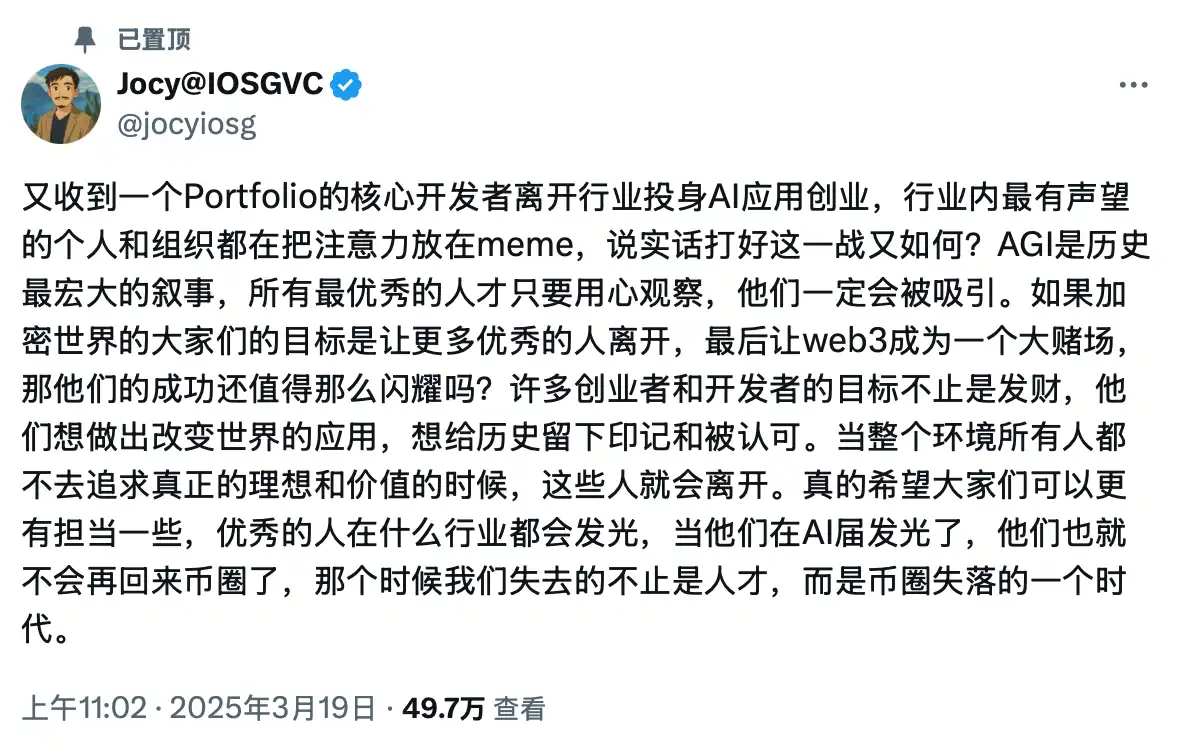
It seems that Crypto VCs are increasingly compelled to enter the AI investment space. As unexpected as it may be to find numerous AI entrepreneurs in their investment portfolios, fund managers must now consider what advantages they have in the AI field and how to position their funds.
Crypto VCs "Forced" into AI Investment
BlockBeats: During this cycle, many fund managers have mentioned that many projects in their investment portfolios have transitioned to focus on AI. Has AllianceDAO experienced similar situations?
Qiao Wang: In our latest incubator, we had 25 projects, with approximately one-third related to AI. Some teams initially focused on pure AI projects, while others were originally in the crypto space but later pivoted. They chose us mainly because the teams have backgrounds in the crypto industry and understand our incubation model.
BlockBeats: Why would pure AI projects choose a crypto-related institution as their incubation platform?
Qiao Wang: These teams had previous experience in the crypto industry and now want to venture into AI. Since they knew about us, they applied to our program. The AI projects they work on are mostly vertically focused applications, such as in education, law, or advertising, where industry experience is more critical than AI technical background.
BlockBeats: When did this trend of transitioning become more frequent?
Qiao Wang: In the past half a year or so, starting from the end of last year.
BlockBeats: Was this transformation process a decision made by the team and then communicated to you, or was it a decision made together in your discussions?
Qiao Wang: Some teams have very strong ideas themselves, made the decision first, and then came to me to communicate. And some teams, they would like to discuss with me first about what to do next, and I would give them some advice. Even if I feel that they have a deep understanding of users and the market in a certain area, I will give them some AI ideas. Then we discuss together on what to do next. So, basically, both situations exist.
BlockBeats: When the Web3 craze first emerged, many Internet teams followed the trend, and now Crypto entrepreneurs are chasing the AI craze. How do you judge whether a project is engaging in "trend arbitrage"? For those teams seriously transitioning to AI, are you concerned about their success rate?
Qiao Wang: We are very cautious about this issue. In 2021, during the Web2 to Web3 transition, we invested in some projects and later found that some teams were just following the trend. Now, in our communication with AI teams, we will delve into product details, target market, user pain points, and why they are doing this project. The key is to judge whether they truly understand the industry and are solving real problems. It is best if the team is solving their own pain points, as this motivation is the most genuine.
The biggest reason for startup failure is solving a non-existent problem. Teams transitioning from Web2 to Web3 often assume there is demand in the market, but this may not be the case in reality. Now, in our communication with AI teams, what we are most concerned about is: who are the target users? What are the pain points? How to validate the pain points? The ideal situation is that the team is solving their own problem because they understand the genuineness of the pain points the most.
For example, a team we invested in, with a background as a product manager at Uniswap, noticed high TikTok ad costs and significantly reduced costs using AI. This is a pain-driven entrepreneurial endeavor. And some people feel very uneasy if they don't solve this problem because they personally experience this issue, so they must address this problem.
BlockBeats: Some entrepreneurs are concerned that large model iterations may devalue vertical applications. How do you view the investment logic for AI projects, and how does it differ from crypto investments?
Qiao Wang: The key is whether a project can provide value that cannot be replaced by large models, such as unique user experience or exclusive data. For example, take Cursor, which uses AI to assist in coding. Despite relying on large models, the value is enhanced through developer data and optimized user experience, evolving alongside large model iterations.
When we invest in AI applications, we focus on the team's deep industry understanding and their ability to address real pain points, rather than just technical background. It mainly revolves around product and market: who is the target user? What pain points are being addressed? Why choose this market? What unresolved issues are there in the market? Each project is different, and the questions are very specific. The goal is to confirm whether they have thought deeply and truly understand user needs.
BlockBeats: In your opinion, what is the primary driving force for most entrepreneurial teams transitioning to AI?
Qiao Wang: Yes, the key is seizing the opportunity and the trend. Moreover, they also find the process itself very interesting, which is crucial.
BlockBeats: What does "interesting" specifically refer to?
Qiao Wang: "Interesting" means that they find the technology itself fascinating and believe it can address user pain points. For example, the biggest issue in Crypto over the past decade has been that many teams have not actually solved a real problem.
However, in the AI field, they may see some genuine pain points and believe that AI can help solve these issues, which is what they find interesting. Do you understand? You see, as you mentioned earlier, many big companies, such as Tencent, release strong products and quickly expand in the market, but ultimately, they still rely on issuing coins. It's quite obvious that this doesn't solve a real problem but is merely for making money.
BlockBeats: Would a co-founder or ally joining the "AI camp" affect the momentum and confidence of other crypto entrepreneurs in your investment portfolio?
Qiao Wang: Yes, this will definitely have an impact. Everyone involved in Crypto entrepreneurship will be influenced by this. It could be the influence of friends around them or public opinion. At such times, everyone will think: Why am I still doing Crypto? Why didn't I go into AI? This kind of mindset is actually quite normal.
BlockBeats: Crypto entrepreneurs seem to be showing a similar enthusiasm for AI as Internet entrepreneurs did for 'Web3' and the 'Metaverse' back in the day.
Qiao Wang: Yes, in the last cycle, there were two mainstream narratives, one being the Metaverse and the other being Web3 Metaverse. I've always thought of that as a 'false narrative,' as I didn't find anything truly interesting about it. However, Web3, at the time, I found very interesting, and I still find it very interesting now.
Web3 did something I consider to be very core, which is decentralized social media. This is fundamentally very interesting because it can't give such great power to companies like Twitter or Facebook. However, perhaps at the time, users didn't really feel a strong need for this, or the technology hadn't yet developed to a level where it could address user pain points.
From Crypto Verticals to General Tech, Alliance Rethinks Branding Issues
BlockBeats: After the projects they invested in transitioned to AI, do they need to adjust their financing models and amounts?
Qiao Wang: At the application layer, the financing model isn't actually much different. But I believe that in the past few years, AI's truly first killer app significantly improved developers' efficiency.
You might have seen some of my recent articles where, since ChatGPT came out—around November 2021, I've been consistently asking teams we invest in a question: How much has AI improved your engineering efficiency?
In the first few months, their responses indicated efficiency gains of around 20% to 50%. But I track this question every year, and the latest time was about one or two months ago when I asked them again, and their responses were: It has improved 2 to 4 times. From the initial 20%-50% to now 2-4 times, this is a very amazing change.
So, if this trend continues, in the next 5 to 10 years, entrepreneurs will actually need less and less capital. Because one engineer can now accomplish the work that used to require four engineers. Based on this assessment, our current investment philosophy has become very simple: we give you $500,000, you take two or three people to do it, and those two to three people can sustain it for about two years, which should be enough for you to find product-market fit.
Then, when you have found product-market fit, either you have started making money and can begin hiring more people, or you will find it easier to raise funding, whether it's a Series A round or a slightly later-stage seed round, and then proceed to hire more people and scale. In this regard, actually, whether it's an AI project or a Crypto project, as long as it is application-layer focused, fundamentally there is no difference. Of course, if you are working on something more fundamental or infrastructure-related, then indeed you may need more money, right?
BlockBeats: Has AllianceDAO now transformed into AI and successfully found a PMF case?
Qiao Wang: My definition of product-market fit is actually quite strict. In my opinion, true product-market fit means that your product's weekly or monthly growth rate can stabilize at 10% to 30% or even higher. At the same time, you have already started achieving annual revenue in the seven figures or even higher.
And most importantly, the demand from users is continuously pouring in, to the point where it's so overwhelming that even your team finds it challenging to cope. It's this state that I consider as reaching PMF. If we look at it from this standard, currently, I haven't seen any projects that have transitioned from Crypto to AI and truly reached this level.
BlockBeats: Is it because these teams are just getting started? Or have they encountered some issues?
Qiao Wang: I think the main reason is that they are just getting started. In fact, transitioning from Crypto to AI has only been a trend for about the past six months, so they may need more time to truly find product-market fit.
Moreover, the competition in AI right now is also extremely fierce, you could say it's "rolled up" to the extreme. Almost every vertical domain has dozens or even hundreds of teams doing similar things, making the competition very intense.
BlockBeats: Going back to AllianceDAO itself, this is an investment firm focused on the crypto space, but now that the portfolio includes a batch of pure AI startups, are you considering some branding positioning questions?
Qiao Wang: We are considering some branding issues, and we are gradually improving our branding. Ultimately, we want to become an accelerator to continue in Crypto, but we will also venture beyond Crypto.
Because in fact, technology always feels like one wave after another, and each wave may last 5 to 10 years, perhaps even longer. But once this wave has passed, the investment opportunity may not be as early as before. So, at this point, you need to look at what the next wave is, and in the end, we will do accelerators in various fields.
BlockBeats: When crypto VCs enter the AI field, do you feel that the risk factor you face has increased? Additionally, does this phenomenon of entrepreneurs "defecting" also affect your personal confidence in the industry?
Qiao Wang: I do not feel that the risk factor has increased. Although AI is indeed highly competitive, it is ultimately a very significant trend. I think this trend may be an order of magnitude larger than cryptocurrency.
So, overall, I do not feel that the risk factor has increased. As for the impact of AI on cryptocurrency, it certainly exists because I have personally seen many cryptocurrency entrepreneurs shift to AI. In my personal opinion and based on data, indeed many talents have migrated to the AI field.
"We Have Invested in Every Entrepreneur Who Has Transitioned from AI to Crypto"
BlockBeats: Are you concerned that an increasing number of projects are pivoting to AI, resulting in fewer Crypto entrepreneurs, which may make people feel like the industry has lost hope?
Qiao Wang: I do have this concern. But actually, what I am most worried about is whether the entrepreneurs we have invested in can ultimately succeed.
If they want to transition to AI, I would focus on confirming two things. First, whether they have lost passion for what they are currently doing? Do they think that the current direction will not lead to good results in the long term? I need to clarify this.
Second, if they want to pursue the new direction—such as AI, are they prepared for it? Do they have the capabilities and resources required to succeed in this new direction? More importantly, can the new project they are working on truly address users' pain points? If the answers to these two questions are positive, then I will not prevent them from pursuing the new direction; I may even encourage them to try.
BlockBeats: You mentioned earlier that the crypto industry has lost many excellent talents to AI. Are these talents primarily developers or visionaries?
Qiao Wang: Both exist. I think there are two main reasons for talent drain in the Crypto space. One is AI, which I have personally witnessed. The other is the U.S. government's crackdown on Crypto over the past four years. The combination of these two factors has indeed led to the loss of many talents, whether they are visionary entrepreneurs or developers.
BlockBeats: Can I make an assessment that most of these lost entrepreneurs entered Crypto in the last cycle?
Qiao Wang: Yes, that's right. In fact, in the past six months, there have been some Web2 people who wanted to enter Crypto. They knew they could do AR, but they didn't want to do AR; instead, they chose to do Crypto because they found Crypto very interesting. In fact, there are still people like this, probably four or five. We have also invested in them. Almost everyone who has transitioned from Web2 to Crypto in the past six months to a year, we have almost invested in them because we find these people very interesting.
They could have gone into AI, but they chose to do Crypto, and they have good ideas, so we would invest in them. These people are often very intriguing. So, there are still people like this, but the number of people who have switched to AI is higher, probably by one or two orders of magnitude.
BlockBeats: So, the emergence of 4-5 Crypto niche projects is accompanied by 10-20 projects transitioning to AI.
Qiao Wang: Yes, it may be higher by one or two orders of magnitude, not just 10 to 20, there may be dozens to hundreds of such projects in the entire industry, or even more.
BlockBeats: What directions are these few entrepreneurs who are determined to do Crypto now pursuing?
Qiao Wang: They will work on projects that combine social interaction and speculation, such as those they see in Palm Fantasy, Moonchat, and some other social projects. Although these products may have failed, they believe that the execution may not have been done well, but the underlying principles are very sound. So they want to do this thing.
At the same time, they also feel that the AI field is too competitive, unsure if they can succeed in the AI domain. Therefore, they would rather work on a project that is both interesting and less competitive.
BlockBeats: Conversely, in the Alliance portfolio, which vertical areas are the AI projects currently focused on?
Qiao Wang: The number of AI projects we are currently investing in is not high. In the most recent round, AI projects accounted for about 1/3, roughly seven to eight projects. They are working in various directions. For example, some are developer-focused, similar to the previous Y Coding, where code is generated directly from language, which is very interesting.
There is also the team that I mentioned earlier that is working on AI video advertising, as well as teams working on education projects for children, primary and secondary school students, and even younger age groups. Some are using AI to create games, basically transforming language generation directly into a game. There is a wide variety of projects we have looked into, but we have not invested in many.
Additionally, all seven to eight teams we have invested in come from the Crypto domain. You see, they all have previously worked on startups in Crypto or come from some well-known companies, such as Uniswap, Coinbase, and the like.
BlockBeats: So, these teams have a strong background in the Crypto industry.
Qiao Wang: While these teams have a strong Crypto background, as I mentioned earlier, when it comes to building AI applications, I believe that AI experience may not necessarily be of great help.
BlockBeats: It's somewhat poignant that the industry's most outstanding individuals are now not planning to stay in this industry.
Qiao Wang: In fact, there are still some very strong teams with a purely Crypto focus. However, the AI content in the previous round was much lower than in this round. In the previous round, it was basically zero, but later there may be one or two teams transitioning to AI. They initially entered the space to work in Crypto, spent some time, perhaps around six months, and then transitioned to AI.
Does Crypto+AI Have a Future?
BlockBeats: Currently, the Crypto+AI concept is still hot. Do you think this is a "pseudo-narrative"?
Qiao Wang: I think 90% of it is a pseudo-narrative, but maybe 10% will do some interesting things. You can think of Crypto and AI as two big circles, and the intersection between them is actually very small. Although both of these circles are very large, the intersection between them may be very small. However, within that small intersection, there may be some interesting things, such as decentralized training, which may be quite interesting.
We have seen some similar projects, but most of them are infrastructure-related. Many VCs are also chasing these projects and giving them very high valuations, making it difficult for us to participate. Although these projects have strong teams, and I like them, these projects are difficult to do and may take several years to do well. As of now, decentralized training has not made much progress.
The biggest challenge is how to aggregate small models trained in each data center. Data transmission between different data centers is very expensive, and the cost of transmitting this information over the network is high. Therefore, whether decentralized training can be cheaper than centralized methods is still unknown.
BlockBeats: Against the current market background, have the primary market valuation and hype of Crypto AI projects seen a significant decline?
Qiao Wang: In fact, there are still some very large funds that do not have many choices and can only focus on investing in this type of project. Therefore, there will ultimately be multiple VCs investing together in the same large project.
I think many VCs do not really understand the application layer of Crypto, so they can only invest in technical infrastructure, but these infrastructure projects do not have that many interesting things. For example, Layer 2; there are already hundreds on the market, and you can only find a few slightly interesting tracks and then concentrate on investing.
You may also like

Token Cannot Compound, Where Is the Real Investment Opportunity?

February 6th Market Key Intelligence, How Much Did You Miss?

China's Central Bank and Eight Other Departments' Latest Regulatory Focus: Key Attention to RWA Tokenized Asset Risk
Foreword: Today, the People's Bank of China's website published the "Notice of the People's Bank of China, National Development and Reform Commission, Ministry of Industry and Information Technology, Ministry of Public Security, State Administration for Market Regulation, China Banking and Insurance Regulatory Commission, China Securities Regulatory Commission, State Administration of Foreign Exchange on Further Preventing and Dealing with Risks Related to Virtual Currency and Others (Yinfa [2026] No. 42)", the latest regulatory requirements from the eight departments including the central bank, which are basically consistent with the regulatory requirements of recent years. The main focus of the regulation is on speculative activities such as virtual currency trading, exchanges, ICOs, overseas platform services, and this time, regulatory oversight of RWA has been added, explicitly prohibiting RWA tokenization, stablecoins (especially those pegged to the RMB). The following is the full text:
To the people's governments of all provinces, autonomous regions, and municipalities directly under the Central Government, the Xinjiang Production and Construction Corps:
Recently, there have been speculative activities related to virtual currency and Real-World Assets (RWA) tokenization, disrupting the economic and financial order and jeopardizing the property security of the people. In order to further prevent and address the risks related to virtual currency and Real-World Assets tokenization, effectively safeguard national security and social stability, in accordance with the "Law of the People's Republic of China on the People's Bank of China," "Law of the People's Republic of China on Commercial Banks," "Securities Law of the People's Republic of China," "Law of the People's Republic of China on Securities Investment Funds," "Law of the People's Republic of China on Futures and Derivatives," "Cybersecurity Law of the People's Republic of China," "Regulations of the People's Republic of China on the Administration of Renminbi," "Regulations on Prevention and Disposal of Illegal Fundraising," "Regulations of the People's Republic of China on Foreign Exchange Administration," "Telecommunications Regulations of the People's Republic of China," and other provisions, after reaching consensus with the Cyberspace Administration of China, the Supreme People's Court, and the Supreme People's Procuratorate, and with the approval of the State Council, the relevant matters are notified as follows:
(I) Virtual currency does not possess the legal status equivalent to fiat currency. Virtual currencies such as Bitcoin, Ether, Tether, etc., have the main characteristics of being issued by non-monetary authorities, using encryption technology and distributed ledger or similar technology, existing in digital form, etc. They do not have legal tender status, should not and cannot be circulated and used as currency in the market.
The business activities related to virtual currency are classified as illegal financial activities. The exchange of fiat currency and virtual currency within the territory, exchange of virtual currencies, acting as a central counterparty in buying and selling virtual currencies, providing information intermediary and pricing services for virtual currency transactions, token issuance financing, and trading of virtual currency-related financial products, etc., fall under illegal financial activities, such as suspected illegal issuance of token vouchers, unauthorized public issuance of securities, illegal operation of securities and futures business, illegal fundraising, etc., are strictly prohibited across the board and resolutely banned in accordance with the law. Overseas entities and individuals are not allowed to provide virtual currency-related services to domestic entities in any form.
A stablecoin pegged to a fiat currency indirectly fulfills some functions of the fiat currency in circulation. Without the consent of relevant authorities in accordance with the law and regulations, any domestic or foreign entity or individual is not allowed to issue a RMB-pegged stablecoin overseas.
(II)Tokenization of Real-World Assets refers to the use of encryption technology and distributed ledger or similar technologies to transform ownership rights, income rights, etc., of assets into tokens (tokens) or other interests or bond certificates with token (token) characteristics, and carry out issuance and trading activities.
Engaging in the tokenization of real-world assets domestically, as well as providing related intermediary, information technology services, etc., which are suspected of illegal issuance of token vouchers, unauthorized public offering of securities, illegal operation of securities and futures business, illegal fundraising, and other illegal financial activities, shall be prohibited; except for relevant business activities carried out with the approval of the competent authorities in accordance with the law and regulations and relying on specific financial infrastructures. Overseas entities and individuals are not allowed to illegally provide services related to the tokenization of real-world assets to domestic entities in any form.
(III) Inter-agency Coordination. The People's Bank of China, together with the National Development and Reform Commission, the Ministry of Industry and Information Technology, the Ministry of Public Security, the State Administration for Market Regulation, the China Banking and Insurance Regulatory Commission, the China Securities Regulatory Commission, the State Administration of Foreign Exchange, and other departments, will improve the work mechanism, strengthen coordination with the Cyberspace Administration of China, the Supreme People's Court, and the Supreme People's Procuratorate, coordinate efforts, and overall guide regions to carry out risk prevention and disposal of virtual currency-related illegal financial activities.
The China Securities Regulatory Commission, together with the National Development and Reform Commission, the Ministry of Industry and Information Technology, the Ministry of Public Security, the People's Bank of China, the State Administration for Market Regulation, the China Banking and Insurance Regulatory Commission, the State Administration of Foreign Exchange, and other departments, will improve the work mechanism, strengthen coordination with the Cyberspace Administration of China, the Supreme People's Court, and the Supreme People's Procuratorate, coordinate efforts, and overall guide regions to carry out risk prevention and disposal of illegal financial activities related to the tokenization of real-world assets.
(IV) Strengthening Local Implementation. The people's governments at the provincial level are overall responsible for the prevention and disposal of risks related to virtual currencies and the tokenization of real-world assets in their respective administrative regions. The specific leading department is the local financial regulatory department, with participation from branches and dispatched institutions of the State Council's financial regulatory department, telecommunications regulators, public security, market supervision, and other departments, in coordination with cyberspace departments, courts, and procuratorates, to improve the normalization of the work mechanism, effectively connect with the relevant work mechanisms of central departments, form a cooperative and coordinated working pattern between central and local governments, effectively prevent and properly handle risks related to virtual currencies and the tokenization of real-world assets, and maintain economic and financial order and social stability.
(5) Enhanced Risk Monitoring. The People's Bank of China, China Securities Regulatory Commission, National Development and Reform Commission, Ministry of Industry and Information Technology, Ministry of Public Security, State Administration of Foreign Exchange, Cyberspace Administration of China, and other departments continue to improve monitoring techniques and system support, enhance cross-departmental data analysis and sharing, establish sound information sharing and cross-validation mechanisms, promptly grasp the risk situation of activities related to virtual currency and real-world asset tokenization. Local governments at all levels give full play to the role of local monitoring and early warning mechanisms. Local financial regulatory authorities, together with branches and agencies of the State Council's financial regulatory authorities, as well as departments of cyberspace and public security, ensure effective connection between online monitoring, offline investigation, and fund tracking, efficiently and accurately identify activities related to virtual currency and real-world asset tokenization, promptly share risk information, improve early warning information dissemination, verification, and rapid response mechanisms.
(6) Strengthened Oversight of Financial Institutions, Intermediaries, and Technology Service Providers. Financial institutions (including non-bank payment institutions) are prohibited from providing account opening, fund transfer, and clearing services for virtual currency-related business activities, issuing and selling financial products related to virtual currency, including virtual currency and related financial products in the scope of collateral, conducting insurance business related to virtual currency, or including virtual currency in the scope of insurance liability. Financial institutions (including non-bank payment institutions) are prohibited from providing custody, clearing, and settlement services for unauthorized real-world asset tokenization-related business and related financial products. Relevant intermediary institutions and information technology service providers are prohibited from providing intermediary, technical, or other services for unauthorized real-world asset tokenization-related businesses and related financial products.
(7) Enhanced Management of Internet Information Content and Access. Internet enterprises are prohibited from providing online business venues, commercial displays, marketing, advertising, or paid traffic diversion services for virtual currency and real-world asset tokenization-related business activities. Upon discovering clues of illegal activities, they should promptly report to relevant departments and provide technical support and assistance for related investigations and inquiries. Based on the clues transferred by the financial regulatory authorities, the cyberspace administration, telecommunications authorities, and public security departments should promptly close and deal with websites, mobile applications (including mini-programs), and public accounts engaged in virtual currency and real-world asset tokenization-related business activities in accordance with the law.
(8) Strengthened Entity Registration and Advertisement Management. Market supervision departments strengthen entity registration and management, and enterprise and individual business registrations must not contain terms such as "virtual currency," "virtual asset," "cryptocurrency," "crypto asset," "stablecoin," "real-world asset tokenization," or "RWA" in their names or business scopes. Market supervision departments, together with financial regulatory authorities, legally enhance the supervision of advertisements related to virtual currency and real-world asset tokenization, promptly investigating and handling relevant illegal advertisements.
(IX) Continued Rectification of Virtual Currency Mining Activities. The National Development and Reform Commission, together with relevant departments, strictly controls virtual currency mining activities, continuously promotes the rectification of virtual currency mining activities. The people's governments of various provinces take overall responsibility for the rectification of "mining" within their respective administrative regions. In accordance with the requirements of the National Development and Reform Commission and other departments in the "Notice on the Rectification of Virtual Currency Mining Activities" (NDRC Energy-saving Building [2021] No. 1283) and the provisions of the "Guidance Catalog for Industrial Structure Adjustment (2024 Edition)," a comprehensive review, investigation, and closure of existing virtual currency mining projects are conducted, new mining projects are strictly prohibited, and mining machine production enterprises are strictly prohibited from providing mining machine sales and other services within the country.
(X) Severe Crackdown on Related Illegal Financial Activities. Upon discovering clues to illegal financial activities related to virtual currency and the tokenization of real-world assets, local financial regulatory authorities, branches of the State Council's financial regulatory authorities, and other relevant departments promptly investigate, determine, and properly handle the issues in accordance with the law, and seriously hold the relevant entities and individuals legally responsible. Those suspected of crimes are transferred to the judicial authorities for processing according to the law.
(XI) Severe Crackdown on Related Illegal and Criminal Activities. The Ministry of Public Security, the People's Bank of China, the State Administration for Market Regulation, the China Banking and Insurance Regulatory Commission, the China Securities Regulatory Commission, as well as judicial and procuratorial organs, in accordance with their respective responsibilities, rigorously crack down on illegal and criminal activities related to virtual currency, the tokenization of real-world assets, such as fraud, money laundering, illegal business operations, pyramid schemes, illegal fundraising, and other illegal and criminal activities carried out under the guise of virtual currency, the tokenization of real-world assets, etc.
(XII) Strengthen Industry Self-discipline. Relevant industry associations should enhance membership management and policy advocacy, based on their own responsibilities, advocate and urge member units to resist illegal financial activities related to virtual currency and the tokenization of real-world assets. Member units that violate regulatory policies and industry self-discipline rules are to be disciplined in accordance with relevant self-regulatory management regulations. By leveraging various industry infrastructure, conduct risk monitoring related to virtual currency, the tokenization of real-world assets, and promptly transfer issue clues to relevant departments.
(XIII) Without the approval of relevant departments in accordance with the law and regulations, domestic entities and foreign entities controlled by them may not issue virtual currency overseas.
(XIV) Domestic entities engaging directly or indirectly in overseas external debt-based tokenization of real-world assets, or conducting asset securitization activities abroad based on domestic ownership rights, income rights, etc. (hereinafter referred to as domestic equity), should be strictly regulated in accordance with the principles of "same business, same risk, same rules." The National Development and Reform Commission, the China Securities Regulatory Commission, the State Administration of Foreign Exchange, and other relevant departments regulate it according to their respective responsibilities. For other forms of overseas real-world asset tokenization activities based on domestic equity by domestic entities, the China Securities Regulatory Commission, together with relevant departments, supervise according to their division of responsibilities. Without the consent and filing of relevant departments, no unit or individual may engage in the above-mentioned business.
(15) Overseas subsidiaries and branches of domestic financial institutions providing Real World Asset Tokenization-related services overseas shall do so legally and prudently. They shall have professional personnel and systems in place to effectively mitigate business risks, strictly implement customer onboarding, suitability management, anti-money laundering requirements, and incorporate them into the domestic financial institutions' compliance and risk management system. Intermediaries and information technology service providers offering Real World Asset Tokenization services abroad based on domestic equity or conducting Real World Asset Tokenization business in the form of overseas debt for domestic entities directly or indirectly venturing abroad must strictly comply with relevant laws and regulations. They should establish and improve relevant compliance and internal control systems in accordance with relevant normative requirements, strengthen business and risk control, and report the business developments to the relevant regulatory authorities for approval or filing.
(16) Strengthen organizational leadership and overall coordination. All departments and regions should attach great importance to the prevention of risks related to virtual currencies and Real World Asset Tokenization, strengthen organizational leadership, clarify work responsibilities, form a long-term effective working mechanism with centralized coordination, local implementation, and shared responsibilities, maintain high pressure, dynamically monitor risks, effectively prevent and mitigate risks in an orderly and efficient manner, legally protect the property security of the people, and make every effort to maintain economic and financial order and social stability.
(17) Widely carry out publicity and education. All departments, regions, and industry associations should make full use of various media and other communication channels to disseminate information through legal and policy interpretation, analysis of typical cases, and education on investment risks, etc. They should promote the illegality and harm of virtual currencies and Real World Asset Tokenization-related businesses and their manifestations, fully alert to potential risks and hidden dangers, and enhance public awareness and identification capabilities for risk prevention.
(18) Engaging in illegal financial activities related to virtual currencies and Real World Asset Tokenization in violation of this notice, as well as providing services for virtual currencies and Real World Asset Tokenization-related businesses, shall be punished in accordance with relevant regulations. If it constitutes a crime, criminal liability shall be pursued according to the law. For domestic entities and individuals who knowingly or should have known that overseas entities illegally provided virtual currency or Real World Asset Tokenization-related services to domestic entities and still assisted them, relevant responsibilities shall be pursued according to the law. If it constitutes a crime, criminal liability shall be pursued according to the law.
(19) If any unit or individual invests in virtual currencies, Real World Asset Tokens, and related financial products against public order and good customs, the relevant civil legal actions shall be invalid, and any resulting losses shall be borne by them. If there are suspicions of disrupting financial order and jeopardizing financial security, the relevant departments shall deal with them according to the law.
This notice shall enter into force upon the date of its issuance. The People's Bank of China and ten other departments' "Notice on Further Preventing and Dealing with the Risks of Virtual Currency Trading Speculation" (Yinfa [2021] No. 237) is hereby repealed.

Former Partner's Perspective on Multicoin: Kyle's Exit, But the Game He Left Behind Just Getting Started
Why Bitcoin Is Falling Now: The Real Reasons Behind BTC's Crash & WEEX's Smart Profit Playbook
Bitcoin's ongoing crash explained: Discover the 5 hidden triggers behind BTC's plunge & how WEEX's Auto Earn and Trade to Earn strategies help traders profit from crypto market volatility.

Wall Street's Hottest Trades See Exodus

Vitalik Discusses Ethereum Scaling Path, Circle Announces Partnership with Polymarket, What's the Overseas Crypto Community Talking About Today?

Believing in the Capital Markets - The Essence and Core Value of Cryptocurrency

Polymarket's 'Weatherman': Predict Temperature, Win Million-Dollar Payout

$15K+ Profits: The 4 AI Trading Secrets WEEX Hackathon Prelim Winners Used to Dominate Volatile Crypto Markets
How WEEX Hackathon's top AI trading strategies made $15K+ in crypto markets: 4 proven rules for ETH/BTC trading, market structure analysis, and risk management in volatile conditions.

A nearly 20% one-day plunge, how long has it been since you last saw a $60,000 Bitcoin?

Raoul Pal: I've seen every single panic, and they are never the end.

Key Market Information Discrepancy on February 6th - A Must-Read! | Alpha Morning Report

2026 Crypto Industry's First Snowfall
The Harsh Reality Behind the $26 Billion Crypto Liquidation: Liquidity Is Killing the Market
Why Is Gold, US Stocks, Bitcoin All Falling?

Key Market Intelligence for February 5th, how much did you miss out on?

Wintermute: By 2026, crypto had gradually become the settlement layer of the Internet economy
Token Cannot Compound, Where Is the Real Investment Opportunity?
February 6th Market Key Intelligence, How Much Did You Miss?
China's Central Bank and Eight Other Departments' Latest Regulatory Focus: Key Attention to RWA Tokenized Asset Risk
Foreword: Today, the People's Bank of China's website published the "Notice of the People's Bank of China, National Development and Reform Commission, Ministry of Industry and Information Technology, Ministry of Public Security, State Administration for Market Regulation, China Banking and Insurance Regulatory Commission, China Securities Regulatory Commission, State Administration of Foreign Exchange on Further Preventing and Dealing with Risks Related to Virtual Currency and Others (Yinfa [2026] No. 42)", the latest regulatory requirements from the eight departments including the central bank, which are basically consistent with the regulatory requirements of recent years. The main focus of the regulation is on speculative activities such as virtual currency trading, exchanges, ICOs, overseas platform services, and this time, regulatory oversight of RWA has been added, explicitly prohibiting RWA tokenization, stablecoins (especially those pegged to the RMB). The following is the full text:
To the people's governments of all provinces, autonomous regions, and municipalities directly under the Central Government, the Xinjiang Production and Construction Corps:
Recently, there have been speculative activities related to virtual currency and Real-World Assets (RWA) tokenization, disrupting the economic and financial order and jeopardizing the property security of the people. In order to further prevent and address the risks related to virtual currency and Real-World Assets tokenization, effectively safeguard national security and social stability, in accordance with the "Law of the People's Republic of China on the People's Bank of China," "Law of the People's Republic of China on Commercial Banks," "Securities Law of the People's Republic of China," "Law of the People's Republic of China on Securities Investment Funds," "Law of the People's Republic of China on Futures and Derivatives," "Cybersecurity Law of the People's Republic of China," "Regulations of the People's Republic of China on the Administration of Renminbi," "Regulations on Prevention and Disposal of Illegal Fundraising," "Regulations of the People's Republic of China on Foreign Exchange Administration," "Telecommunications Regulations of the People's Republic of China," and other provisions, after reaching consensus with the Cyberspace Administration of China, the Supreme People's Court, and the Supreme People's Procuratorate, and with the approval of the State Council, the relevant matters are notified as follows:
(I) Virtual currency does not possess the legal status equivalent to fiat currency. Virtual currencies such as Bitcoin, Ether, Tether, etc., have the main characteristics of being issued by non-monetary authorities, using encryption technology and distributed ledger or similar technology, existing in digital form, etc. They do not have legal tender status, should not and cannot be circulated and used as currency in the market.
The business activities related to virtual currency are classified as illegal financial activities. The exchange of fiat currency and virtual currency within the territory, exchange of virtual currencies, acting as a central counterparty in buying and selling virtual currencies, providing information intermediary and pricing services for virtual currency transactions, token issuance financing, and trading of virtual currency-related financial products, etc., fall under illegal financial activities, such as suspected illegal issuance of token vouchers, unauthorized public issuance of securities, illegal operation of securities and futures business, illegal fundraising, etc., are strictly prohibited across the board and resolutely banned in accordance with the law. Overseas entities and individuals are not allowed to provide virtual currency-related services to domestic entities in any form.
A stablecoin pegged to a fiat currency indirectly fulfills some functions of the fiat currency in circulation. Without the consent of relevant authorities in accordance with the law and regulations, any domestic or foreign entity or individual is not allowed to issue a RMB-pegged stablecoin overseas.
(II)Tokenization of Real-World Assets refers to the use of encryption technology and distributed ledger or similar technologies to transform ownership rights, income rights, etc., of assets into tokens (tokens) or other interests or bond certificates with token (token) characteristics, and carry out issuance and trading activities.
Engaging in the tokenization of real-world assets domestically, as well as providing related intermediary, information technology services, etc., which are suspected of illegal issuance of token vouchers, unauthorized public offering of securities, illegal operation of securities and futures business, illegal fundraising, and other illegal financial activities, shall be prohibited; except for relevant business activities carried out with the approval of the competent authorities in accordance with the law and regulations and relying on specific financial infrastructures. Overseas entities and individuals are not allowed to illegally provide services related to the tokenization of real-world assets to domestic entities in any form.
(III) Inter-agency Coordination. The People's Bank of China, together with the National Development and Reform Commission, the Ministry of Industry and Information Technology, the Ministry of Public Security, the State Administration for Market Regulation, the China Banking and Insurance Regulatory Commission, the China Securities Regulatory Commission, the State Administration of Foreign Exchange, and other departments, will improve the work mechanism, strengthen coordination with the Cyberspace Administration of China, the Supreme People's Court, and the Supreme People's Procuratorate, coordinate efforts, and overall guide regions to carry out risk prevention and disposal of virtual currency-related illegal financial activities.
The China Securities Regulatory Commission, together with the National Development and Reform Commission, the Ministry of Industry and Information Technology, the Ministry of Public Security, the People's Bank of China, the State Administration for Market Regulation, the China Banking and Insurance Regulatory Commission, the State Administration of Foreign Exchange, and other departments, will improve the work mechanism, strengthen coordination with the Cyberspace Administration of China, the Supreme People's Court, and the Supreme People's Procuratorate, coordinate efforts, and overall guide regions to carry out risk prevention and disposal of illegal financial activities related to the tokenization of real-world assets.
(IV) Strengthening Local Implementation. The people's governments at the provincial level are overall responsible for the prevention and disposal of risks related to virtual currencies and the tokenization of real-world assets in their respective administrative regions. The specific leading department is the local financial regulatory department, with participation from branches and dispatched institutions of the State Council's financial regulatory department, telecommunications regulators, public security, market supervision, and other departments, in coordination with cyberspace departments, courts, and procuratorates, to improve the normalization of the work mechanism, effectively connect with the relevant work mechanisms of central departments, form a cooperative and coordinated working pattern between central and local governments, effectively prevent and properly handle risks related to virtual currencies and the tokenization of real-world assets, and maintain economic and financial order and social stability.
(5) Enhanced Risk Monitoring. The People's Bank of China, China Securities Regulatory Commission, National Development and Reform Commission, Ministry of Industry and Information Technology, Ministry of Public Security, State Administration of Foreign Exchange, Cyberspace Administration of China, and other departments continue to improve monitoring techniques and system support, enhance cross-departmental data analysis and sharing, establish sound information sharing and cross-validation mechanisms, promptly grasp the risk situation of activities related to virtual currency and real-world asset tokenization. Local governments at all levels give full play to the role of local monitoring and early warning mechanisms. Local financial regulatory authorities, together with branches and agencies of the State Council's financial regulatory authorities, as well as departments of cyberspace and public security, ensure effective connection between online monitoring, offline investigation, and fund tracking, efficiently and accurately identify activities related to virtual currency and real-world asset tokenization, promptly share risk information, improve early warning information dissemination, verification, and rapid response mechanisms.
(6) Strengthened Oversight of Financial Institutions, Intermediaries, and Technology Service Providers. Financial institutions (including non-bank payment institutions) are prohibited from providing account opening, fund transfer, and clearing services for virtual currency-related business activities, issuing and selling financial products related to virtual currency, including virtual currency and related financial products in the scope of collateral, conducting insurance business related to virtual currency, or including virtual currency in the scope of insurance liability. Financial institutions (including non-bank payment institutions) are prohibited from providing custody, clearing, and settlement services for unauthorized real-world asset tokenization-related business and related financial products. Relevant intermediary institutions and information technology service providers are prohibited from providing intermediary, technical, or other services for unauthorized real-world asset tokenization-related businesses and related financial products.
(7) Enhanced Management of Internet Information Content and Access. Internet enterprises are prohibited from providing online business venues, commercial displays, marketing, advertising, or paid traffic diversion services for virtual currency and real-world asset tokenization-related business activities. Upon discovering clues of illegal activities, they should promptly report to relevant departments and provide technical support and assistance for related investigations and inquiries. Based on the clues transferred by the financial regulatory authorities, the cyberspace administration, telecommunications authorities, and public security departments should promptly close and deal with websites, mobile applications (including mini-programs), and public accounts engaged in virtual currency and real-world asset tokenization-related business activities in accordance with the law.
(8) Strengthened Entity Registration and Advertisement Management. Market supervision departments strengthen entity registration and management, and enterprise and individual business registrations must not contain terms such as "virtual currency," "virtual asset," "cryptocurrency," "crypto asset," "stablecoin," "real-world asset tokenization," or "RWA" in their names or business scopes. Market supervision departments, together with financial regulatory authorities, legally enhance the supervision of advertisements related to virtual currency and real-world asset tokenization, promptly investigating and handling relevant illegal advertisements.
(IX) Continued Rectification of Virtual Currency Mining Activities. The National Development and Reform Commission, together with relevant departments, strictly controls virtual currency mining activities, continuously promotes the rectification of virtual currency mining activities. The people's governments of various provinces take overall responsibility for the rectification of "mining" within their respective administrative regions. In accordance with the requirements of the National Development and Reform Commission and other departments in the "Notice on the Rectification of Virtual Currency Mining Activities" (NDRC Energy-saving Building [2021] No. 1283) and the provisions of the "Guidance Catalog for Industrial Structure Adjustment (2024 Edition)," a comprehensive review, investigation, and closure of existing virtual currency mining projects are conducted, new mining projects are strictly prohibited, and mining machine production enterprises are strictly prohibited from providing mining machine sales and other services within the country.
(X) Severe Crackdown on Related Illegal Financial Activities. Upon discovering clues to illegal financial activities related to virtual currency and the tokenization of real-world assets, local financial regulatory authorities, branches of the State Council's financial regulatory authorities, and other relevant departments promptly investigate, determine, and properly handle the issues in accordance with the law, and seriously hold the relevant entities and individuals legally responsible. Those suspected of crimes are transferred to the judicial authorities for processing according to the law.
(XI) Severe Crackdown on Related Illegal and Criminal Activities. The Ministry of Public Security, the People's Bank of China, the State Administration for Market Regulation, the China Banking and Insurance Regulatory Commission, the China Securities Regulatory Commission, as well as judicial and procuratorial organs, in accordance with their respective responsibilities, rigorously crack down on illegal and criminal activities related to virtual currency, the tokenization of real-world assets, such as fraud, money laundering, illegal business operations, pyramid schemes, illegal fundraising, and other illegal and criminal activities carried out under the guise of virtual currency, the tokenization of real-world assets, etc.
(XII) Strengthen Industry Self-discipline. Relevant industry associations should enhance membership management and policy advocacy, based on their own responsibilities, advocate and urge member units to resist illegal financial activities related to virtual currency and the tokenization of real-world assets. Member units that violate regulatory policies and industry self-discipline rules are to be disciplined in accordance with relevant self-regulatory management regulations. By leveraging various industry infrastructure, conduct risk monitoring related to virtual currency, the tokenization of real-world assets, and promptly transfer issue clues to relevant departments.
(XIII) Without the approval of relevant departments in accordance with the law and regulations, domestic entities and foreign entities controlled by them may not issue virtual currency overseas.
(XIV) Domestic entities engaging directly or indirectly in overseas external debt-based tokenization of real-world assets, or conducting asset securitization activities abroad based on domestic ownership rights, income rights, etc. (hereinafter referred to as domestic equity), should be strictly regulated in accordance with the principles of "same business, same risk, same rules." The National Development and Reform Commission, the China Securities Regulatory Commission, the State Administration of Foreign Exchange, and other relevant departments regulate it according to their respective responsibilities. For other forms of overseas real-world asset tokenization activities based on domestic equity by domestic entities, the China Securities Regulatory Commission, together with relevant departments, supervise according to their division of responsibilities. Without the consent and filing of relevant departments, no unit or individual may engage in the above-mentioned business.
(15) Overseas subsidiaries and branches of domestic financial institutions providing Real World Asset Tokenization-related services overseas shall do so legally and prudently. They shall have professional personnel and systems in place to effectively mitigate business risks, strictly implement customer onboarding, suitability management, anti-money laundering requirements, and incorporate them into the domestic financial institutions' compliance and risk management system. Intermediaries and information technology service providers offering Real World Asset Tokenization services abroad based on domestic equity or conducting Real World Asset Tokenization business in the form of overseas debt for domestic entities directly or indirectly venturing abroad must strictly comply with relevant laws and regulations. They should establish and improve relevant compliance and internal control systems in accordance with relevant normative requirements, strengthen business and risk control, and report the business developments to the relevant regulatory authorities for approval or filing.
(16) Strengthen organizational leadership and overall coordination. All departments and regions should attach great importance to the prevention of risks related to virtual currencies and Real World Asset Tokenization, strengthen organizational leadership, clarify work responsibilities, form a long-term effective working mechanism with centralized coordination, local implementation, and shared responsibilities, maintain high pressure, dynamically monitor risks, effectively prevent and mitigate risks in an orderly and efficient manner, legally protect the property security of the people, and make every effort to maintain economic and financial order and social stability.
(17) Widely carry out publicity and education. All departments, regions, and industry associations should make full use of various media and other communication channels to disseminate information through legal and policy interpretation, analysis of typical cases, and education on investment risks, etc. They should promote the illegality and harm of virtual currencies and Real World Asset Tokenization-related businesses and their manifestations, fully alert to potential risks and hidden dangers, and enhance public awareness and identification capabilities for risk prevention.
(18) Engaging in illegal financial activities related to virtual currencies and Real World Asset Tokenization in violation of this notice, as well as providing services for virtual currencies and Real World Asset Tokenization-related businesses, shall be punished in accordance with relevant regulations. If it constitutes a crime, criminal liability shall be pursued according to the law. For domestic entities and individuals who knowingly or should have known that overseas entities illegally provided virtual currency or Real World Asset Tokenization-related services to domestic entities and still assisted them, relevant responsibilities shall be pursued according to the law. If it constitutes a crime, criminal liability shall be pursued according to the law.
(19) If any unit or individual invests in virtual currencies, Real World Asset Tokens, and related financial products against public order and good customs, the relevant civil legal actions shall be invalid, and any resulting losses shall be borne by them. If there are suspicions of disrupting financial order and jeopardizing financial security, the relevant departments shall deal with them according to the law.
This notice shall enter into force upon the date of its issuance. The People's Bank of China and ten other departments' "Notice on Further Preventing and Dealing with the Risks of Virtual Currency Trading Speculation" (Yinfa [2021] No. 237) is hereby repealed.
Former Partner's Perspective on Multicoin: Kyle's Exit, But the Game He Left Behind Just Getting Started
Why Bitcoin Is Falling Now: The Real Reasons Behind BTC's Crash & WEEX's Smart Profit Playbook
Bitcoin's ongoing crash explained: Discover the 5 hidden triggers behind BTC's plunge & how WEEX's Auto Earn and Trade to Earn strategies help traders profit from crypto market volatility.


 App
App