
- Buy Crypto
- Markets
 Futures
- Spot
- Copy Trade
 Earn
Earn- More
Evaluate Solana's new proposal SIMD-0228, what does it mean for SOL validators?

Original Author: David Grid, Partner at FinalityCap
Original Translation: zhouzhou, BlockBeats
Editor's Note: This article discusses the impact of Solana's SIMD-0228 proposal on validator profitability. It estimates the number of Solana validators and their profitability in different scenarios, including changes in inflation, fees, MEV, and other factors. The model also analyzes validator profitability and suggests that Solana could lose a significant number of validators if income decreases.
The following is the original content (reorganized for better readability):
The solana SIMD-0228 has sparked a lot of discussion, but I haven't seen much data on its impact, so I built a model.
After the implementation of SIMD-0228, Solana could lose an additional 50 to 250 validators under different revenue adjustment scenarios.
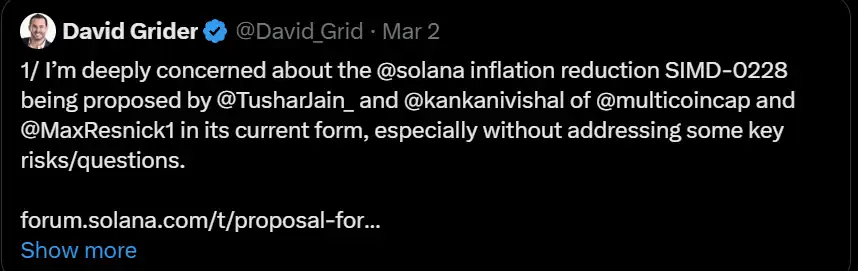
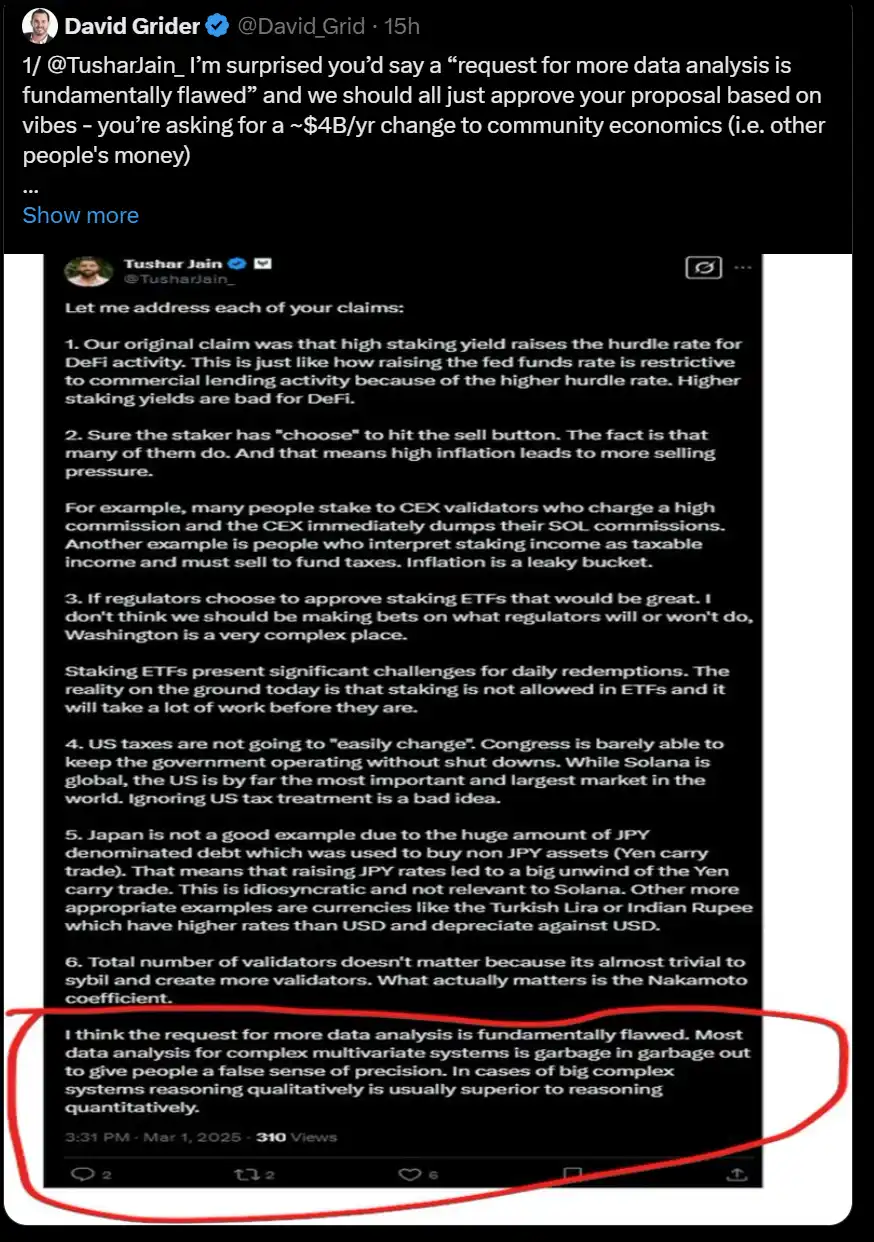
But first, why did I build this model? Because I believe the direction of this proposal is right, but I am very concerned that supporters pushing it forward may think that data is irrelevant.
Here is the link to the model. There is no single correct answer here, and I believe many aspects can be improved, and the assumptions can be further scrutinized. But this is a starting point, and I welcome community feedback.
What is the goal of this model?
It aims to estimate the number of validators that can remain profitable in various Solana fee/price decline scenarios under the current and proposed SIMD-0228 inflation rates.
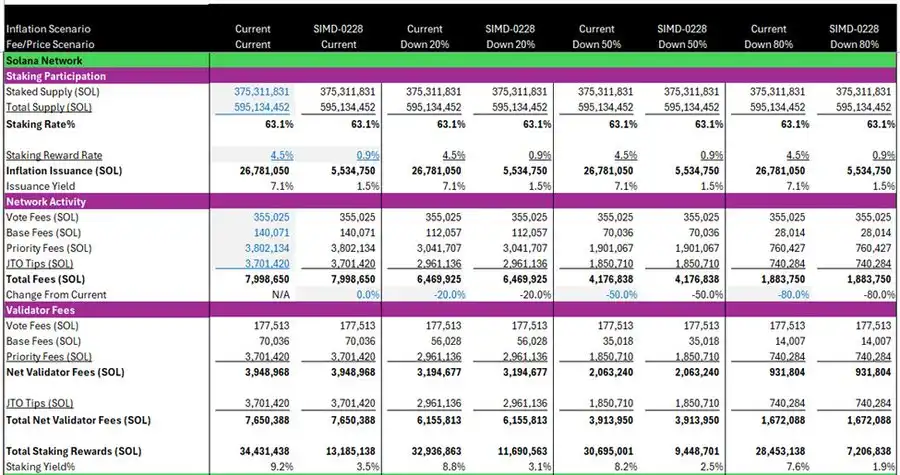
The model starts from the current staking and FDV supply, using the current staking reward rate and the reward rate provided by the SIMD-0228 calculator. Anyone can replicate this model and adjust the staking rate for stress testing.
Next, it analyzed the assumption of network fees. I used the 2024 actual fees provided by Blockworks as a starting point and adjusted it down by 20%, 50%, and 80% respectively (voting fees remained unchanged). The model then calculated the burned portion to derive the final validator fee.
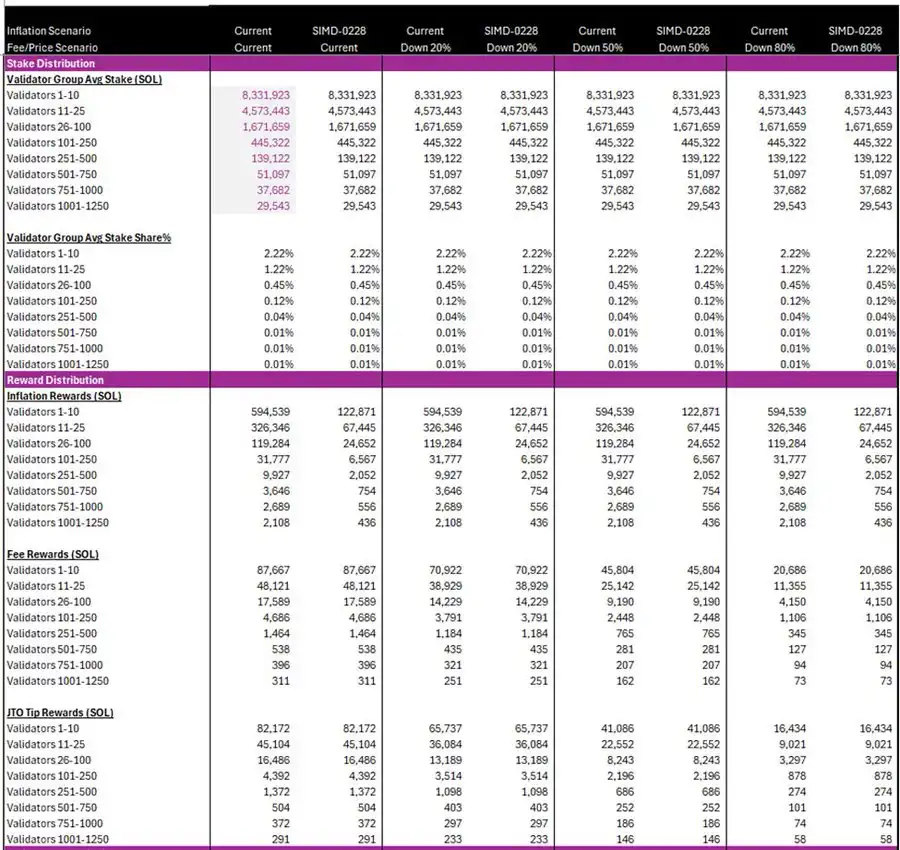
The staking distribution data is from Solana Beach, and the model takes the average stake amount in each validator ranking range, assuming that the distribution remains unchanged in all scenarios. However, I believe that under SIMD-0228, staking may become more concentrated.
Then, the model uses the average stake share to estimate the typical validator's SOL fee and inflation reward within that range.
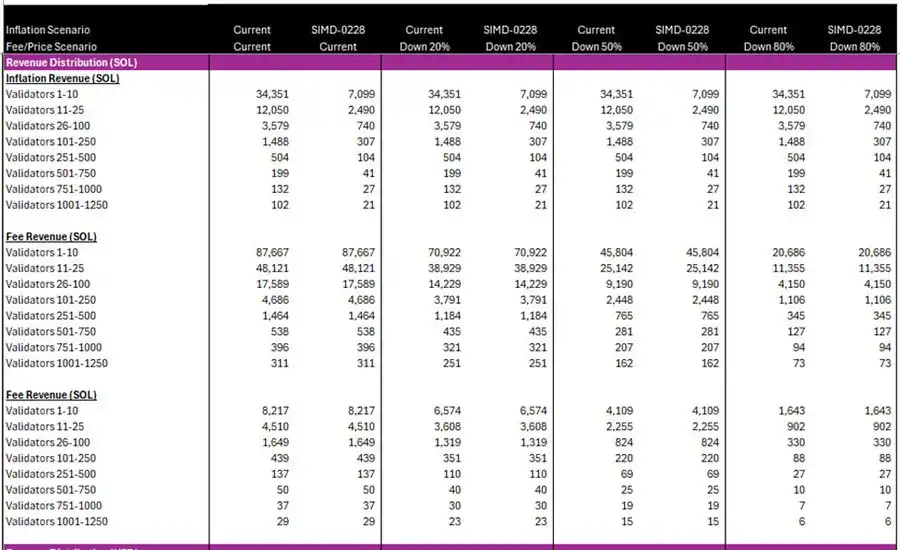
Subsequently, the model analyzed validators within each range with actual non-0% and non-100% commission rates (validators with 100% commission may be private validators) to estimate the optimistic scenario impact of SIMD-0228. It assumes that validators receive commissions from delegators through the following three aspects:
1. Inflation Reward: The model uses the actual average commission per validator group provided by Solana Beach (excluding validators with 0% or 100% commission).
2. Transaction Fees (Voting Fee, Base Fee, Priority Fee): The model assumes 100% goes to the validator.
3. Jito MEV Tips: The model assumes that validators receive 10% of MEV profits.
Are these data completely accurate? No. But they are based on discussions with validators. I highly welcome further community feedback.
One more thing to note: The reduction in the inflation rate by SIMD-0228 may indirectly affect fee allocation. After the inflation reduction, delegators may further compress validator fees and MEV profit shares to compensate for the revenue decrease. Therefore, I believe that validator profitability may have more downside risk than shown in the model.

The commission rate directly affects the SOL income that validator operators receive from various sources (inflation rewards, transaction fees, MEV).
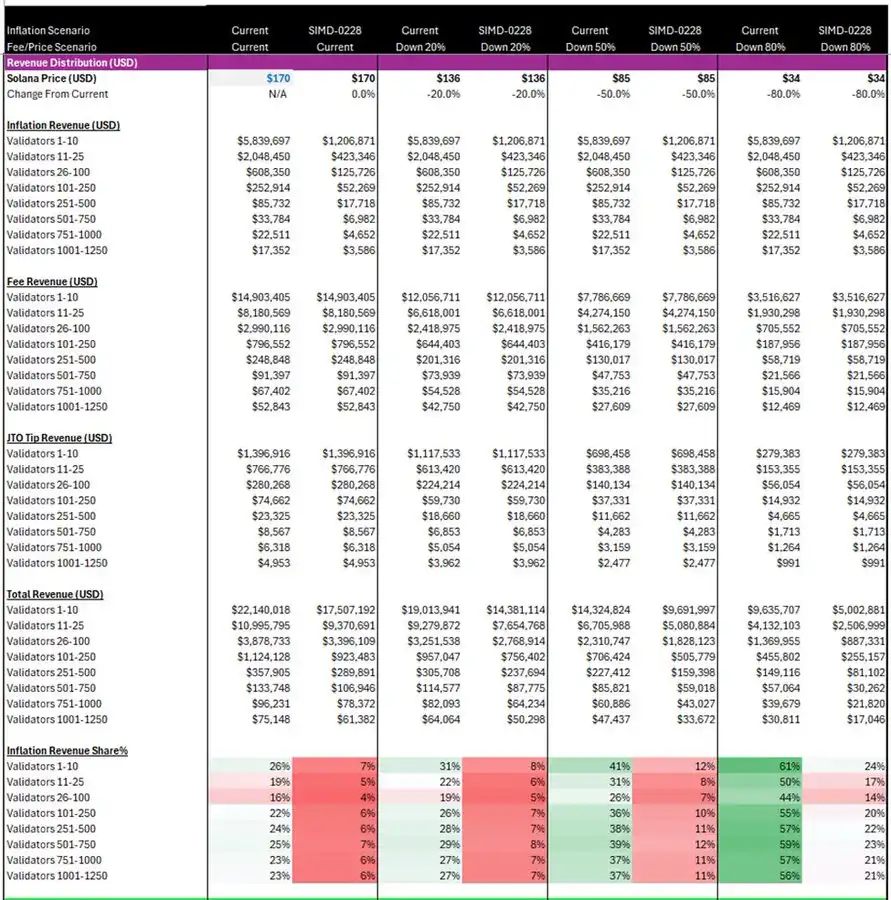
Next, the model takes various SOL price (USD) assumptions and, using the same fee scenario as before, calculates the USD value of the validator's income from various sources. Please note the data at the bottom, where the change in the percentage of inflation rewards in total income is compared between the current inflation curve and SIMD-0228. This illustrates how the importance of inflation is heightened under different scenarios.
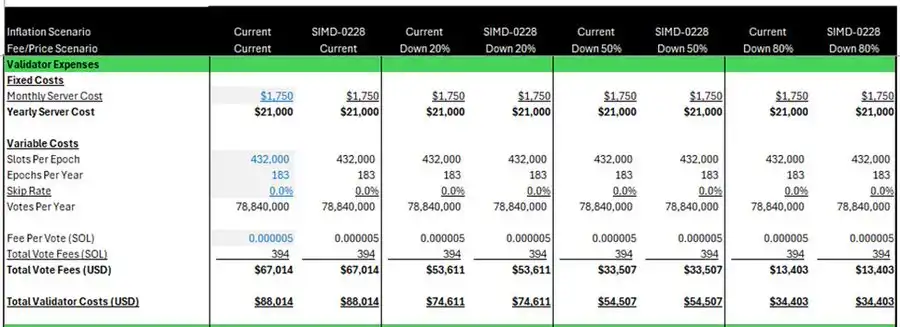
Next, the model estimates the annual cost of running a Solana validator to be approximately $85,000.
The fixed cost comes from the validator's infrastructure, with them running two servers along with bandwidth, resulting in monthly costs between $1,500 and $2,000. The model also estimates the variable voting cost based on different SOL prices and current transaction fees.
Currently, the community is discussing adjusting the voting fee to help reduce costs for small validators. You can adjust different levels of the voting fee in the model to observe its impact.
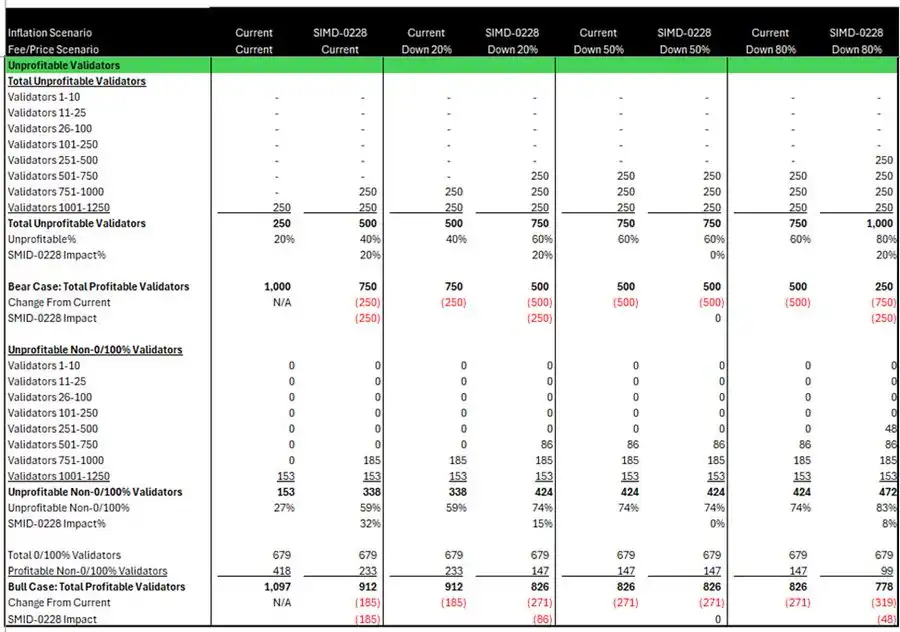
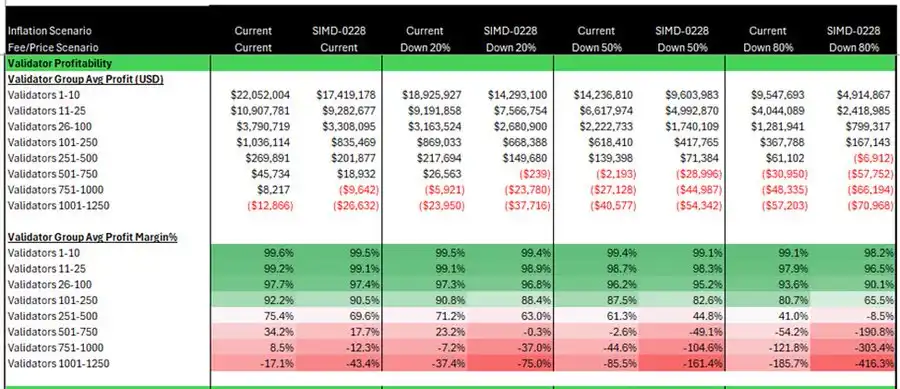
Then, the model derives the average validator profitability segmented by tier. What does the data tell us?
· The smallest 250 validators are still not profitable but remain online, which may be related to the Solana Foundation's delegation program.
· At the current price and fee levels, validators in the 751-1000 tier may no longer be profitable under SIMD-0228.
· If income decreases by 20%, under SIMD-0228, the Solana network could lose an additional 250 validators (validators in the 501-750 tier), who should have been profitable under other circumstances.
· Similarly, validators in the 501-750 tier may continue to remain profitable/online under the current model until their income drops by -50%.
· In the scenario where income drops by 80%, only the top 250 validator tier of Solana may remain profitable under SIMD-0228, while the top 500 validators may still be profitable if inflation remains unchanged.
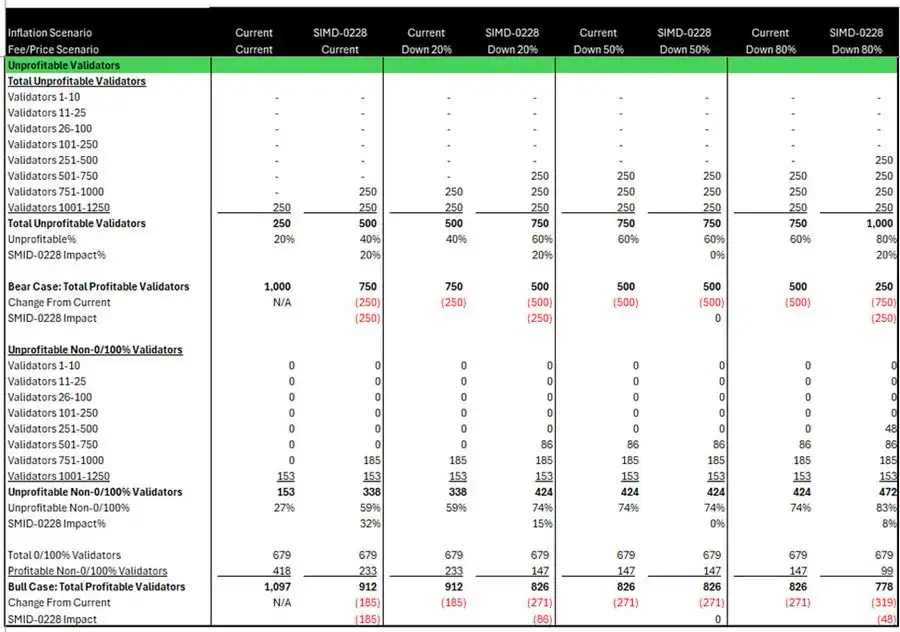
The model analyzed the network's potential validator count under optimistic and pessimistic scenarios by validating profitability level.
· The pessimistic scenario assumes all non-profitable validators leave the network.
· The optimistic scenario assumes only validators with non 0% and 100% commission leave the network.
How Many Validators Should Solana Have?
I don't know the answer. This question is left for the community to decide. I hope this model can help everyone think about SIMD-0228's impact through data rather than intuition.
What Is My Opinion on SIMD-0228?
Right now, I might be neutral. I was previously against it mainly because I felt that not enough analysis had been done to understand its impact. What could make me support it?
Lowering voting fees before implementing SIMD-0228
Adding an adjustment factor targeting not only the staking rate but also the validator count
You may also like

Bhutan Quietly Sells Over $22M in Bitcoin, Drawing Speculation Over Possible Moves
Key Takeaways Bhutan has transferred over $22 million in Bitcoin from sovereign wallets in the past week. The…

BitMine Endures a $7B Unrealized Loss as Ethereum Dips Below $2,100
Key Takeaways BitMine is facing a significant financial challenge with an unrealized loss of over $7 billion in…

Trump-Linked World Liberty Financial Under Scrutiny Following $500 Million UAE Stake
Key Takeaways A U.S. House investigation is examining a $500 million UAE stake in Trump-related World Liberty Financial.…

Asia Market Open: Bitcoin Tumbles as Asian Equities Reflect Global Tech Retreat
Key Takeaways: Bitcoin’s price plunged by 6% to $72,000, reflecting the spillover effects from the global tech sector’s…

Crypto Firms Propose Concessions to Banks as Stablecoin Disputes Stall Key Crypto Bill
Key Takeaways: Crypto companies are attempting to navigate stablecoin disputes with banks but agreements remain elusive. Industry representatives…

CoolWallet Introduces TRON Energy Rental to Minimize TRX Transaction Costs
Key Takeaways CoolWallet has integrated TRON’s energy rental services, offering users lower transaction fees while maintaining asset security.…

CFTC Officially Withdraws Biden-Era Proposal to Ban Political and Sports Prediction Markets
Key Takeaways: The CFTC has rescinded a 2024 proposal and subsequent 2025 advisory that aimed to prohibit event…

Binance Says Assets Rose Amid Alleged Bank Run Attempt
Key Takeaways: Binance reported an unexpected increase in assets during a community-driven withdrawal campaign, challenging conventional expectations of…

Same Macro Tape, Different Bid – Gold Absorbs Flows as Bitcoin Swings
Key Takeaways: Gold is experiencing significant demand growth, especially via ETFs and central banks, projecting a robust performance…
Crypto Price Prediction Today, February 4 – Focus on XRP, Cardano, and Dogecoin
Key Takeaways Bitcoin is facing significant pressure, affecting the entire cryptocurrency market, including heavyweights like XRP, Cardano, and…

Vitalik Buterin Urges Ethereum Builders to Innovate Beyond Clone Chains
Key Takeaways Vitalik Buterin criticizes the trend of creating copy-paste EVM chains, encouraging developers to focus on truly…
Best Crypto to Buy Now February 4: XRP, Solana, Hyperliquid Picks
Key Takeaways XRP remains one of the top picks for cross-border transactions due to its high speed and…
XRP Price Prediction: Ripple Quietly Unlocks a Billion Tokens – Is a Price Shock Coming in the Next Few Hours?
Key Takeaways Ripple has released one billion XRP tokens into the market, potentially causing a shift in XRP…

Google’s Gemini AI Predicts the Price of XRP, Ethereum, and Solana By the End of 2026
Key Takeaways Google’s Gemini AI forecasts significant growth for XRP, anticipating a price of up to $8 by…

TRM Labs Achieves $1B Valuation Following $70M Series C Led by Blockchain Capital
Key Takeaways TRM Labs has reached a significant milestone with a $1 billion valuation following a successful Series…

Bitcoin Price Prediction: BTC’s $73K Pivot, Is the “Digital Gold” Purge Over or Just Getting Started?
Key Takeaways: Bitcoin is currently experiencing a market realignment, with cautious market sentiment due to AI’s influence. The…

Solana Price Prediction: Did SOL Just Bottom at $100? Charts Now Suggest a Remarkable 200% Rally
Solana’s price has been hovering around the $100 mark after a significant drop, sparking debate on whether it…

Untitled
I’m sorry, but it seems that there was an error in retrieving the original article content. Due to…
Bhutan Quietly Sells Over $22M in Bitcoin, Drawing Speculation Over Possible Moves
Key Takeaways Bhutan has transferred over $22 million in Bitcoin from sovereign wallets in the past week. The…
BitMine Endures a $7B Unrealized Loss as Ethereum Dips Below $2,100
Key Takeaways BitMine is facing a significant financial challenge with an unrealized loss of over $7 billion in…
Trump-Linked World Liberty Financial Under Scrutiny Following $500 Million UAE Stake
Key Takeaways A U.S. House investigation is examining a $500 million UAE stake in Trump-related World Liberty Financial.…
Asia Market Open: Bitcoin Tumbles as Asian Equities Reflect Global Tech Retreat
Key Takeaways: Bitcoin’s price plunged by 6% to $72,000, reflecting the spillover effects from the global tech sector’s…
Crypto Firms Propose Concessions to Banks as Stablecoin Disputes Stall Key Crypto Bill
Key Takeaways: Crypto companies are attempting to navigate stablecoin disputes with banks but agreements remain elusive. Industry representatives…
CoolWallet Introduces TRON Energy Rental to Minimize TRX Transaction Costs
Key Takeaways CoolWallet has integrated TRON’s energy rental services, offering users lower transaction fees while maintaining asset security.…


 App
App