
- Buy Crypto
- Markets
 Futures
- Spot
- Copy Trade
 Earn
Earn- More
Dialogue with Gen Z Fintech Entrepreneur Christian: Eager for iteration speed and radical candor, financial worldview is more important than what to choose, "Young people should have a sense of awe"

Original Title: "Conversation with Post-00s Fintech Entrepreneur Christian: Aspiring for Iteration Speed and Candid Communication, Financial Views Are More Important Than Choices, 'Young People Should Have A Sense of Awe'"
Original Author: kaori, Observant Beating
How has your 2025 been? As the founder of Infini, post-00s Christian frankly wishes it were over soon. For a Fintech startup that has only been around for a year, whether experiencing a trust crisis caused by a hack or facing the choice of transformation that requires tearing down old answers, it's not a smooth journey that can be easily glossed over.
If we rewind three years, Christian in 2022 was still a typical crypto Degen, immersed in NFTs, later diving into DeFi, memes, with emotions fluctuating with the market, relying on intuition and gut feeling for decisions. It was an era of daring moves, with narratives running ahead of risk management, where growth obscured many details. However, when he actually started working—from product development, asset management to payment pathways, the industry's feedback changed. The harsh reality that a single incident could reset one's credibility made Christian realize that the most valuable thing in finance is not efficiency, but trust.
Financial enlightenment for Christian's generation was almost entirely fed by products: from QR code payments to passwordless deductions, from one-click installment plans to tap-to-pay, the golden age of Fintech lowered the financial barrier and made smoothness the default setting. However, when they started their own ventures, the industry climate had changed. Many entrepreneurs from the previous generation grew their businesses first on dividends and then caught up on learning, while this generation often learns on the go.
Therefore, this conversation discusses not just the path of a product or a company, but a more current portrayal of an entrepreneur: in an era where fees are getting thinner, channels are becoming more selective, and compliance increasingly resembles a time cost, what truly propels a business forward is an experience that can be realized in the long term.
Finance is not just the game of the "old guard"; new markets must retain the ambitions of young people while also learning to toughen up at the most fragile points. 2025 will surely be long remembered by Christian, as from this year onwards, both Infini and he truly entered the heart of the financial business, needing not only to run fast but also to withstand slowness and pain.
Beating Highlights:
· The greater opportunity may not only lie in B2B cross-border settlements, but in scenarios closer to the point of transaction occurrence; how to make it more convenient for the new generation of entrepreneurs to receive payments and manage funds, how to target global markets from the start of business, is the value stablecoins are about to realize.
· What is truly difficult to replicate is a company's core values, how you treat customers, how you serve them, especially whether you truly value customers' assets and are willing to respond 24 hours when customers have issues. Now, many products have similar functionalities, but faster iteration, a more carefully crafted user experience, more timely responses, and patience are actually decisive factors.
· A good entrepreneur must have the courage to let go. Even if the business is doing well at the time, if it cannot help us reach our goals within the expected time frame, you should take the team to find a more worthwhile direction.
· Instead of just offering a seemingly better asset management product, help users truly understand the risks. Do not put all trust in any single target or institution; at the very least, maintain independent judgment.
· What truly sets a product and team apart often lies in the details: every detail of the product, every piece of copy, every design element, and the implementation behind each feature. These will in turn determine what the product ultimately becomes.
· The more levels and politics there are in a startup, the more it will drag down efficiency and delivery. Everyone will make mistakes, including myself; I am willing to admit that. But more importantly, when you see a problem, you must dare to speak up. Do not stay silent due to concerns, as it will ultimately affect the entire team's goal.
The following is the full interview:
“Young People Must Have A Sense of Awe”
Dongcha: You previously mentioned that everything had been smooth sailing for you, but when disaster struck in the form of a $50 million hit, what was your initial reaction?
Christian: My initial reaction at that time was definitely shock. My mind went blank, thinking about how such a thing could happen to me. Not long ago, I had seen a similar event, and we had specifically paid attention to it, never expecting that next would be our turn.
But soon I realized that there were only two possible outcomes: either solve the problem, get through it, and continue moving forward with the team; or if handled poorly, it would essentially be game over for most people.
As you can see from the subsequent results, fortunately, we got through it, and growth even went more smoothly after March and April. That was my most genuine reaction at the time—I didn't overthink, I just felt it was what I should do.
Dongcha: What was the biggest difference in your mindset after experiencing this event, something you didn’t have before?
Christian: I think the biggest takeaway for me was “awe.” Many young people do not understand awe, especially when everything has been smooth sailing, making it easier to drift along. The case of SBF, fundamentally, was due to a lack of awe and respect for the industry, the market, and users.
After this incident, I became more certain about two things. First, I am not omnipotent, and I will definitely make mistakes. The goal of risk management is not to never make mistakes, but to minimize losses when they occur, preventing a single error from becoming a fatal blow.
Second, many problems ultimately come down to people. Whether intentional or not, there is always someone who didn't do their job properly. Therefore, after the event, we spent a lot of effort rebuilding and strengthening our recruitment, screening criteria, and team mechanisms.
I am actually grateful for this experience. If it hadn't happened, the state and capabilities of Infini's team might not be as good as they are now. It forced me to continuously iterate, align standards, and made me more aware that individuals whose values and pace don't match will have a hard time walking together in the long term. Initially, of course, I was frustrated, but now it is more of a continuous sense of gratitude. Things will eventually be resolved; the key is how you resolve them and whether your reputation and trust can be maintained in the long run.
Insight: "The general public may not necessarily need financial products, but they need a financial perspective." Why do you have this insight?
Christian: This year, we experienced a black swan event in the industry. Whether in crypto or traditional finance, there is no such thing as a product that will never encounter issues. Those considered superior are simply more knowledgeable about risk control and more responsible, able to handle things with a longer-term perspective.
However, if someone trusts all their wealth to a single entity and an incident occurs, even if the probability of that happening is one in a million, it would be unbearable for them.
So I increasingly feel that helping everyone develop the right financial perspective is more important. Instead of just offering a seemingly better asset management product, it's better to truly educate users about risk, not to trust everything in any single asset or institution, and at least maintain independent judgment.
Also, due to these reflections, our direction is adjusting, from initially focusing only on asset management to now wanting to establish a solid payment and settlement foundation. I increasingly believe that the two must ultimately be integrated; you have to first address "how to earn money, how to receive money" before you can talk about accumulating capital and then managing and preserving it. This has been my biggest realization this year.
Fearless First-Mover Advantage: Infini's Underlying Ambition
Insight: Infini made a significant pivot, moving away from its B2C business and refocusing. How did you make this decision, and where did the determination to make this change come from?
Christian: During the ToC phase, our team was relatively young and lacked relevant experience, so we encountered many challenges along the way. Some pitfalls you won't know unless you experience them firsthand, and no one will proactively tell you. For many people, this lack of transparency is actually key to their profitability and arbitrage. However, I really dislike this kind of system; I have always believed that the payment industry should be more transparent. Additionally, at that time, we were not yet at a very ready state overall, and it was particularly challenging for us to proceed.
At the same time, the business model at that time was not very clear. For example, in the U Card business, we hardly made any money because we wanted to minimize costs, allowing more people to use it at a lower threshold rather than just serving large clients.
However, as the user base grew, problems arose. These users might not necessarily bring you revenue, yet you had to invest a significant amount of time and effort in dealing with various situations. During that time, the team was basically being pushed by problems, and everyone was very tired and unhappy. The R&D team was frequently putting out fires, customer service had to stay up all night to respond, there was a huge number of customer complaints, and many of the issues were not ones we could solve because the entire chain was too long and there were too many links; it was very difficult to address any problem that arose.
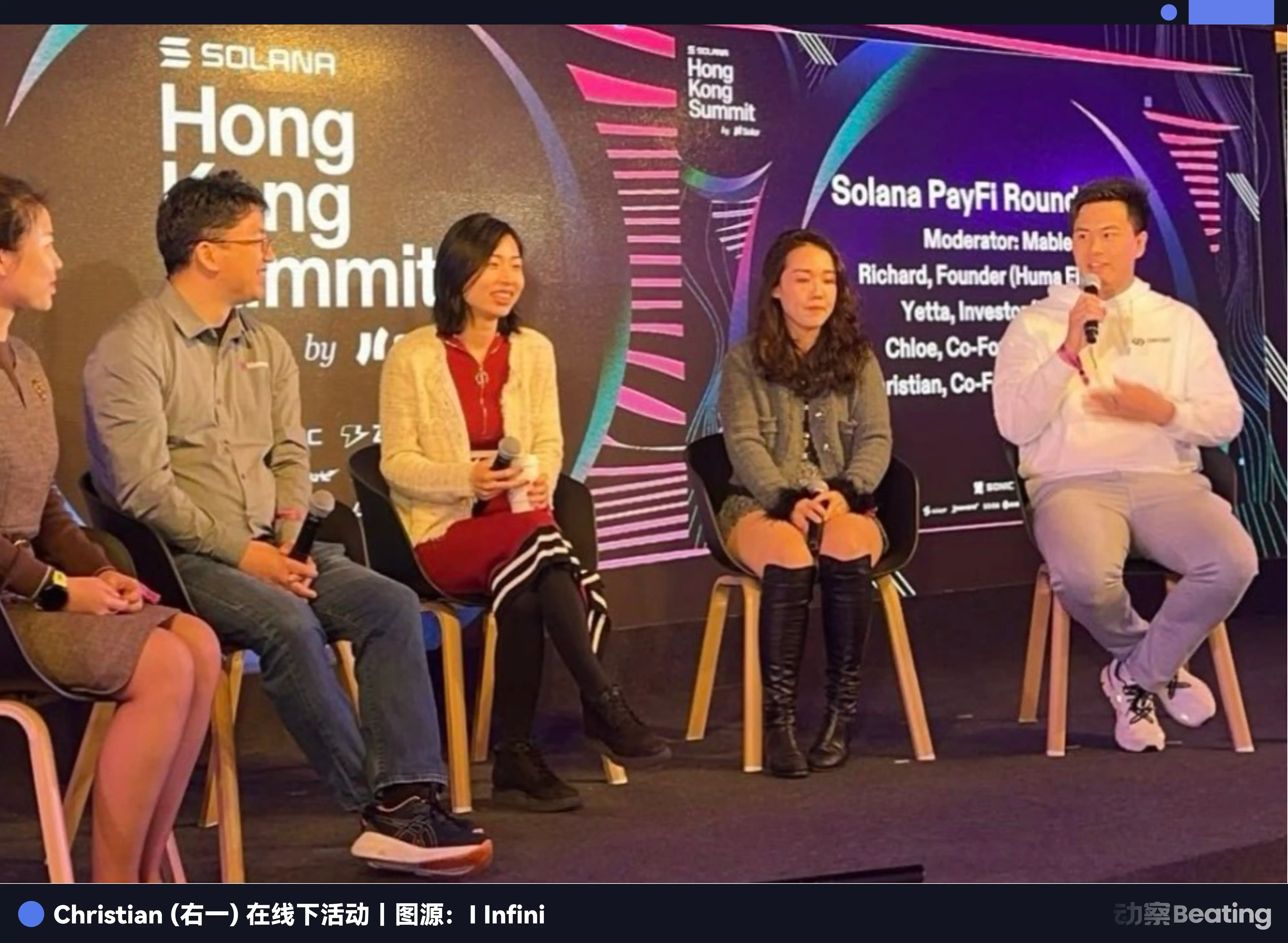
It was precisely because of this that we became more eager to do something based on blockchain, with a more certain underlying chain and fewer supply chain issues. As long as we did what we were supposed to do well, we could deliver a more stable product and experience.
The second thing we realized was that no matter how well we did on this path, it did not truly create new value at its core. It was more like regulatory arbitrage, indeed bringing convenience to some people who found traditional bank cards inconvenient, but the underlying network remained unchanged, costs and efficiency were not fundamentally improved, and because the chain was more complex, cost optimization became higher, ultimately still passing on to consumers.
Rather than continuing to grow in a race track where the final differentiation is very limited and can only end up in a price war, I believe good entrepreneurs should have the courage to let go. Even if the business was doing well at the time, if it cannot lead us to our goal within the expected time frame, then we should take the team to find a direction that is more worthy of investment. In comparison, the path we are now on, I do think it is truly worth someone's long-term development, and there are still many infrastructure and standards that need to be filled.
Dynamic Insights: Now Infini has expanded its acquiring business, which is a direction that values channels and operations very much. How did you find the first batch of customers? What needs did you hit?
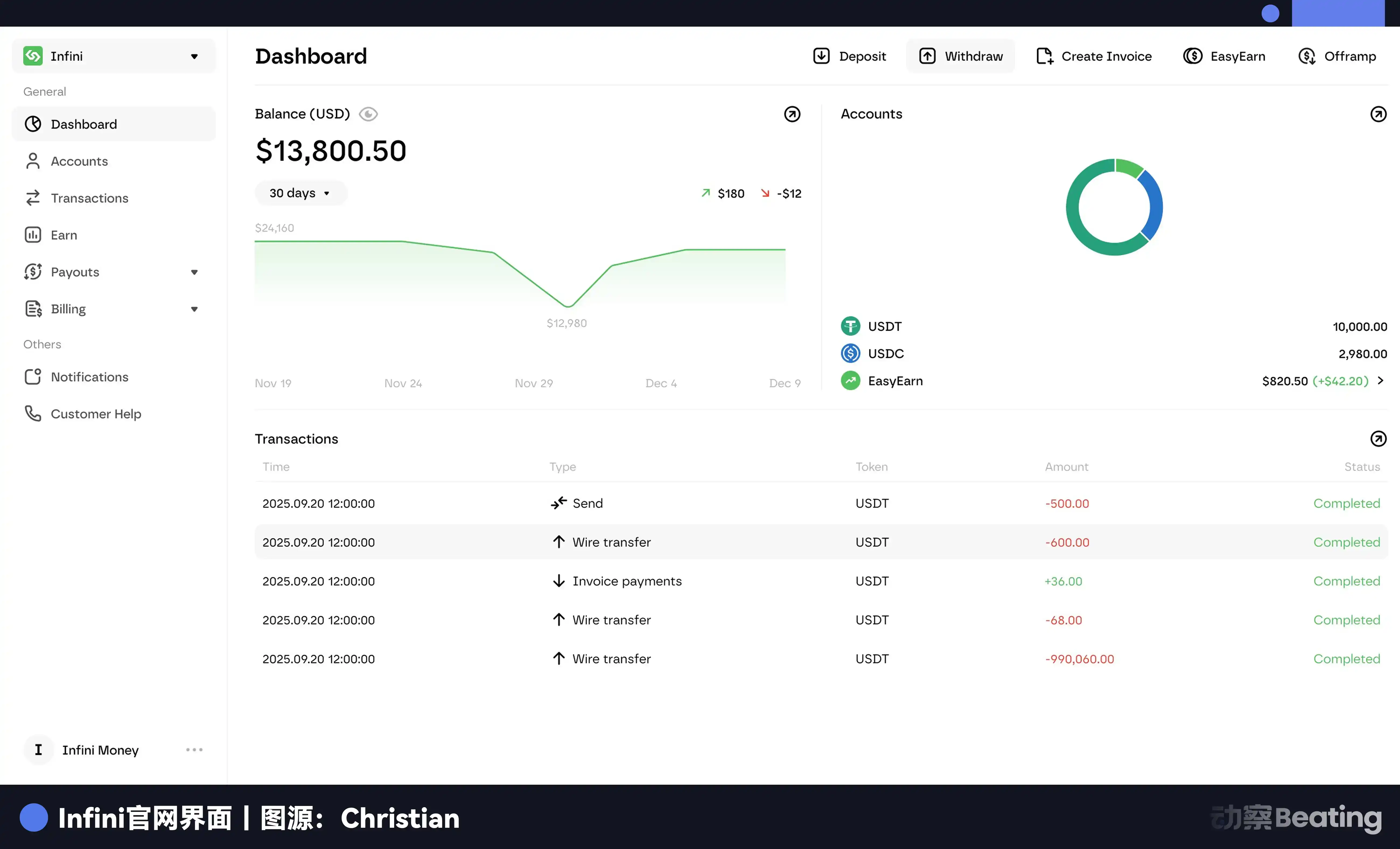
Christian: Acquiring is, of course, our core component, but we will not just stop at acquiring. Our positioning is more like a financial OS, aiming to provide an experience and functionality close to a bank level.
Specifically for acquiring, there are roughly two categories of problems to solve. The first is to provide a more lightweight payment account for overseas entrepreneurs and small teams. My assessment is that in the future, many people creating products and starting to accept payments might not necessarily need to have a bank account first.
Especially in the AI era, the time from development to deployment has been significantly compressed by various tools. You can no longer follow the traditional banking process at the traditional pace. In the past, it might have taken a month to set up an account and integrate, following the banking process, but with Infini, an account could be opened in as quickly as ten minutes, and integration could be completed in as little as a day, allowing you to start receiving payments.
This will be very practical for independent developers, super individuals, and small entrepreneurial teams. Among the less than 20 seed merchants we have now, the proportion of AI application developers is quite high, and there are indeed "one-person companies" using it, with their most urgent need being to get the payment process up and running.
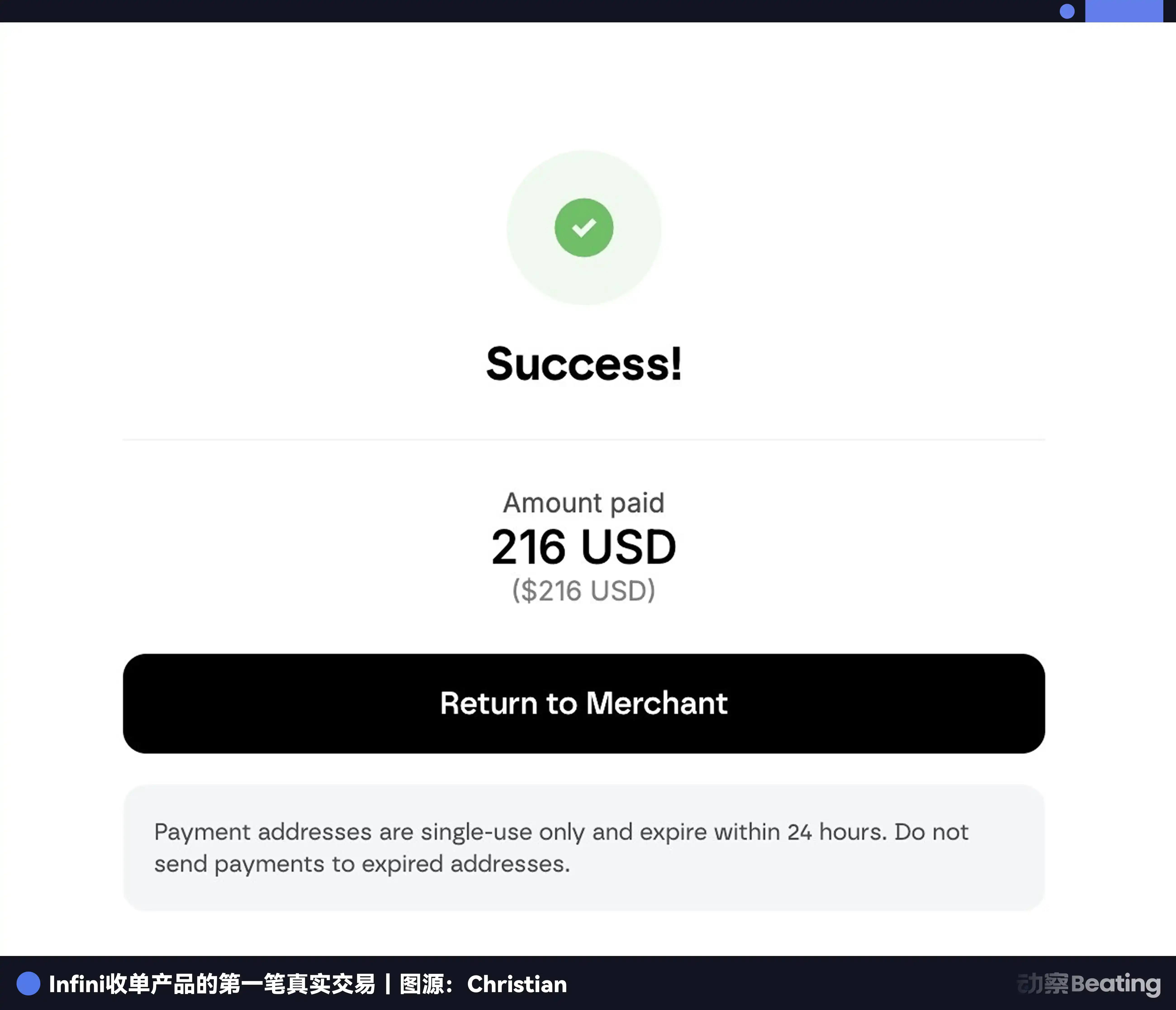
The second type is to enable merchants to accept stablecoin payments earlier in the process. Today, the vast majority of company revenues still rely on fiat-based settlement systems, but I believe that the proportion of stablecoins in wallets will continue to increase in the future, especially in regions like Latin America.
When we were developing the U Card in the past, we also observed that many users actually just want to pay for Netflix, Starlink, or shop on Amazon. So why do they have to go through the stablecoin-to-card process before spending? There is inevitably friction in between. If they can pay directly with stablecoins, the chain will be shorter, and the experience will be better.
For merchants, having another stablecoin payment option is essentially having another source of income. Just like adding another wallet channel in traditional payments, expanding the customer base can often lead to some increase in coverage.
We have also seen some cases where stablecoin payments bring in new users, rather than just providing a smoother experience for existing users. Of course, the scale is still small, but the earlier you adopt it, the more the share of this channel will increase as merchants grow and user habits improve.
Insight: Fintech companies like Revolut, with years of accumulated experience, already have scale, data, and strong regulatory capabilities. Even if they are not the first to introduce new features, they can quickly replicate and distribute them to tens of millions of users. In contrast, Crypto Native companies are often constrained by fundraising, licensing, and compliance. Faced with this first-mover advantage, how do you compete? In the Financial OS path you mentioned, what is Infini's core moat?
Christian: I think it can be viewed from two perspectives. First of all, the Fintech industry itself does not have such strong network effects, unlike social products where one winner takes all. Many small Fintech companies can also thrive because the core of customer choice is often trust.
Actually, every era has its giants, and there has never been a lack of challengers. It's just that today, this trend is being reinforced. Some large domestic companies may indeed quickly launch the product features that catch your attention and then use multiple or even hundreds of times the resources to compete, and this scenario exists and the likelihood is increasing. But I actually wouldn't focus on preventing plagiarism. The idea itself is not valuable, as features and interfaces can be easily copied.
What is truly difficult to replicate is a company's core values, how you treat customers, how you serve customers, especially whether you truly value customer assets and are willing to respond 24/7 when customers encounter issues. Nowadays, many products have similar functionalities, with faster iterations, meticulously crafted user experiences, and timely and patient responses becoming decisive factors.
The True Mission of Financial Products is Equity
Insight: Many believe that much of the innovation in the past two decades has mostly focused on the distribution layer, enhancing the user experience, while the underlying logic of fund circulation remains traditional. This has led to standardization, thin profit margins, and intense competition. As a new generation Fintech entrepreneur, what do you most want to improve?
Christian: I agree with this assessment. Looking at the timeline, many of the well-known financial technology products in the market today were actually born around fifteen years ago. The first generation of successful unicorns did indeed bring about a lot of innovation, but most of their innovations were still achieved within the confines of traditional banking and payment paradigms, essentially creating better products and experiences on old systems.
Within this traditional paradigm, there has long been a difficult-to-solve problem, which is the barrier to entry. Many financial technology products require users to have a traditional bank account before they can use them. No matter how much innovation you do on top, you still have to sync a significant amount of information and details with the underlying bank; as long as you rely on bank licenses and systems, these restrictions cannot be bypassed. Second is the cost of the transfer network, especially cross-border. High fees, difficulty in processing small transactions, unstable timeliness, and complex mutual recognition and anti-money laundering processes between different countries.
Insight: Where does your value capture lie?
Christian: For B2B companies, one of the future's greatest values is enabling enterprises to access and use financial services without relying on a traditional bank account as a cornerstone. For independent developers, small teams, or small startup companies, this will bring about an order of magnitude change in onboarding efficiency.
Our advantage as this new breed of entrepreneurs lies in being able to conduct a more globalized business from the infrastructure and technological perspective today, especially being able to quickly cover emerging markets and allow users to register and use services more freely and smoothly. Of course, in the long run, everyone will still move towards more comprehensive compliance and licensing arrangements, but the paths at the initial stage are different.
In our products, we aim to build new payment networks based on stablecoins as much as possible. Traditional players are also moving in a similar direction, but most of them still settle around card networks like Visa and Mastercard. My belief is that the bigger opportunity may not only be in B2B cross-border settlements but in scenarios closer to the transaction, such as how to enable the new generation of entrepreneurs to receive payments and manage funds more conveniently, and how to face the global market at the inception of the business. This is the value that stablecoins are about to deliver.
Insight: The previous generation of Fintech entrepreneurs also early on attempted to "specialize," such as targeting students, gig workers, teenagers, but eventually were forced to develop into a large, all-encompassing super app.
Christian: I think this is not just the logic of Fintech, but rather a path that all apps will eventually follow. True growth often comes from precisely targeting a small group of people with pain points. First, deeply understand this pain point, then expand outward along the demand, discover similar issues among more adjacent groups, and continuously design and iterate to gradually push the boundaries.
Of course, as companies reach a certain stage, they will differentiate. Some founders are more content with excelling in a very niche area. If the problem in this area is solved well enough, they are willing to hold their ground, make the service deeper and more specialized. Some people think further, hoping to serve more people, see more needs, and from a business perspective, also pursue a larger scale, profit, and path to capitalization.
Insight: If you were to describe your ideal Fintech product in one sentence, how would you describe it?
Christian: My ideal product, and also the product we hope to create in the future, is a kind of equality: to provide the capabilities of banking and financial services in a more indiscriminate, fair way to every person in need—especially every person who wants to start a business. In my view, the true mission of financial products lies here.
Management View of the New Generation of Entrepreneurs
Insight: Some people say that being a little older in finance has more advantages. What is your take on this statement?
Christian: I think the phenomenon of "Fintech preferring older, more experienced founders" is more common in Asia, but in Europe and America, there are also many very young, outstanding entrepreneurs.
The difference lies first in the choice of environment and ecosystem. I have asked many investors, and they do indeed prefer to invest in slightly older, more experienced individuals, especially in the Fintech industry, which is highly regulated and requires strong risk control. Many pitfalls are accumulated through time and experience which only those who have traversed them would know, from this perspective, they have the advantage.
But I don't think age itself is a deciding factor. When we hire people, we also do not judge ability solely based on age. Being older does not mean lacking innovation, and being young does not mean that one cannot perform well. The key factors are whether you have experienced pitfalls and your understanding of and control over risks.
Since everyone will encounter challenges, another variable is the pace of growth and iteration. Young people may need to pay some tuition fees, and I have paid quite a bit myself. However, if you can progress quickly during the process, truly clarify compliance and risk control, you can also do very well.
Dynamics Observation: You mentioned that you pretended to be in entrepreneurship for a while, so where was the pretense?
Christian: This is a state, especially for some older founders who came from managerial roles in large companies in the past. After starting a business, it is easy to continue previous habits, thinking that as long as they do a few management tasks well, such as fundraising, team building, and setting direction, everything will be fine. Of course, these are responsibilities that a CEO must shoulder because no one else can do them for you.
If you think that by doing these three things well, things will naturally proceed ideally, I believe this is a fallacy and a reason why many people stumble. What truly makes a product and team stand out is often found in the details—the nuances of every product feature, every piece of copy, every design element, and the implementation behind each function. All these factors will ultimately determine what the product will grow into.
Team management is similar. It’s not that the team cannot perform well; it’s that if a founder could personally set the standard at the beginning, the team's execution later on would be much smoother, and the overall outcome would be more likely to achieve consistent high quality.
Dynamics Observation: During this period, you must have gained many insights into organizational management in the entrepreneurial process.
Christian: In addition to what was mentioned earlier about not pretending to be an entrepreneur, another key point is to lead by example. You have to be on the front line with the team, or at the very least, be willing to understand what’s going on. If you yourself do not understand, are not interested, or lack the curiosity to figure things out, colleagues will find it hard to consider it a matter that should be taken seriously to the end. You certainly cannot be an expert in everything, but your attitude is crucial—let everyone see that you are constantly reflecting and improving. Often, morale is built in this way.
Then, it is essential to find the right people. The most fatal aspect of hiring the wrong person is not their lack of ability, but how they can slow down the organization's iteration speed. Some individuals may be very talented but are more suitable for large companies; in a startup, they may not adapt well, struggle to keep up with the pace, and fail to meet expectations. One of the most crucial qualities of a startup is the courage to make decisions; it is important to let unsuitable individuals leave early on and continuously search for more fitting team members.
The strength of a startup team lies in whether the overall average quality is high enough, with ideally each person capable of holding their own and delivering at a high standard. In the future, with the assistance of AI tools, the team size will likely become more streamlined, moving away from the expansion model of hundreds or thousands of people. However, the smaller the team, the higher the demand for each person's skill level to be on the same page because if anyone's attitude or abilities fall behind, it could potentially drag down the entire team's speed. Therefore, apart from developing the product, continuously evaluating, making timely adjustments, and consistently strengthening the team are all crucial tasks in and of themselves.
Insight: How do you screen for suitable co-founders?
Christian: I value three things more than experience, background, or education. The first is iteration speed and curiosity, which is essentially learning ability. It is not necessarily related to age, especially since we are in a new field with almost no mature paradigms to follow and no products to copy. Learning and thinking ability take precedence. Additionally, if a person has hardly used AI or other productivity tools in their current workflow, I would think they lack awareness of maximizing efficiency.
The second is long-term thinking and the ability to see things through with the team. In the crypto world, many people are more inclined to short-term gains, which is reasonable. However, we do not consider ourselves solely a Web3/Crypto company but more like building long-term internet products and platforms.
We do not plan to launch tokens for short-term gains; many times, we need to sacrifice short-term cash flow for long-term value. In this process, there are many decisions to make with little room for error. If someone is only motivated by making quick money, they are naturally not well-suited for our environment.
The third is absolute honesty. The more hierarchical and political a startup becomes, the more it will hinder efficiency and delivery. Everyone will make mistakes, including myself, and I am willing to admit that. However, it is more important to speak up when you see an issue, not stay silent due to concerns. Otherwise, it will ultimately affect the entire team's goals.
Insight: Who do you admire the most in your entrepreneurial journey?
Christian: The founder of Revolut; Revolut is also a company I admire greatly. They have absolute execution power and the utmost standards for the team.
From a product perspective, what Revolut did in the early days was not groundbreaking innovation. Features like card issuance and foreign exchange are the fundamental aspects of traditional banks. What I truly admire is their drive and speed of execution.
In the common perception, European companies are thought to be slow and inefficient, but Revolut has shown that Europe can also possess the speed and determination seen in domestic internet companies. Their impressive ability lies in replicating a product's basic functions in a short timeframe, continuously optimizing it, and then surpassing the competition. This capability is very strong, and I hope we can nurture it as well.
However, it is not just about speed; the prerequisite is that every feature must genuinely solve a user's problem and do it better than others. Revolut's iteration speed, on the one hand, is fast in development, but more importantly, they can precisely pinpoint user needs, ensuring that the product is used as soon as it is released—a quality I highly appreciate.
The second point is the founder's attitude toward team management. He has a famous saying called "get shit done," and I even consider this phrase as the motto of our internal collaboration. It is not about advocating for a 996 work culture or using rules and regulations to pressure people. Instead, it's about making a mutual choice when building a team: those who join should have a sense of responsibility. How is a sense of responsibility manifested? First, through curiosity, and second, through a desire to do things well and strive for excellence.
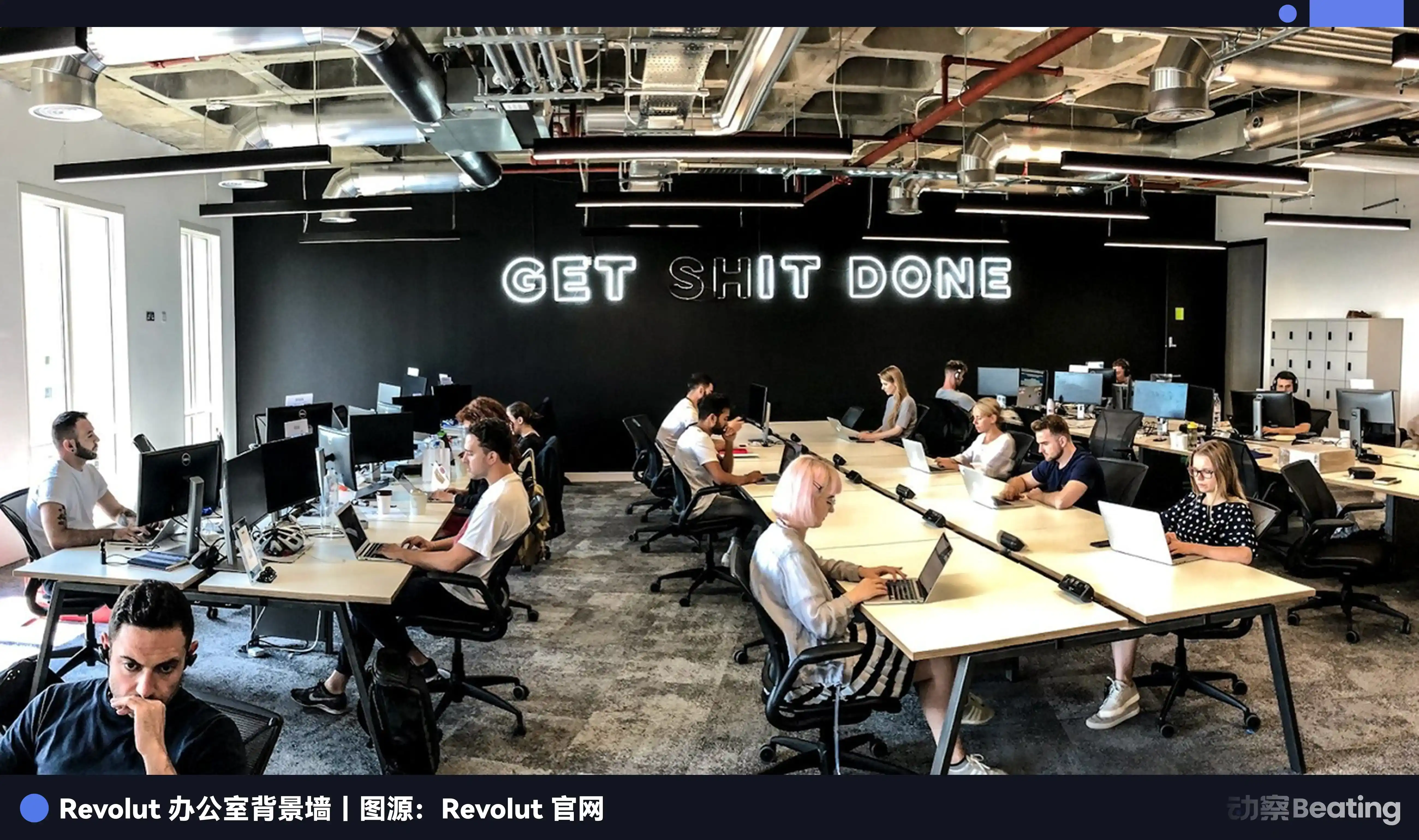
Behind this is actually a very strict management philosophy. He sets very high standards for the team, and those who cannot meet them will be asked to leave. This almost ruthless standard, in turn, enhances the overall combat effectiveness, quality, and speed of advancement of the team. This is the kind of environment I aspire to, and I also hope to get as close to it as possible. Of course, ultimately, everyone will find their own unique management style.
Interviewer: What book has inspired you the most or been your favorite this year?
Christian: After finishing reading "The Lychee Light Pavilion in Chang'an," I realized that I didn't know much about the Tang Dynasty. So, I read three related books in succession. As I read, I was deeply moved. The most exciting part of history often revolves around Li Shimin, and his experiences have provided me with strong inspiration. Conquering in ancient times is very similar to entrepreneurship today—the essence is to have a leader who can lead a group of people to accomplish something.
I especially admire Li Shimin's tolerance and vision, which is almost universally acknowledged among emperors throughout history. After his victory, he could consolidate, trust, and even reappoint former enemies and strong opponents. Entrepreneurs should also have this kind of tolerance because the most outstanding individuals are often unruly and difficult to persuade. If you can still make this group of people follow you wholeheartedly, that is a rare and crucial ability.
Also, he seized power through a military coup, even rebelling against his own father. Perhaps because I study philosophy, I often think about what kind of situation would lead a person to make such a choice that is considered outrageous within the traditional moral framework? For me, this matter is not a simple evaluation of right or wrong, good or bad. It is more like providing a perspective. Perhaps there is a certain type of person who exists in a different moral state. How each person chooses to act in different circumstances is very thought-provoking and worth contemplating long term.
Interviewer: 2025 may have been a bit challenging for you. What will your year-end summary say?
Christian: I genuinely hope that 2025 will hurry up and pass by (laughs). It's not that this year has been entirely challenging, but it has indeed been quite tough. However, looking back, I feel very fortunate. Being able to experience so much at this age has been the fastest period of growth for me.
My year-end reflection is really about one thing: in which areas could I have done better if I had another chance? What lessons should I learn? Of course, most of the time I am also thinking about what to do next. Another fortunate thing is that during this process, I found that many people around me have been there all along, colleagues, friends, family, accompanying me through this difficult time.
At the same time, this year also made it clearer to me who are the people who can still help you solve the problem when you are in difficulty. I am more willing to believe, and I feel it is worth working together in the long term and going forward together.
You may also like

Token Cannot Compound, Where Is the Real Investment Opportunity?

February 6th Market Key Intelligence, How Much Did You Miss?

China's Central Bank and Eight Other Departments' Latest Regulatory Focus: Key Attention to RWA Tokenized Asset Risk
Foreword: Today, the People's Bank of China's website published the "Notice of the People's Bank of China, National Development and Reform Commission, Ministry of Industry and Information Technology, Ministry of Public Security, State Administration for Market Regulation, China Banking and Insurance Regulatory Commission, China Securities Regulatory Commission, State Administration of Foreign Exchange on Further Preventing and Dealing with Risks Related to Virtual Currency and Others (Yinfa [2026] No. 42)", the latest regulatory requirements from the eight departments including the central bank, which are basically consistent with the regulatory requirements of recent years. The main focus of the regulation is on speculative activities such as virtual currency trading, exchanges, ICOs, overseas platform services, and this time, regulatory oversight of RWA has been added, explicitly prohibiting RWA tokenization, stablecoins (especially those pegged to the RMB). The following is the full text:
To the people's governments of all provinces, autonomous regions, and municipalities directly under the Central Government, the Xinjiang Production and Construction Corps:
Recently, there have been speculative activities related to virtual currency and Real-World Assets (RWA) tokenization, disrupting the economic and financial order and jeopardizing the property security of the people. In order to further prevent and address the risks related to virtual currency and Real-World Assets tokenization, effectively safeguard national security and social stability, in accordance with the "Law of the People's Republic of China on the People's Bank of China," "Law of the People's Republic of China on Commercial Banks," "Securities Law of the People's Republic of China," "Law of the People's Republic of China on Securities Investment Funds," "Law of the People's Republic of China on Futures and Derivatives," "Cybersecurity Law of the People's Republic of China," "Regulations of the People's Republic of China on the Administration of Renminbi," "Regulations on Prevention and Disposal of Illegal Fundraising," "Regulations of the People's Republic of China on Foreign Exchange Administration," "Telecommunications Regulations of the People's Republic of China," and other provisions, after reaching consensus with the Cyberspace Administration of China, the Supreme People's Court, and the Supreme People's Procuratorate, and with the approval of the State Council, the relevant matters are notified as follows:
(I) Virtual currency does not possess the legal status equivalent to fiat currency. Virtual currencies such as Bitcoin, Ether, Tether, etc., have the main characteristics of being issued by non-monetary authorities, using encryption technology and distributed ledger or similar technology, existing in digital form, etc. They do not have legal tender status, should not and cannot be circulated and used as currency in the market.
The business activities related to virtual currency are classified as illegal financial activities. The exchange of fiat currency and virtual currency within the territory, exchange of virtual currencies, acting as a central counterparty in buying and selling virtual currencies, providing information intermediary and pricing services for virtual currency transactions, token issuance financing, and trading of virtual currency-related financial products, etc., fall under illegal financial activities, such as suspected illegal issuance of token vouchers, unauthorized public issuance of securities, illegal operation of securities and futures business, illegal fundraising, etc., are strictly prohibited across the board and resolutely banned in accordance with the law. Overseas entities and individuals are not allowed to provide virtual currency-related services to domestic entities in any form.
A stablecoin pegged to a fiat currency indirectly fulfills some functions of the fiat currency in circulation. Without the consent of relevant authorities in accordance with the law and regulations, any domestic or foreign entity or individual is not allowed to issue a RMB-pegged stablecoin overseas.
(II)Tokenization of Real-World Assets refers to the use of encryption technology and distributed ledger or similar technologies to transform ownership rights, income rights, etc., of assets into tokens (tokens) or other interests or bond certificates with token (token) characteristics, and carry out issuance and trading activities.
Engaging in the tokenization of real-world assets domestically, as well as providing related intermediary, information technology services, etc., which are suspected of illegal issuance of token vouchers, unauthorized public offering of securities, illegal operation of securities and futures business, illegal fundraising, and other illegal financial activities, shall be prohibited; except for relevant business activities carried out with the approval of the competent authorities in accordance with the law and regulations and relying on specific financial infrastructures. Overseas entities and individuals are not allowed to illegally provide services related to the tokenization of real-world assets to domestic entities in any form.
(III) Inter-agency Coordination. The People's Bank of China, together with the National Development and Reform Commission, the Ministry of Industry and Information Technology, the Ministry of Public Security, the State Administration for Market Regulation, the China Banking and Insurance Regulatory Commission, the China Securities Regulatory Commission, the State Administration of Foreign Exchange, and other departments, will improve the work mechanism, strengthen coordination with the Cyberspace Administration of China, the Supreme People's Court, and the Supreme People's Procuratorate, coordinate efforts, and overall guide regions to carry out risk prevention and disposal of virtual currency-related illegal financial activities.
The China Securities Regulatory Commission, together with the National Development and Reform Commission, the Ministry of Industry and Information Technology, the Ministry of Public Security, the People's Bank of China, the State Administration for Market Regulation, the China Banking and Insurance Regulatory Commission, the State Administration of Foreign Exchange, and other departments, will improve the work mechanism, strengthen coordination with the Cyberspace Administration of China, the Supreme People's Court, and the Supreme People's Procuratorate, coordinate efforts, and overall guide regions to carry out risk prevention and disposal of illegal financial activities related to the tokenization of real-world assets.
(IV) Strengthening Local Implementation. The people's governments at the provincial level are overall responsible for the prevention and disposal of risks related to virtual currencies and the tokenization of real-world assets in their respective administrative regions. The specific leading department is the local financial regulatory department, with participation from branches and dispatched institutions of the State Council's financial regulatory department, telecommunications regulators, public security, market supervision, and other departments, in coordination with cyberspace departments, courts, and procuratorates, to improve the normalization of the work mechanism, effectively connect with the relevant work mechanisms of central departments, form a cooperative and coordinated working pattern between central and local governments, effectively prevent and properly handle risks related to virtual currencies and the tokenization of real-world assets, and maintain economic and financial order and social stability.
(5) Enhanced Risk Monitoring. The People's Bank of China, China Securities Regulatory Commission, National Development and Reform Commission, Ministry of Industry and Information Technology, Ministry of Public Security, State Administration of Foreign Exchange, Cyberspace Administration of China, and other departments continue to improve monitoring techniques and system support, enhance cross-departmental data analysis and sharing, establish sound information sharing and cross-validation mechanisms, promptly grasp the risk situation of activities related to virtual currency and real-world asset tokenization. Local governments at all levels give full play to the role of local monitoring and early warning mechanisms. Local financial regulatory authorities, together with branches and agencies of the State Council's financial regulatory authorities, as well as departments of cyberspace and public security, ensure effective connection between online monitoring, offline investigation, and fund tracking, efficiently and accurately identify activities related to virtual currency and real-world asset tokenization, promptly share risk information, improve early warning information dissemination, verification, and rapid response mechanisms.
(6) Strengthened Oversight of Financial Institutions, Intermediaries, and Technology Service Providers. Financial institutions (including non-bank payment institutions) are prohibited from providing account opening, fund transfer, and clearing services for virtual currency-related business activities, issuing and selling financial products related to virtual currency, including virtual currency and related financial products in the scope of collateral, conducting insurance business related to virtual currency, or including virtual currency in the scope of insurance liability. Financial institutions (including non-bank payment institutions) are prohibited from providing custody, clearing, and settlement services for unauthorized real-world asset tokenization-related business and related financial products. Relevant intermediary institutions and information technology service providers are prohibited from providing intermediary, technical, or other services for unauthorized real-world asset tokenization-related businesses and related financial products.
(7) Enhanced Management of Internet Information Content and Access. Internet enterprises are prohibited from providing online business venues, commercial displays, marketing, advertising, or paid traffic diversion services for virtual currency and real-world asset tokenization-related business activities. Upon discovering clues of illegal activities, they should promptly report to relevant departments and provide technical support and assistance for related investigations and inquiries. Based on the clues transferred by the financial regulatory authorities, the cyberspace administration, telecommunications authorities, and public security departments should promptly close and deal with websites, mobile applications (including mini-programs), and public accounts engaged in virtual currency and real-world asset tokenization-related business activities in accordance with the law.
(8) Strengthened Entity Registration and Advertisement Management. Market supervision departments strengthen entity registration and management, and enterprise and individual business registrations must not contain terms such as "virtual currency," "virtual asset," "cryptocurrency," "crypto asset," "stablecoin," "real-world asset tokenization," or "RWA" in their names or business scopes. Market supervision departments, together with financial regulatory authorities, legally enhance the supervision of advertisements related to virtual currency and real-world asset tokenization, promptly investigating and handling relevant illegal advertisements.
(IX) Continued Rectification of Virtual Currency Mining Activities. The National Development and Reform Commission, together with relevant departments, strictly controls virtual currency mining activities, continuously promotes the rectification of virtual currency mining activities. The people's governments of various provinces take overall responsibility for the rectification of "mining" within their respective administrative regions. In accordance with the requirements of the National Development and Reform Commission and other departments in the "Notice on the Rectification of Virtual Currency Mining Activities" (NDRC Energy-saving Building [2021] No. 1283) and the provisions of the "Guidance Catalog for Industrial Structure Adjustment (2024 Edition)," a comprehensive review, investigation, and closure of existing virtual currency mining projects are conducted, new mining projects are strictly prohibited, and mining machine production enterprises are strictly prohibited from providing mining machine sales and other services within the country.
(X) Severe Crackdown on Related Illegal Financial Activities. Upon discovering clues to illegal financial activities related to virtual currency and the tokenization of real-world assets, local financial regulatory authorities, branches of the State Council's financial regulatory authorities, and other relevant departments promptly investigate, determine, and properly handle the issues in accordance with the law, and seriously hold the relevant entities and individuals legally responsible. Those suspected of crimes are transferred to the judicial authorities for processing according to the law.
(XI) Severe Crackdown on Related Illegal and Criminal Activities. The Ministry of Public Security, the People's Bank of China, the State Administration for Market Regulation, the China Banking and Insurance Regulatory Commission, the China Securities Regulatory Commission, as well as judicial and procuratorial organs, in accordance with their respective responsibilities, rigorously crack down on illegal and criminal activities related to virtual currency, the tokenization of real-world assets, such as fraud, money laundering, illegal business operations, pyramid schemes, illegal fundraising, and other illegal and criminal activities carried out under the guise of virtual currency, the tokenization of real-world assets, etc.
(XII) Strengthen Industry Self-discipline. Relevant industry associations should enhance membership management and policy advocacy, based on their own responsibilities, advocate and urge member units to resist illegal financial activities related to virtual currency and the tokenization of real-world assets. Member units that violate regulatory policies and industry self-discipline rules are to be disciplined in accordance with relevant self-regulatory management regulations. By leveraging various industry infrastructure, conduct risk monitoring related to virtual currency, the tokenization of real-world assets, and promptly transfer issue clues to relevant departments.
(XIII) Without the approval of relevant departments in accordance with the law and regulations, domestic entities and foreign entities controlled by them may not issue virtual currency overseas.
(XIV) Domestic entities engaging directly or indirectly in overseas external debt-based tokenization of real-world assets, or conducting asset securitization activities abroad based on domestic ownership rights, income rights, etc. (hereinafter referred to as domestic equity), should be strictly regulated in accordance with the principles of "same business, same risk, same rules." The National Development and Reform Commission, the China Securities Regulatory Commission, the State Administration of Foreign Exchange, and other relevant departments regulate it according to their respective responsibilities. For other forms of overseas real-world asset tokenization activities based on domestic equity by domestic entities, the China Securities Regulatory Commission, together with relevant departments, supervise according to their division of responsibilities. Without the consent and filing of relevant departments, no unit or individual may engage in the above-mentioned business.
(15) Overseas subsidiaries and branches of domestic financial institutions providing Real World Asset Tokenization-related services overseas shall do so legally and prudently. They shall have professional personnel and systems in place to effectively mitigate business risks, strictly implement customer onboarding, suitability management, anti-money laundering requirements, and incorporate them into the domestic financial institutions' compliance and risk management system. Intermediaries and information technology service providers offering Real World Asset Tokenization services abroad based on domestic equity or conducting Real World Asset Tokenization business in the form of overseas debt for domestic entities directly or indirectly venturing abroad must strictly comply with relevant laws and regulations. They should establish and improve relevant compliance and internal control systems in accordance with relevant normative requirements, strengthen business and risk control, and report the business developments to the relevant regulatory authorities for approval or filing.
(16) Strengthen organizational leadership and overall coordination. All departments and regions should attach great importance to the prevention of risks related to virtual currencies and Real World Asset Tokenization, strengthen organizational leadership, clarify work responsibilities, form a long-term effective working mechanism with centralized coordination, local implementation, and shared responsibilities, maintain high pressure, dynamically monitor risks, effectively prevent and mitigate risks in an orderly and efficient manner, legally protect the property security of the people, and make every effort to maintain economic and financial order and social stability.
(17) Widely carry out publicity and education. All departments, regions, and industry associations should make full use of various media and other communication channels to disseminate information through legal and policy interpretation, analysis of typical cases, and education on investment risks, etc. They should promote the illegality and harm of virtual currencies and Real World Asset Tokenization-related businesses and their manifestations, fully alert to potential risks and hidden dangers, and enhance public awareness and identification capabilities for risk prevention.
(18) Engaging in illegal financial activities related to virtual currencies and Real World Asset Tokenization in violation of this notice, as well as providing services for virtual currencies and Real World Asset Tokenization-related businesses, shall be punished in accordance with relevant regulations. If it constitutes a crime, criminal liability shall be pursued according to the law. For domestic entities and individuals who knowingly or should have known that overseas entities illegally provided virtual currency or Real World Asset Tokenization-related services to domestic entities and still assisted them, relevant responsibilities shall be pursued according to the law. If it constitutes a crime, criminal liability shall be pursued according to the law.
(19) If any unit or individual invests in virtual currencies, Real World Asset Tokens, and related financial products against public order and good customs, the relevant civil legal actions shall be invalid, and any resulting losses shall be borne by them. If there are suspicions of disrupting financial order and jeopardizing financial security, the relevant departments shall deal with them according to the law.
This notice shall enter into force upon the date of its issuance. The People's Bank of China and ten other departments' "Notice on Further Preventing and Dealing with the Risks of Virtual Currency Trading Speculation" (Yinfa [2021] No. 237) is hereby repealed.

Former Partner's Perspective on Multicoin: Kyle's Exit, But the Game He Left Behind Just Getting Started
Why Bitcoin Is Falling Now: The Real Reasons Behind BTC's Crash & WEEX's Smart Profit Playbook
Bitcoin's ongoing crash explained: Discover the 5 hidden triggers behind BTC's plunge & how WEEX's Auto Earn and Trade to Earn strategies help traders profit from crypto market volatility.

Wall Street's Hottest Trades See Exodus

Vitalik Discusses Ethereum Scaling Path, Circle Announces Partnership with Polymarket, What's the Overseas Crypto Community Talking About Today?

Believing in the Capital Markets - The Essence and Core Value of Cryptocurrency

Polymarket's 'Weatherman': Predict Temperature, Win Million-Dollar Payout

$15K+ Profits: The 4 AI Trading Secrets WEEX Hackathon Prelim Winners Used to Dominate Volatile Crypto Markets
How WEEX Hackathon's top AI trading strategies made $15K+ in crypto markets: 4 proven rules for ETH/BTC trading, market structure analysis, and risk management in volatile conditions.

A nearly 20% one-day plunge, how long has it been since you last saw a $60,000 Bitcoin?

Raoul Pal: I've seen every single panic, and they are never the end.

Key Market Information Discrepancy on February 6th - A Must-Read! | Alpha Morning Report

2026 Crypto Industry's First Snowfall
The Harsh Reality Behind the $26 Billion Crypto Liquidation: Liquidity Is Killing the Market
Why Is Gold, US Stocks, Bitcoin All Falling?

Key Market Intelligence for February 5th, how much did you miss out on?

Wintermute: By 2026, crypto had gradually become the settlement layer of the Internet economy
Token Cannot Compound, Where Is the Real Investment Opportunity?
February 6th Market Key Intelligence, How Much Did You Miss?
China's Central Bank and Eight Other Departments' Latest Regulatory Focus: Key Attention to RWA Tokenized Asset Risk
Foreword: Today, the People's Bank of China's website published the "Notice of the People's Bank of China, National Development and Reform Commission, Ministry of Industry and Information Technology, Ministry of Public Security, State Administration for Market Regulation, China Banking and Insurance Regulatory Commission, China Securities Regulatory Commission, State Administration of Foreign Exchange on Further Preventing and Dealing with Risks Related to Virtual Currency and Others (Yinfa [2026] No. 42)", the latest regulatory requirements from the eight departments including the central bank, which are basically consistent with the regulatory requirements of recent years. The main focus of the regulation is on speculative activities such as virtual currency trading, exchanges, ICOs, overseas platform services, and this time, regulatory oversight of RWA has been added, explicitly prohibiting RWA tokenization, stablecoins (especially those pegged to the RMB). The following is the full text:
To the people's governments of all provinces, autonomous regions, and municipalities directly under the Central Government, the Xinjiang Production and Construction Corps:
Recently, there have been speculative activities related to virtual currency and Real-World Assets (RWA) tokenization, disrupting the economic and financial order and jeopardizing the property security of the people. In order to further prevent and address the risks related to virtual currency and Real-World Assets tokenization, effectively safeguard national security and social stability, in accordance with the "Law of the People's Republic of China on the People's Bank of China," "Law of the People's Republic of China on Commercial Banks," "Securities Law of the People's Republic of China," "Law of the People's Republic of China on Securities Investment Funds," "Law of the People's Republic of China on Futures and Derivatives," "Cybersecurity Law of the People's Republic of China," "Regulations of the People's Republic of China on the Administration of Renminbi," "Regulations on Prevention and Disposal of Illegal Fundraising," "Regulations of the People's Republic of China on Foreign Exchange Administration," "Telecommunications Regulations of the People's Republic of China," and other provisions, after reaching consensus with the Cyberspace Administration of China, the Supreme People's Court, and the Supreme People's Procuratorate, and with the approval of the State Council, the relevant matters are notified as follows:
(I) Virtual currency does not possess the legal status equivalent to fiat currency. Virtual currencies such as Bitcoin, Ether, Tether, etc., have the main characteristics of being issued by non-monetary authorities, using encryption technology and distributed ledger or similar technology, existing in digital form, etc. They do not have legal tender status, should not and cannot be circulated and used as currency in the market.
The business activities related to virtual currency are classified as illegal financial activities. The exchange of fiat currency and virtual currency within the territory, exchange of virtual currencies, acting as a central counterparty in buying and selling virtual currencies, providing information intermediary and pricing services for virtual currency transactions, token issuance financing, and trading of virtual currency-related financial products, etc., fall under illegal financial activities, such as suspected illegal issuance of token vouchers, unauthorized public issuance of securities, illegal operation of securities and futures business, illegal fundraising, etc., are strictly prohibited across the board and resolutely banned in accordance with the law. Overseas entities and individuals are not allowed to provide virtual currency-related services to domestic entities in any form.
A stablecoin pegged to a fiat currency indirectly fulfills some functions of the fiat currency in circulation. Without the consent of relevant authorities in accordance with the law and regulations, any domestic or foreign entity or individual is not allowed to issue a RMB-pegged stablecoin overseas.
(II)Tokenization of Real-World Assets refers to the use of encryption technology and distributed ledger or similar technologies to transform ownership rights, income rights, etc., of assets into tokens (tokens) or other interests or bond certificates with token (token) characteristics, and carry out issuance and trading activities.
Engaging in the tokenization of real-world assets domestically, as well as providing related intermediary, information technology services, etc., which are suspected of illegal issuance of token vouchers, unauthorized public offering of securities, illegal operation of securities and futures business, illegal fundraising, and other illegal financial activities, shall be prohibited; except for relevant business activities carried out with the approval of the competent authorities in accordance with the law and regulations and relying on specific financial infrastructures. Overseas entities and individuals are not allowed to illegally provide services related to the tokenization of real-world assets to domestic entities in any form.
(III) Inter-agency Coordination. The People's Bank of China, together with the National Development and Reform Commission, the Ministry of Industry and Information Technology, the Ministry of Public Security, the State Administration for Market Regulation, the China Banking and Insurance Regulatory Commission, the China Securities Regulatory Commission, the State Administration of Foreign Exchange, and other departments, will improve the work mechanism, strengthen coordination with the Cyberspace Administration of China, the Supreme People's Court, and the Supreme People's Procuratorate, coordinate efforts, and overall guide regions to carry out risk prevention and disposal of virtual currency-related illegal financial activities.
The China Securities Regulatory Commission, together with the National Development and Reform Commission, the Ministry of Industry and Information Technology, the Ministry of Public Security, the People's Bank of China, the State Administration for Market Regulation, the China Banking and Insurance Regulatory Commission, the State Administration of Foreign Exchange, and other departments, will improve the work mechanism, strengthen coordination with the Cyberspace Administration of China, the Supreme People's Court, and the Supreme People's Procuratorate, coordinate efforts, and overall guide regions to carry out risk prevention and disposal of illegal financial activities related to the tokenization of real-world assets.
(IV) Strengthening Local Implementation. The people's governments at the provincial level are overall responsible for the prevention and disposal of risks related to virtual currencies and the tokenization of real-world assets in their respective administrative regions. The specific leading department is the local financial regulatory department, with participation from branches and dispatched institutions of the State Council's financial regulatory department, telecommunications regulators, public security, market supervision, and other departments, in coordination with cyberspace departments, courts, and procuratorates, to improve the normalization of the work mechanism, effectively connect with the relevant work mechanisms of central departments, form a cooperative and coordinated working pattern between central and local governments, effectively prevent and properly handle risks related to virtual currencies and the tokenization of real-world assets, and maintain economic and financial order and social stability.
(5) Enhanced Risk Monitoring. The People's Bank of China, China Securities Regulatory Commission, National Development and Reform Commission, Ministry of Industry and Information Technology, Ministry of Public Security, State Administration of Foreign Exchange, Cyberspace Administration of China, and other departments continue to improve monitoring techniques and system support, enhance cross-departmental data analysis and sharing, establish sound information sharing and cross-validation mechanisms, promptly grasp the risk situation of activities related to virtual currency and real-world asset tokenization. Local governments at all levels give full play to the role of local monitoring and early warning mechanisms. Local financial regulatory authorities, together with branches and agencies of the State Council's financial regulatory authorities, as well as departments of cyberspace and public security, ensure effective connection between online monitoring, offline investigation, and fund tracking, efficiently and accurately identify activities related to virtual currency and real-world asset tokenization, promptly share risk information, improve early warning information dissemination, verification, and rapid response mechanisms.
(6) Strengthened Oversight of Financial Institutions, Intermediaries, and Technology Service Providers. Financial institutions (including non-bank payment institutions) are prohibited from providing account opening, fund transfer, and clearing services for virtual currency-related business activities, issuing and selling financial products related to virtual currency, including virtual currency and related financial products in the scope of collateral, conducting insurance business related to virtual currency, or including virtual currency in the scope of insurance liability. Financial institutions (including non-bank payment institutions) are prohibited from providing custody, clearing, and settlement services for unauthorized real-world asset tokenization-related business and related financial products. Relevant intermediary institutions and information technology service providers are prohibited from providing intermediary, technical, or other services for unauthorized real-world asset tokenization-related businesses and related financial products.
(7) Enhanced Management of Internet Information Content and Access. Internet enterprises are prohibited from providing online business venues, commercial displays, marketing, advertising, or paid traffic diversion services for virtual currency and real-world asset tokenization-related business activities. Upon discovering clues of illegal activities, they should promptly report to relevant departments and provide technical support and assistance for related investigations and inquiries. Based on the clues transferred by the financial regulatory authorities, the cyberspace administration, telecommunications authorities, and public security departments should promptly close and deal with websites, mobile applications (including mini-programs), and public accounts engaged in virtual currency and real-world asset tokenization-related business activities in accordance with the law.
(8) Strengthened Entity Registration and Advertisement Management. Market supervision departments strengthen entity registration and management, and enterprise and individual business registrations must not contain terms such as "virtual currency," "virtual asset," "cryptocurrency," "crypto asset," "stablecoin," "real-world asset tokenization," or "RWA" in their names or business scopes. Market supervision departments, together with financial regulatory authorities, legally enhance the supervision of advertisements related to virtual currency and real-world asset tokenization, promptly investigating and handling relevant illegal advertisements.
(IX) Continued Rectification of Virtual Currency Mining Activities. The National Development and Reform Commission, together with relevant departments, strictly controls virtual currency mining activities, continuously promotes the rectification of virtual currency mining activities. The people's governments of various provinces take overall responsibility for the rectification of "mining" within their respective administrative regions. In accordance with the requirements of the National Development and Reform Commission and other departments in the "Notice on the Rectification of Virtual Currency Mining Activities" (NDRC Energy-saving Building [2021] No. 1283) and the provisions of the "Guidance Catalog for Industrial Structure Adjustment (2024 Edition)," a comprehensive review, investigation, and closure of existing virtual currency mining projects are conducted, new mining projects are strictly prohibited, and mining machine production enterprises are strictly prohibited from providing mining machine sales and other services within the country.
(X) Severe Crackdown on Related Illegal Financial Activities. Upon discovering clues to illegal financial activities related to virtual currency and the tokenization of real-world assets, local financial regulatory authorities, branches of the State Council's financial regulatory authorities, and other relevant departments promptly investigate, determine, and properly handle the issues in accordance with the law, and seriously hold the relevant entities and individuals legally responsible. Those suspected of crimes are transferred to the judicial authorities for processing according to the law.
(XI) Severe Crackdown on Related Illegal and Criminal Activities. The Ministry of Public Security, the People's Bank of China, the State Administration for Market Regulation, the China Banking and Insurance Regulatory Commission, the China Securities Regulatory Commission, as well as judicial and procuratorial organs, in accordance with their respective responsibilities, rigorously crack down on illegal and criminal activities related to virtual currency, the tokenization of real-world assets, such as fraud, money laundering, illegal business operations, pyramid schemes, illegal fundraising, and other illegal and criminal activities carried out under the guise of virtual currency, the tokenization of real-world assets, etc.
(XII) Strengthen Industry Self-discipline. Relevant industry associations should enhance membership management and policy advocacy, based on their own responsibilities, advocate and urge member units to resist illegal financial activities related to virtual currency and the tokenization of real-world assets. Member units that violate regulatory policies and industry self-discipline rules are to be disciplined in accordance with relevant self-regulatory management regulations. By leveraging various industry infrastructure, conduct risk monitoring related to virtual currency, the tokenization of real-world assets, and promptly transfer issue clues to relevant departments.
(XIII) Without the approval of relevant departments in accordance with the law and regulations, domestic entities and foreign entities controlled by them may not issue virtual currency overseas.
(XIV) Domestic entities engaging directly or indirectly in overseas external debt-based tokenization of real-world assets, or conducting asset securitization activities abroad based on domestic ownership rights, income rights, etc. (hereinafter referred to as domestic equity), should be strictly regulated in accordance with the principles of "same business, same risk, same rules." The National Development and Reform Commission, the China Securities Regulatory Commission, the State Administration of Foreign Exchange, and other relevant departments regulate it according to their respective responsibilities. For other forms of overseas real-world asset tokenization activities based on domestic equity by domestic entities, the China Securities Regulatory Commission, together with relevant departments, supervise according to their division of responsibilities. Without the consent and filing of relevant departments, no unit or individual may engage in the above-mentioned business.
(15) Overseas subsidiaries and branches of domestic financial institutions providing Real World Asset Tokenization-related services overseas shall do so legally and prudently. They shall have professional personnel and systems in place to effectively mitigate business risks, strictly implement customer onboarding, suitability management, anti-money laundering requirements, and incorporate them into the domestic financial institutions' compliance and risk management system. Intermediaries and information technology service providers offering Real World Asset Tokenization services abroad based on domestic equity or conducting Real World Asset Tokenization business in the form of overseas debt for domestic entities directly or indirectly venturing abroad must strictly comply with relevant laws and regulations. They should establish and improve relevant compliance and internal control systems in accordance with relevant normative requirements, strengthen business and risk control, and report the business developments to the relevant regulatory authorities for approval or filing.
(16) Strengthen organizational leadership and overall coordination. All departments and regions should attach great importance to the prevention of risks related to virtual currencies and Real World Asset Tokenization, strengthen organizational leadership, clarify work responsibilities, form a long-term effective working mechanism with centralized coordination, local implementation, and shared responsibilities, maintain high pressure, dynamically monitor risks, effectively prevent and mitigate risks in an orderly and efficient manner, legally protect the property security of the people, and make every effort to maintain economic and financial order and social stability.
(17) Widely carry out publicity and education. All departments, regions, and industry associations should make full use of various media and other communication channels to disseminate information through legal and policy interpretation, analysis of typical cases, and education on investment risks, etc. They should promote the illegality and harm of virtual currencies and Real World Asset Tokenization-related businesses and their manifestations, fully alert to potential risks and hidden dangers, and enhance public awareness and identification capabilities for risk prevention.
(18) Engaging in illegal financial activities related to virtual currencies and Real World Asset Tokenization in violation of this notice, as well as providing services for virtual currencies and Real World Asset Tokenization-related businesses, shall be punished in accordance with relevant regulations. If it constitutes a crime, criminal liability shall be pursued according to the law. For domestic entities and individuals who knowingly or should have known that overseas entities illegally provided virtual currency or Real World Asset Tokenization-related services to domestic entities and still assisted them, relevant responsibilities shall be pursued according to the law. If it constitutes a crime, criminal liability shall be pursued according to the law.
(19) If any unit or individual invests in virtual currencies, Real World Asset Tokens, and related financial products against public order and good customs, the relevant civil legal actions shall be invalid, and any resulting losses shall be borne by them. If there are suspicions of disrupting financial order and jeopardizing financial security, the relevant departments shall deal with them according to the law.
This notice shall enter into force upon the date of its issuance. The People's Bank of China and ten other departments' "Notice on Further Preventing and Dealing with the Risks of Virtual Currency Trading Speculation" (Yinfa [2021] No. 237) is hereby repealed.
Former Partner's Perspective on Multicoin: Kyle's Exit, But the Game He Left Behind Just Getting Started
Why Bitcoin Is Falling Now: The Real Reasons Behind BTC's Crash & WEEX's Smart Profit Playbook
Bitcoin's ongoing crash explained: Discover the 5 hidden triggers behind BTC's plunge & how WEEX's Auto Earn and Trade to Earn strategies help traders profit from crypto market volatility.


 App
App