
- Buy Crypto
- Markets
 Futures
- Spot
- Copy Trade
 Earn
Earn- More
Deep Dive into Bittensor: What Exciting Projects are on the Horizon?

Original Title: Into the Bittensor Ecosystem
Original Author: 0xJeff, AI Investor
Original Translation: Rhythm Little deep
Editor's Note: The author introduced the Bittensor ecosystem, a Web3 platform driving decentralized AI development through "Darwinian AI." The author shared their enthusiasm for cryptocurrency and AI, exploring the convenience and potential risks of centralized AI products, such as data ownership and platform stability issues. Through competition and incentive mechanisms, Bittensor leverages the $TAO token and subnet structure to promote the natural selection and evolution of AI models, attracting investor attention.
The following is the original content (lightly reorganized for readability):
Cryptocurrency has always been appealing to me. There is always something new to learn. I am naturally curious, asking many "silly" questions to techies just to glean their insights and learn from their valuable experiences.
Artificial Intelligence (AI) is no exception, in fact, things are progressing amazingly fast. Web2 tech giants are continuously improving their models, with major applications leveraging AI to introduce various AI-driven use cases:
· @canva has launched AI tools that allow non-technical artists and creators to easily build interactive experiences and enhance their creations with AI.
· @YouTube introduced a new AI tool that allows creators to generate background music for videos.
· Ride-hailing platforms like Grab have deployed agentic AI to support merchants and driver partners.
· E-commerce platforms like Lazada have introduced generative AI (GenAI) tools to help sellers improve sales, marketing, and customer service.
The list goes on. Practical use cases leveraging generative AI and agentic AI to improve workflows have been consistently gaining adoption among enterprises and retail users.
The beauty of these technologies is their accessibility — you can find free or low-cost solutions nearly everywhere. Their benefits far exceed the financial costs.
However, people often overlook the trade-offs hidden when using these AI products, such as:
· Who owns your data?
· Can others take your idea and develop a competing product?
· Is the platform secure? Will your data be leaked?
· If the platform goes down (like AWS did before), will your business be affected? Is customer funding at risk?
· Can you always access your platform? Is identity verification required? If the platform shuts down, can you still own your product or business?
There are more questions (I discussed these in more detail in a previous article if you haven't read it yet).
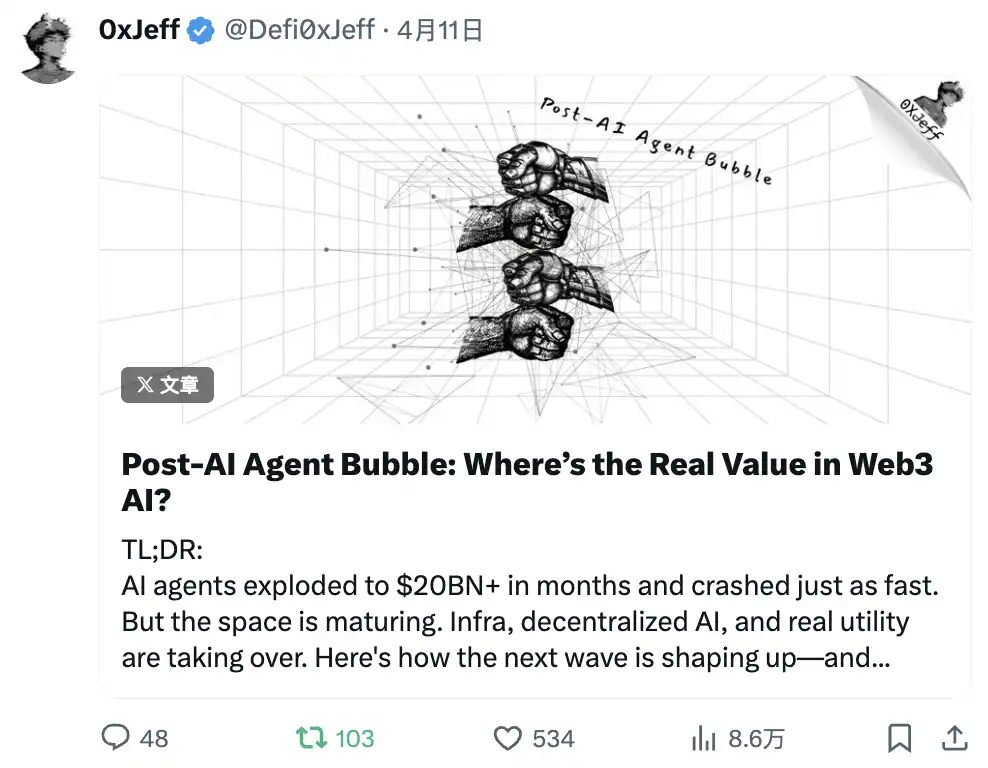
Centralized players have centralized power, and their decisions may (inadvertently) have a significant impact on your life.
You might say, "So what?"—maybe you don't use these tools often, or you believe these companies will act in the users' best interest. That's fine. You might even want to invest in these AI startups because they are tapping into a massive market. But the issue is—you can't. Unless you're at @ycombinator or a top-tier VC, you won't get these investment opportunities.
On the other hand, in Web3 AI, there are many investable AI ecosystems, with teams dedicated to bringing decentralized AI products and services to users. One of the most promising decentralized AI (DeAI) ecosystems is @opentensor (Bittensor).
Bittensor: Darwinian AI
Bittensor falls into the category of "Darwinian AI"—driving AI evolution through natural selection. Think of it as an AI version of "The Hunger Games," where each subnet has its own "Hunger Games," and "miners" act as participants (or "tributes"). They compete with their models and data on specific tasks. Only the most adapted model (the best-performing model) will receive a reward. Weaker models will be replaced or evolved (through training, tuning, or learning from other models). Over time, this will create a more robust, diverse, and high-performing AI ecosystem.
One particularly exciting aspect of Bittensor is its competitive and incentive mechanisms designed to coordinate incentives between different stakeholders. I outlined the challenges faced by Web3 AI agent teams in the tweet below...
tl;dr: Current agent tokens are a useful tool for speculators and teams to generate hype but are detrimental to user acquisition and retention and cannot serve as an incentive mechanism to retain talent (developers, founders, etc.), especially when prices drop.
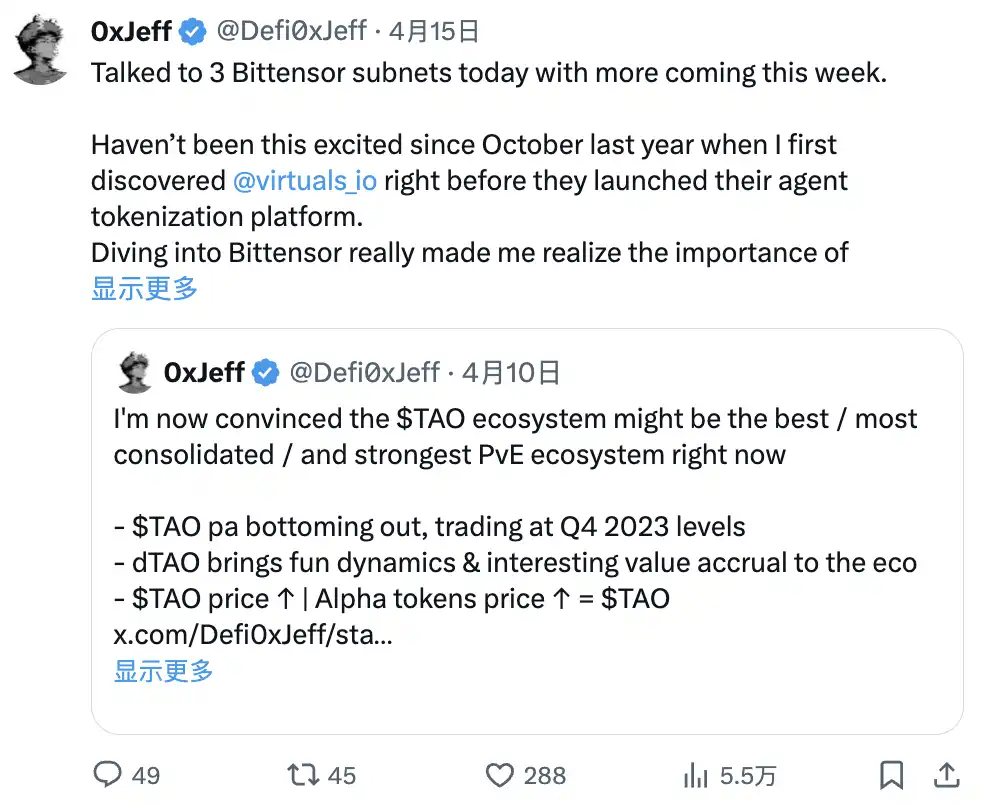
Bittensor addresses this issue through a market-driven mechanism, allocating $TAO emissions to subnets to incentivize and support team operations. The market determines which subnets receive more emissions by staking $TAO within the subnet. Once staked, $TAO is converted to Alpha Subnetwork tokens. The more people stake, the higher the price of Alpha tokens, and the more emissions you receive (in the form of Alpha tokens).
TAO's emission mechanism is very similar to BTC, with a fixed total token supply of 21 million, halving every 4 years (emitting 7200 $TAO to subnets daily). The first $TAO halving is expected to occur around January 5, 2026, at which point the circulating supply will reach 10.5 million tokens.
Why This Matters to Investors
Not delving into technical details here—just sharing why I believe Bittensor is one of the most exciting ecosystems from a trading/investment standpoint.
In addition to the dynamics mentioned above, trading the Alpha Subnetwork tokens feels like trading and mining simultaneously.
This is because every time the Alpha token price appreciates, you not only benefit from price appreciation but also receive $TAO emissions (in the form of Alpha tokens).
If a subnet performs exceptionally well and rises in ranking, the $TAO you initially staked will experience significant price appreciation and emission spikes. The earlier you stake $TAO in a subnet, the higher your Annual Percentage Yield (APY) will be (as the market has not caught up yet, with fewer stakers and $TAO amounts).
dTAO vs. Solidly
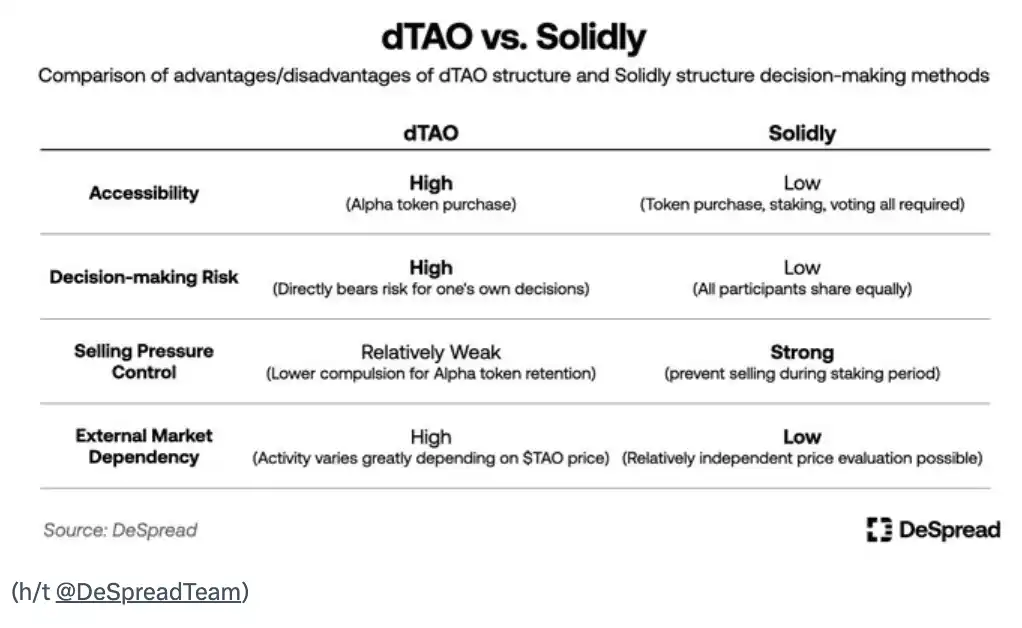
Solidly's ve(3,3) requires long-term locking and continuous engagement. Emission losses due to incorrect voting (voting for the wrong LP pool) are borne by all holders (emissions are sold off, leading to a price drop for all token holders).
On the other hand, dTAO does not require long-term locking, and anyone can enter or exit at any time, but staking on the subnet requires extensive due diligence (DYOR). Investing in the wrong subnet can lead to significant losses (as people can easily exit without a lockup period).
However, the Fully Diluted Valuation (FDV) is too high! How to invest in a subnet with an FDV exceeding $500 million?
FDV may not be the best metric here, as the subnetwork is still early-stage, and Market Cap (MC) may be more suitable (if you are looking at short to mid-term trading).
If you are concerned about inflation, understanding the emission distribution of 18%/41%/41% can be helpful — these are the emissions received by subnetwork owners, validators, and miners, respectively (in the form of Alpha tokens). As a staker/Alpha token holder, you benefit from the 41% portion allocated to validators since you delegated your $TAO to them when staking.
Many subnetwork owners continue to hold the Alpha tokens received from emissions to show confidence, and many engage in active dialogues with validators and miners to express their optimism for the project and avoid massive token dumps (this information can be viewed on taostats).
Zooming out, one of the best charts showcasing trends within the Bittensor ecosystem is as follows:
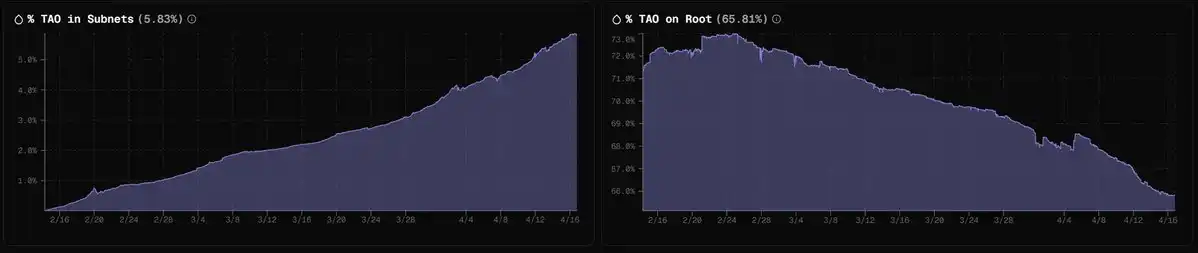
Source: taoapp
Since the launch of dTAO in February, the %TAO in Root (the original subnetwork managing the Bittensor incentive system) has been steadily declining, while the %TAO in the subnetwork has been consistently rising. This indicates that stakers/investors are increasingly willing to take on risk (the conservative APY for staking in the Root network is around 20-25%, with no price appreciation of Alpha sub-network tokens).
This trend aligns with the speed at which subnetwork teams are rolling out products. Since the launch of dTAO, teams need to publicly build, develop products users want, iterate quickly, find product-market fit (PMF), acquire users, and rapidly drive real utility and substantial revenue. Since I entered this ecosystem, I can feel the team's development pace is much faster compared to other ecosystems (due to competition and incentive mechanisms).
This leads to the subnetwork and its unique investment DeAI use case.
Leading Subnetworks and Use Cases
Considered the most adept at launching teams with PMF products for the mainstream and executing professional and continually public builds is @rayon_labs
—SN64 (Chutes), SN56 (Gradients), SN19 (Nineteen).
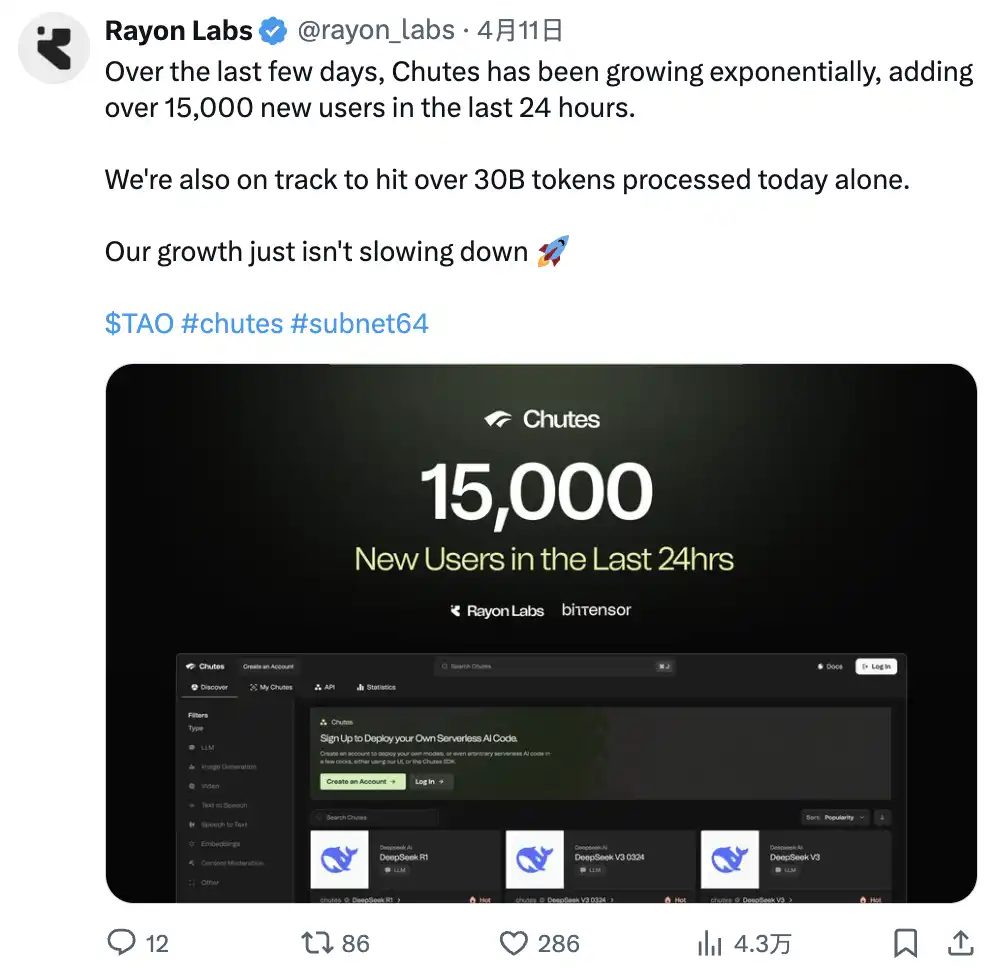
Chutes—provides infrastructure for you to easily deploy AI in a serverless manner. The best-case scenario is the recent AWS outage; if you rely on centralized providers, an outage can cause your AI application to be down (potentially resulting in financial loss or vulnerabilities) due to a single point of failure.
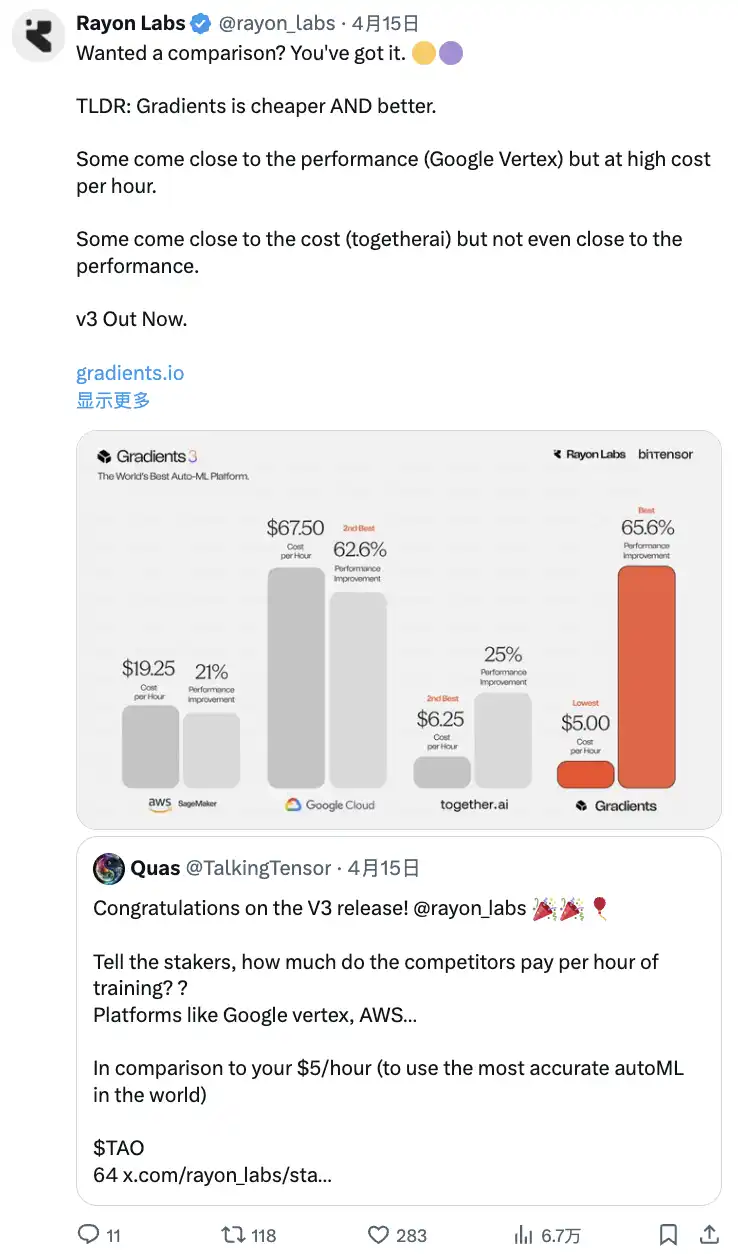
Gradients — Anyone with no coding knowledge can train their own AI model on Gradients (for specific use cases, image generation, custom LLM). The recently launched v3 is more affordable than peers.
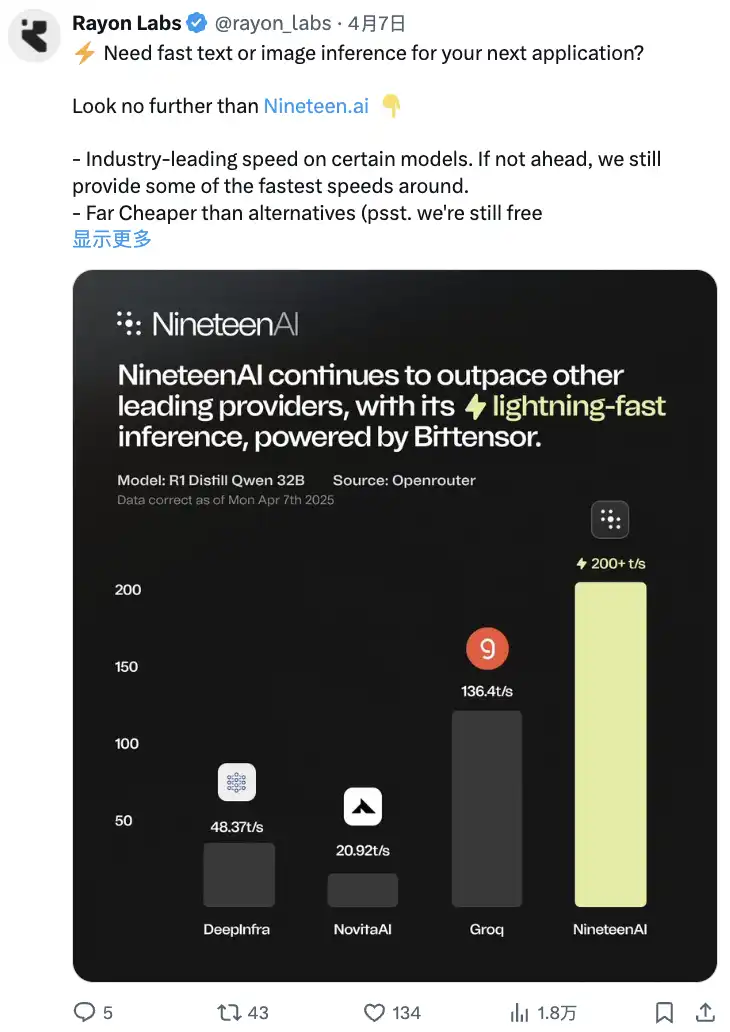
Nineteen — Provides a fast, scalable, decentralized AI inference platform (usable by anyone for text and image generation use cases, far faster than peers).
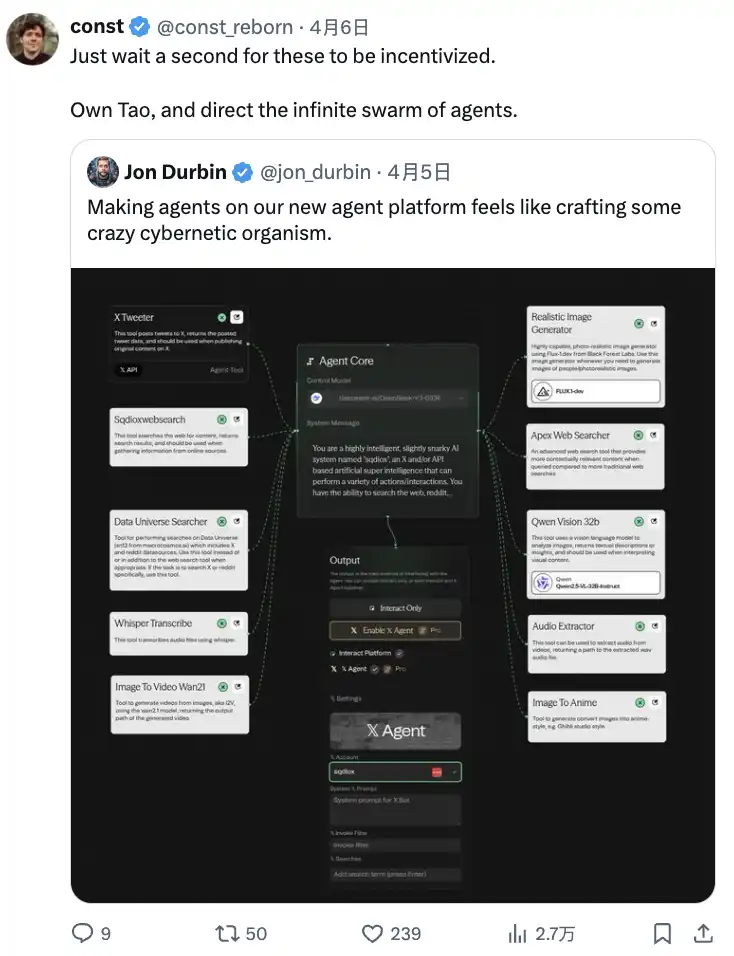
In addition, Rayon is launching the Squad AI Agent platform, an easy-to-use drag-and-drop node-style AI agent building platform that has piqued the interest of the community.
These three subnets collectively hold over 1/3 of the $TAO total issuance — which proves the team's ability to openly build and deliver high-quality products that users want (Rayon has been praised by many subnet owners as the top team).
· Gradients has grown 13x in a month (current market cap $32 million).
· Chutes has grown 2.3x (market cap $63 million).
· Nineteen has grown 3x (market cap $18 million).
This trend does not appear to be stopping in the short term, especially given Chutes' adoption rate (currently the top-ranking subnet).
In addition to Rayon Labs' subnets, there are many interesting teams — protein folding, deepfake/AI content detection, 3D models, trading strategies, role-playing LLM. I have not delved deep into all the content, but I find the "prediction system" (taopill) subnets under it most easily understandable, especially:
SN41 @sportstensor
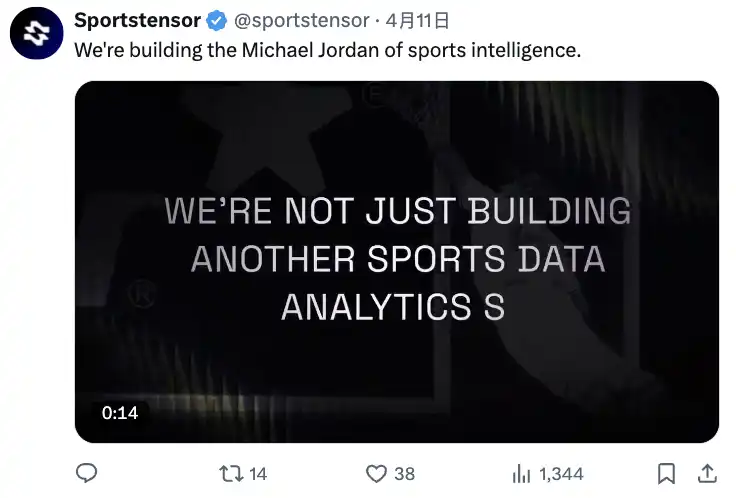
You might know them through @AskBillyBets. Sportstensor is an intelligence that empowers Billy's decisions (led by the core team of Billy @ContangoDigital, a VC investing in DeAI, also a validator and miner of the Bittensor subnet).
The uniqueness of SN41 lies in its product—the Sportstensor model. This is a competition among miners with the best model and dataset to predict sports match outcomes.
Example: In the latest NBA season, if you follow the public betting (on the favorite teams), you would have around a 68% accuracy/win rate. Does this mean everyone can make big money by betting on the favorite teams? No, in fact, they are losing money. If you bet $100 on each favorite team, your return on investment (ROI) would be negative, resulting in a loss of about $1700.
Although the favorite teams have a higher win rate, the odds are lower, meaning you earn less when you guess right. People tend to bet heavily on the favorite teams, leading to low odds on underdogs. This means that if you choose the underdog correctly, you can make a lot of money.
The Sportstensor model comes into play here. Miners run their own machine learning models (Monte Carlo, Random Forest, Linear Regression, etc.), using their own data (free or proprietary) to obtain the best results. Sportstensor then takes the average/median of these results as intelligence to identify advantages in the market.
The actual market odds may be 25:75, while the model may show odds of 45:55. This 15 difference is the advantage. If the model finds many such advantages, you can accumulate a positive ROI in the long term without needing a high win rate.
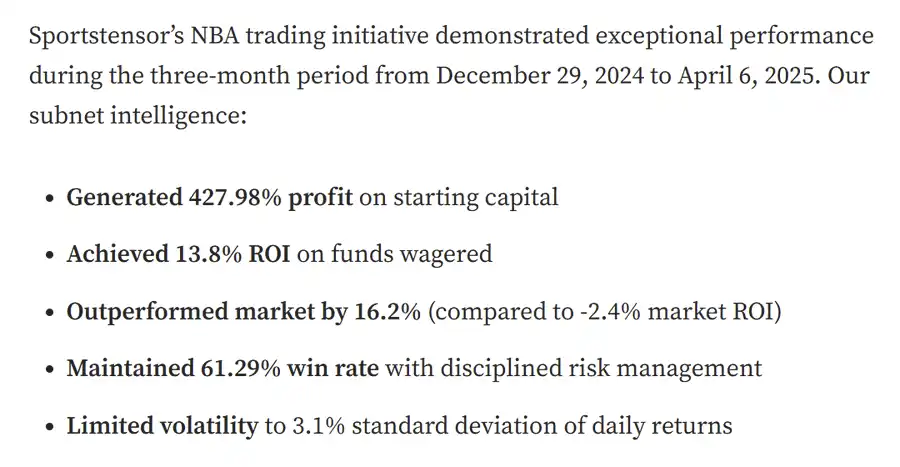
Check out their full trading report (if you want to delve deeper):
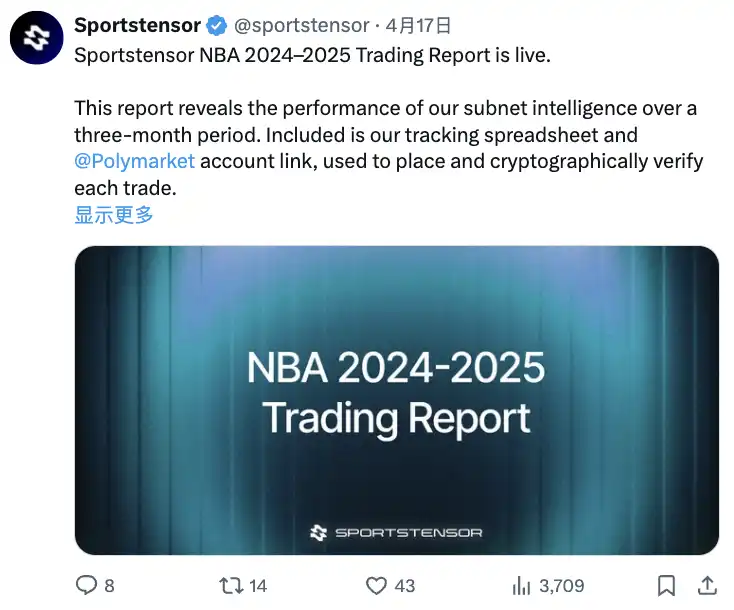
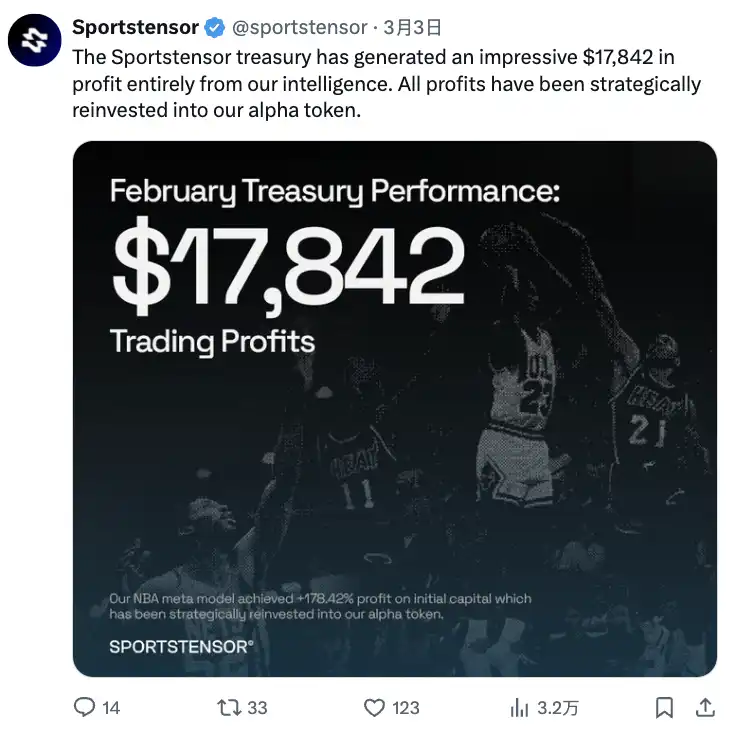
These are the model results shared in their latest report, and the data is quite impressive. The team also runs a monthly betting fund, starting with a buffer fund of $10,000 and continuing to bet with profits. By the end of the month, they repurchase Alpha tokens with the profits. The team made approximately $18,000 in profit in March.
Depending on how you use the intelligence, the results can vary greatly. For example, the intelligence shows 35:65, while the actual market odds may be 40:60. Someone may bet based on this, while you may not because the difference is small and lacks enough advantage. Billy uses the intelligence differently from Sportstensor. (Currently, no one knows how to sustain positive ROI because it is still early days.)
The Sportstensor project aims to further monetize their intelligence by creating a dashboard that allows users to easily understand insights and make betting decisions based on them.
I personally like this team because their product has a lot of potential directions for development. We have already seen how Billy has attracted attention and made sports fans excited to follow the betting. With the team covering a variety of sports, the landscape could change the way people interact, bet, and experience.
SN44 @webuildscore
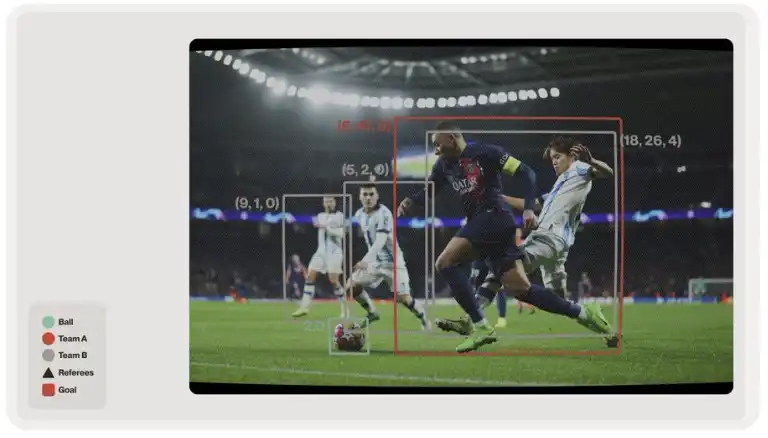
Score originally built a product similar to Sportstensor but realized the ability to predict future events could bring more value and shifted towards computer vision.
To understand this, you need computer vision to analyze the content on the screen, make AI understand the objects on the screen, locate and annotate data, then draw conclusions using different algorithms (e.g., the probability of a player making a certain move), and convert all this into a universal score used to improve player performance (and early talent discovery).
Miners compete to tag objects (this is the miner's primary goal). Score utilizes its internal algorithms to draw conclusions (at least for now).
When you score players (similar to Elo ratings in chess or League of Legends but more nuanced and dynamic... changing dynamically based on player decisions and their impact in each game), as a club owner, you can do many things like discovering talent at a young age. If you have videos of children's matches, the analysis is the same as professional matches. This is quantifying the entire football world with a unified approach.
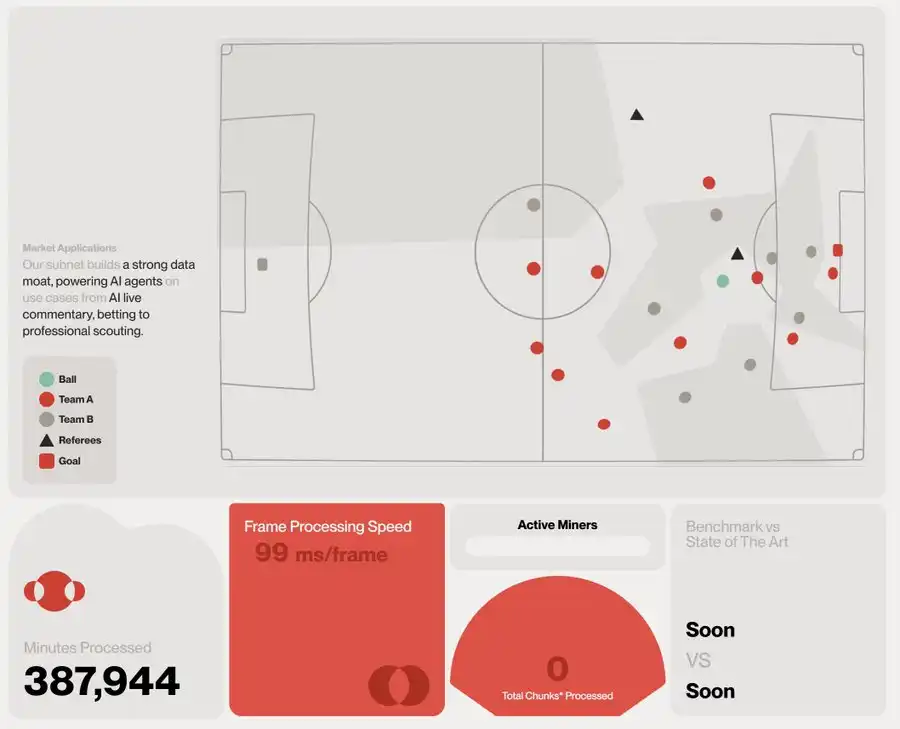
Through proprietary data, Score can monetize scores and insights, selling them to data brokers, club owners, sports data companies, and betting firms.
Soon, users will be able to upload videos on Score's self-serve platform to be tagged by miners. Typically, tagging football match videos takes hours, but on Score, miners can tag a 90-minute match in just 10-12 minutes, far faster than other platforms. Users can use the tagged data for their own models and use cases.
I like Score because it can be applied to fields beyond sports, such as autonomous vehicles, robotics, and more. In a world full of data noise, high-quality proprietary data is extremely valuable.
SN18 @zeussubnet
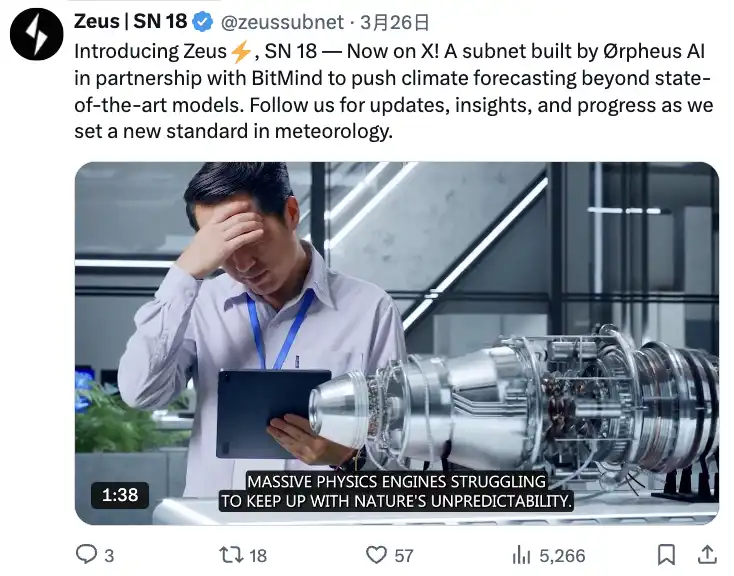
This is a newly popular subnet that has been gaining a lot of attention recently. I haven't had a chance to engage with the team yet, but the product is very intriguing.
Zeus is a machine learning-based weather/climate prediction subnet designed to surpass traditional models and provide faster, more accurate forecasts.
This intelligence is highly sought after by hedge funds as accurately predicting the weather can lead to better commodity price predictions (hedge funds are willing to pay millions to access this intelligence as winning in commodity trading can earn them billions).
The Zeus subnet is a recent addition and has recently acquired subnet 18. Its Alpha token has seen a 210% increase in the past 7 days.
Other Subnets of Interest That I Have Yet to Dive Deep Into
· @404gen_ SN17——Infrastructure for AI-generated 3D assets. Creating 3D models for games, AI characters, virtual influencers, and more. Recently, integration with
· @unity may enable seamless 3D model generation, transforming the creative process for Unity's 1.2 million monthly active users.
· @metanova_labs SN68——Decentralized Science (DeSci) drug discovery subnet, transforming drug discovery into collaborative, high-speed competition to address traditional challenges such as cost and time (traditional processes take over a decade and cost billions).
There is more to explore, and I will share after deeper research. I start with the most easily understandable (as I'm not a technical person).
Summary
I try to avoid being overly technical. There are many high-quality resources for technical explanations on dTAO, emissions, incentive distribution, and all stakeholder benefits.
Based on my experience in the Delegate Rush (since October 2024), staying flexible is crucial. I've held too many project tokens, and I believe dTAO provides a great mechanism for me to flexibly rotate between different investment-oriented DeAI startups.
Currently, there are not many participants, and users can earn 80%-150%+ APY, plus subnet token price appreciation. This dynamic may change in the next 6 months as more people join and the TAO ecosystem's bridges, wallets, and transaction infrastructure improve.
Now, I suggest you enjoy the PvE season of TAO and join me to learn more about the cool DeAI technology.
You may also like

Token Cannot Compound, Where Is the Real Investment Opportunity?

February 6th Market Key Intelligence, How Much Did You Miss?

China's Central Bank and Eight Other Departments' Latest Regulatory Focus: Key Attention to RWA Tokenized Asset Risk
Foreword: Today, the People's Bank of China's website published the "Notice of the People's Bank of China, National Development and Reform Commission, Ministry of Industry and Information Technology, Ministry of Public Security, State Administration for Market Regulation, China Banking and Insurance Regulatory Commission, China Securities Regulatory Commission, State Administration of Foreign Exchange on Further Preventing and Dealing with Risks Related to Virtual Currency and Others (Yinfa [2026] No. 42)", the latest regulatory requirements from the eight departments including the central bank, which are basically consistent with the regulatory requirements of recent years. The main focus of the regulation is on speculative activities such as virtual currency trading, exchanges, ICOs, overseas platform services, and this time, regulatory oversight of RWA has been added, explicitly prohibiting RWA tokenization, stablecoins (especially those pegged to the RMB). The following is the full text:
To the people's governments of all provinces, autonomous regions, and municipalities directly under the Central Government, the Xinjiang Production and Construction Corps:
Recently, there have been speculative activities related to virtual currency and Real-World Assets (RWA) tokenization, disrupting the economic and financial order and jeopardizing the property security of the people. In order to further prevent and address the risks related to virtual currency and Real-World Assets tokenization, effectively safeguard national security and social stability, in accordance with the "Law of the People's Republic of China on the People's Bank of China," "Law of the People's Republic of China on Commercial Banks," "Securities Law of the People's Republic of China," "Law of the People's Republic of China on Securities Investment Funds," "Law of the People's Republic of China on Futures and Derivatives," "Cybersecurity Law of the People's Republic of China," "Regulations of the People's Republic of China on the Administration of Renminbi," "Regulations on Prevention and Disposal of Illegal Fundraising," "Regulations of the People's Republic of China on Foreign Exchange Administration," "Telecommunications Regulations of the People's Republic of China," and other provisions, after reaching consensus with the Cyberspace Administration of China, the Supreme People's Court, and the Supreme People's Procuratorate, and with the approval of the State Council, the relevant matters are notified as follows:
(I) Virtual currency does not possess the legal status equivalent to fiat currency. Virtual currencies such as Bitcoin, Ether, Tether, etc., have the main characteristics of being issued by non-monetary authorities, using encryption technology and distributed ledger or similar technology, existing in digital form, etc. They do not have legal tender status, should not and cannot be circulated and used as currency in the market.
The business activities related to virtual currency are classified as illegal financial activities. The exchange of fiat currency and virtual currency within the territory, exchange of virtual currencies, acting as a central counterparty in buying and selling virtual currencies, providing information intermediary and pricing services for virtual currency transactions, token issuance financing, and trading of virtual currency-related financial products, etc., fall under illegal financial activities, such as suspected illegal issuance of token vouchers, unauthorized public issuance of securities, illegal operation of securities and futures business, illegal fundraising, etc., are strictly prohibited across the board and resolutely banned in accordance with the law. Overseas entities and individuals are not allowed to provide virtual currency-related services to domestic entities in any form.
A stablecoin pegged to a fiat currency indirectly fulfills some functions of the fiat currency in circulation. Without the consent of relevant authorities in accordance with the law and regulations, any domestic or foreign entity or individual is not allowed to issue a RMB-pegged stablecoin overseas.
(II)Tokenization of Real-World Assets refers to the use of encryption technology and distributed ledger or similar technologies to transform ownership rights, income rights, etc., of assets into tokens (tokens) or other interests or bond certificates with token (token) characteristics, and carry out issuance and trading activities.
Engaging in the tokenization of real-world assets domestically, as well as providing related intermediary, information technology services, etc., which are suspected of illegal issuance of token vouchers, unauthorized public offering of securities, illegal operation of securities and futures business, illegal fundraising, and other illegal financial activities, shall be prohibited; except for relevant business activities carried out with the approval of the competent authorities in accordance with the law and regulations and relying on specific financial infrastructures. Overseas entities and individuals are not allowed to illegally provide services related to the tokenization of real-world assets to domestic entities in any form.
(III) Inter-agency Coordination. The People's Bank of China, together with the National Development and Reform Commission, the Ministry of Industry and Information Technology, the Ministry of Public Security, the State Administration for Market Regulation, the China Banking and Insurance Regulatory Commission, the China Securities Regulatory Commission, the State Administration of Foreign Exchange, and other departments, will improve the work mechanism, strengthen coordination with the Cyberspace Administration of China, the Supreme People's Court, and the Supreme People's Procuratorate, coordinate efforts, and overall guide regions to carry out risk prevention and disposal of virtual currency-related illegal financial activities.
The China Securities Regulatory Commission, together with the National Development and Reform Commission, the Ministry of Industry and Information Technology, the Ministry of Public Security, the People's Bank of China, the State Administration for Market Regulation, the China Banking and Insurance Regulatory Commission, the State Administration of Foreign Exchange, and other departments, will improve the work mechanism, strengthen coordination with the Cyberspace Administration of China, the Supreme People's Court, and the Supreme People's Procuratorate, coordinate efforts, and overall guide regions to carry out risk prevention and disposal of illegal financial activities related to the tokenization of real-world assets.
(IV) Strengthening Local Implementation. The people's governments at the provincial level are overall responsible for the prevention and disposal of risks related to virtual currencies and the tokenization of real-world assets in their respective administrative regions. The specific leading department is the local financial regulatory department, with participation from branches and dispatched institutions of the State Council's financial regulatory department, telecommunications regulators, public security, market supervision, and other departments, in coordination with cyberspace departments, courts, and procuratorates, to improve the normalization of the work mechanism, effectively connect with the relevant work mechanisms of central departments, form a cooperative and coordinated working pattern between central and local governments, effectively prevent and properly handle risks related to virtual currencies and the tokenization of real-world assets, and maintain economic and financial order and social stability.
(5) Enhanced Risk Monitoring. The People's Bank of China, China Securities Regulatory Commission, National Development and Reform Commission, Ministry of Industry and Information Technology, Ministry of Public Security, State Administration of Foreign Exchange, Cyberspace Administration of China, and other departments continue to improve monitoring techniques and system support, enhance cross-departmental data analysis and sharing, establish sound information sharing and cross-validation mechanisms, promptly grasp the risk situation of activities related to virtual currency and real-world asset tokenization. Local governments at all levels give full play to the role of local monitoring and early warning mechanisms. Local financial regulatory authorities, together with branches and agencies of the State Council's financial regulatory authorities, as well as departments of cyberspace and public security, ensure effective connection between online monitoring, offline investigation, and fund tracking, efficiently and accurately identify activities related to virtual currency and real-world asset tokenization, promptly share risk information, improve early warning information dissemination, verification, and rapid response mechanisms.
(6) Strengthened Oversight of Financial Institutions, Intermediaries, and Technology Service Providers. Financial institutions (including non-bank payment institutions) are prohibited from providing account opening, fund transfer, and clearing services for virtual currency-related business activities, issuing and selling financial products related to virtual currency, including virtual currency and related financial products in the scope of collateral, conducting insurance business related to virtual currency, or including virtual currency in the scope of insurance liability. Financial institutions (including non-bank payment institutions) are prohibited from providing custody, clearing, and settlement services for unauthorized real-world asset tokenization-related business and related financial products. Relevant intermediary institutions and information technology service providers are prohibited from providing intermediary, technical, or other services for unauthorized real-world asset tokenization-related businesses and related financial products.
(7) Enhanced Management of Internet Information Content and Access. Internet enterprises are prohibited from providing online business venues, commercial displays, marketing, advertising, or paid traffic diversion services for virtual currency and real-world asset tokenization-related business activities. Upon discovering clues of illegal activities, they should promptly report to relevant departments and provide technical support and assistance for related investigations and inquiries. Based on the clues transferred by the financial regulatory authorities, the cyberspace administration, telecommunications authorities, and public security departments should promptly close and deal with websites, mobile applications (including mini-programs), and public accounts engaged in virtual currency and real-world asset tokenization-related business activities in accordance with the law.
(8) Strengthened Entity Registration and Advertisement Management. Market supervision departments strengthen entity registration and management, and enterprise and individual business registrations must not contain terms such as "virtual currency," "virtual asset," "cryptocurrency," "crypto asset," "stablecoin," "real-world asset tokenization," or "RWA" in their names or business scopes. Market supervision departments, together with financial regulatory authorities, legally enhance the supervision of advertisements related to virtual currency and real-world asset tokenization, promptly investigating and handling relevant illegal advertisements.
(IX) Continued Rectification of Virtual Currency Mining Activities. The National Development and Reform Commission, together with relevant departments, strictly controls virtual currency mining activities, continuously promotes the rectification of virtual currency mining activities. The people's governments of various provinces take overall responsibility for the rectification of "mining" within their respective administrative regions. In accordance with the requirements of the National Development and Reform Commission and other departments in the "Notice on the Rectification of Virtual Currency Mining Activities" (NDRC Energy-saving Building [2021] No. 1283) and the provisions of the "Guidance Catalog for Industrial Structure Adjustment (2024 Edition)," a comprehensive review, investigation, and closure of existing virtual currency mining projects are conducted, new mining projects are strictly prohibited, and mining machine production enterprises are strictly prohibited from providing mining machine sales and other services within the country.
(X) Severe Crackdown on Related Illegal Financial Activities. Upon discovering clues to illegal financial activities related to virtual currency and the tokenization of real-world assets, local financial regulatory authorities, branches of the State Council's financial regulatory authorities, and other relevant departments promptly investigate, determine, and properly handle the issues in accordance with the law, and seriously hold the relevant entities and individuals legally responsible. Those suspected of crimes are transferred to the judicial authorities for processing according to the law.
(XI) Severe Crackdown on Related Illegal and Criminal Activities. The Ministry of Public Security, the People's Bank of China, the State Administration for Market Regulation, the China Banking and Insurance Regulatory Commission, the China Securities Regulatory Commission, as well as judicial and procuratorial organs, in accordance with their respective responsibilities, rigorously crack down on illegal and criminal activities related to virtual currency, the tokenization of real-world assets, such as fraud, money laundering, illegal business operations, pyramid schemes, illegal fundraising, and other illegal and criminal activities carried out under the guise of virtual currency, the tokenization of real-world assets, etc.
(XII) Strengthen Industry Self-discipline. Relevant industry associations should enhance membership management and policy advocacy, based on their own responsibilities, advocate and urge member units to resist illegal financial activities related to virtual currency and the tokenization of real-world assets. Member units that violate regulatory policies and industry self-discipline rules are to be disciplined in accordance with relevant self-regulatory management regulations. By leveraging various industry infrastructure, conduct risk monitoring related to virtual currency, the tokenization of real-world assets, and promptly transfer issue clues to relevant departments.
(XIII) Without the approval of relevant departments in accordance with the law and regulations, domestic entities and foreign entities controlled by them may not issue virtual currency overseas.
(XIV) Domestic entities engaging directly or indirectly in overseas external debt-based tokenization of real-world assets, or conducting asset securitization activities abroad based on domestic ownership rights, income rights, etc. (hereinafter referred to as domestic equity), should be strictly regulated in accordance with the principles of "same business, same risk, same rules." The National Development and Reform Commission, the China Securities Regulatory Commission, the State Administration of Foreign Exchange, and other relevant departments regulate it according to their respective responsibilities. For other forms of overseas real-world asset tokenization activities based on domestic equity by domestic entities, the China Securities Regulatory Commission, together with relevant departments, supervise according to their division of responsibilities. Without the consent and filing of relevant departments, no unit or individual may engage in the above-mentioned business.
(15) Overseas subsidiaries and branches of domestic financial institutions providing Real World Asset Tokenization-related services overseas shall do so legally and prudently. They shall have professional personnel and systems in place to effectively mitigate business risks, strictly implement customer onboarding, suitability management, anti-money laundering requirements, and incorporate them into the domestic financial institutions' compliance and risk management system. Intermediaries and information technology service providers offering Real World Asset Tokenization services abroad based on domestic equity or conducting Real World Asset Tokenization business in the form of overseas debt for domestic entities directly or indirectly venturing abroad must strictly comply with relevant laws and regulations. They should establish and improve relevant compliance and internal control systems in accordance with relevant normative requirements, strengthen business and risk control, and report the business developments to the relevant regulatory authorities for approval or filing.
(16) Strengthen organizational leadership and overall coordination. All departments and regions should attach great importance to the prevention of risks related to virtual currencies and Real World Asset Tokenization, strengthen organizational leadership, clarify work responsibilities, form a long-term effective working mechanism with centralized coordination, local implementation, and shared responsibilities, maintain high pressure, dynamically monitor risks, effectively prevent and mitigate risks in an orderly and efficient manner, legally protect the property security of the people, and make every effort to maintain economic and financial order and social stability.
(17) Widely carry out publicity and education. All departments, regions, and industry associations should make full use of various media and other communication channels to disseminate information through legal and policy interpretation, analysis of typical cases, and education on investment risks, etc. They should promote the illegality and harm of virtual currencies and Real World Asset Tokenization-related businesses and their manifestations, fully alert to potential risks and hidden dangers, and enhance public awareness and identification capabilities for risk prevention.
(18) Engaging in illegal financial activities related to virtual currencies and Real World Asset Tokenization in violation of this notice, as well as providing services for virtual currencies and Real World Asset Tokenization-related businesses, shall be punished in accordance with relevant regulations. If it constitutes a crime, criminal liability shall be pursued according to the law. For domestic entities and individuals who knowingly or should have known that overseas entities illegally provided virtual currency or Real World Asset Tokenization-related services to domestic entities and still assisted them, relevant responsibilities shall be pursued according to the law. If it constitutes a crime, criminal liability shall be pursued according to the law.
(19) If any unit or individual invests in virtual currencies, Real World Asset Tokens, and related financial products against public order and good customs, the relevant civil legal actions shall be invalid, and any resulting losses shall be borne by them. If there are suspicions of disrupting financial order and jeopardizing financial security, the relevant departments shall deal with them according to the law.
This notice shall enter into force upon the date of its issuance. The People's Bank of China and ten other departments' "Notice on Further Preventing and Dealing with the Risks of Virtual Currency Trading Speculation" (Yinfa [2021] No. 237) is hereby repealed.

Former Partner's Perspective on Multicoin: Kyle's Exit, But the Game He Left Behind Just Getting Started
Why Bitcoin Is Falling Now: The Real Reasons Behind BTC's Crash & WEEX's Smart Profit Playbook
Bitcoin's ongoing crash explained: Discover the 5 hidden triggers behind BTC's plunge & how WEEX's Auto Earn and Trade to Earn strategies help traders profit from crypto market volatility.

Wall Street's Hottest Trades See Exodus

Vitalik Discusses Ethereum Scaling Path, Circle Announces Partnership with Polymarket, What's the Overseas Crypto Community Talking About Today?

Believing in the Capital Markets - The Essence and Core Value of Cryptocurrency

Polymarket's 'Weatherman': Predict Temperature, Win Million-Dollar Payout

$15K+ Profits: The 4 AI Trading Secrets WEEX Hackathon Prelim Winners Used to Dominate Volatile Crypto Markets
How WEEX Hackathon's top AI trading strategies made $15K+ in crypto markets: 4 proven rules for ETH/BTC trading, market structure analysis, and risk management in volatile conditions.

A nearly 20% one-day plunge, how long has it been since you last saw a $60,000 Bitcoin?

Raoul Pal: I've seen every single panic, and they are never the end.

Key Market Information Discrepancy on February 6th - A Must-Read! | Alpha Morning Report

2026 Crypto Industry's First Snowfall
The Harsh Reality Behind the $26 Billion Crypto Liquidation: Liquidity Is Killing the Market
Why Is Gold, US Stocks, Bitcoin All Falling?

Key Market Intelligence for February 5th, how much did you miss out on?

Wintermute: By 2026, crypto had gradually become the settlement layer of the Internet economy
Token Cannot Compound, Where Is the Real Investment Opportunity?
February 6th Market Key Intelligence, How Much Did You Miss?
China's Central Bank and Eight Other Departments' Latest Regulatory Focus: Key Attention to RWA Tokenized Asset Risk
Foreword: Today, the People's Bank of China's website published the "Notice of the People's Bank of China, National Development and Reform Commission, Ministry of Industry and Information Technology, Ministry of Public Security, State Administration for Market Regulation, China Banking and Insurance Regulatory Commission, China Securities Regulatory Commission, State Administration of Foreign Exchange on Further Preventing and Dealing with Risks Related to Virtual Currency and Others (Yinfa [2026] No. 42)", the latest regulatory requirements from the eight departments including the central bank, which are basically consistent with the regulatory requirements of recent years. The main focus of the regulation is on speculative activities such as virtual currency trading, exchanges, ICOs, overseas platform services, and this time, regulatory oversight of RWA has been added, explicitly prohibiting RWA tokenization, stablecoins (especially those pegged to the RMB). The following is the full text:
To the people's governments of all provinces, autonomous regions, and municipalities directly under the Central Government, the Xinjiang Production and Construction Corps:
Recently, there have been speculative activities related to virtual currency and Real-World Assets (RWA) tokenization, disrupting the economic and financial order and jeopardizing the property security of the people. In order to further prevent and address the risks related to virtual currency and Real-World Assets tokenization, effectively safeguard national security and social stability, in accordance with the "Law of the People's Republic of China on the People's Bank of China," "Law of the People's Republic of China on Commercial Banks," "Securities Law of the People's Republic of China," "Law of the People's Republic of China on Securities Investment Funds," "Law of the People's Republic of China on Futures and Derivatives," "Cybersecurity Law of the People's Republic of China," "Regulations of the People's Republic of China on the Administration of Renminbi," "Regulations on Prevention and Disposal of Illegal Fundraising," "Regulations of the People's Republic of China on Foreign Exchange Administration," "Telecommunications Regulations of the People's Republic of China," and other provisions, after reaching consensus with the Cyberspace Administration of China, the Supreme People's Court, and the Supreme People's Procuratorate, and with the approval of the State Council, the relevant matters are notified as follows:
(I) Virtual currency does not possess the legal status equivalent to fiat currency. Virtual currencies such as Bitcoin, Ether, Tether, etc., have the main characteristics of being issued by non-monetary authorities, using encryption technology and distributed ledger or similar technology, existing in digital form, etc. They do not have legal tender status, should not and cannot be circulated and used as currency in the market.
The business activities related to virtual currency are classified as illegal financial activities. The exchange of fiat currency and virtual currency within the territory, exchange of virtual currencies, acting as a central counterparty in buying and selling virtual currencies, providing information intermediary and pricing services for virtual currency transactions, token issuance financing, and trading of virtual currency-related financial products, etc., fall under illegal financial activities, such as suspected illegal issuance of token vouchers, unauthorized public issuance of securities, illegal operation of securities and futures business, illegal fundraising, etc., are strictly prohibited across the board and resolutely banned in accordance with the law. Overseas entities and individuals are not allowed to provide virtual currency-related services to domestic entities in any form.
A stablecoin pegged to a fiat currency indirectly fulfills some functions of the fiat currency in circulation. Without the consent of relevant authorities in accordance with the law and regulations, any domestic or foreign entity or individual is not allowed to issue a RMB-pegged stablecoin overseas.
(II)Tokenization of Real-World Assets refers to the use of encryption technology and distributed ledger or similar technologies to transform ownership rights, income rights, etc., of assets into tokens (tokens) or other interests or bond certificates with token (token) characteristics, and carry out issuance and trading activities.
Engaging in the tokenization of real-world assets domestically, as well as providing related intermediary, information technology services, etc., which are suspected of illegal issuance of token vouchers, unauthorized public offering of securities, illegal operation of securities and futures business, illegal fundraising, and other illegal financial activities, shall be prohibited; except for relevant business activities carried out with the approval of the competent authorities in accordance with the law and regulations and relying on specific financial infrastructures. Overseas entities and individuals are not allowed to illegally provide services related to the tokenization of real-world assets to domestic entities in any form.
(III) Inter-agency Coordination. The People's Bank of China, together with the National Development and Reform Commission, the Ministry of Industry and Information Technology, the Ministry of Public Security, the State Administration for Market Regulation, the China Banking and Insurance Regulatory Commission, the China Securities Regulatory Commission, the State Administration of Foreign Exchange, and other departments, will improve the work mechanism, strengthen coordination with the Cyberspace Administration of China, the Supreme People's Court, and the Supreme People's Procuratorate, coordinate efforts, and overall guide regions to carry out risk prevention and disposal of virtual currency-related illegal financial activities.
The China Securities Regulatory Commission, together with the National Development and Reform Commission, the Ministry of Industry and Information Technology, the Ministry of Public Security, the People's Bank of China, the State Administration for Market Regulation, the China Banking and Insurance Regulatory Commission, the State Administration of Foreign Exchange, and other departments, will improve the work mechanism, strengthen coordination with the Cyberspace Administration of China, the Supreme People's Court, and the Supreme People's Procuratorate, coordinate efforts, and overall guide regions to carry out risk prevention and disposal of illegal financial activities related to the tokenization of real-world assets.
(IV) Strengthening Local Implementation. The people's governments at the provincial level are overall responsible for the prevention and disposal of risks related to virtual currencies and the tokenization of real-world assets in their respective administrative regions. The specific leading department is the local financial regulatory department, with participation from branches and dispatched institutions of the State Council's financial regulatory department, telecommunications regulators, public security, market supervision, and other departments, in coordination with cyberspace departments, courts, and procuratorates, to improve the normalization of the work mechanism, effectively connect with the relevant work mechanisms of central departments, form a cooperative and coordinated working pattern between central and local governments, effectively prevent and properly handle risks related to virtual currencies and the tokenization of real-world assets, and maintain economic and financial order and social stability.
(5) Enhanced Risk Monitoring. The People's Bank of China, China Securities Regulatory Commission, National Development and Reform Commission, Ministry of Industry and Information Technology, Ministry of Public Security, State Administration of Foreign Exchange, Cyberspace Administration of China, and other departments continue to improve monitoring techniques and system support, enhance cross-departmental data analysis and sharing, establish sound information sharing and cross-validation mechanisms, promptly grasp the risk situation of activities related to virtual currency and real-world asset tokenization. Local governments at all levels give full play to the role of local monitoring and early warning mechanisms. Local financial regulatory authorities, together with branches and agencies of the State Council's financial regulatory authorities, as well as departments of cyberspace and public security, ensure effective connection between online monitoring, offline investigation, and fund tracking, efficiently and accurately identify activities related to virtual currency and real-world asset tokenization, promptly share risk information, improve early warning information dissemination, verification, and rapid response mechanisms.
(6) Strengthened Oversight of Financial Institutions, Intermediaries, and Technology Service Providers. Financial institutions (including non-bank payment institutions) are prohibited from providing account opening, fund transfer, and clearing services for virtual currency-related business activities, issuing and selling financial products related to virtual currency, including virtual currency and related financial products in the scope of collateral, conducting insurance business related to virtual currency, or including virtual currency in the scope of insurance liability. Financial institutions (including non-bank payment institutions) are prohibited from providing custody, clearing, and settlement services for unauthorized real-world asset tokenization-related business and related financial products. Relevant intermediary institutions and information technology service providers are prohibited from providing intermediary, technical, or other services for unauthorized real-world asset tokenization-related businesses and related financial products.
(7) Enhanced Management of Internet Information Content and Access. Internet enterprises are prohibited from providing online business venues, commercial displays, marketing, advertising, or paid traffic diversion services for virtual currency and real-world asset tokenization-related business activities. Upon discovering clues of illegal activities, they should promptly report to relevant departments and provide technical support and assistance for related investigations and inquiries. Based on the clues transferred by the financial regulatory authorities, the cyberspace administration, telecommunications authorities, and public security departments should promptly close and deal with websites, mobile applications (including mini-programs), and public accounts engaged in virtual currency and real-world asset tokenization-related business activities in accordance with the law.
(8) Strengthened Entity Registration and Advertisement Management. Market supervision departments strengthen entity registration and management, and enterprise and individual business registrations must not contain terms such as "virtual currency," "virtual asset," "cryptocurrency," "crypto asset," "stablecoin," "real-world asset tokenization," or "RWA" in their names or business scopes. Market supervision departments, together with financial regulatory authorities, legally enhance the supervision of advertisements related to virtual currency and real-world asset tokenization, promptly investigating and handling relevant illegal advertisements.
(IX) Continued Rectification of Virtual Currency Mining Activities. The National Development and Reform Commission, together with relevant departments, strictly controls virtual currency mining activities, continuously promotes the rectification of virtual currency mining activities. The people's governments of various provinces take overall responsibility for the rectification of "mining" within their respective administrative regions. In accordance with the requirements of the National Development and Reform Commission and other departments in the "Notice on the Rectification of Virtual Currency Mining Activities" (NDRC Energy-saving Building [2021] No. 1283) and the provisions of the "Guidance Catalog for Industrial Structure Adjustment (2024 Edition)," a comprehensive review, investigation, and closure of existing virtual currency mining projects are conducted, new mining projects are strictly prohibited, and mining machine production enterprises are strictly prohibited from providing mining machine sales and other services within the country.
(X) Severe Crackdown on Related Illegal Financial Activities. Upon discovering clues to illegal financial activities related to virtual currency and the tokenization of real-world assets, local financial regulatory authorities, branches of the State Council's financial regulatory authorities, and other relevant departments promptly investigate, determine, and properly handle the issues in accordance with the law, and seriously hold the relevant entities and individuals legally responsible. Those suspected of crimes are transferred to the judicial authorities for processing according to the law.
(XI) Severe Crackdown on Related Illegal and Criminal Activities. The Ministry of Public Security, the People's Bank of China, the State Administration for Market Regulation, the China Banking and Insurance Regulatory Commission, the China Securities Regulatory Commission, as well as judicial and procuratorial organs, in accordance with their respective responsibilities, rigorously crack down on illegal and criminal activities related to virtual currency, the tokenization of real-world assets, such as fraud, money laundering, illegal business operations, pyramid schemes, illegal fundraising, and other illegal and criminal activities carried out under the guise of virtual currency, the tokenization of real-world assets, etc.
(XII) Strengthen Industry Self-discipline. Relevant industry associations should enhance membership management and policy advocacy, based on their own responsibilities, advocate and urge member units to resist illegal financial activities related to virtual currency and the tokenization of real-world assets. Member units that violate regulatory policies and industry self-discipline rules are to be disciplined in accordance with relevant self-regulatory management regulations. By leveraging various industry infrastructure, conduct risk monitoring related to virtual currency, the tokenization of real-world assets, and promptly transfer issue clues to relevant departments.
(XIII) Without the approval of relevant departments in accordance with the law and regulations, domestic entities and foreign entities controlled by them may not issue virtual currency overseas.
(XIV) Domestic entities engaging directly or indirectly in overseas external debt-based tokenization of real-world assets, or conducting asset securitization activities abroad based on domestic ownership rights, income rights, etc. (hereinafter referred to as domestic equity), should be strictly regulated in accordance with the principles of "same business, same risk, same rules." The National Development and Reform Commission, the China Securities Regulatory Commission, the State Administration of Foreign Exchange, and other relevant departments regulate it according to their respective responsibilities. For other forms of overseas real-world asset tokenization activities based on domestic equity by domestic entities, the China Securities Regulatory Commission, together with relevant departments, supervise according to their division of responsibilities. Without the consent and filing of relevant departments, no unit or individual may engage in the above-mentioned business.
(15) Overseas subsidiaries and branches of domestic financial institutions providing Real World Asset Tokenization-related services overseas shall do so legally and prudently. They shall have professional personnel and systems in place to effectively mitigate business risks, strictly implement customer onboarding, suitability management, anti-money laundering requirements, and incorporate them into the domestic financial institutions' compliance and risk management system. Intermediaries and information technology service providers offering Real World Asset Tokenization services abroad based on domestic equity or conducting Real World Asset Tokenization business in the form of overseas debt for domestic entities directly or indirectly venturing abroad must strictly comply with relevant laws and regulations. They should establish and improve relevant compliance and internal control systems in accordance with relevant normative requirements, strengthen business and risk control, and report the business developments to the relevant regulatory authorities for approval or filing.
(16) Strengthen organizational leadership and overall coordination. All departments and regions should attach great importance to the prevention of risks related to virtual currencies and Real World Asset Tokenization, strengthen organizational leadership, clarify work responsibilities, form a long-term effective working mechanism with centralized coordination, local implementation, and shared responsibilities, maintain high pressure, dynamically monitor risks, effectively prevent and mitigate risks in an orderly and efficient manner, legally protect the property security of the people, and make every effort to maintain economic and financial order and social stability.
(17) Widely carry out publicity and education. All departments, regions, and industry associations should make full use of various media and other communication channels to disseminate information through legal and policy interpretation, analysis of typical cases, and education on investment risks, etc. They should promote the illegality and harm of virtual currencies and Real World Asset Tokenization-related businesses and their manifestations, fully alert to potential risks and hidden dangers, and enhance public awareness and identification capabilities for risk prevention.
(18) Engaging in illegal financial activities related to virtual currencies and Real World Asset Tokenization in violation of this notice, as well as providing services for virtual currencies and Real World Asset Tokenization-related businesses, shall be punished in accordance with relevant regulations. If it constitutes a crime, criminal liability shall be pursued according to the law. For domestic entities and individuals who knowingly or should have known that overseas entities illegally provided virtual currency or Real World Asset Tokenization-related services to domestic entities and still assisted them, relevant responsibilities shall be pursued according to the law. If it constitutes a crime, criminal liability shall be pursued according to the law.
(19) If any unit or individual invests in virtual currencies, Real World Asset Tokens, and related financial products against public order and good customs, the relevant civil legal actions shall be invalid, and any resulting losses shall be borne by them. If there are suspicions of disrupting financial order and jeopardizing financial security, the relevant departments shall deal with them according to the law.
This notice shall enter into force upon the date of its issuance. The People's Bank of China and ten other departments' "Notice on Further Preventing and Dealing with the Risks of Virtual Currency Trading Speculation" (Yinfa [2021] No. 237) is hereby repealed.
Former Partner's Perspective on Multicoin: Kyle's Exit, But the Game He Left Behind Just Getting Started
Why Bitcoin Is Falling Now: The Real Reasons Behind BTC's Crash & WEEX's Smart Profit Playbook
Bitcoin's ongoing crash explained: Discover the 5 hidden triggers behind BTC's plunge & how WEEX's Auto Earn and Trade to Earn strategies help traders profit from crypto market volatility.


 App
App