
- Buy Crypto
- Markets
 Futures
- Spot
- Copy Trade
 Earn
Earn- More
Compared to the Gas futures market, ETHGas is more interested in being a real-time execution layer

Original Article Title: "ETHGas Aims to Be More About Real-Time Execution Layer Than Gas Futures Market"
Original Article Author: Eric, Foresight News
On December 17, the Ethereum block space futures market ETHGas announced the completion of a $12 million financing round, led by Polychain Capital and with participation from Stake Capital, BlueYard Capital, Lafayette Macro Advisors, SIG DT, and Amber Group. Founder Kevin Lepsoe stated that ETHGas had previously raised an undisclosed Pre-Seed round of around $5 million in mid-2024.
Additionally, Lepsoe mentioned that Ethereum validators, block producers, and relayers have committed to providing around $800 million to support market and product development, not in cash investment but in the form of Ethereum block space liquidity to the ETHGas market.
While the project is defined as a block space futures market, its true vision is to achieve "Real-Time Ethereum."
Block Order
Ethereum co-founder Vitalik Buterin proposed the concept of a Gas futures market earlier this month, aimed at addressing Ethereum Gas volatility. Similar to the logic of traditional commodity futures markets, the key role of futures locking in future Gas costs is to make Gas costs predictable and controllable.
As a result, DApps can lock in Gas costs, for example, before events like user token airdrops, and design incentives for user activities. L2 can also buy futures when Gas fees are lower to reduce the cost of submitting data packets to L1, making transaction costs on L2 stable and predictable, serving businesses that require upfront cost calculations, such as tokenizing stocks.
According to the documentation, ETHGas will also launch a zero-code tool called Open Gas specifically for DApps to provide Gas subsidy plans, allowing users to claim back Gas fees spent while using a DApp on the ETHGas platform.
There is not much difficulty in the design and development of the Gas futures market; essentially, it requires establishing an on-chain futures trading market with sufficient liquidity. However, ETHGas's "killer move" is the block space auction market.
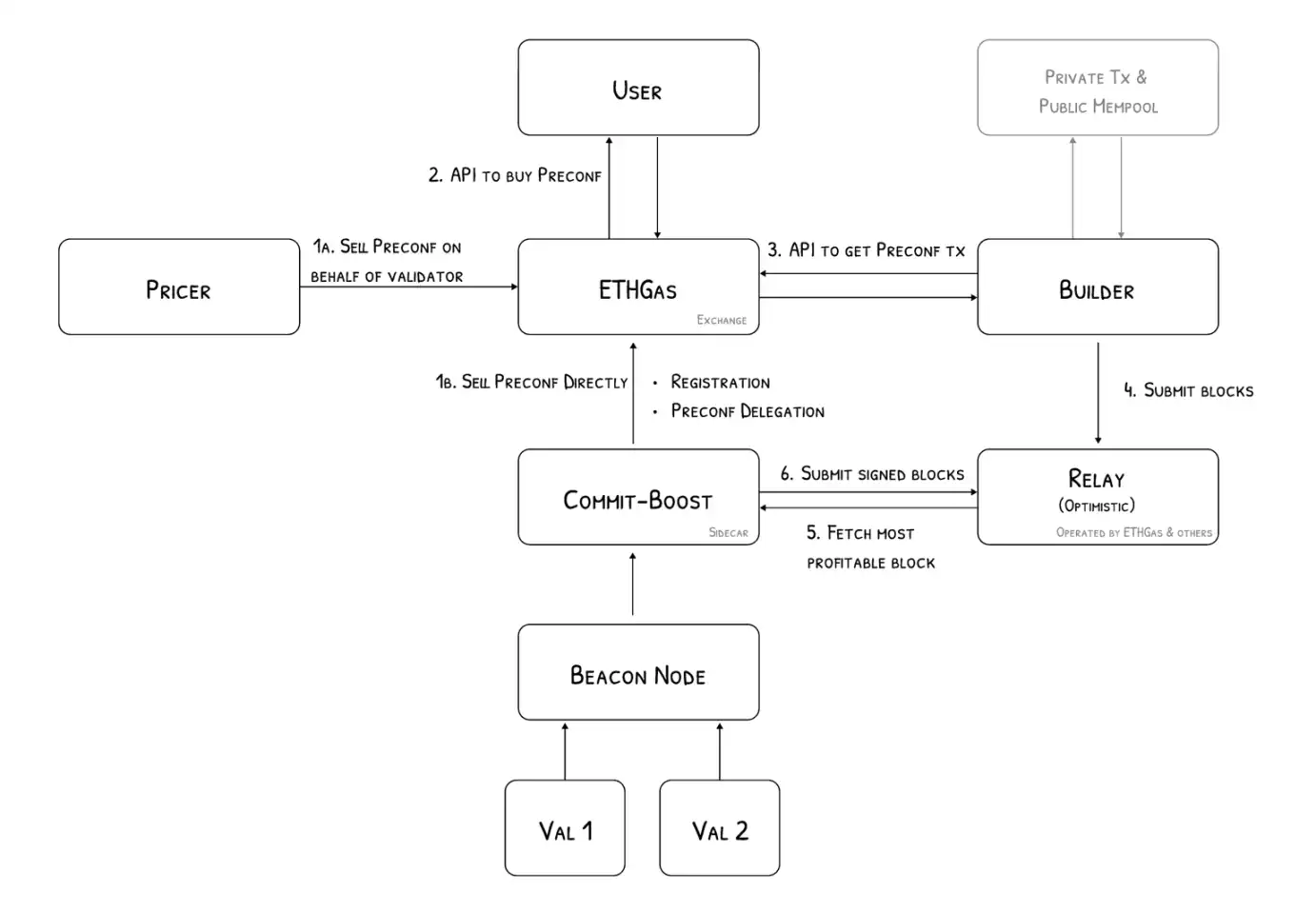
The auction market is called Blockspace, where Ethereum validators, block creators, and relay nodes can auction off space in upcoming blocks to ensure that the bidder's transaction will be included in the next block and to guarantee the transaction's execution efficiency. Furthermore, bidders can even bid for the entire next block to have it contain only their own transactions or transactions provided by others.
If we liken transactions to packages, ensuring a block's inclusion of transactions is like ensuring a package will definitely be loaded onto a transport plane, and ensuring transaction execution is like ensuring the package will be delivered to a specific recipient on time. Bidding for a complete block is akin to chartering a plane to transport your packages, but at the same time, you can sublease any excess space to other packages.
ETHGas' ultimate goal is to achieve Ethereum's "real-time transactions" through Blockspace. This real-time transaction can only be in quotes because the completion of transactions on the Ethereum mainnet must wait for the block to be finalized, but if a transaction can be guaranteed to be included in the next block, it can, to some extent, be considered "completed". We can think of ETHGas as an execution layer on top of Ethereum, but how real-time transactions will be reflected in the frontend still awaits ETHGas' answer.
The core of ETHGas is to establish an orderly block space, rather than the current chaotic bidding to compete for block space, which leads to numerous uncontrollable MEV transactions. By attracting infrastructure operators to join Blockspace through predictable earnings to create sufficient liquidity for achieving real-time transactions, the efficiency improvement attracts various DApps. DApps attract users through Open Gas, bringing more transaction volume into the ETHGas network, thereby increasing the earnings of infrastructure operators, creating a virtuous cycle.
Challenges Under the Good Vision
For a DApp about to conduct a token airdrop, it can estimate the number of transactions for claiming the airdrop, prebook a certain number of blocks after a specific time, and provide a Gas subsidy plan to achieve budget controllability without causing network congestion during the token claim activity.
Although such visions are ideal, allowing block space to be auctioned off may lead to many foreseeable issues.
First, if institutional users can freely auction block space, they may bid heavily for entire blocks and resell them to retail users. In this scenario, while validators' earnings are secure and stable, it actually raises transaction costs for retail users. In this case, retail users, due to their lack of technical ability, are unable to compete with institutional users, and even if retail users can participate in auctions or use futures markets to hedge against the increased Gas costs, it fundamentally raises transaction costs.
Furthermore, the futures market may also serve as a tool for market manipulation, where large holders intentionally generate a large number of on-chain transactions to increase Gas fees and profit in the futures market. However, this action may cause other users to experience a rise in transaction costs on the Ethereum mainnet. Additionally, as a DApp operator, being aware of specific times when certain actions may cause a surge in transaction volume, one can proactively benefit from operations in the futures market, turning the futures market into an arbitrage market for information advantage players, leading to unforeseen losses for regular users who solely rely on market hedging.
The emergence of a new trading market inevitably means that there will be arbitrage opportunities due to information asymmetry, affecting the market's ability to address the problems it aims to solve. For ETHGas, balancing this issue to prevent the "positive feedback loop" from turning into a "death spiral" may require some necessary regulatory measures.
You may also like

$15K+ Profits: The 4 AI Trading Secrets WEEX Hackathon Prelim Winners Used to Dominate Volatile Crypto Markets
How WEEX Hackathon's top AI trading strategies made $15K+ in crypto markets: 4 proven rules for ETH/BTC trading, market structure analysis, and risk management in volatile conditions.

A nearly 20% one-day plunge, how long has it been since you last saw a $60,000 Bitcoin?

Raoul Pal: I've seen every single panic, and they are never the end.

Key Market Information Discrepancy on February 6th - A Must-Read! | Alpha Morning Report

2026 Crypto Industry's First Snowfall

The Harsh Reality Behind the $26 Billion Crypto Liquidation: Liquidity Is Killing the Market

Why Is Gold, US Stocks, Bitcoin All Falling?

Key Market Intelligence for February 5th, how much did you miss out on?

Wintermute: By 2026, crypto had gradually become the settlement layer of the Internet economy
Tether Q4 2025 Report: USDT Market Cap Nears $190 Billion, Multiple Metrics Reach All-Time Highs

Kyle Samani's about-face, one of the biggest believers in web3, has also left the industry

Bhutan Quietly Sells Over $22M in Bitcoin, Drawing Speculation Over Possible Moves
Key Takeaways Bhutan has transferred over $22 million in Bitcoin from sovereign wallets in the past week. The…
BitMine Endures a $7B Unrealized Loss as Ethereum Dips Below $2,100
Key Takeaways BitMine is facing a significant financial challenge with an unrealized loss of over $7 billion in…

Trump-Linked World Liberty Financial Under Scrutiny Following $500 Million UAE Stake
Key Takeaways A U.S. House investigation is examining a $500 million UAE stake in Trump-related World Liberty Financial.…

Asia Market Open: Bitcoin Tumbles as Asian Equities Reflect Global Tech Retreat
Key Takeaways: Bitcoin’s price plunged by 6% to $72,000, reflecting the spillover effects from the global tech sector’s…

Crypto Firms Propose Concessions to Banks as Stablecoin Disputes Stall Key Crypto Bill
Key Takeaways: Crypto companies are attempting to navigate stablecoin disputes with banks but agreements remain elusive. Industry representatives…
CoolWallet Introduces TRON Energy Rental to Minimize TRX Transaction Costs
Key Takeaways CoolWallet has integrated TRON’s energy rental services, offering users lower transaction fees while maintaining asset security.…

CFTC Officially Withdraws Biden-Era Proposal to Ban Political and Sports Prediction Markets
Key Takeaways: The CFTC has rescinded a 2024 proposal and subsequent 2025 advisory that aimed to prohibit event…
$15K+ Profits: The 4 AI Trading Secrets WEEX Hackathon Prelim Winners Used to Dominate Volatile Crypto Markets
How WEEX Hackathon's top AI trading strategies made $15K+ in crypto markets: 4 proven rules for ETH/BTC trading, market structure analysis, and risk management in volatile conditions.


 App
App