
- Buy Crypto
- Markets
 Futures
- Spot
- Copy Trade
 Earn
Earn- More
Arthur Hayes New Article: Bitcoin to Return to “Gold Tier” Safe Haven, Altseason to Potentially Follow

Original Title: Ski Cut
Original Author: Arthur Hayes, BitMEX Founder
Original Translation: AIMan, Golden Finance
For me, the Hokkaido ski season ended in mid-March this year. However, the lessons learned from the mountain are still applicable to President Trump's "Tariff Tantrum." Every day is different, with too many variables interacting—no one knows which snowflake or which turn of the ski will trigger an avalanche. The best we can do is estimate the probability of triggering an avalanche. One technique for more accurately assessing slope instability is a ski cut.
Before heading downhill, one skier in the team will traverse the starting zone, performing up-and-down jumps to try to trigger an avalanche. If successful, the way the avalanche propagates on the slope will determine if the guide deems the slope safe for skiing. Even if an avalanche is triggered, we can still ski, but we must carefully choose our ski direction to avoid triggering consequences worse than loose powder slides. If we see cracks or large sheets of snow fracturing, it's time to get out.
The key is to try to quantify the worst-case scenario based on current conditions and take appropriate action. President Trump's self-proclaimed April 2nd "Day of Liberation" was a ski-cut-like reduction on the steep and dangerous side of the global financial markets. Trump's tariff policy team drew inspiration from a trade economics book titled "Balanced Trade: The Unbearable Cost of America's Trade Deficits" and took an extreme stance. The announced tariff rates were worse than even the worst-case estimates of mainstream economists and financial analysts. In avalanche terms, Trump triggered a sustained weak layer avalanche, threatening to destroy the entire fugazi (derived from the Vietnam War-era U.S. military, meaning something fake) portion of the dirty fiat financial system.
The initial tariff policy represented the worst outcome as both the U.S. and China took extreme stances, pitting each other against. Despite the severe turbulence in financial asset markets, leading to trillions of dollars in global losses, the real issue was the rise in U.S. bond market volatility (measured by the MOVE index). The index surged to a historical high of 172 points intraday, after which the Trump team retreated from the danger zone. Within a week of announcing the tariff policy, Trump softened his plans and halted the additional tariffs on all countries except China for 90 days.
Subsequently, Boston Fed Governor Susan Collins wrote in the Financial Times that the Fed was ready to do everything possible to ensure market functioning. However, volatility remained stubbornly high. Finally, U.S. Treasury Secretary Scott spoke to Bloomberg and declared to the world that his department was massive, especially as it could significantly increase the speed and scale of debt repurchases (see Golden Finance's previous report "Arthur Hayes: I Believe BTC Could Reach $250,000 by Year End Due to U.S. Treasury Dominance of the Fed"). I describe this series of events as policymakers shifting from "everything is fine" to "everything is terrible, we need to act," the market surges, and most importantly, Bitcoin finds a bottom. Yes, everyone, I predict $74,500 is a local low.
Whether you describe Trump's policy changes as a retreat or a shrewd negotiation strategy, the result is the government deliberately triggering a financial market collapse, and the situation is so serious that they adjusted the policy a week later. Now, as a market, we know some things. We understand what will happen in the worst-case scenario bond market turmoil, we recognize the level of volatility that triggers behavioral changes, and we also know what currency levers will be used to mitigate this situation. Leveraging this information, we as Bitcoin holders and cryptocurrency investors know that the bottom has been reached because the next time Trump amplifies tariff rhetoric or refuses to reduce tariffs on China, Bitcoin will rise as people anticipate monetary officials running the printing press at full tilt to ensure bond market volatility remains low.
This article will explore why taking an extreme stance on tariffs leads to dysfunction in the bond market (measured by the MOVE index). Then, I will discuss the solution proposed by U.S. Treasury Secretary Bessent—bond repurchases—and how it will inject a significant amount of USD liquidity into the system, even though technically buying old bonds with newly issued bonds does not increase USD liquidity in the system. Lastly, I will discuss why the current state of Bitcoin and the macroeconomic environment is similar to the situation in the third quarter of 2022 when Yellen, Bessent's predecessor, raised bond issuance levels to deplete the Reverse Repurchase Plan (RRP). Bitcoin hit a local low after touching FTX in the third quarter of 2022, and now, following Bessent's introduction of his "non-quantitative easing" quantitative easing policy, Bitcoin hit a local low in the second quarter of 2025 amid this bull market cycle.
The Greatest Pain
I want to reiterate that Trump's goal is to reduce the U.S. current account deficit to zero. Rapidly achieving this goal requires a painful adjustment, and tariffs are his government's usual trick. I don't care whether you think this is good or not, nor do I care if Americans are ready to work over 8 hours in an iPhone factory. Part of the reason Trump was elected is because his supporters believed that globalization had hurt them. His team was single-minded about fulfilling their campaign promise, saying they would prioritize "Main Street" over "Wall Street." All of this was predicated on those around Trump being able to secure re-election through this path, but that's not a done deal.
The reason the financial markets crashed on Liberation Day is that if foreign exporters earn fewer or no USD, they cannot buy as many or any U.S. stocks and bonds. Additionally, if exporters have to change their supply chains or even rebuild them domestically in the United States, they must fund part of the rebuilding by selling their liquid assets, such as U.S. bonds and stocks. That's why the U.S. market and any market overly reliant on U.S. export income collapsed.
At least in the initial stages, the primary hope was that fear-driven traders and investors would flock to the U.S. Treasury market. Treasury prices would rise, yields would fall. The 10-year Treasury yield saw a significant drop, which was good news for Bessent as it helped him push more bonds into the market. However, the sharp price swings in bonds and stocks exacerbated market volatility, spelling doom for certain types of hedge funds.
Hedge funds, hedging... sometimes, but always with a heavy dose of leverage. Relative Value (RV) traders typically identify relationships or spreads between two assets, and if the spread widens, they use leverage to buy one asset and sell another, expecting mean reversion. In general, most hedge fund strategies implicitly or explicitly bet against market volatility at a macro level. When volatility decreases, mean reversion occurs. When volatility rises, things go haywire, and the stable "relationship" between assets breaks down. That's why risk managers at banks or trading platforms offering leverage to hedge funds increase margin requirements when market volatility rises. When hedge funds receive a margin call, they must close out positions immediately, or else face liquidation. Some investment banks are happy to bankrupt clients during periods of high market volatility through margin calls, take over the bankrupt clients' positions, and profit when policymakers inevitably print money to suppress volatility.
What we're really concerned about is the relationship between stocks and bonds. Since U.S. Treasuries are nominally risk-free assets and also global reserve assets, when worldwide investors flee the stock market, U.S. Treasury prices rise. This makes sense because fiat must be present to earn a return, and the U.S. government, thanks to its ability to effortlessly print money, will never willingly default in dollar terms. The actual value of Treasuries may decline, and indeed it does, but policymakers aren't concerned with the actual value of all the junk fiat assets flooding in from around the globe.
In the days following the "day of liberation," the stock market fell, and bond prices rose/yields fell. Then, something happened: bond prices and the stock market simultaneously dropped. The 10-year Treasury yield experienced unprecedented back-and-forth swings not seen since the early 1980s. The question is, why? The answer, or at least what policymakers believe the answer to be, is of utmost importance. Is there a structural issue in the market that must be fixed by the Fed and/or Treasury through some form of money printing?
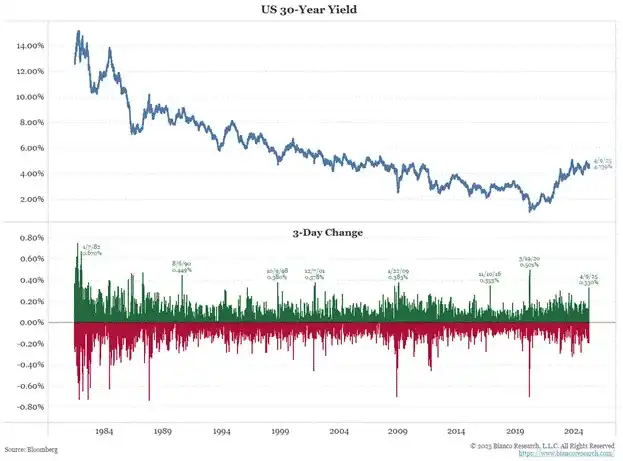
From Bianco Research, the bottom shows the abnormality of the 3-day change in the 30-year bond yield. The extent of the change triggered by tariff panic is akin to market volatility during financial crises such as the 2020 COVID-19 pandemic, the 2008 global financial crisis, and the 1998 Asian financial crisis. This is not a good sign.
The RV Fund's Treasury Bond Basis Trade position may be liquidated, which is a concern. What is the size of this trade?
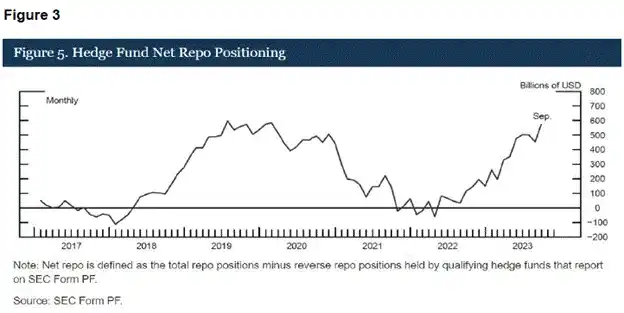
February 2022 is crucial for the U.S. Treasury market as President Biden has decided to freeze the holdings of Treasury bonds by Russia, the world's largest commodity-producing country. This effectively signifies that property rights are no longer a right for anyone but a privilege. As a result, overseas demand continues to wane, but the RV Fund, as a marginal buyer of U.S. Treasuries, has filled this gap. The chart above clearly shows the increase in repo positions, which can be seen as a representation of the scale of basis trades within the market.
· Basis Trade Overview:
A Treasury Bond Basis Trade involves buying a cash bond and simultaneously selling a bond futures contract. The margin impact from banks and trading platforms is crucial. The RV Fund's position size is limited by the cash amount required as margin. Margin requirements will vary based on market volatility and liquidity factors.
· Bank Margin:
To obtain the cash needed to purchase bonds, the fund engages in repurchase agreement (repo) trades. Banks agree to pay a small fee, provide upfront cash, awaiting settlement with purchased bonds as collateral. Banks will require a certain amount of cash margin as collateral for the repo.
The greater the bond price fluctuation, the higher the margin required by banks.
The poorer the bond's liquidity, the more margin banks will need. Liquidity is always concentrated at certain tenors of the yield curve. For the global market, the 10-year Treasury bond is most crucial and also the most liquid. When the latest 10-year Treasury is auctioned, it becomes the "on-the-run" 10-year bond, the most liquid bond. Over time, it moves further away from the liquidity center, becoming "off-the-run." As time progresses, the on-the-run naturally becomes off-the-run, increasing the cash amount needed for repo trades while awaiting basis collapse.
Essentially, in periods of high market volatility, banks are concerned that if they need to liquidate bonds, prices will fall too quickly, and liquidity will not be enough to absorb their market sell orders. Therefore, they will increase margin requirements.
· Futures Trading Platform Margin:
Each bond futures contract is set at an initial margin level that determines the cash margin amount required per contract. This initial margin level will fluctuate with market volatility.
The focus of a trading platform is its ability to close out positions before exhausting its initial margin. The faster the price fluctuates, the more challenging it is to maintain solvency; therefore, when market volatility intensifies, margin requirements also increase.
· Fear Elimination:
The impact of basis trading on the bond market and the financing methods of major participants have always been hot topics in the bond market. The Treasury Borrowing Advisory Committee (TBAC) in its Quarterly Refunding Announcement (QRA) has provided data confirming the following statement: Starting in 2022, the marginal buyers of U.S. Treasuries have consistently been RV hedge funds engaging in such basis trading. Below is a link to a detailed paper submitted to the Commodity Futures Trading Commission (CFTC) based on data provided by the TBAC since April 2024.
A recursive market event chain amplifies in a terrifying manner in each cycle, as outlined below:
1. As bond market volatility increases, RV hedge funds will need to deposit more cash with banks and trading platforms.
2. At a certain point, these funds will be unable to meet additional margin call requirements and must liquidate positions simultaneously. This involves selling spot bonds and repurchasing bond futures contracts.
3. As market makers reduce the size of their quoted spreads to protect themselves from the impact of adverse one-way flows, liquidity in the spot market decreases.
4. As liquidity and prices both decline, market volatility further increases.
Traders are well aware of this market phenomenon, and both regulators themselves and their financial journalist lackeys have been issuing warning signals about it. Therefore, as bond market volatility escalates, traders front-run forced selling by buying ahead, exacerbating downward pressure and causing the market to collapse faster.
If this is a known source of market stress, what policies could the U.S. Treasury Department implement internally to maintain funding (i.e., leverage) flowing to these RV funds?
Treasury Repo
Several years ago, the U.S. Treasury Department initiated a bond repurchase program. Many analysts speculate about the future, considering how this may nurture or incentivize certain money-printing behaviors. I will outline my theory on the impact of repos on the money supply. But first, let's understand how the program operates.
The Treasury Department issues new bonds and uses the proceeds to repurchase off-the-run bonds with lower liquidity. This causes the value of off-the-run bonds to rise, potentially even exceeding fair value, as the Treasury Department becomes the largest buyer in the illiquid market. RV funds will see a narrowing of the basis between off-the-run bonds and bond futures contracts.
Basis Trading = Long Cash Bond + Short Bond Futures
Due to the expectation that the Treasury will buy bonds, the long cash bond price will rise along with the old bond price.
Therefore, the RV fund will lock in profits by selling higher-priced old bonds and closing out its short bond futures contracts. This frees up valuable funding for banks and trading platforms. Since the RV funds are profitable, they will directly engage in basis trading at the next government bond auction. With price and liquidity increasing, the volatility of the bond market will decrease. This reduces the fund's margin requirement and allows it to hold larger positions. This is the best embodiment of pro-cyclical reflexivity.
Knowing that the Treasury is providing more leverage to the financial system, the market will now relax. Bond prices rise; all is well.
US Treasury Secretary Besset boasted about his new tool in an interview because theoretically, the Treasury can engage in unlimited repo operations. Without congressional approval of spending bills, the Treasury cannot issue bonds at will. However, the essence of repo is that the Treasury issues new bonds to pay off old debt, and the Treasury has already issued new bonds to repay the principal of maturing bonds. As the Treasury buys and sells bonds with a primary dealer bank in the same name, the cash flow of this transaction is neutral, so it does not need to borrow from the Fed to conduct repos. Therefore, if reaching the repo level can alleviate market concerns about a collapse in the bond market and lead to the market accepting lower yields on bonds not yet issued, the Treasury will wholeheartedly engage in repos. It can't stop and won't stop.
Explanation of Treasury Bond Supply
Besset is well aware that the debt ceiling will be raised at some point this year, and the government will continue to spend more recklessly. He also knows that Elon Musk's pace of cutting expenses through his Department of Government Efficiency (DOGE) is not fast enough due to various structural and legal reasons. Specifically, Musk's estimate of spending cuts for this year has dropped from an expected $1 trillion per year to a negligible $150 billion (taking into account the massive scale of the deficit). This leads to an obvious conclusion: the deficit may actually widen, forcing Besset to issue more government bonds.
Currently, as of March in the 25 fiscal year, the deficit exceeds the 24 fiscal year's deficit for the same period by 22%. Let's believe Musk for now—I know some of you would rather burn a Tesla while listening to Grimes' song than believe—the effort has only been two months. More worrisome is the uncertainty surrounding the intensity and impact of tariffs on businesses, coupled with the stock market decline, which will lead to a significant drop in tax revenue. This will point to a structural reason that even if DOGE succeeds in cutting more government spending, the deficit will continue to expand.
Deep inside, Besset is worried that, due to these factors, he will have to revise upward his borrowing expectations for the remainder of the year. With the upcoming deluge of government bond supply, market participants will demand a substantial increase in yields. Besset needs the RV fund to increase its exposure, utilize maximum leverage, and completely corner the bond market. Therefore, a repo is imperative.
The positive impact of a repo on USD liquidity is not as direct as central bank money printing. Repos are neutral for both the budget and supply, allowing the treasury to repo unlimitedly to create massive RV purchasing power. Ultimately, this enables the government to fund itself at sustainable rates. The more debt is issued, the more that debt is not purchased with private savings but with leverage funds created through the banking system, the greater the expansion of the money supply. And as we know, when the fiat supply expands, the only asset we want to own is Bitcoin. Let's go!
Obviously, this is not an infinite source of USD liquidity. The amount of unissued government debt available for purchase is limited. However, repos are a tool that can help Besset alleviate short-term market fluctuations and provide funding for the government at sustainable levels. This is the reason for the decline in the MOVE index. As the government bond market stabilizes, concerns about the collapse of the entire system also arise.
Same Scenario
I liken this trading strategy to the strategy of the third quarter of 2022. In the third quarter of 2022, a "righteous" white boy like Sam Bankman-Fried (SBF) went bankrupt; the Fed was still hiking rates, bond prices were falling, yields were rising. Yellen needed to find a way to stimulate the market so she could use a red-soled stiletto to open the market's throat and excrete the bonds without inducing vomiting. In short, just like now—due to the transition of the global monetary system, increased market volatility—this is a terrible time to increase bond issuance.
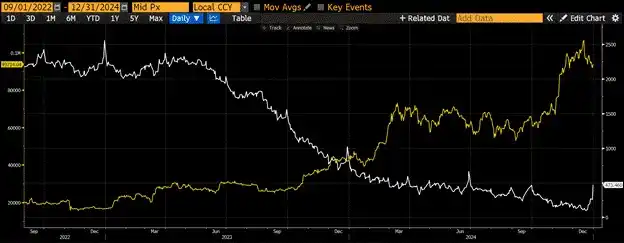
RRP Balance (White) vs. Bitcoin (Gold)
Like today, but for different reasons, Yellen couldn't count on the Fed to ease monetary policy, as Powell was busy participating in his Paul Volcker-inspired teetotaler juggling act. Yellen, or some clever aide, correctly deduced that the excess funds in RRP held by money market funds could be attracted into the leveraged financial system by issuing more U.S. treasuries, which these funds are happy to hold as the yields are slightly higher than RRP. This allowed her to inject $2.5 trillion of liquidity into the market from the third quarter of 2022 to early 2025. During this period, the price of Bitcoin surged nearly 6x.
This sounds like a rather optimistic scenario, but people are panicking. They know that high tariffs and the Chi-Merica divorce are not good for stock prices. They see Bitcoin as nothing but a high-beta version of the Nasdaq 100 index. They are bearish, not believing that a seemingly harmless buyback plan can increase future dollar liquidity. They are standing by, waiting for Powell to ease policy. He cannot directly ease policy or implement quantitative easing like his predecessors as Fed chairs from 2008 to 2019. Times have changed, and the burden of Treasury printing has grown heavier. If Powell truly cares about inflation and the long-term strength of the dollar, he would eliminate the effect of the actions taken by the Treasury under Yellen and now under Benson. But he did not do so then, and he won't do it now; he will be scrambling in the chair's seat, being manipulated.
Just like in the third quarter of 2022, people believe that after hitting a cyclical low around $15,000, Bitcoin may fall below $10,000 due to a series of unfavorable market factors stacking up. Some now believe that the Bitcoin price will drop below $74,500, falling below $60,000, signaling the end of the bull market. Yellen and Benson are not messing around. They will ensure the government gets funds at tolerable rates and suppress volatility in the bond market. Short-term Treasury issuance by Yellen exceeds long-term issuance, injecting limited RRP liquidity into the system; Benson will repurchase old debt with new debt issuance and maximize the RV fund's ability to absorb the increased bond supply. Neither of these is a quantitative easing policy that most investors are familiar with or endorse. Therefore, they turn a blind eye to it and will have to chase the price once Bitcoin confirms the breakout.
Verification
For a repurchase to have a net stimulative effect, the deficit must continue to rise. On May 1, we will learn about the upcoming borrowing plans and how they compare to previous estimates through the U.S. Treasury's Quarterly Refunding Announcement (QRA). If Benson needs to borrow more or is expected to borrow more, it means that tax revenue is expected to decline; thus, with spending remaining constant, this will result in an expanded deficit.
Then, in mid-May, we will receive the official deficit or surplus data for April from the Treasury, including actual data on tax receipts from April 15. We can compare the year-over-year change to date in FY25 and observe whether the deficit is widening. If the deficit increases, bond issuance will increase, and Benson must do everything possible to ensure the risk mitigation fund can increase its basis trade position.
Trading Strategy
When Trump was skiing, the steep slope suddenly dropped, triggering an avalanche. Now, we finally know the pain or fluctuation level (MOVE Index) that the Trump administration can withstand before implementing any policy to alleviate any market perception that would negatively impact the fiat financial system cornerstone. This will trigger a policy response, the effects of which will increase the USD fiat supply available to purchase U.S. Treasuries.
If the increase in repo frequency and scale is not sufficient to calm the market, then the Fed will eventually find a path to easing. They have already said they would. Most importantly, they reduced the rate of quantitative tightening (QT) at the recent March meeting, which is favorable for USD liquidity prospectively. However, besides quantitative easing, the Fed can do more. Here is a brief list of procedural policies that are not quantitative easing but can enhance market absorption of new Treasury issuances; one of which may be announced at the May 6-7 Fed meeting:
Exempting U.S. Treasuries from the supplementary leverage ratio (SLR) requirement for banks. This allows banks to use unlimited leverage to purchase Treasuries.
Implementing 'QT Reversal,' which involves reinvesting funds from maturing Mortgage-Backed Securities (MBS) into newly issued Treasuries. The Fed's balance sheet remains the same size, but this will bring $35 billion of monthly marginal buying pressure to the Treasury market for the next few years until all MBS outstanding expires.
The next time Trump presses the tariff button — and he will to ensure other countries respect his authority — he will be able to demand more concessions, and Bitcoin will not suffer as much as some stocks. Bitcoin knows that given the current and future insane levels of indebtedness required to keep the dirty fiat financial system running, a deflationary policy cannot be maintained in the long run.
The collapse of Sharp Mountain World (referring to the financial markets) ski resort triggered a secondary market avalanche, which could have quickly escalated to a five-level, the highest level. But the Trump team quickly responded, changed the course, and pushed the empire to another extreme. The foundation of the avalanche was crystallized U.S. dollar bills provided by U.S. Treasury repo, solidified by the driest, wettest 'pow pow.' Now is the time to climb difficultly from a backpack full of uncertainties to transitioning to jumping off a powdery pillow, cheering on how high Bitcoin will soar.
As you can see, I am very bullish on Bitcoin. At Maelstrom, we have already maximized our cryptocurrency exposure. Now, it's all about accumulating Bitcoin by trading different cryptocurrencies. During the downturn when the Bitcoin price dropped from $110k to $74.5k, the highest buying volume was for Bitcoin. Bitcoin will continue to lead the market as it is a direct beneficiary of more USD circulation brought in for mitigating the impacts of the U.S.-China decoupling in the future. Today, the international community sees Trump as a madman wildly wielding tariff weapons, and any investors holding U.S. stocks and bonds are looking for something counter-systemic. Tangibly, that's gold. Digitally, that's Bitcoin.
Gold has never been seen as a high-beta version of U.S. tech stocks; therefore, as the overall market crashed, it performed well as the oldest anti-establishment financial hedge tool. Bitcoin will break free from its association with U.S. tech stocks and rejoin gold in the "only goes up" camp.
What about the Shitcoins, though?
Once Bitcoin breaks its previous all-time high of $110,000, it is likely to surge, further solidifying its dominance. Maybe it won't reach $200,000. Then, Bitcoin starts to rotate into shitcoins. The rise of shitcoins (AltSzn: Chikun), let's go!
Aside from those shiny new shitcoin metadata, the best-performing tokens are those that both earn profits and give back profits to stakers. Such projects are few and far between. Maelstrom has been working diligently to accumulate positions in some qualified tokens and has not yet completed purchases of these gems. They are gems because they, like all other shitcoins in the recent sell-off, have been hit hard, but unlike 99% of shit projects, these gems actually have paying customers.
With a large token supply and the token launched on CEX in Down Only mode, convincing the market to give your project another chance is impossible. Shitcoin divers are looking for higher staking APYs where rewards come from actual profits since these cash flows are sustainable. To market our product, I will write a comprehensive article introducing some of these projects and why we believe their cash flows will continue to grow in the near future. So before that, turn the truck around and buy everything!
You may also like

Token Cannot Compound, Where Is the Real Investment Opportunity?

February 6th Market Key Intelligence, How Much Did You Miss?

China's Central Bank and Eight Other Departments' Latest Regulatory Focus: Key Attention to RWA Tokenized Asset Risk
Foreword: Today, the People's Bank of China's website published the "Notice of the People's Bank of China, National Development and Reform Commission, Ministry of Industry and Information Technology, Ministry of Public Security, State Administration for Market Regulation, China Banking and Insurance Regulatory Commission, China Securities Regulatory Commission, State Administration of Foreign Exchange on Further Preventing and Dealing with Risks Related to Virtual Currency and Others (Yinfa [2026] No. 42)", the latest regulatory requirements from the eight departments including the central bank, which are basically consistent with the regulatory requirements of recent years. The main focus of the regulation is on speculative activities such as virtual currency trading, exchanges, ICOs, overseas platform services, and this time, regulatory oversight of RWA has been added, explicitly prohibiting RWA tokenization, stablecoins (especially those pegged to the RMB). The following is the full text:
To the people's governments of all provinces, autonomous regions, and municipalities directly under the Central Government, the Xinjiang Production and Construction Corps:
Recently, there have been speculative activities related to virtual currency and Real-World Assets (RWA) tokenization, disrupting the economic and financial order and jeopardizing the property security of the people. In order to further prevent and address the risks related to virtual currency and Real-World Assets tokenization, effectively safeguard national security and social stability, in accordance with the "Law of the People's Republic of China on the People's Bank of China," "Law of the People's Republic of China on Commercial Banks," "Securities Law of the People's Republic of China," "Law of the People's Republic of China on Securities Investment Funds," "Law of the People's Republic of China on Futures and Derivatives," "Cybersecurity Law of the People's Republic of China," "Regulations of the People's Republic of China on the Administration of Renminbi," "Regulations on Prevention and Disposal of Illegal Fundraising," "Regulations of the People's Republic of China on Foreign Exchange Administration," "Telecommunications Regulations of the People's Republic of China," and other provisions, after reaching consensus with the Cyberspace Administration of China, the Supreme People's Court, and the Supreme People's Procuratorate, and with the approval of the State Council, the relevant matters are notified as follows:
(I) Virtual currency does not possess the legal status equivalent to fiat currency. Virtual currencies such as Bitcoin, Ether, Tether, etc., have the main characteristics of being issued by non-monetary authorities, using encryption technology and distributed ledger or similar technology, existing in digital form, etc. They do not have legal tender status, should not and cannot be circulated and used as currency in the market.
The business activities related to virtual currency are classified as illegal financial activities. The exchange of fiat currency and virtual currency within the territory, exchange of virtual currencies, acting as a central counterparty in buying and selling virtual currencies, providing information intermediary and pricing services for virtual currency transactions, token issuance financing, and trading of virtual currency-related financial products, etc., fall under illegal financial activities, such as suspected illegal issuance of token vouchers, unauthorized public issuance of securities, illegal operation of securities and futures business, illegal fundraising, etc., are strictly prohibited across the board and resolutely banned in accordance with the law. Overseas entities and individuals are not allowed to provide virtual currency-related services to domestic entities in any form.
A stablecoin pegged to a fiat currency indirectly fulfills some functions of the fiat currency in circulation. Without the consent of relevant authorities in accordance with the law and regulations, any domestic or foreign entity or individual is not allowed to issue a RMB-pegged stablecoin overseas.
(II)Tokenization of Real-World Assets refers to the use of encryption technology and distributed ledger or similar technologies to transform ownership rights, income rights, etc., of assets into tokens (tokens) or other interests or bond certificates with token (token) characteristics, and carry out issuance and trading activities.
Engaging in the tokenization of real-world assets domestically, as well as providing related intermediary, information technology services, etc., which are suspected of illegal issuance of token vouchers, unauthorized public offering of securities, illegal operation of securities and futures business, illegal fundraising, and other illegal financial activities, shall be prohibited; except for relevant business activities carried out with the approval of the competent authorities in accordance with the law and regulations and relying on specific financial infrastructures. Overseas entities and individuals are not allowed to illegally provide services related to the tokenization of real-world assets to domestic entities in any form.
(III) Inter-agency Coordination. The People's Bank of China, together with the National Development and Reform Commission, the Ministry of Industry and Information Technology, the Ministry of Public Security, the State Administration for Market Regulation, the China Banking and Insurance Regulatory Commission, the China Securities Regulatory Commission, the State Administration of Foreign Exchange, and other departments, will improve the work mechanism, strengthen coordination with the Cyberspace Administration of China, the Supreme People's Court, and the Supreme People's Procuratorate, coordinate efforts, and overall guide regions to carry out risk prevention and disposal of virtual currency-related illegal financial activities.
The China Securities Regulatory Commission, together with the National Development and Reform Commission, the Ministry of Industry and Information Technology, the Ministry of Public Security, the People's Bank of China, the State Administration for Market Regulation, the China Banking and Insurance Regulatory Commission, the State Administration of Foreign Exchange, and other departments, will improve the work mechanism, strengthen coordination with the Cyberspace Administration of China, the Supreme People's Court, and the Supreme People's Procuratorate, coordinate efforts, and overall guide regions to carry out risk prevention and disposal of illegal financial activities related to the tokenization of real-world assets.
(IV) Strengthening Local Implementation. The people's governments at the provincial level are overall responsible for the prevention and disposal of risks related to virtual currencies and the tokenization of real-world assets in their respective administrative regions. The specific leading department is the local financial regulatory department, with participation from branches and dispatched institutions of the State Council's financial regulatory department, telecommunications regulators, public security, market supervision, and other departments, in coordination with cyberspace departments, courts, and procuratorates, to improve the normalization of the work mechanism, effectively connect with the relevant work mechanisms of central departments, form a cooperative and coordinated working pattern between central and local governments, effectively prevent and properly handle risks related to virtual currencies and the tokenization of real-world assets, and maintain economic and financial order and social stability.
(5) Enhanced Risk Monitoring. The People's Bank of China, China Securities Regulatory Commission, National Development and Reform Commission, Ministry of Industry and Information Technology, Ministry of Public Security, State Administration of Foreign Exchange, Cyberspace Administration of China, and other departments continue to improve monitoring techniques and system support, enhance cross-departmental data analysis and sharing, establish sound information sharing and cross-validation mechanisms, promptly grasp the risk situation of activities related to virtual currency and real-world asset tokenization. Local governments at all levels give full play to the role of local monitoring and early warning mechanisms. Local financial regulatory authorities, together with branches and agencies of the State Council's financial regulatory authorities, as well as departments of cyberspace and public security, ensure effective connection between online monitoring, offline investigation, and fund tracking, efficiently and accurately identify activities related to virtual currency and real-world asset tokenization, promptly share risk information, improve early warning information dissemination, verification, and rapid response mechanisms.
(6) Strengthened Oversight of Financial Institutions, Intermediaries, and Technology Service Providers. Financial institutions (including non-bank payment institutions) are prohibited from providing account opening, fund transfer, and clearing services for virtual currency-related business activities, issuing and selling financial products related to virtual currency, including virtual currency and related financial products in the scope of collateral, conducting insurance business related to virtual currency, or including virtual currency in the scope of insurance liability. Financial institutions (including non-bank payment institutions) are prohibited from providing custody, clearing, and settlement services for unauthorized real-world asset tokenization-related business and related financial products. Relevant intermediary institutions and information technology service providers are prohibited from providing intermediary, technical, or other services for unauthorized real-world asset tokenization-related businesses and related financial products.
(7) Enhanced Management of Internet Information Content and Access. Internet enterprises are prohibited from providing online business venues, commercial displays, marketing, advertising, or paid traffic diversion services for virtual currency and real-world asset tokenization-related business activities. Upon discovering clues of illegal activities, they should promptly report to relevant departments and provide technical support and assistance for related investigations and inquiries. Based on the clues transferred by the financial regulatory authorities, the cyberspace administration, telecommunications authorities, and public security departments should promptly close and deal with websites, mobile applications (including mini-programs), and public accounts engaged in virtual currency and real-world asset tokenization-related business activities in accordance with the law.
(8) Strengthened Entity Registration and Advertisement Management. Market supervision departments strengthen entity registration and management, and enterprise and individual business registrations must not contain terms such as "virtual currency," "virtual asset," "cryptocurrency," "crypto asset," "stablecoin," "real-world asset tokenization," or "RWA" in their names or business scopes. Market supervision departments, together with financial regulatory authorities, legally enhance the supervision of advertisements related to virtual currency and real-world asset tokenization, promptly investigating and handling relevant illegal advertisements.
(IX) Continued Rectification of Virtual Currency Mining Activities. The National Development and Reform Commission, together with relevant departments, strictly controls virtual currency mining activities, continuously promotes the rectification of virtual currency mining activities. The people's governments of various provinces take overall responsibility for the rectification of "mining" within their respective administrative regions. In accordance with the requirements of the National Development and Reform Commission and other departments in the "Notice on the Rectification of Virtual Currency Mining Activities" (NDRC Energy-saving Building [2021] No. 1283) and the provisions of the "Guidance Catalog for Industrial Structure Adjustment (2024 Edition)," a comprehensive review, investigation, and closure of existing virtual currency mining projects are conducted, new mining projects are strictly prohibited, and mining machine production enterprises are strictly prohibited from providing mining machine sales and other services within the country.
(X) Severe Crackdown on Related Illegal Financial Activities. Upon discovering clues to illegal financial activities related to virtual currency and the tokenization of real-world assets, local financial regulatory authorities, branches of the State Council's financial regulatory authorities, and other relevant departments promptly investigate, determine, and properly handle the issues in accordance with the law, and seriously hold the relevant entities and individuals legally responsible. Those suspected of crimes are transferred to the judicial authorities for processing according to the law.
(XI) Severe Crackdown on Related Illegal and Criminal Activities. The Ministry of Public Security, the People's Bank of China, the State Administration for Market Regulation, the China Banking and Insurance Regulatory Commission, the China Securities Regulatory Commission, as well as judicial and procuratorial organs, in accordance with their respective responsibilities, rigorously crack down on illegal and criminal activities related to virtual currency, the tokenization of real-world assets, such as fraud, money laundering, illegal business operations, pyramid schemes, illegal fundraising, and other illegal and criminal activities carried out under the guise of virtual currency, the tokenization of real-world assets, etc.
(XII) Strengthen Industry Self-discipline. Relevant industry associations should enhance membership management and policy advocacy, based on their own responsibilities, advocate and urge member units to resist illegal financial activities related to virtual currency and the tokenization of real-world assets. Member units that violate regulatory policies and industry self-discipline rules are to be disciplined in accordance with relevant self-regulatory management regulations. By leveraging various industry infrastructure, conduct risk monitoring related to virtual currency, the tokenization of real-world assets, and promptly transfer issue clues to relevant departments.
(XIII) Without the approval of relevant departments in accordance with the law and regulations, domestic entities and foreign entities controlled by them may not issue virtual currency overseas.
(XIV) Domestic entities engaging directly or indirectly in overseas external debt-based tokenization of real-world assets, or conducting asset securitization activities abroad based on domestic ownership rights, income rights, etc. (hereinafter referred to as domestic equity), should be strictly regulated in accordance with the principles of "same business, same risk, same rules." The National Development and Reform Commission, the China Securities Regulatory Commission, the State Administration of Foreign Exchange, and other relevant departments regulate it according to their respective responsibilities. For other forms of overseas real-world asset tokenization activities based on domestic equity by domestic entities, the China Securities Regulatory Commission, together with relevant departments, supervise according to their division of responsibilities. Without the consent and filing of relevant departments, no unit or individual may engage in the above-mentioned business.
(15) Overseas subsidiaries and branches of domestic financial institutions providing Real World Asset Tokenization-related services overseas shall do so legally and prudently. They shall have professional personnel and systems in place to effectively mitigate business risks, strictly implement customer onboarding, suitability management, anti-money laundering requirements, and incorporate them into the domestic financial institutions' compliance and risk management system. Intermediaries and information technology service providers offering Real World Asset Tokenization services abroad based on domestic equity or conducting Real World Asset Tokenization business in the form of overseas debt for domestic entities directly or indirectly venturing abroad must strictly comply with relevant laws and regulations. They should establish and improve relevant compliance and internal control systems in accordance with relevant normative requirements, strengthen business and risk control, and report the business developments to the relevant regulatory authorities for approval or filing.
(16) Strengthen organizational leadership and overall coordination. All departments and regions should attach great importance to the prevention of risks related to virtual currencies and Real World Asset Tokenization, strengthen organizational leadership, clarify work responsibilities, form a long-term effective working mechanism with centralized coordination, local implementation, and shared responsibilities, maintain high pressure, dynamically monitor risks, effectively prevent and mitigate risks in an orderly and efficient manner, legally protect the property security of the people, and make every effort to maintain economic and financial order and social stability.
(17) Widely carry out publicity and education. All departments, regions, and industry associations should make full use of various media and other communication channels to disseminate information through legal and policy interpretation, analysis of typical cases, and education on investment risks, etc. They should promote the illegality and harm of virtual currencies and Real World Asset Tokenization-related businesses and their manifestations, fully alert to potential risks and hidden dangers, and enhance public awareness and identification capabilities for risk prevention.
(18) Engaging in illegal financial activities related to virtual currencies and Real World Asset Tokenization in violation of this notice, as well as providing services for virtual currencies and Real World Asset Tokenization-related businesses, shall be punished in accordance with relevant regulations. If it constitutes a crime, criminal liability shall be pursued according to the law. For domestic entities and individuals who knowingly or should have known that overseas entities illegally provided virtual currency or Real World Asset Tokenization-related services to domestic entities and still assisted them, relevant responsibilities shall be pursued according to the law. If it constitutes a crime, criminal liability shall be pursued according to the law.
(19) If any unit or individual invests in virtual currencies, Real World Asset Tokens, and related financial products against public order and good customs, the relevant civil legal actions shall be invalid, and any resulting losses shall be borne by them. If there are suspicions of disrupting financial order and jeopardizing financial security, the relevant departments shall deal with them according to the law.
This notice shall enter into force upon the date of its issuance. The People's Bank of China and ten other departments' "Notice on Further Preventing and Dealing with the Risks of Virtual Currency Trading Speculation" (Yinfa [2021] No. 237) is hereby repealed.

Former Partner's Perspective on Multicoin: Kyle's Exit, But the Game He Left Behind Just Getting Started
Why Bitcoin Is Falling Now: The Real Reasons Behind BTC's Crash & WEEX's Smart Profit Playbook
Bitcoin's ongoing crash explained: Discover the 5 hidden triggers behind BTC's plunge & how WEEX's Auto Earn and Trade to Earn strategies help traders profit from crypto market volatility.

Wall Street's Hottest Trades See Exodus

Vitalik Discusses Ethereum Scaling Path, Circle Announces Partnership with Polymarket, What's the Overseas Crypto Community Talking About Today?

Believing in the Capital Markets - The Essence and Core Value of Cryptocurrency

Polymarket's 'Weatherman': Predict Temperature, Win Million-Dollar Payout

$15K+ Profits: The 4 AI Trading Secrets WEEX Hackathon Prelim Winners Used to Dominate Volatile Crypto Markets
How WEEX Hackathon's top AI trading strategies made $15K+ in crypto markets: 4 proven rules for ETH/BTC trading, market structure analysis, and risk management in volatile conditions.

A nearly 20% one-day plunge, how long has it been since you last saw a $60,000 Bitcoin?

Raoul Pal: I've seen every single panic, and they are never the end.

Key Market Information Discrepancy on February 6th - A Must-Read! | Alpha Morning Report

2026 Crypto Industry's First Snowfall
The Harsh Reality Behind the $26 Billion Crypto Liquidation: Liquidity Is Killing the Market
Why Is Gold, US Stocks, Bitcoin All Falling?

Key Market Intelligence for February 5th, how much did you miss out on?

Wintermute: By 2026, crypto had gradually become the settlement layer of the Internet economy
Token Cannot Compound, Where Is the Real Investment Opportunity?
February 6th Market Key Intelligence, How Much Did You Miss?
China's Central Bank and Eight Other Departments' Latest Regulatory Focus: Key Attention to RWA Tokenized Asset Risk
Foreword: Today, the People's Bank of China's website published the "Notice of the People's Bank of China, National Development and Reform Commission, Ministry of Industry and Information Technology, Ministry of Public Security, State Administration for Market Regulation, China Banking and Insurance Regulatory Commission, China Securities Regulatory Commission, State Administration of Foreign Exchange on Further Preventing and Dealing with Risks Related to Virtual Currency and Others (Yinfa [2026] No. 42)", the latest regulatory requirements from the eight departments including the central bank, which are basically consistent with the regulatory requirements of recent years. The main focus of the regulation is on speculative activities such as virtual currency trading, exchanges, ICOs, overseas platform services, and this time, regulatory oversight of RWA has been added, explicitly prohibiting RWA tokenization, stablecoins (especially those pegged to the RMB). The following is the full text:
To the people's governments of all provinces, autonomous regions, and municipalities directly under the Central Government, the Xinjiang Production and Construction Corps:
Recently, there have been speculative activities related to virtual currency and Real-World Assets (RWA) tokenization, disrupting the economic and financial order and jeopardizing the property security of the people. In order to further prevent and address the risks related to virtual currency and Real-World Assets tokenization, effectively safeguard national security and social stability, in accordance with the "Law of the People's Republic of China on the People's Bank of China," "Law of the People's Republic of China on Commercial Banks," "Securities Law of the People's Republic of China," "Law of the People's Republic of China on Securities Investment Funds," "Law of the People's Republic of China on Futures and Derivatives," "Cybersecurity Law of the People's Republic of China," "Regulations of the People's Republic of China on the Administration of Renminbi," "Regulations on Prevention and Disposal of Illegal Fundraising," "Regulations of the People's Republic of China on Foreign Exchange Administration," "Telecommunications Regulations of the People's Republic of China," and other provisions, after reaching consensus with the Cyberspace Administration of China, the Supreme People's Court, and the Supreme People's Procuratorate, and with the approval of the State Council, the relevant matters are notified as follows:
(I) Virtual currency does not possess the legal status equivalent to fiat currency. Virtual currencies such as Bitcoin, Ether, Tether, etc., have the main characteristics of being issued by non-monetary authorities, using encryption technology and distributed ledger or similar technology, existing in digital form, etc. They do not have legal tender status, should not and cannot be circulated and used as currency in the market.
The business activities related to virtual currency are classified as illegal financial activities. The exchange of fiat currency and virtual currency within the territory, exchange of virtual currencies, acting as a central counterparty in buying and selling virtual currencies, providing information intermediary and pricing services for virtual currency transactions, token issuance financing, and trading of virtual currency-related financial products, etc., fall under illegal financial activities, such as suspected illegal issuance of token vouchers, unauthorized public issuance of securities, illegal operation of securities and futures business, illegal fundraising, etc., are strictly prohibited across the board and resolutely banned in accordance with the law. Overseas entities and individuals are not allowed to provide virtual currency-related services to domestic entities in any form.
A stablecoin pegged to a fiat currency indirectly fulfills some functions of the fiat currency in circulation. Without the consent of relevant authorities in accordance with the law and regulations, any domestic or foreign entity or individual is not allowed to issue a RMB-pegged stablecoin overseas.
(II)Tokenization of Real-World Assets refers to the use of encryption technology and distributed ledger or similar technologies to transform ownership rights, income rights, etc., of assets into tokens (tokens) or other interests or bond certificates with token (token) characteristics, and carry out issuance and trading activities.
Engaging in the tokenization of real-world assets domestically, as well as providing related intermediary, information technology services, etc., which are suspected of illegal issuance of token vouchers, unauthorized public offering of securities, illegal operation of securities and futures business, illegal fundraising, and other illegal financial activities, shall be prohibited; except for relevant business activities carried out with the approval of the competent authorities in accordance with the law and regulations and relying on specific financial infrastructures. Overseas entities and individuals are not allowed to illegally provide services related to the tokenization of real-world assets to domestic entities in any form.
(III) Inter-agency Coordination. The People's Bank of China, together with the National Development and Reform Commission, the Ministry of Industry and Information Technology, the Ministry of Public Security, the State Administration for Market Regulation, the China Banking and Insurance Regulatory Commission, the China Securities Regulatory Commission, the State Administration of Foreign Exchange, and other departments, will improve the work mechanism, strengthen coordination with the Cyberspace Administration of China, the Supreme People's Court, and the Supreme People's Procuratorate, coordinate efforts, and overall guide regions to carry out risk prevention and disposal of virtual currency-related illegal financial activities.
The China Securities Regulatory Commission, together with the National Development and Reform Commission, the Ministry of Industry and Information Technology, the Ministry of Public Security, the People's Bank of China, the State Administration for Market Regulation, the China Banking and Insurance Regulatory Commission, the State Administration of Foreign Exchange, and other departments, will improve the work mechanism, strengthen coordination with the Cyberspace Administration of China, the Supreme People's Court, and the Supreme People's Procuratorate, coordinate efforts, and overall guide regions to carry out risk prevention and disposal of illegal financial activities related to the tokenization of real-world assets.
(IV) Strengthening Local Implementation. The people's governments at the provincial level are overall responsible for the prevention and disposal of risks related to virtual currencies and the tokenization of real-world assets in their respective administrative regions. The specific leading department is the local financial regulatory department, with participation from branches and dispatched institutions of the State Council's financial regulatory department, telecommunications regulators, public security, market supervision, and other departments, in coordination with cyberspace departments, courts, and procuratorates, to improve the normalization of the work mechanism, effectively connect with the relevant work mechanisms of central departments, form a cooperative and coordinated working pattern between central and local governments, effectively prevent and properly handle risks related to virtual currencies and the tokenization of real-world assets, and maintain economic and financial order and social stability.
(5) Enhanced Risk Monitoring. The People's Bank of China, China Securities Regulatory Commission, National Development and Reform Commission, Ministry of Industry and Information Technology, Ministry of Public Security, State Administration of Foreign Exchange, Cyberspace Administration of China, and other departments continue to improve monitoring techniques and system support, enhance cross-departmental data analysis and sharing, establish sound information sharing and cross-validation mechanisms, promptly grasp the risk situation of activities related to virtual currency and real-world asset tokenization. Local governments at all levels give full play to the role of local monitoring and early warning mechanisms. Local financial regulatory authorities, together with branches and agencies of the State Council's financial regulatory authorities, as well as departments of cyberspace and public security, ensure effective connection between online monitoring, offline investigation, and fund tracking, efficiently and accurately identify activities related to virtual currency and real-world asset tokenization, promptly share risk information, improve early warning information dissemination, verification, and rapid response mechanisms.
(6) Strengthened Oversight of Financial Institutions, Intermediaries, and Technology Service Providers. Financial institutions (including non-bank payment institutions) are prohibited from providing account opening, fund transfer, and clearing services for virtual currency-related business activities, issuing and selling financial products related to virtual currency, including virtual currency and related financial products in the scope of collateral, conducting insurance business related to virtual currency, or including virtual currency in the scope of insurance liability. Financial institutions (including non-bank payment institutions) are prohibited from providing custody, clearing, and settlement services for unauthorized real-world asset tokenization-related business and related financial products. Relevant intermediary institutions and information technology service providers are prohibited from providing intermediary, technical, or other services for unauthorized real-world asset tokenization-related businesses and related financial products.
(7) Enhanced Management of Internet Information Content and Access. Internet enterprises are prohibited from providing online business venues, commercial displays, marketing, advertising, or paid traffic diversion services for virtual currency and real-world asset tokenization-related business activities. Upon discovering clues of illegal activities, they should promptly report to relevant departments and provide technical support and assistance for related investigations and inquiries. Based on the clues transferred by the financial regulatory authorities, the cyberspace administration, telecommunications authorities, and public security departments should promptly close and deal with websites, mobile applications (including mini-programs), and public accounts engaged in virtual currency and real-world asset tokenization-related business activities in accordance with the law.
(8) Strengthened Entity Registration and Advertisement Management. Market supervision departments strengthen entity registration and management, and enterprise and individual business registrations must not contain terms such as "virtual currency," "virtual asset," "cryptocurrency," "crypto asset," "stablecoin," "real-world asset tokenization," or "RWA" in their names or business scopes. Market supervision departments, together with financial regulatory authorities, legally enhance the supervision of advertisements related to virtual currency and real-world asset tokenization, promptly investigating and handling relevant illegal advertisements.
(IX) Continued Rectification of Virtual Currency Mining Activities. The National Development and Reform Commission, together with relevant departments, strictly controls virtual currency mining activities, continuously promotes the rectification of virtual currency mining activities. The people's governments of various provinces take overall responsibility for the rectification of "mining" within their respective administrative regions. In accordance with the requirements of the National Development and Reform Commission and other departments in the "Notice on the Rectification of Virtual Currency Mining Activities" (NDRC Energy-saving Building [2021] No. 1283) and the provisions of the "Guidance Catalog for Industrial Structure Adjustment (2024 Edition)," a comprehensive review, investigation, and closure of existing virtual currency mining projects are conducted, new mining projects are strictly prohibited, and mining machine production enterprises are strictly prohibited from providing mining machine sales and other services within the country.
(X) Severe Crackdown on Related Illegal Financial Activities. Upon discovering clues to illegal financial activities related to virtual currency and the tokenization of real-world assets, local financial regulatory authorities, branches of the State Council's financial regulatory authorities, and other relevant departments promptly investigate, determine, and properly handle the issues in accordance with the law, and seriously hold the relevant entities and individuals legally responsible. Those suspected of crimes are transferred to the judicial authorities for processing according to the law.
(XI) Severe Crackdown on Related Illegal and Criminal Activities. The Ministry of Public Security, the People's Bank of China, the State Administration for Market Regulation, the China Banking and Insurance Regulatory Commission, the China Securities Regulatory Commission, as well as judicial and procuratorial organs, in accordance with their respective responsibilities, rigorously crack down on illegal and criminal activities related to virtual currency, the tokenization of real-world assets, such as fraud, money laundering, illegal business operations, pyramid schemes, illegal fundraising, and other illegal and criminal activities carried out under the guise of virtual currency, the tokenization of real-world assets, etc.
(XII) Strengthen Industry Self-discipline. Relevant industry associations should enhance membership management and policy advocacy, based on their own responsibilities, advocate and urge member units to resist illegal financial activities related to virtual currency and the tokenization of real-world assets. Member units that violate regulatory policies and industry self-discipline rules are to be disciplined in accordance with relevant self-regulatory management regulations. By leveraging various industry infrastructure, conduct risk monitoring related to virtual currency, the tokenization of real-world assets, and promptly transfer issue clues to relevant departments.
(XIII) Without the approval of relevant departments in accordance with the law and regulations, domestic entities and foreign entities controlled by them may not issue virtual currency overseas.
(XIV) Domestic entities engaging directly or indirectly in overseas external debt-based tokenization of real-world assets, or conducting asset securitization activities abroad based on domestic ownership rights, income rights, etc. (hereinafter referred to as domestic equity), should be strictly regulated in accordance with the principles of "same business, same risk, same rules." The National Development and Reform Commission, the China Securities Regulatory Commission, the State Administration of Foreign Exchange, and other relevant departments regulate it according to their respective responsibilities. For other forms of overseas real-world asset tokenization activities based on domestic equity by domestic entities, the China Securities Regulatory Commission, together with relevant departments, supervise according to their division of responsibilities. Without the consent and filing of relevant departments, no unit or individual may engage in the above-mentioned business.
(15) Overseas subsidiaries and branches of domestic financial institutions providing Real World Asset Tokenization-related services overseas shall do so legally and prudently. They shall have professional personnel and systems in place to effectively mitigate business risks, strictly implement customer onboarding, suitability management, anti-money laundering requirements, and incorporate them into the domestic financial institutions' compliance and risk management system. Intermediaries and information technology service providers offering Real World Asset Tokenization services abroad based on domestic equity or conducting Real World Asset Tokenization business in the form of overseas debt for domestic entities directly or indirectly venturing abroad must strictly comply with relevant laws and regulations. They should establish and improve relevant compliance and internal control systems in accordance with relevant normative requirements, strengthen business and risk control, and report the business developments to the relevant regulatory authorities for approval or filing.
(16) Strengthen organizational leadership and overall coordination. All departments and regions should attach great importance to the prevention of risks related to virtual currencies and Real World Asset Tokenization, strengthen organizational leadership, clarify work responsibilities, form a long-term effective working mechanism with centralized coordination, local implementation, and shared responsibilities, maintain high pressure, dynamically monitor risks, effectively prevent and mitigate risks in an orderly and efficient manner, legally protect the property security of the people, and make every effort to maintain economic and financial order and social stability.
(17) Widely carry out publicity and education. All departments, regions, and industry associations should make full use of various media and other communication channels to disseminate information through legal and policy interpretation, analysis of typical cases, and education on investment risks, etc. They should promote the illegality and harm of virtual currencies and Real World Asset Tokenization-related businesses and their manifestations, fully alert to potential risks and hidden dangers, and enhance public awareness and identification capabilities for risk prevention.
(18) Engaging in illegal financial activities related to virtual currencies and Real World Asset Tokenization in violation of this notice, as well as providing services for virtual currencies and Real World Asset Tokenization-related businesses, shall be punished in accordance with relevant regulations. If it constitutes a crime, criminal liability shall be pursued according to the law. For domestic entities and individuals who knowingly or should have known that overseas entities illegally provided virtual currency or Real World Asset Tokenization-related services to domestic entities and still assisted them, relevant responsibilities shall be pursued according to the law. If it constitutes a crime, criminal liability shall be pursued according to the law.
(19) If any unit or individual invests in virtual currencies, Real World Asset Tokens, and related financial products against public order and good customs, the relevant civil legal actions shall be invalid, and any resulting losses shall be borne by them. If there are suspicions of disrupting financial order and jeopardizing financial security, the relevant departments shall deal with them according to the law.
This notice shall enter into force upon the date of its issuance. The People's Bank of China and ten other departments' "Notice on Further Preventing and Dealing with the Risks of Virtual Currency Trading Speculation" (Yinfa [2021] No. 237) is hereby repealed.
Former Partner's Perspective on Multicoin: Kyle's Exit, But the Game He Left Behind Just Getting Started
Why Bitcoin Is Falling Now: The Real Reasons Behind BTC's Crash & WEEX's Smart Profit Playbook
Bitcoin's ongoing crash explained: Discover the 5 hidden triggers behind BTC's plunge & how WEEX's Auto Earn and Trade to Earn strategies help traders profit from crypto market volatility.


 App
App