
- Buy Crypto
- Markets
 Futures
- Spot
- Copy Trade
 Earn
Earn- More
A $500,000 Ticker Bought Out and "Rebranded by Force"? Hyperliquid's Trust Test

Hyperliquid is undoubtedly the shining star of the crypto world this year.
However, a recent dispute over "naming rights" has sparked considerable debate and controversy within the community.
If you spent $500,000 on Hyperliquid to acquire a token ticker, would you consider it yours by default? The recent action taken by the Hyperliquid team provides an answer: it belongs to you on-chain, but I control it on the web.
$500,000 for $MON, and it can be taken away?
The controversy stems from January of this year when the GameFi project Pixelmon, backed by the Mon Protocol, participated in Hyperliquid's HIP-1 spot listing auction to attract the Hyperliquid community.
Here, let's briefly explain Hyperliquid's spot listing mechanism. Unlike centralized exchanges' "listing fees" or "bribes," HL utilizes a Dutch auction listing. This is a permissionless process where projects bid and pay Gas fees in a bidding war to qualify for listing (initially using USDC, later switched to HYPE).
Source: https://data.asxn.xyz/dashboard/hl-auctions
At that time, Mon Protocol spent around $500,000, winning the auction at a high price, and successfully registered the $MON ticker on-chain.
At that time, in the early stages of the Hyperliquid spot market and before the launch of the spot bridging project Unit, besides high-market-cap assets like HYPE and PURR, other spot trading pairs generally lacked liquidity. The performance of Mon Protocol's token after listing was nearly equivalent to a rug pull.
Monad, as a much-anticipated "king-level project," also had a token called $MON. So when Monad landed on Hyperliquid, an awkward scene unfolded: the Hyperliquid team directly modified the frontend display, renaming Mon Protocol to "MONPRO" on the frontend, while Monad directly used the "MON" name.
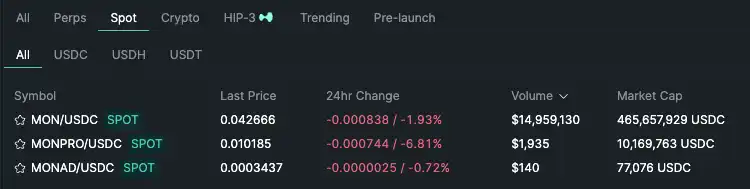
Although on-chain, Pixelmon's token code is still MON, Monad is actually UMON. But in the most direct frontend perceptible to users, Pixelmon's $500,000 "naming rights" were instantly stripped away.
User Security or Traffic First?
This action quickly ignited public opinion on Twitter. Trader Akku bluntly stated that this decision was "extremely disappointing."
"Pixelmon spent $500,000 to buy something on the frontend that can be arbitrarily overridden, while Monad (or Unit closely related to it) can obtain this visible name for free... Does this mean: you can buy the on-chain code, but we will decide what the frontend displays based on our relationships?"
Facing criticism, xulian, a core member of Hyperliquid, gave a very "Web2" explanation:
"The most important factor on the frontend is to protect the user. It is bad for everyone if the user buys the wrong token. As far as I know, all major exchanges changed MON to display as MONPRO a few weeks ago. The auction was the on-chain gas fee, and the Mon Protocol team still owns the MON ticker. Any other frontend can name it whatever they want."
This statement translates to: To prevent user confusion, we sacrificed the original Ticker owner's display rights.
Another party involved in this event, the Unit team closely related to Hyperliquid (responsible for the on-chain bridging of the Monad token on HL), was also embroiled in the controversy due to acquiring this name. Unit member Shadow (0xmev) was forced to come out and clarify:
"Protocol and App are two different things. Hyperliquid Labs has decision-making power over the App. This matter is clear: one project (Mon Protocol) designed to attract buying interest from the Hyperliquid community failed, resulting in the token price going to zero; while another project (Monad) with high visibility and trading volume entered. Labs felt that giving the name to the latter was a better display choice."
Community Outrage
While the official explanation may hold up logically (the frontend does indeed belong to Hyperliquid Labs), the community does not consider it acceptable on emotional or business ethics grounds.
Akku argued that the initial spot auction's marketing made everyone assume "spot listing = frontend display," and now playing a word game to claim it is "on-chain only" is nothing short of a marketing scam. He believes that if Monad does not want conflict, they should rename themselves instead of depriving the early comers of their rights.
Ramen's view represents the sentiment of the majority of onlookers:
"Displaying $MON for Monad to avoid confusion may be right, but forcibly renaming after someone has paid $500,000 is wrong. A refund seems to be the best course of action."
Of course, there are also voices supporting HL. Users aaalex.hl and altoshi insist that "the protocol is not the same as the frontend," "Hyperliquid is a business, not a charity," and believe that as long as the on-chain contract has not changed, it does not violate the decentralization principle.
“Arrogance” is a Byproduct of Success
Hyperliquid has done nothing wrong. They do have absolute control over the hyperliquid.xyz domain and have the right to adjust the display logic for the sake of user experience. Given Monad's scale and attention far exceeding Pixelmon, giving Monad the code MON not only aligns with the platform's interests but also protects unaware users from purchasing a low-liquidity token of the same name.
This seemingly reasonable "unilateral" action actually makes some ecosystem builders uneasy.
Absolute Interpretation Authority
In another story revealed by Unit team member Shadow in a reply, perhaps more thought-provoking than the renaming event itself:
"We built the entire brand (tradexyz) from scratch, precisely because we had no influence over Labs' frontend decisions. They ultimately decided to roll out HIP-3 on their official frontend immediately after we completed and announced the entire project—effectively destroying the competitive advantage we had spent a lot of time building. But we will not complain about it; we will continue to move forward."
If even a "core force" like Unit could be "blood-sucked" by the official front end at any time, how can those small-scale projects without background find a sense of security in such an ecosystem?
Rigid Handling
Hyperliquid's "arrogance" towards capital is a major factor in winning enthusiastic community support. They have rejected investment from top VCs, refused to pay listing fees to CEXs, and insisted on fair distribution.
However, as Akku pointed out, even if they were to refund the auction fee from that year or reach some kind of compensation agreement with the Pixelmon team in advance, it would make this matter much more decent. The current approach not only harms early supporters (even of a failed project), but also sends a signal to the outside world that "might makes right."
Hyperliquid is still one of the best Perp DEXs in the market, and its technical strength is beyond doubt. However, after reaching the top, how to avoid becoming the same kind of "arbitrary giant" they originally wanted to disrupt may be a question that the Hyperliquid team needs to consider.
Water can carry a boat, but it can also capsize it. The "arrogance" that the community likes is the resilience in the face of authority, not the capriciousness when facing rules.
You may also like

After being questioned by Vitalik, L2s are collectively saying goodbye to the "cheap" era

WEEX AI Trading Hackathon Paris Workshop Reveals: How Retail Crypto Traders Can Outperform Hedge Funds
Witness how WEEX's Paris AI Trading Hackathon revealed AI's edge over human traders. Explore key strategies, live competition results & how to build your own AI trading bot.

U.S. Oil (USOR) Price Prediction 2026–2030
Key Takeaways U.S. Oil (USOR) is a speculative Solana-based crypto project that aims to index the United States…

USOR Surges on Meme Narrative Despite No Real-World Asset Backing
Key Takeaways: USOR, a Solana-based token, has seen a notable surge driven by speculative narratives rather than verifiable…

How to Buy U.S. Oil Reserve (USOR) Cryptocurrency
Key Takeaways U.S. Oil Reserve (USOR) is a Solana-based token primarily traded on decentralized exchanges (DEXs). Claims have…

USOR vs Oil ETFs: Understanding Why the ‘Oil Reserve’ Token Doesn’t Track Crude Prices
Key Takeaways The U.S. Oil Reserve (USOR) token has become noteworthy for its claims, yet it does not…

Trend Research Reduces Ether Holdings After Major Market Turbulence
Key Takeaways: Trend Research has significantly cut down its Ether holdings, moving over 404,000 ETH to exchanges recently.…
Investors Channel $258M into Crypto Startups Despite $2 Trillion Market Sell-Off
Key Takeaways: Investors pumped approximately $258 million into crypto startups in early February, highlighting continued support for blockchain-related…
NBA Star Giannis Antetokounmpo Becomes Shareholder in Prediction Market Kalshi
Key Takeaways: Giannis Antetokounmpo, the NBA’s two-time MVP, invests in the prediction market platform Kalshi as a shareholder.…

Arizona Home Invasion Targets $66 Million in Cryptocurrency: Two Teens Charged
Key Takeaways Two teenagers from California face serious felony charges for allegedly attempting to steal $66 million in…

El Salvador’s Bukele Approval Reaches Record 91.9% Despite Limited Bitcoin Use
Key Takeaways: El Salvador President Nayib Bukele enjoys a record high approval rating of 91.9% from his populace,…

Crypto Price Prediction for February 6: XRP, Dogecoin, and Shiba Inu’s Market Movements
Key Takeaways: The crypto market experienced a notable shift with Bitcoin’s significant surge, impacting altcoins like XRP, Dogecoin,…

China Restricts Unapproved Yuan-Pegged Stablecoins to Maintain Currency Stability
Key Takeaways: China’s central bank and seven government agencies have banned the issuance of yuan-pegged stablecoins abroad without…

Solana Price Prediction: $80 SOL Looks Scary – But Smart Money Just Signaled This Might Be the Bottom
Key Takeaways Despite Solana’s descent to $80, some traders find security as smart money enters the fray, suggesting…

XRP Price Prediction: Major Ledger Upgrade Quietly Activated – Why This Could Be the Most Bullish Signal Yet
Key Takeaways: The activation of the Permissioned Domains amendment on XRPL represents a significant development in XRP’s potential…

Dogecoin Price Prediction: Death Cross Confirmed as DOGE Falls Below $0.10 – Is DOGE Reaching Zero?
Key Takeaways The death cross event signals potential bearish trends for Dogecoin as its price dips under $0.10,…

Stablecoin Inflows Have Doubled to $98B Amid Selling Pressure
Key Takeaways Stablecoin inflows to crypto exchanges have surged to $98 billion, doubling previous levels amidst heightened market…

Coinbase UK Executive Declares Tokenised Collateral a Mainstream Financial Force
Key Takeaways Tokenised collateral is transitioning from its initial experimental stages into becoming core infrastructure within financial markets.…
After being questioned by Vitalik, L2s are collectively saying goodbye to the "cheap" era
WEEX AI Trading Hackathon Paris Workshop Reveals: How Retail Crypto Traders Can Outperform Hedge Funds
Witness how WEEX's Paris AI Trading Hackathon revealed AI's edge over human traders. Explore key strategies, live competition results & how to build your own AI trading bot.
U.S. Oil (USOR) Price Prediction 2026–2030
Key Takeaways U.S. Oil (USOR) is a speculative Solana-based crypto project that aims to index the United States…
USOR Surges on Meme Narrative Despite No Real-World Asset Backing
Key Takeaways: USOR, a Solana-based token, has seen a notable surge driven by speculative narratives rather than verifiable…
How to Buy U.S. Oil Reserve (USOR) Cryptocurrency
Key Takeaways U.S. Oil Reserve (USOR) is a Solana-based token primarily traded on decentralized exchanges (DEXs). Claims have…
USOR vs Oil ETFs: Understanding Why the ‘Oil Reserve’ Token Doesn’t Track Crude Prices
Key Takeaways The U.S. Oil Reserve (USOR) token has become noteworthy for its claims, yet it does not…


 App
App