
- Buy Crypto
- Markets
 Futures
- Spot
- Copy Trade
 Earn
Earn- More
2025 Whale Saga: Mansion Kidnapping, Supply Chain Poisoning, and Billions Liquidated

Original Title: "Top 10 Hard Lessons of the 2025 Crypto Market: From Contract Liquidation to Trusting 'Customer Service,' Whales Paid Hundreds of Millions in 'Tuition'"
Original Author: angelilu, Foresight News
The 2025 crypto market was like a high-speed express train. Looking back from the platform, people could only see the survivors inside the train raising their glasses in celebration, but few paid attention to those passengers who were thrown off track.
This year, we not only witnessed gamblers going crazy in the futures market but also saw the Web3 Dark Forest Rule cruelly seep into the physical world. The stories of getting rich quick were similar, but the ways of getting liquidated were diverse. We reconstructed the losing records of several typical figures in 2025 — among them were billionaires, tech geeks, legendary gamblers, and even ordinary people who just wanted to save money.
Trading Section
Machi Big Brother Becomes the On-Chain 'Liquidation Champion'
· Identity: Renowned singer, entrepreneur, NFT whale
· Loss: Liquidated 71 times in just 19 days 11 months ago; Daily loss of $21.28 million
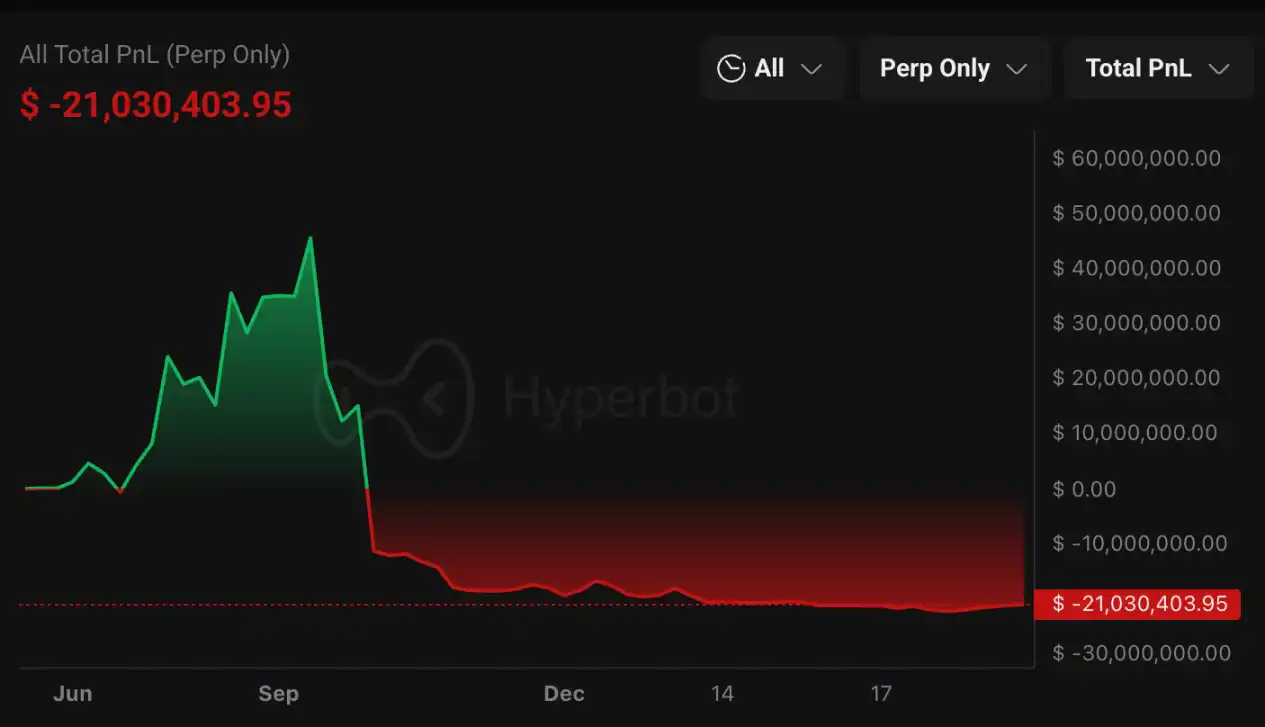
Huang Licheng's PnL Curve Chart, Source: Hyperbot
If we turn the clock back three months, Machi Big Brother was still the winner in the Hyperliquid ecosystem, with a paper gain of over $44 million at one point, heavily invested in HYPE, XPL, and ETH. By the end of September and the beginning of October, the XPL price collapsed (with a maximum drawdown of 46%), and HYPE also saw a significant pullback. He did not take profits in time, leading to a rapid expansion of the unrealized losses of a single coin to over $8.7 million.
With the "10.11" market crash, Machi Big Brother officially turned into a loss. However, this turning point into a loss was not the end for Machi Big Brother but the starting point of his infinite martingale strategy. He tried to recoup his losses by longing ETH with high leverage. He held long positions of around 7,000 to 30,000 ETH (leverage ratios often between 20x and 25x), but every time ETH took a nosedive, it would trigger his liquidation.
In just 19 days from November 1 to 19, Machi Big Brother was forcibly liquidated 71 times. This means that in nearly three weeks, he experienced nearly 4 liquidations per day on average, claiming the title of the on-chain "Liquidation Champion," but he kept topping up, getting liquidated, topping up again, and getting liquidated again. As of the time of writing, his total perpetual contract loss on Hyperliquid has reached $21.20 million. From earning $45.66 million to losing $21.20 million, in less than 3 months, he experienced a withdrawal of assets exceeding $66 million. Despite a brief recovery, he is still deeply in loss and in a state of frequent fund injections and liquidations.
Unlike ordinary people, Brother Ma, Licheng Huang, has even shouldered the aura of a superstar. In the 1990s, he was the soul of Taiwan's L.A. Boyz, a pioneering idol who brought pure American hip-hop into the Chinese music scene. This was not Brother Ma's first time playing the role of a "retail savior." Everyone surely remembers the NFT battlefield of 2023. In order to compete for BLUR's airdrop points, he once frenziedly traded in this abyss. The outcome was tragic: he did receive airdropped tokens worth 1.9 million USD, but at the cost of losing 12,000 ETH (worth 25 million USD at the time).
James Wynn's Billion-Dollar Gamble
· Name: James Wynn
· Loss: Opened a 1.25 billion USD Bitcoin long position, lost 100 million USD in a week
If Brother Ma is considered "the pastime of the wealthy," then James Wynn's story is like that of a mortal who flew too high and ultimately had his wings melted by the sun.
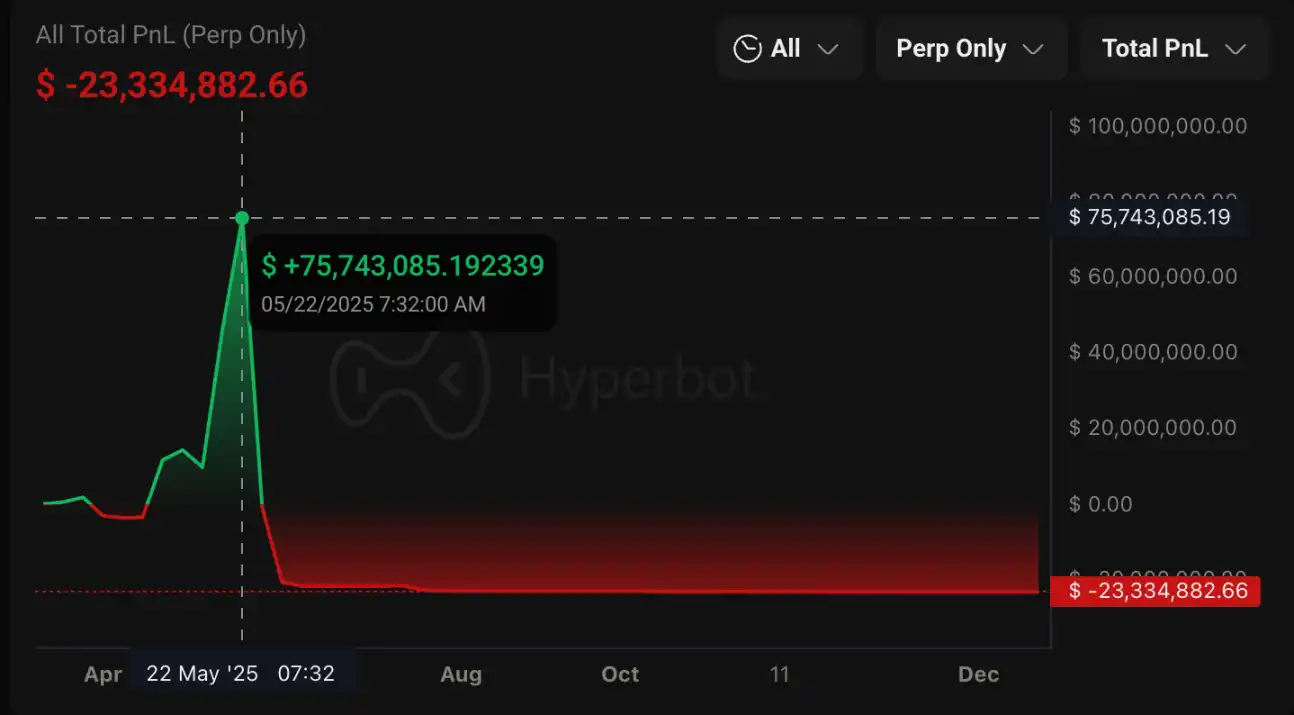
Also involved in a smart contract transaction, James Wynn's legend began with PEPE but erupted in the Hyperliquid contract battlefield. In March 2025, James Wynn, armed with the massive 25 million USD he earned from PEPE, plunged into Hyperliquid to start contract trading. This 25 million USD windfall was earned by heavily betting on the meme coin PEPE with a capital of just 7,600 USD in 2023. Unsatisfied with spot trading gains, he aggressively leveraged long positions on PEPE and ETH from March to April, once again profiting 25 million USD, becoming a super whale holding 50 million USD.
In May 2025, James Wynn turned his attention to Bitcoin, when BTC was challenging the historical high of 110,000 USD. At that time, James Wynn did something monumental on-chain: near Bitcoin's historical high of around 108,000 USD, he went all-in with 40x leverage, crazily opening a massive long position worth a nominal 12.5 billion USD. What does this number represent? His on-chain position alone exceeded the treasury reserves of many small countries. He attempted to use this 12.5 billion USD leverage to pry open the door to becoming the world's richest man.
However, a sharp Bitcoin retracement that broke through the 105,000 USD mark became James Wynn's nightmare. In just one week, his invaluable contract melted away like an iceberg in the sun. Ultimately, he had to liquidate his position, losing nearly 100 million USD. Overnight, almost all of the astronomical figures he earned through PEPE were returned to the market. In the aftermath, he left a nihilistic quote on Twitter: "Money isn't real."
Unyielding, James Wynn attempted to "turn the tables" in November, but misjudged his direction — he bet that Bitcoin would drop below $92,000 and went all in on a short position. Data recorded his final madness: in just 2 months, he was liquidated 45 times; on his worst day, he was liquidated 12 times within 12 hours. The once "Meme Coin Oracle" has now become a gambler shouting at the candlesticks. He vowed on social media, "I will sell all stablecoins to go short. Either make billions or go completely bankrupt."
Spot Whale Loses $125 Million, "Cuts Losses" and Exits
· Identity: Whale shorting 66,000 ETH
· Loss: Single position floating loss of $125 million; transferred $140 million to Binance to dump within 8 hours
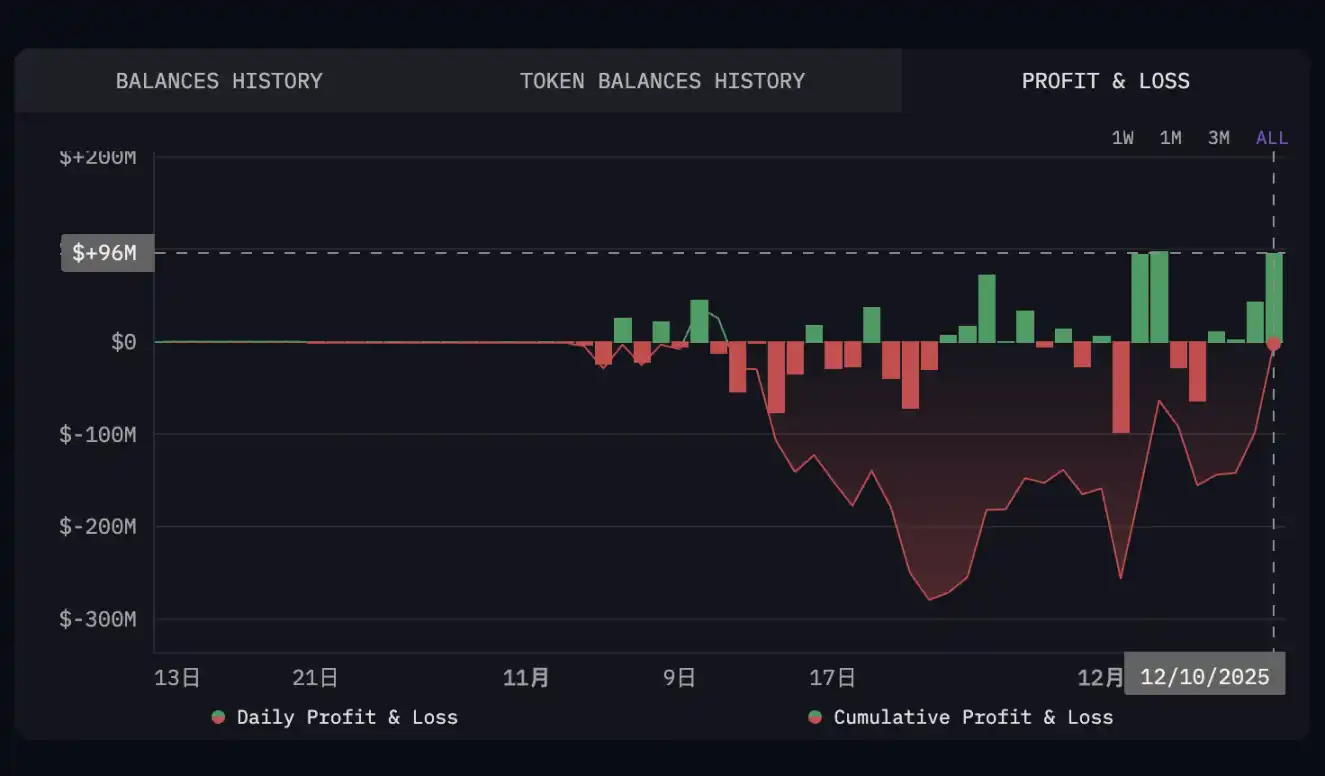
In addition to futures contracts, whales holding spot positions also suffered massive losses. The "whale shorting 66,000 ETH" was once a hunter in the market, skilled at conducting large-scale short arbitrage using lending protocols. But this time, the hunter became the hunted.
Earning $24 million through shorting did not satisfy him; he wanted more — he wanted to "short the market twice." On November 5, after closing his short positions, he immediately reversed course and began to bottom fish recklessly. Within just 9 days until November 14, like a man possessed, he transferred a total of $1.187 billion to Binance, withdrew 422,000 ETH, and raised his average holding price to $3,413. For this high-stakes gamble, he even used on-chain leverage loans amounting to as high as $485 million.
The market dealt the greediest one the harshest blow. As the ETH price plummeted, breaking below the $3,000 mark, his "bottom fishing" turned into a "deep trap." On-chain data recorded his most desperate moment: during November's darkest period, his massive long position saw a floating loss of up to $133 million. The $24.48 million profit previously hard-earned through shorting was instantly swallowed by this massive loss, with even the principal entirely wiped out to the tune of a full billion. The former "Shorting War God," along with borrowed money, turned into a "leveraged gambler" burdened with $480 million in debt.
On November 16, the whale began a large-scale retreat, redeeming 177,000 ETH from Aave and starting to gradually deposit 44,000 ETH to Binance (worth $140 million), realizing a $125 million loss.
The Whale Who Fell in the "Chinese Meme" Trap
· Identity: High-profile holder of Chinese Meme tokens
· Loss: Total loss of 3.598 million dollars (Single-asset loss of 2.49 million)
Aside from holding onto ETH for dear life, many have also experienced significant losses due to holding onto Meme coins.
In October 2025, as the market hype rotated between AI and mainstream coins, this whale found himself trapped in the narrative maze of "Chinese Meme."
Like a determined stamp collector, he invested 4.49 million dollars and went on a frenzy to accumulate a series of Chinese Meme tokens on the BSC chain: "Binance Life," "Customer Service Xiao He," "Hakimi." He heavily bought into "Binance Life" at an average price of $0.3485 and continued to buy the dip until his holdings reached 4.08 million dollars, becoming the 7th largest individual holder of the token. The market gave him numerous opportunities to exit, but he chose to be a "diamond hand."
After holding for an initial 8 days, his meme assets shrank by 56.5%, with a floating loss of over 3 million dollars. All tokens except "Hakimi" collapsed, but he did not liquidate and continued to chase the price up. Finally, in early November, his faith collapsed in the face of the gravity of the zeroing candlesticks, and he liquidated all tokens in 50 minutes. The outcome was brutal: a total loss of 3.598 million dollars. Of this, the token "Binance Life" alone caused him a loss of 2.49 million dollars.
This whale paid 3.6 million dollars for a lesson: in the world of Meme coins, what is scarier than the contract is liquidity depletion; once the trend sours, every second is a window to escape, and HODLing only leads to zero.
The "Unnamed Hacker's" "Karmic Retribution"
· Identity: On-chain hacker / Top-tier "counter indicator"
· Loss: A loss of only 8.88 million dollars in October trades
This may be the most "spiritually fulfilling" loss story of 2025. We usually think of hackers as cold, rational predators, but this "unnamed hacker" proved through actions: he only understands code, not candlesticks.
In March and August of this year, he stole a huge amount of funds through technical means, and he should have disappeared quietly to enjoy his wealth. However, he made a fatal mistake—trying to use the stolen money to trade coins. As it turns out, the whales of the crypto market are more ruthless than hackers.
Practicing "buy high, sell low" skillfully on ETH, at the beginning of October, he aggressively bought 8637 ETH at an average price of $4400 (approximately $38.01 million). Holding for only 10 days, he encountered the "10·11" flash crash. Instead of holding, he panicked and market sold at a floor price of $3778, resulting in a loss of $5.37 million.
In mid-October, during another dip, he panic-sold again, resulting in a $3.24 million loss. The most ludicrous scene occurred just an hour after his sell-off—watching the price bounce back, he couldn't resist buying back over 2000 ETH at a higher price. The price dropped again, forcing him to sell once more. As of October 18, in just half a month, due to frequent buying high and selling low, he accumulated a total loss of $8.88 million.
This trader's firsthand experience tells us: stealing money requires technical skills, but safeguarding wealth requires the right mindset. In the face of volatile price action, even a trader is merely a tender green onion.
Attack Section
User Babur, failed "multisig," and costly "double-spend"
· Identity: On-chain whale
· Loss: Approximately $27 million (some funds have been washed through Tornado Cash)
If some losses are due to overly complex technology, then Babur's $27 million loss was due to "extremely poor habits."
By the end of December 2025, SlowMist Founder Cao and CertiK successively disclosed this incident. Whale Babur's Solana and Ethereum addresses were drained, resulting in a massive $27 million loss. What is heartbreaking is that Babur actually had a certain level of security awareness—he used an industry-leading safe multisig wallet to store his assets.
In theory, a multisig wallet requires multiple private key signatures for transfers, ensuring high security. However, an investigation revealed a fatal rookie mistake: Babur had stored the two required signing private keys on the same computer. It's as if you bought the most secure safe in the world (multisig), requiring two keys to open, but then hung both keys on the safe's door handle.
When he double-clicked on a malicious file on the computer ("supply chain attack"), the virus effortlessly took all the private keys. Cao commented on this, saying, "A real supply chain attack is probably very simple, with no advanced skills, and many threats are also very common."
Subsequently, CertiK detected that the hacker had transferred 4250 ETH (approximately $14 million) to Tornado Cash for mixing. Babur paid a high price of $27 million for a very basic lesson: even the most advanced multisig is just a layer of glass if the private key is not physically isolated.
Suji Yan, the "Vanishing 11 Minutes" at His Birthday Party
· Identity: Mask Network Founder
· Loss: $4 million (the nightmare on his 29th birthday)
On February 27, 2025, what should have been a joyful celebration of Mask Network founder Suji Yan's 29th birthday turned into a nightmarish scenario reminiscent of a locked-room mystery. It was not a sophisticated cyberattack from the dark web but a chilling crisis involving someone close. According to Suji's account, he was celebrating his birthday at a private gathering with a dozen friends. Just because he took a trip to the restroom and his phone was out of sight for a few minutes, the gears of fate started turning.
On-chain data revealed that, in the following 11 minutes, the hacker craftily and deliberately siphoned off over $4 million from his public wallet through manual transactions. Slowmist Labs co-founder Wu Xing confirmed that these funds were rapidly converted to ETH and dispersed to 7 addresses.
"The operation was manual and lasted for over 11 minutes." This meant that behind the laughter and cheers, someone (or perhaps lurking malicious software) exploited this brief window to carry out the heist right under his nose. Suji admitted, "I trusted my friends, but this is a nightmare for anyone." This incident became the chilling lesson of Web3 in 2025: never store a significant amount of assets in a hot wallet's private key kept in a phone carried around for socializing and photography.
Sam Altman's Ex-Boyfriend's Night of Terror
· Identity: Prominent Tech Investor, Ex-Boyfriend of Sam Altman
· Loss: $11 million + Physical Harm
If on-chain theft is considered a financial loss, Lachy Groom's experience shattered the illusion that decentralized assets are safer. On a Saturday in November, an armed robber disguised as a delivery person deceived his way into Lachy's mansion in San Francisco. Lachy not only faced an armed kidnapping but was also bound with duct tape and physically assaulted. In a harrowing 90-minute ordeal, the robber coerced him to reveal his password and emptied his account of $11 million worth of crypto assets. This incident symbolizes a worrying trend in Web3 crime: hackers no longer need to breach your code; they just need to breach your front door.
Recommended Reading: "Even ChatGPT's Creator's Ex-Boyfriend Was Robbed of Millions of Dollars, How Crazy Is Foreign Robbery"
Furthermore, according to Bloomberg, over the past three years, there has been a significant increase in "Sim Swapping" attacks targeting cryptocurrency holders. According to a database maintained by Jameson Lopp, co-founder of cryptocurrency security company Casa, around 60 such attacks have been recorded globally this year, resulting in tens of millions of dollars in losses.
TikTok Buyer, the Cold Wallet "Poisoned" by the Supply Chain
· Identity: Ordinary Investor
· Loss: 50 million RMB (approximately $7.08 million)
This is a typical case of "cognitive harvesting." An investor, in pursuit of so-called absolute security, decided to use a hardware cold wallet to store assets. However, he made a fatal mistake: he purchased a "discounted" cold wallet on TikTok.
Unbeknownst to him, this wallet had already been tampered with before leaving the factory, and the private key had long been leaked. When he confidently deposited 50 million RMB, he actually sent the money directly to the hacker. A few hours later, the assets were laundered through Huione, leaving no trace. This costly lesson tells us that the biggest security vulnerability is often human greed for bargains.
Believing "Official Customer Service," a Whale Loses $91.4 Million
· Identity: A "compliant" whale with $300 million in Bitcoin
· Loss: 783 Bitcoins (valued at approximately $91.4 million at the time)
On August 19, 2025, a whale fell victim to a "social engineering attack." He did not click on any links recklessly or download any viruses; he simply answered a phone call. On the other end was a gentle, professional voice claiming to be a "hardware wallet official senior engineer," informing him of a critical vulnerability in his device that required immediate "firmware upgrade." Over a phone call lasting an hour, under the "guidance," this whale completely let his guard down and willingly handed over 783 Bitcoins worth around $91.4 million. After the malicious transfer, the funds began undergoing the typical money laundering process, being repeatedly deposited into Wasabi Wallet (a privacy tool commonly used for obfuscation and tracing).
A similar case occurred in 2024, with an even larger amount involved, where the victim lost around $300 million worth of Bitcoin.
Survivorship Bias
These 10 names, with their billion-dollar tuition, show us the true face of the Web3 dark forest: There are no absolute winners here, hackers steal code only to lose to whales in the secondary market; there is no absolute security as Babur's technical defenses succumb to the physical world's "poisoning"; there are also no impregnable fortresses, as Lachy's mansion cannot withstand the robber's gun, and whales trusting "official support" cannot resist the deep-seated human tendency to blind obedience.
Every person on this list was once at the top of their respective field or was simply lucky. If there is one survival rule that must be remembered in 2025, it may not be "how to get rich quick," but rather "how to survive."
In the crypto market, staying alive is far more important than how much you earn. After all, only those who survive will be able to tell the story of next year.
You may also like

Token Cannot Compound, Where Is the Real Investment Opportunity?

February 6th Market Key Intelligence, How Much Did You Miss?

China's Central Bank and Eight Other Departments' Latest Regulatory Focus: Key Attention to RWA Tokenized Asset Risk
Foreword: Today, the People's Bank of China's website published the "Notice of the People's Bank of China, National Development and Reform Commission, Ministry of Industry and Information Technology, Ministry of Public Security, State Administration for Market Regulation, China Banking and Insurance Regulatory Commission, China Securities Regulatory Commission, State Administration of Foreign Exchange on Further Preventing and Dealing with Risks Related to Virtual Currency and Others (Yinfa [2026] No. 42)", the latest regulatory requirements from the eight departments including the central bank, which are basically consistent with the regulatory requirements of recent years. The main focus of the regulation is on speculative activities such as virtual currency trading, exchanges, ICOs, overseas platform services, and this time, regulatory oversight of RWA has been added, explicitly prohibiting RWA tokenization, stablecoins (especially those pegged to the RMB). The following is the full text:
To the people's governments of all provinces, autonomous regions, and municipalities directly under the Central Government, the Xinjiang Production and Construction Corps:
Recently, there have been speculative activities related to virtual currency and Real-World Assets (RWA) tokenization, disrupting the economic and financial order and jeopardizing the property security of the people. In order to further prevent and address the risks related to virtual currency and Real-World Assets tokenization, effectively safeguard national security and social stability, in accordance with the "Law of the People's Republic of China on the People's Bank of China," "Law of the People's Republic of China on Commercial Banks," "Securities Law of the People's Republic of China," "Law of the People's Republic of China on Securities Investment Funds," "Law of the People's Republic of China on Futures and Derivatives," "Cybersecurity Law of the People's Republic of China," "Regulations of the People's Republic of China on the Administration of Renminbi," "Regulations on Prevention and Disposal of Illegal Fundraising," "Regulations of the People's Republic of China on Foreign Exchange Administration," "Telecommunications Regulations of the People's Republic of China," and other provisions, after reaching consensus with the Cyberspace Administration of China, the Supreme People's Court, and the Supreme People's Procuratorate, and with the approval of the State Council, the relevant matters are notified as follows:
(I) Virtual currency does not possess the legal status equivalent to fiat currency. Virtual currencies such as Bitcoin, Ether, Tether, etc., have the main characteristics of being issued by non-monetary authorities, using encryption technology and distributed ledger or similar technology, existing in digital form, etc. They do not have legal tender status, should not and cannot be circulated and used as currency in the market.
The business activities related to virtual currency are classified as illegal financial activities. The exchange of fiat currency and virtual currency within the territory, exchange of virtual currencies, acting as a central counterparty in buying and selling virtual currencies, providing information intermediary and pricing services for virtual currency transactions, token issuance financing, and trading of virtual currency-related financial products, etc., fall under illegal financial activities, such as suspected illegal issuance of token vouchers, unauthorized public issuance of securities, illegal operation of securities and futures business, illegal fundraising, etc., are strictly prohibited across the board and resolutely banned in accordance with the law. Overseas entities and individuals are not allowed to provide virtual currency-related services to domestic entities in any form.
A stablecoin pegged to a fiat currency indirectly fulfills some functions of the fiat currency in circulation. Without the consent of relevant authorities in accordance with the law and regulations, any domestic or foreign entity or individual is not allowed to issue a RMB-pegged stablecoin overseas.
(II)Tokenization of Real-World Assets refers to the use of encryption technology and distributed ledger or similar technologies to transform ownership rights, income rights, etc., of assets into tokens (tokens) or other interests or bond certificates with token (token) characteristics, and carry out issuance and trading activities.
Engaging in the tokenization of real-world assets domestically, as well as providing related intermediary, information technology services, etc., which are suspected of illegal issuance of token vouchers, unauthorized public offering of securities, illegal operation of securities and futures business, illegal fundraising, and other illegal financial activities, shall be prohibited; except for relevant business activities carried out with the approval of the competent authorities in accordance with the law and regulations and relying on specific financial infrastructures. Overseas entities and individuals are not allowed to illegally provide services related to the tokenization of real-world assets to domestic entities in any form.
(III) Inter-agency Coordination. The People's Bank of China, together with the National Development and Reform Commission, the Ministry of Industry and Information Technology, the Ministry of Public Security, the State Administration for Market Regulation, the China Banking and Insurance Regulatory Commission, the China Securities Regulatory Commission, the State Administration of Foreign Exchange, and other departments, will improve the work mechanism, strengthen coordination with the Cyberspace Administration of China, the Supreme People's Court, and the Supreme People's Procuratorate, coordinate efforts, and overall guide regions to carry out risk prevention and disposal of virtual currency-related illegal financial activities.
The China Securities Regulatory Commission, together with the National Development and Reform Commission, the Ministry of Industry and Information Technology, the Ministry of Public Security, the People's Bank of China, the State Administration for Market Regulation, the China Banking and Insurance Regulatory Commission, the State Administration of Foreign Exchange, and other departments, will improve the work mechanism, strengthen coordination with the Cyberspace Administration of China, the Supreme People's Court, and the Supreme People's Procuratorate, coordinate efforts, and overall guide regions to carry out risk prevention and disposal of illegal financial activities related to the tokenization of real-world assets.
(IV) Strengthening Local Implementation. The people's governments at the provincial level are overall responsible for the prevention and disposal of risks related to virtual currencies and the tokenization of real-world assets in their respective administrative regions. The specific leading department is the local financial regulatory department, with participation from branches and dispatched institutions of the State Council's financial regulatory department, telecommunications regulators, public security, market supervision, and other departments, in coordination with cyberspace departments, courts, and procuratorates, to improve the normalization of the work mechanism, effectively connect with the relevant work mechanisms of central departments, form a cooperative and coordinated working pattern between central and local governments, effectively prevent and properly handle risks related to virtual currencies and the tokenization of real-world assets, and maintain economic and financial order and social stability.
(5) Enhanced Risk Monitoring. The People's Bank of China, China Securities Regulatory Commission, National Development and Reform Commission, Ministry of Industry and Information Technology, Ministry of Public Security, State Administration of Foreign Exchange, Cyberspace Administration of China, and other departments continue to improve monitoring techniques and system support, enhance cross-departmental data analysis and sharing, establish sound information sharing and cross-validation mechanisms, promptly grasp the risk situation of activities related to virtual currency and real-world asset tokenization. Local governments at all levels give full play to the role of local monitoring and early warning mechanisms. Local financial regulatory authorities, together with branches and agencies of the State Council's financial regulatory authorities, as well as departments of cyberspace and public security, ensure effective connection between online monitoring, offline investigation, and fund tracking, efficiently and accurately identify activities related to virtual currency and real-world asset tokenization, promptly share risk information, improve early warning information dissemination, verification, and rapid response mechanisms.
(6) Strengthened Oversight of Financial Institutions, Intermediaries, and Technology Service Providers. Financial institutions (including non-bank payment institutions) are prohibited from providing account opening, fund transfer, and clearing services for virtual currency-related business activities, issuing and selling financial products related to virtual currency, including virtual currency and related financial products in the scope of collateral, conducting insurance business related to virtual currency, or including virtual currency in the scope of insurance liability. Financial institutions (including non-bank payment institutions) are prohibited from providing custody, clearing, and settlement services for unauthorized real-world asset tokenization-related business and related financial products. Relevant intermediary institutions and information technology service providers are prohibited from providing intermediary, technical, or other services for unauthorized real-world asset tokenization-related businesses and related financial products.
(7) Enhanced Management of Internet Information Content and Access. Internet enterprises are prohibited from providing online business venues, commercial displays, marketing, advertising, or paid traffic diversion services for virtual currency and real-world asset tokenization-related business activities. Upon discovering clues of illegal activities, they should promptly report to relevant departments and provide technical support and assistance for related investigations and inquiries. Based on the clues transferred by the financial regulatory authorities, the cyberspace administration, telecommunications authorities, and public security departments should promptly close and deal with websites, mobile applications (including mini-programs), and public accounts engaged in virtual currency and real-world asset tokenization-related business activities in accordance with the law.
(8) Strengthened Entity Registration and Advertisement Management. Market supervision departments strengthen entity registration and management, and enterprise and individual business registrations must not contain terms such as "virtual currency," "virtual asset," "cryptocurrency," "crypto asset," "stablecoin," "real-world asset tokenization," or "RWA" in their names or business scopes. Market supervision departments, together with financial regulatory authorities, legally enhance the supervision of advertisements related to virtual currency and real-world asset tokenization, promptly investigating and handling relevant illegal advertisements.
(IX) Continued Rectification of Virtual Currency Mining Activities. The National Development and Reform Commission, together with relevant departments, strictly controls virtual currency mining activities, continuously promotes the rectification of virtual currency mining activities. The people's governments of various provinces take overall responsibility for the rectification of "mining" within their respective administrative regions. In accordance with the requirements of the National Development and Reform Commission and other departments in the "Notice on the Rectification of Virtual Currency Mining Activities" (NDRC Energy-saving Building [2021] No. 1283) and the provisions of the "Guidance Catalog for Industrial Structure Adjustment (2024 Edition)," a comprehensive review, investigation, and closure of existing virtual currency mining projects are conducted, new mining projects are strictly prohibited, and mining machine production enterprises are strictly prohibited from providing mining machine sales and other services within the country.
(X) Severe Crackdown on Related Illegal Financial Activities. Upon discovering clues to illegal financial activities related to virtual currency and the tokenization of real-world assets, local financial regulatory authorities, branches of the State Council's financial regulatory authorities, and other relevant departments promptly investigate, determine, and properly handle the issues in accordance with the law, and seriously hold the relevant entities and individuals legally responsible. Those suspected of crimes are transferred to the judicial authorities for processing according to the law.
(XI) Severe Crackdown on Related Illegal and Criminal Activities. The Ministry of Public Security, the People's Bank of China, the State Administration for Market Regulation, the China Banking and Insurance Regulatory Commission, the China Securities Regulatory Commission, as well as judicial and procuratorial organs, in accordance with their respective responsibilities, rigorously crack down on illegal and criminal activities related to virtual currency, the tokenization of real-world assets, such as fraud, money laundering, illegal business operations, pyramid schemes, illegal fundraising, and other illegal and criminal activities carried out under the guise of virtual currency, the tokenization of real-world assets, etc.
(XII) Strengthen Industry Self-discipline. Relevant industry associations should enhance membership management and policy advocacy, based on their own responsibilities, advocate and urge member units to resist illegal financial activities related to virtual currency and the tokenization of real-world assets. Member units that violate regulatory policies and industry self-discipline rules are to be disciplined in accordance with relevant self-regulatory management regulations. By leveraging various industry infrastructure, conduct risk monitoring related to virtual currency, the tokenization of real-world assets, and promptly transfer issue clues to relevant departments.
(XIII) Without the approval of relevant departments in accordance with the law and regulations, domestic entities and foreign entities controlled by them may not issue virtual currency overseas.
(XIV) Domestic entities engaging directly or indirectly in overseas external debt-based tokenization of real-world assets, or conducting asset securitization activities abroad based on domestic ownership rights, income rights, etc. (hereinafter referred to as domestic equity), should be strictly regulated in accordance with the principles of "same business, same risk, same rules." The National Development and Reform Commission, the China Securities Regulatory Commission, the State Administration of Foreign Exchange, and other relevant departments regulate it according to their respective responsibilities. For other forms of overseas real-world asset tokenization activities based on domestic equity by domestic entities, the China Securities Regulatory Commission, together with relevant departments, supervise according to their division of responsibilities. Without the consent and filing of relevant departments, no unit or individual may engage in the above-mentioned business.
(15) Overseas subsidiaries and branches of domestic financial institutions providing Real World Asset Tokenization-related services overseas shall do so legally and prudently. They shall have professional personnel and systems in place to effectively mitigate business risks, strictly implement customer onboarding, suitability management, anti-money laundering requirements, and incorporate them into the domestic financial institutions' compliance and risk management system. Intermediaries and information technology service providers offering Real World Asset Tokenization services abroad based on domestic equity or conducting Real World Asset Tokenization business in the form of overseas debt for domestic entities directly or indirectly venturing abroad must strictly comply with relevant laws and regulations. They should establish and improve relevant compliance and internal control systems in accordance with relevant normative requirements, strengthen business and risk control, and report the business developments to the relevant regulatory authorities for approval or filing.
(16) Strengthen organizational leadership and overall coordination. All departments and regions should attach great importance to the prevention of risks related to virtual currencies and Real World Asset Tokenization, strengthen organizational leadership, clarify work responsibilities, form a long-term effective working mechanism with centralized coordination, local implementation, and shared responsibilities, maintain high pressure, dynamically monitor risks, effectively prevent and mitigate risks in an orderly and efficient manner, legally protect the property security of the people, and make every effort to maintain economic and financial order and social stability.
(17) Widely carry out publicity and education. All departments, regions, and industry associations should make full use of various media and other communication channels to disseminate information through legal and policy interpretation, analysis of typical cases, and education on investment risks, etc. They should promote the illegality and harm of virtual currencies and Real World Asset Tokenization-related businesses and their manifestations, fully alert to potential risks and hidden dangers, and enhance public awareness and identification capabilities for risk prevention.
(18) Engaging in illegal financial activities related to virtual currencies and Real World Asset Tokenization in violation of this notice, as well as providing services for virtual currencies and Real World Asset Tokenization-related businesses, shall be punished in accordance with relevant regulations. If it constitutes a crime, criminal liability shall be pursued according to the law. For domestic entities and individuals who knowingly or should have known that overseas entities illegally provided virtual currency or Real World Asset Tokenization-related services to domestic entities and still assisted them, relevant responsibilities shall be pursued according to the law. If it constitutes a crime, criminal liability shall be pursued according to the law.
(19) If any unit or individual invests in virtual currencies, Real World Asset Tokens, and related financial products against public order and good customs, the relevant civil legal actions shall be invalid, and any resulting losses shall be borne by them. If there are suspicions of disrupting financial order and jeopardizing financial security, the relevant departments shall deal with them according to the law.
This notice shall enter into force upon the date of its issuance. The People's Bank of China and ten other departments' "Notice on Further Preventing and Dealing with the Risks of Virtual Currency Trading Speculation" (Yinfa [2021] No. 237) is hereby repealed.

Former Partner's Perspective on Multicoin: Kyle's Exit, But the Game He Left Behind Just Getting Started

Why Bitcoin Is Falling Now: The Real Reasons Behind BTC's Crash & WEEX's Smart Profit Playbook
Bitcoin's ongoing crash explained: Discover the 5 hidden triggers behind BTC's plunge & how WEEX's Auto Earn and Trade to Earn strategies help traders profit from crypto market volatility.

Wall Street's Hottest Trades See Exodus

Vitalik Discusses Ethereum Scaling Path, Circle Announces Partnership with Polymarket, What's the Overseas Crypto Community Talking About Today?

Believing in the Capital Markets - The Essence and Core Value of Cryptocurrency

Polymarket's 'Weatherman': Predict Temperature, Win Million-Dollar Payout

$15K+ Profits: The 4 AI Trading Secrets WEEX Hackathon Prelim Winners Used to Dominate Volatile Crypto Markets
How WEEX Hackathon's top AI trading strategies made $15K+ in crypto markets: 4 proven rules for ETH/BTC trading, market structure analysis, and risk management in volatile conditions.

A nearly 20% one-day plunge, how long has it been since you last saw a $60,000 Bitcoin?

Raoul Pal: I've seen every single panic, and they are never the end.

Key Market Information Discrepancy on February 6th - A Must-Read! | Alpha Morning Report

2026 Crypto Industry's First Snowfall
The Harsh Reality Behind the $26 Billion Crypto Liquidation: Liquidity Is Killing the Market
Why Is Gold, US Stocks, Bitcoin All Falling?

Key Market Intelligence for February 5th, how much did you miss out on?

Wintermute: By 2026, crypto had gradually become the settlement layer of the Internet economy
Token Cannot Compound, Where Is the Real Investment Opportunity?
February 6th Market Key Intelligence, How Much Did You Miss?
China's Central Bank and Eight Other Departments' Latest Regulatory Focus: Key Attention to RWA Tokenized Asset Risk
Foreword: Today, the People's Bank of China's website published the "Notice of the People's Bank of China, National Development and Reform Commission, Ministry of Industry and Information Technology, Ministry of Public Security, State Administration for Market Regulation, China Banking and Insurance Regulatory Commission, China Securities Regulatory Commission, State Administration of Foreign Exchange on Further Preventing and Dealing with Risks Related to Virtual Currency and Others (Yinfa [2026] No. 42)", the latest regulatory requirements from the eight departments including the central bank, which are basically consistent with the regulatory requirements of recent years. The main focus of the regulation is on speculative activities such as virtual currency trading, exchanges, ICOs, overseas platform services, and this time, regulatory oversight of RWA has been added, explicitly prohibiting RWA tokenization, stablecoins (especially those pegged to the RMB). The following is the full text:
To the people's governments of all provinces, autonomous regions, and municipalities directly under the Central Government, the Xinjiang Production and Construction Corps:
Recently, there have been speculative activities related to virtual currency and Real-World Assets (RWA) tokenization, disrupting the economic and financial order and jeopardizing the property security of the people. In order to further prevent and address the risks related to virtual currency and Real-World Assets tokenization, effectively safeguard national security and social stability, in accordance with the "Law of the People's Republic of China on the People's Bank of China," "Law of the People's Republic of China on Commercial Banks," "Securities Law of the People's Republic of China," "Law of the People's Republic of China on Securities Investment Funds," "Law of the People's Republic of China on Futures and Derivatives," "Cybersecurity Law of the People's Republic of China," "Regulations of the People's Republic of China on the Administration of Renminbi," "Regulations on Prevention and Disposal of Illegal Fundraising," "Regulations of the People's Republic of China on Foreign Exchange Administration," "Telecommunications Regulations of the People's Republic of China," and other provisions, after reaching consensus with the Cyberspace Administration of China, the Supreme People's Court, and the Supreme People's Procuratorate, and with the approval of the State Council, the relevant matters are notified as follows:
(I) Virtual currency does not possess the legal status equivalent to fiat currency. Virtual currencies such as Bitcoin, Ether, Tether, etc., have the main characteristics of being issued by non-monetary authorities, using encryption technology and distributed ledger or similar technology, existing in digital form, etc. They do not have legal tender status, should not and cannot be circulated and used as currency in the market.
The business activities related to virtual currency are classified as illegal financial activities. The exchange of fiat currency and virtual currency within the territory, exchange of virtual currencies, acting as a central counterparty in buying and selling virtual currencies, providing information intermediary and pricing services for virtual currency transactions, token issuance financing, and trading of virtual currency-related financial products, etc., fall under illegal financial activities, such as suspected illegal issuance of token vouchers, unauthorized public issuance of securities, illegal operation of securities and futures business, illegal fundraising, etc., are strictly prohibited across the board and resolutely banned in accordance with the law. Overseas entities and individuals are not allowed to provide virtual currency-related services to domestic entities in any form.
A stablecoin pegged to a fiat currency indirectly fulfills some functions of the fiat currency in circulation. Without the consent of relevant authorities in accordance with the law and regulations, any domestic or foreign entity or individual is not allowed to issue a RMB-pegged stablecoin overseas.
(II)Tokenization of Real-World Assets refers to the use of encryption technology and distributed ledger or similar technologies to transform ownership rights, income rights, etc., of assets into tokens (tokens) or other interests or bond certificates with token (token) characteristics, and carry out issuance and trading activities.
Engaging in the tokenization of real-world assets domestically, as well as providing related intermediary, information technology services, etc., which are suspected of illegal issuance of token vouchers, unauthorized public offering of securities, illegal operation of securities and futures business, illegal fundraising, and other illegal financial activities, shall be prohibited; except for relevant business activities carried out with the approval of the competent authorities in accordance with the law and regulations and relying on specific financial infrastructures. Overseas entities and individuals are not allowed to illegally provide services related to the tokenization of real-world assets to domestic entities in any form.
(III) Inter-agency Coordination. The People's Bank of China, together with the National Development and Reform Commission, the Ministry of Industry and Information Technology, the Ministry of Public Security, the State Administration for Market Regulation, the China Banking and Insurance Regulatory Commission, the China Securities Regulatory Commission, the State Administration of Foreign Exchange, and other departments, will improve the work mechanism, strengthen coordination with the Cyberspace Administration of China, the Supreme People's Court, and the Supreme People's Procuratorate, coordinate efforts, and overall guide regions to carry out risk prevention and disposal of virtual currency-related illegal financial activities.
The China Securities Regulatory Commission, together with the National Development and Reform Commission, the Ministry of Industry and Information Technology, the Ministry of Public Security, the People's Bank of China, the State Administration for Market Regulation, the China Banking and Insurance Regulatory Commission, the State Administration of Foreign Exchange, and other departments, will improve the work mechanism, strengthen coordination with the Cyberspace Administration of China, the Supreme People's Court, and the Supreme People's Procuratorate, coordinate efforts, and overall guide regions to carry out risk prevention and disposal of illegal financial activities related to the tokenization of real-world assets.
(IV) Strengthening Local Implementation. The people's governments at the provincial level are overall responsible for the prevention and disposal of risks related to virtual currencies and the tokenization of real-world assets in their respective administrative regions. The specific leading department is the local financial regulatory department, with participation from branches and dispatched institutions of the State Council's financial regulatory department, telecommunications regulators, public security, market supervision, and other departments, in coordination with cyberspace departments, courts, and procuratorates, to improve the normalization of the work mechanism, effectively connect with the relevant work mechanisms of central departments, form a cooperative and coordinated working pattern between central and local governments, effectively prevent and properly handle risks related to virtual currencies and the tokenization of real-world assets, and maintain economic and financial order and social stability.
(5) Enhanced Risk Monitoring. The People's Bank of China, China Securities Regulatory Commission, National Development and Reform Commission, Ministry of Industry and Information Technology, Ministry of Public Security, State Administration of Foreign Exchange, Cyberspace Administration of China, and other departments continue to improve monitoring techniques and system support, enhance cross-departmental data analysis and sharing, establish sound information sharing and cross-validation mechanisms, promptly grasp the risk situation of activities related to virtual currency and real-world asset tokenization. Local governments at all levels give full play to the role of local monitoring and early warning mechanisms. Local financial regulatory authorities, together with branches and agencies of the State Council's financial regulatory authorities, as well as departments of cyberspace and public security, ensure effective connection between online monitoring, offline investigation, and fund tracking, efficiently and accurately identify activities related to virtual currency and real-world asset tokenization, promptly share risk information, improve early warning information dissemination, verification, and rapid response mechanisms.
(6) Strengthened Oversight of Financial Institutions, Intermediaries, and Technology Service Providers. Financial institutions (including non-bank payment institutions) are prohibited from providing account opening, fund transfer, and clearing services for virtual currency-related business activities, issuing and selling financial products related to virtual currency, including virtual currency and related financial products in the scope of collateral, conducting insurance business related to virtual currency, or including virtual currency in the scope of insurance liability. Financial institutions (including non-bank payment institutions) are prohibited from providing custody, clearing, and settlement services for unauthorized real-world asset tokenization-related business and related financial products. Relevant intermediary institutions and information technology service providers are prohibited from providing intermediary, technical, or other services for unauthorized real-world asset tokenization-related businesses and related financial products.
(7) Enhanced Management of Internet Information Content and Access. Internet enterprises are prohibited from providing online business venues, commercial displays, marketing, advertising, or paid traffic diversion services for virtual currency and real-world asset tokenization-related business activities. Upon discovering clues of illegal activities, they should promptly report to relevant departments and provide technical support and assistance for related investigations and inquiries. Based on the clues transferred by the financial regulatory authorities, the cyberspace administration, telecommunications authorities, and public security departments should promptly close and deal with websites, mobile applications (including mini-programs), and public accounts engaged in virtual currency and real-world asset tokenization-related business activities in accordance with the law.
(8) Strengthened Entity Registration and Advertisement Management. Market supervision departments strengthen entity registration and management, and enterprise and individual business registrations must not contain terms such as "virtual currency," "virtual asset," "cryptocurrency," "crypto asset," "stablecoin," "real-world asset tokenization," or "RWA" in their names or business scopes. Market supervision departments, together with financial regulatory authorities, legally enhance the supervision of advertisements related to virtual currency and real-world asset tokenization, promptly investigating and handling relevant illegal advertisements.
(IX) Continued Rectification of Virtual Currency Mining Activities. The National Development and Reform Commission, together with relevant departments, strictly controls virtual currency mining activities, continuously promotes the rectification of virtual currency mining activities. The people's governments of various provinces take overall responsibility for the rectification of "mining" within their respective administrative regions. In accordance with the requirements of the National Development and Reform Commission and other departments in the "Notice on the Rectification of Virtual Currency Mining Activities" (NDRC Energy-saving Building [2021] No. 1283) and the provisions of the "Guidance Catalog for Industrial Structure Adjustment (2024 Edition)," a comprehensive review, investigation, and closure of existing virtual currency mining projects are conducted, new mining projects are strictly prohibited, and mining machine production enterprises are strictly prohibited from providing mining machine sales and other services within the country.
(X) Severe Crackdown on Related Illegal Financial Activities. Upon discovering clues to illegal financial activities related to virtual currency and the tokenization of real-world assets, local financial regulatory authorities, branches of the State Council's financial regulatory authorities, and other relevant departments promptly investigate, determine, and properly handle the issues in accordance with the law, and seriously hold the relevant entities and individuals legally responsible. Those suspected of crimes are transferred to the judicial authorities for processing according to the law.
(XI) Severe Crackdown on Related Illegal and Criminal Activities. The Ministry of Public Security, the People's Bank of China, the State Administration for Market Regulation, the China Banking and Insurance Regulatory Commission, the China Securities Regulatory Commission, as well as judicial and procuratorial organs, in accordance with their respective responsibilities, rigorously crack down on illegal and criminal activities related to virtual currency, the tokenization of real-world assets, such as fraud, money laundering, illegal business operations, pyramid schemes, illegal fundraising, and other illegal and criminal activities carried out under the guise of virtual currency, the tokenization of real-world assets, etc.
(XII) Strengthen Industry Self-discipline. Relevant industry associations should enhance membership management and policy advocacy, based on their own responsibilities, advocate and urge member units to resist illegal financial activities related to virtual currency and the tokenization of real-world assets. Member units that violate regulatory policies and industry self-discipline rules are to be disciplined in accordance with relevant self-regulatory management regulations. By leveraging various industry infrastructure, conduct risk monitoring related to virtual currency, the tokenization of real-world assets, and promptly transfer issue clues to relevant departments.
(XIII) Without the approval of relevant departments in accordance with the law and regulations, domestic entities and foreign entities controlled by them may not issue virtual currency overseas.
(XIV) Domestic entities engaging directly or indirectly in overseas external debt-based tokenization of real-world assets, or conducting asset securitization activities abroad based on domestic ownership rights, income rights, etc. (hereinafter referred to as domestic equity), should be strictly regulated in accordance with the principles of "same business, same risk, same rules." The National Development and Reform Commission, the China Securities Regulatory Commission, the State Administration of Foreign Exchange, and other relevant departments regulate it according to their respective responsibilities. For other forms of overseas real-world asset tokenization activities based on domestic equity by domestic entities, the China Securities Regulatory Commission, together with relevant departments, supervise according to their division of responsibilities. Without the consent and filing of relevant departments, no unit or individual may engage in the above-mentioned business.
(15) Overseas subsidiaries and branches of domestic financial institutions providing Real World Asset Tokenization-related services overseas shall do so legally and prudently. They shall have professional personnel and systems in place to effectively mitigate business risks, strictly implement customer onboarding, suitability management, anti-money laundering requirements, and incorporate them into the domestic financial institutions' compliance and risk management system. Intermediaries and information technology service providers offering Real World Asset Tokenization services abroad based on domestic equity or conducting Real World Asset Tokenization business in the form of overseas debt for domestic entities directly or indirectly venturing abroad must strictly comply with relevant laws and regulations. They should establish and improve relevant compliance and internal control systems in accordance with relevant normative requirements, strengthen business and risk control, and report the business developments to the relevant regulatory authorities for approval or filing.
(16) Strengthen organizational leadership and overall coordination. All departments and regions should attach great importance to the prevention of risks related to virtual currencies and Real World Asset Tokenization, strengthen organizational leadership, clarify work responsibilities, form a long-term effective working mechanism with centralized coordination, local implementation, and shared responsibilities, maintain high pressure, dynamically monitor risks, effectively prevent and mitigate risks in an orderly and efficient manner, legally protect the property security of the people, and make every effort to maintain economic and financial order and social stability.
(17) Widely carry out publicity and education. All departments, regions, and industry associations should make full use of various media and other communication channels to disseminate information through legal and policy interpretation, analysis of typical cases, and education on investment risks, etc. They should promote the illegality and harm of virtual currencies and Real World Asset Tokenization-related businesses and their manifestations, fully alert to potential risks and hidden dangers, and enhance public awareness and identification capabilities for risk prevention.
(18) Engaging in illegal financial activities related to virtual currencies and Real World Asset Tokenization in violation of this notice, as well as providing services for virtual currencies and Real World Asset Tokenization-related businesses, shall be punished in accordance with relevant regulations. If it constitutes a crime, criminal liability shall be pursued according to the law. For domestic entities and individuals who knowingly or should have known that overseas entities illegally provided virtual currency or Real World Asset Tokenization-related services to domestic entities and still assisted them, relevant responsibilities shall be pursued according to the law. If it constitutes a crime, criminal liability shall be pursued according to the law.
(19) If any unit or individual invests in virtual currencies, Real World Asset Tokens, and related financial products against public order and good customs, the relevant civil legal actions shall be invalid, and any resulting losses shall be borne by them. If there are suspicions of disrupting financial order and jeopardizing financial security, the relevant departments shall deal with them according to the law.
This notice shall enter into force upon the date of its issuance. The People's Bank of China and ten other departments' "Notice on Further Preventing and Dealing with the Risks of Virtual Currency Trading Speculation" (Yinfa [2021] No. 237) is hereby repealed.
Former Partner's Perspective on Multicoin: Kyle's Exit, But the Game He Left Behind Just Getting Started
Why Bitcoin Is Falling Now: The Real Reasons Behind BTC's Crash & WEEX's Smart Profit Playbook
Bitcoin's ongoing crash explained: Discover the 5 hidden triggers behind BTC's plunge & how WEEX's Auto Earn and Trade to Earn strategies help traders profit from crypto market volatility.


 App
App