
- Buy Crypto
- Markets
 Futures
- Spot
- Copy Trade
 Earn
Earn- More
2025 Crypto Rich List: 12 Big Winners, Who Bet on the Money Maker?

Original Title: The top 12 crypto winners of 2025: who got it right this year?
Original Author: Oluwapelumi Adejumo, CryptoSlate
Original Translation: Saoirse, Foresight News
If 2024 was the year of crypto's 'recovery,' then 2025 was the year the industry's 'infrastructure finally got its due.'
This year, the nascent industry started with cautious optimism in January and ended with explicit federal regulatory support by December.
The result was a complete shift in the industry narrative from 'cryptocurrency equals a casino' to 'cryptocurrency is capital market infrastructure.'
During this time, volume moved on-chain, policymaking entered the White House's purview, and major asset management firms no longer hesitated—Vanguard's earlier stance shift this month being the clearest proof yet, allowing cryptocurrency ETFs on its platform.
Yet, in this year, despite record funding inflows and legislative victories, rewards were not evenly distributed among all participants.
The winners of 2025 were not just the assets that saw price rallies but also protocols, personalities, and products that have solidified their positions in the future financial landscape.
Based on CryptoSlate's analysis, here are the 12 clear winners of the year and their significance:
1. The United States and the Trump Administration
Discussing the 2025 cryptocurrency landscape is incomplete without acknowledging the profound impact of the U.S. stance shift. For years, the cryptocurrency industry had been in a state of 'ready to exit,' viewing Dubai or Singapore as potential safe havens.
However, in 2025, the U.S. closed this 'exit door' entirely, with all industry participants embracing this change. Therefore, this victory belongs to both the U.S. jurisdiction and the top-level power players driving this transformation.
In less than 12 months, the government led by the 47th U.S. President, Donald Trump, achieved many long-standing demands of the cryptocurrency industry, effectively 'pulling back the digital asset economy' to the homeland.
A series of executive orders supporting multiple digital assets has set the tone, with its strategic victories reflected in specific strategies:
The "GENIUS Act," signed on July 18, provided a federal-level definition for stablecoins for the first time;
The "Strategic Bitcoin Reserve" executive order released in March sent a clear signal to global sovereign wealth funds — digital assets have become a critical issue at the national security level.
Critically, by driving leadership changes at the U.S. SEC and CFTC, the Trump administration dispelled the fog of "regulation through enforcement."
Essentially, Trump's series of actions laid the groundwork for the U.S. to "become the global cryptocurrency center."
2026 Outlook: Consolidation of U.S. Hegemony
It is expected that the U.S. will actively promote its newly established industry standards. In addition, an executive order that took effect on January 1 also expressly prohibits the issuance of central bank digital currencies (CBDCs), clearing the way for private sector innovation: the future dollar will still move towards digitization, but the issuers will be Tether, Circle, various banks, rather than the Federal Reserve.
2. U.S. Spot ETF
(Represented by IBIT, including ETH, SOL, XRP ETF camps)
As the primary tool for institutions to enter the cryptocurrency market, cryptocurrency spot ETFs not only "passed the second-year survival period" in 2025 but also thrived even in the case of poor Bitcoin performance.
BlackRock's iShares Bitcoin Trust Fund (IBIT) became one of the top ten ETFs in terms of inflows in the U.S., with its inflow volume even surpassing traditional giants such as the Invesco QQQ Trust and the SPDR Gold Trust (GLD), providing the most direct evidence.
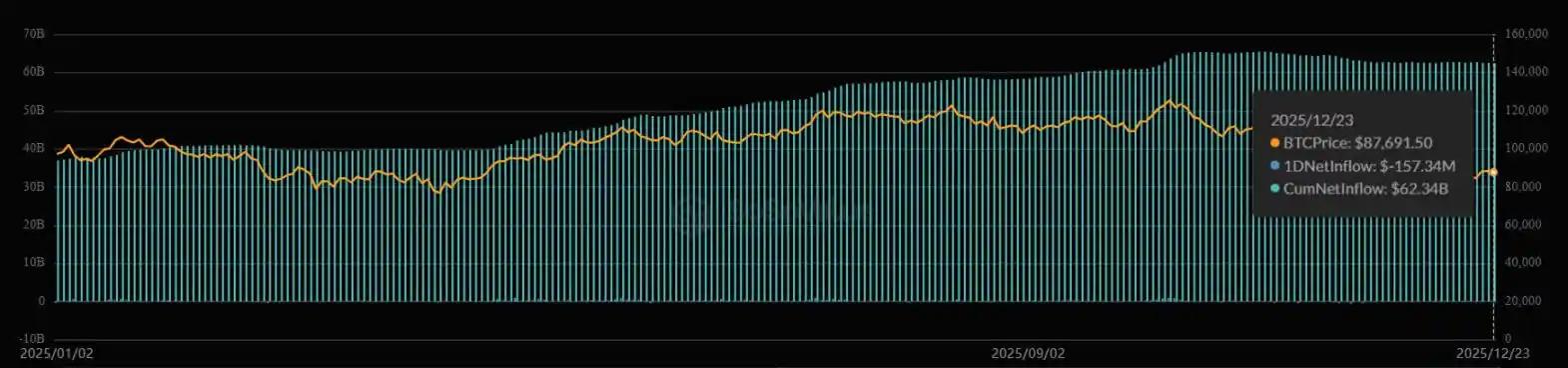
IBIT Cumulative Net Inflows (Source: SoSo Value)
In addition to Bitcoin, Ethereum spot ETF also solidified its position, becoming the "default entry channel" for wealth management institutions — making debates like "not your keys, not your assets" irrelevant among institutional investors.
September was a key turning point: the SEC approved the "Generic Listing Standards." This technical but crucial policy victory significantly streamlines the approval process for future products, no longer requiring a separate 19b-4 filing for each new code.
Subsequently, the market saw a plethora of new products focusing on other digital assets (such as Solana, XRP), all of which have also seen strong performance this year.
2026 Outlook: Product Diversification and Risk Reduction
With Vanguard Group opening the cryptocurrency ETF channel on December 1, a large number of "basket of assets ETFs" and "covered call options ETFs" are expected to emerge. A more robust options market will begin to lower realized volatility, ultimately making cryptocurrency as an asset class acceptable to conservative pension funds.
3. Solana (SOL)
In 2025, Solana completely shed the label of "high-risk beta asset," and the old narrative of "fast but buggy" is now history.
Meanwhile, Solana has also completed the most challenging transformation in the cryptocurrency industry this year: transitioning from a "Meme coin casino" to a "global market liquidity layer."
While maintaining its dominance in the cultural sector, CoinGecko data shows that Solana has been the world's most-watched blockchain ecosystem for two consecutive years (2024-2025).
The current Solana network is no longer only revolving around speculative tokens but has become a "hub of efficient capital."
According to Artemis data, Solana has become a core liquidity layer: its on-chain SOL-USD trading volume has exceeded the sum of SOL spot trading volumes on Binance and Bybit (two of the world's top three centralized exchanges by trading volume) for three consecutive months.
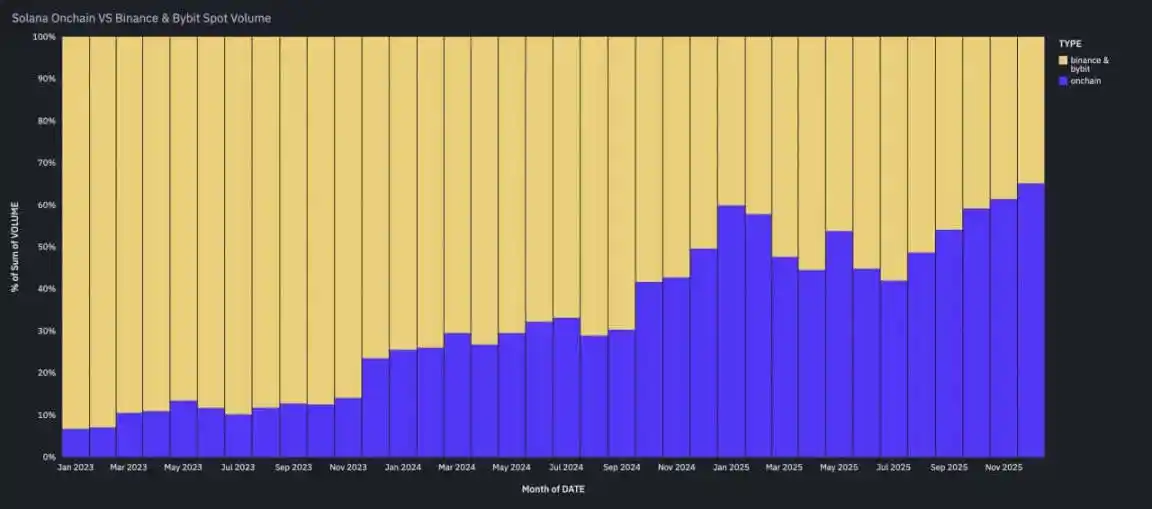
Solana's on-chain trading volume surpasses the spot trading volume on Binance and Bybit (Source: Artemis)
Essentially, Solana has positioned itself as the "primary venue for activities sensitive to transaction execution speed." Its competitors are no longer just Ethereum, but traditional financial market platforms like Nasdaq.
2026 Outlook: On-chain Price Discovery Goes Mainstream
This level of trading volume's "on-chain shift" marks a structural transformation: price discovery is shifting from centralized exchanges to on-chain. In 2026, Solana will no longer be a "high-risk beta network" but the primary venue for high-frequency, stablecoin-denominated trading.
4. Ethereum Layer 2 Network Base
If Solana's strength lies in "speed," then Coinbase's Ethereum Layer 2 network Base stands out due to its "user engagement capability."
By leveraging the vast existing user base of this American exchange platform, Base has become the "default choice for consumer apps and stablecoin experiments," with extremely high user stickiness.
Base's success proves that in the cryptocurrency industry of 2025, "user engagement" is more important than "novel encryption technology." It has become an "incubator for mainstream crypto applications" — these consumer fintech apps use cryptocurrency infrastructure on the backend, but users are completely unaware of this fact. It could be said that Base is the bridge connecting the chaotic on-chain world with Coinbase's compliant security system.
2026 Outlook: The Rise of "Wallet-native Business"
It is expected that Base will become the "core engine" for Coinbase's foray into the merchant payment field next year, and "wallet-native business" (business activities based on crypto wallets) may become a new industry trend.
5. Ripple and XRP
After years of legal troubles, 2025 finally became the year of Ripple and XRP's "regained freedom."
The long-standing legal battle between Ripple and the SEC finally came to an end with a final judgment, clearing the way for institutional adoption of XRP.
The result was that XRP's narrative transformed overnight from a "litigation-risk asset" to a "liquidity engine," driving its price up and paving the way for the launch of the first XRP spot ETF in November.
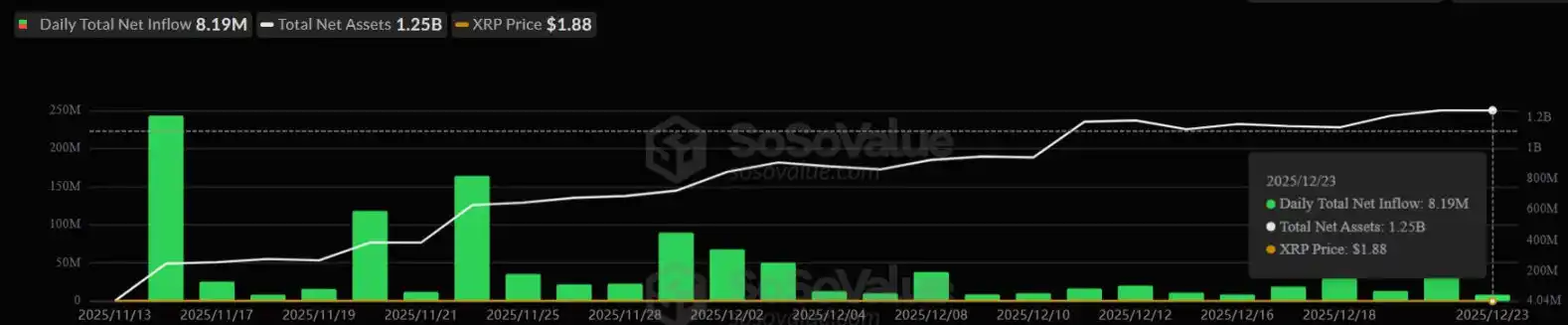
XRP Exchange-Traded Fund Daily Fund Flow (Source: SoSo Value)
Meanwhile, Ripple Inc. made significant acquisitions of traditional financial infrastructure this year: in just one year in 2025, Ripple invested over $4 billion in strategic acquisitions, the most notable of which included the acquisitions of the bulk broker Hidden Road, the asset management company GTreasury, and the stablecoin infrastructure provider Rail.
These moves effectively transform Ripple from a "payment company" into a "full-stack institutional giant."
2026 Outlook: Integrating Traditional Finance with the Crypto Ecosystem
The "ETF-ication" of XRP is just the beginning. With legal risks dissipating and Wall Street products landing, 2026 will be the "year of integration": Ripple's newly acquired asset management and brokerage business division is expected to start cross-promoting the RLUSD stablecoin to Fortune 500 companies, ultimately breaking down barriers between the Ripple ledger and corporate balance sheets.
6. Zcash and the Privacy Coin Space
The resurgence of Zcash and the entire privacy coin space was the most surprising "comeback story" of the 2025 cryptocurrency industry.
As the best-performing sector of 2025, privacy coins shed the stigma of "illicit use" and became darlings of the "post-surveillance economy era."
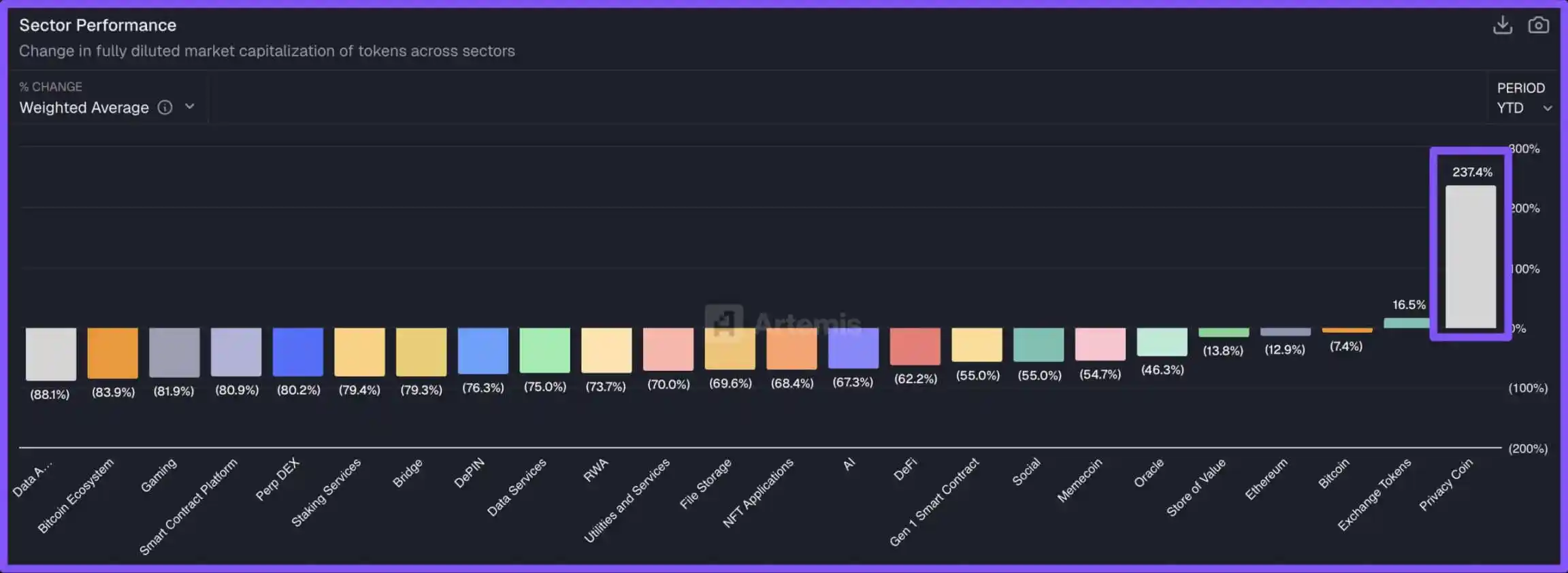
2025 Privacy Coin Performance (Source: Artemis)
While Zcash led this revival, the momentum covered the entire privacy coin space: Ethereum developers accelerated privacy-related initiatives, and other privacy solutions finally saw real-world applications.
Furthermore, the "thawing" of the regulatory environment was evident—SEC held its first official meeting with privacy protocol leads to discuss the establishment of compliance frameworks. Remember, this was entirely unimaginable a year ago.
2026 Outlook: Emergence of "Privacy DeFi"
The privacy coin space is expected to see "differentiation" in 2026: privacy will become a "premium feature" for compliant institutions. Wall Street will actively adopt these "selective disclosure tools" to prevent MEV (Maximal Extractable Value) frontrunning and safeguard the confidentiality of proprietary trading strategies.
7. Asset Tokenization (RWAs)
With strong support from a SEC-friendly attitude, Real-World Assets (RWAs) transitioned from "pilot projects" to the "core infrastructure" of the cryptocurrency industry.
The SEC no longer takes a hostile enforcement stance, allowing large institutions to confidently integrate these assets without fear of receiving a "Wells Notice" (SEC's precursor to enforcement investigations).
The BlackRock BUIDL Fund has been accepted by Binance as "off-chain collateral," marking a watershed event in the space — blurring the lines between Traditional Finance (TradFi) and the cryptocurrency market structure.
By December, the Asset Under Management (AUM) of tokenized money market funds and U.S. Treasuries had exceeded $8 billion, while the total Real World Asset (RWA) market size was about $20 billion.
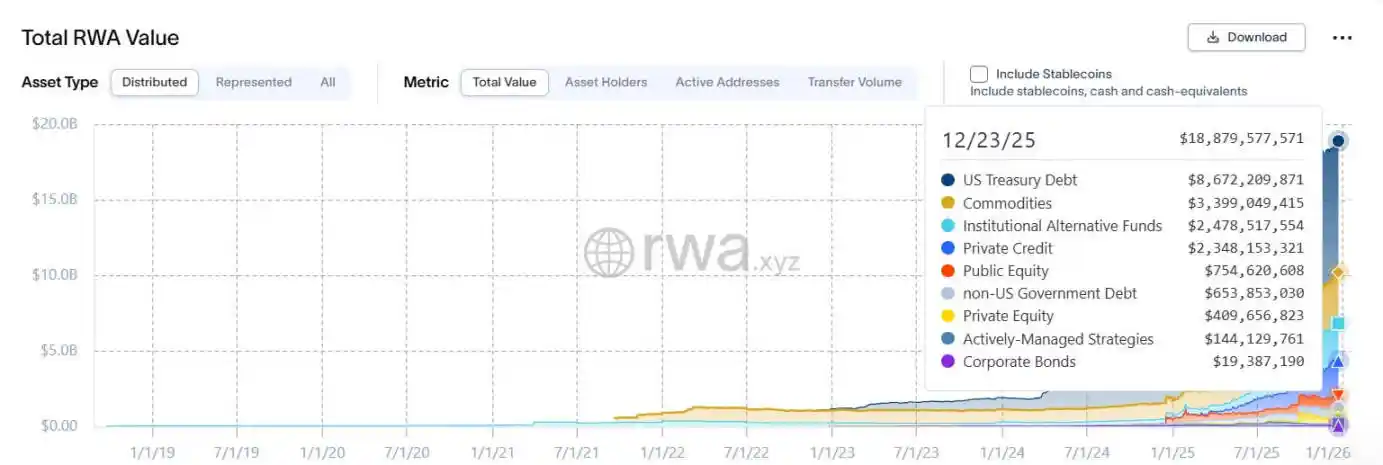
RWA Assets (Source: RWA.xyz)
Moreover, traditional financial giants such as BlackRock, JPMorgan Chase, Fidelity, Nasdaq, and the Depository Trust & Clearing Corporation (DTCC) are all optimistic about the RWA space, hoping to enhance transparency and efficiency in the traditional finance industry through it.
As SEC Chairman Paul Atkins put it, "The on-chain market will bring greater predictability, transparency, and efficiency to investors."
Outlook for 2026: Efficiency Gains in "Repo-Like" Transactions
As large banks like JPMorgan Chase and BNY Mellon continue to integrate RWA assets, a 24/7 collateral market is expected to gradually form, driving the asset management scale in this space towards $18 billion.
8. Stablecoins
The debate over the "cryptocurrency killer app" has settled: Stablecoins are the core infrastructure. In October 2025, the total market capitalization of stablecoins exceeded $300 billion; in September, the supply of stablecoins in the Ethereum ecosystem also hit a record high of $166 billion.
In fact, data from Token Terminal shows that the total number of stablecoin holders has reached a historical peak of about 200 million.
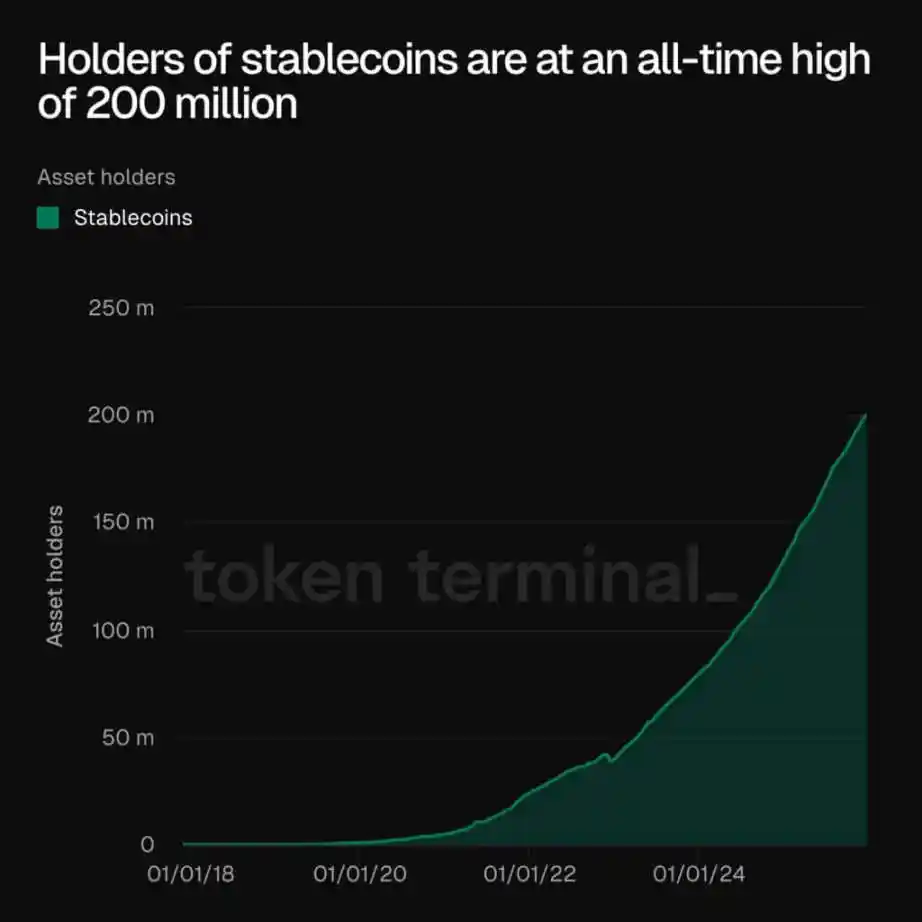
Stablecoin Holders (Source: Token Terminal)
This data indicates that the growth in the stablecoin space is driven by its core ability of "cross-border, 24/7, instant settlement."
Meanwhile, legislative progress in the United States, especially the passage of the "GENIUS Act," has provided legal certainty for banks to enter the stablecoin space.
Essentially, stablecoins are no longer just a "trading chip" but are evolving into a global financial technology "settlement layer." As Open Eden founder Jeremy NG puts it: "Stablecoins have transitioned from a cryptocurrency 'infrastructure accessory' to a 'financial infrastructure core.'"
2026 Outlook: Growth Driven by Yield
It is expected that "programmatic treasury investing" and "forex use cases" will be core drivers of stablecoin growth, with the total stablecoin market cap projected to reach a baseline level of $380 billion in 2026.
9. Perp DEXs
On-chain derivatives broke through the "credibility bottleneck" in 2025 — with monthly trading volumes hitting a record $12 trillion in October.
What has allowed this sector to emerge as a winner is its successful attraction of significant trading volume from centralized exchanges (CEXs): by offering "self-custody" features and more attractive incentive mechanisms, on-chain perpetual contract trading platforms have gained traders' favor.
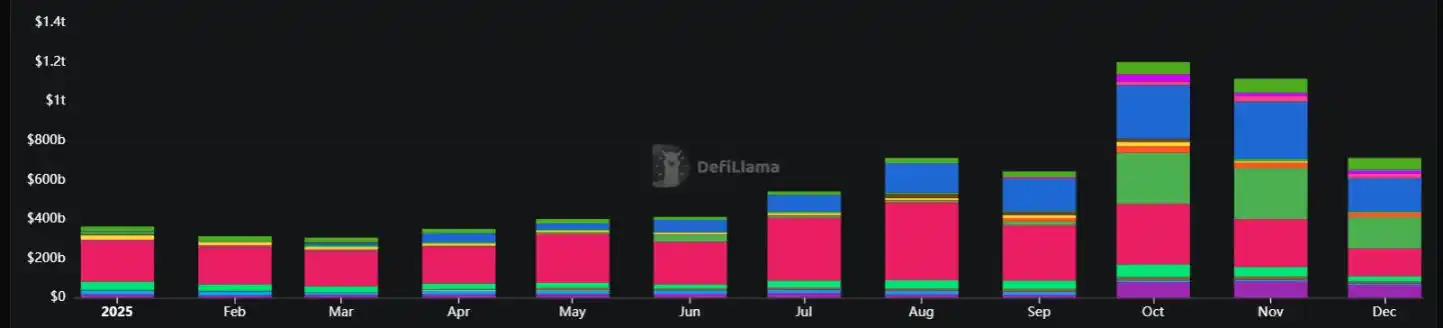
Decentralized perpetual contract exchange trading volume rising (Source: DeFiLlama)
The rise of on-chain perpetual contract decentralized exchanges (Perp DEXs) like Hyperliquid and Aster marks the maturation of the DeFi market structure. Today, traders are willing to take on smart contract risks amounting to billions of dollars in order to mitigate counterparty risks.
2026 Outlook: Intensified Fee Competition
On-chain open interest (OI) is becoming a legitimate macro risk indicator. However, the sector may witness fierce "fee wars" in 2026 — where protocols will engage in intense competition to capture a share of this $12 trillion monthly trading volume.
10. Prediction Markets
2025 was the year "event contracts" (the core product of prediction markets) entered the mainstream U.S. market: the two leading platforms in this sector, Kalshi and Polymarket, both saw record-level trading volumes.
But the most notable victory is that several traditional financial institutions and native crypto companies like Gemini and Coinbase have also joined the fray in this emerging field.
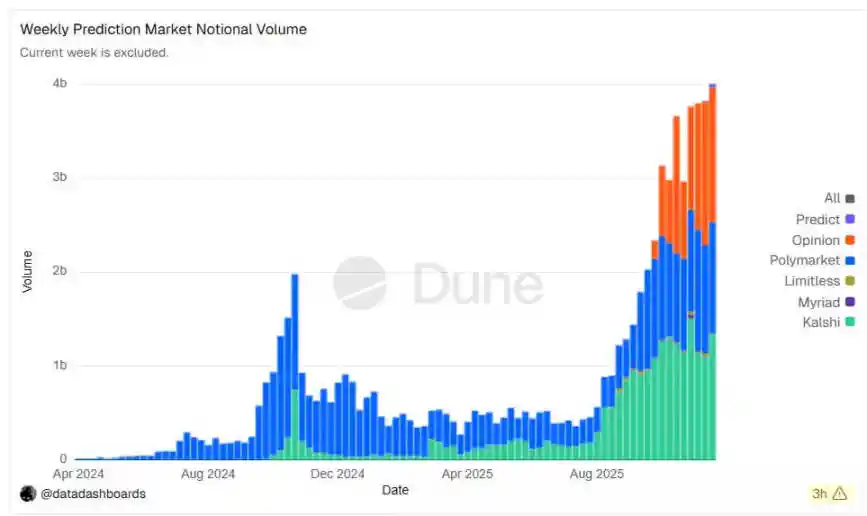
Weekly Trading Volume Prediction Market (Source: Dune Analytics)
The prediction market has emerged as a winner because it bridges the gap between 'gambling' and 'finance.' Furthermore, Polymarket has obtained a clear development path through a framework revised by the CFTC (Commodity Futures Trading Commission), transforming 'event contracts' from 'niche internet curiosities' into 'compliant hedging tools.'
2026 Outlook: Standardization and Scaling
Event contracts are becoming a standardized asset class. With 'outcome economics' (financial activities around event outcomes) expected to reach a scale of $600 billion in nominal value, crypto wallet infrastructure and USDC liquidity are poised for significant growth.
11. Hong Kong, China
While the United States focuses on legislation, Hong Kong, China has shifted its focus to 'execution advantage'—a fact supported by data. In the third quarter of 2025, Hong Kong's ETP (Exchange-Traded Products) market surpassed South Korea and Japan in terms of trading volume, becoming the world's third-largest ETP market with a daily average turnover of 37.8 billion HKD, a 150% year-on-year increase.
Hong Kong's strategy of 'attracting industry through clear regulation' has yielded tangible results in the exchange platform sector: the Virtual Asset Trading Platform (VATP) regime has evolved from a vague 'presumed licensed' state to a sound ecosystem.
By mid-2025, the Securities and Futures Commission of Hong Kong (SFC) had issued formal licenses to more global major exchange platforms, bringing the total number of licensed trading platforms to 11. This measure effectively integrates institutional liquidity within the region into a system that is 'compliant and connected to banking,' while isolating unregulated participants.
Simultaneously, the 'Stablecoin Ordinance' that took effect in Hong Kong on August 1st has created a 'high-quality sandbox'—as of the September application deadline, the sandbox had attracted over 30 applications.
2026 Outlook: Becoming Asia's Settlement Hub
With the first batch of stablecoin licenses expected to be issued in early 2026, Hong Kong is poised to become Asia's cryptocurrency settlement hub. By combining the 'world's top three ETP market' with 'licensed stablecoin infrastructure,' Hong Kong has successfully positioned itself as the 'key gateway for institutional liquidity in the Asia-Pacific region.'
12. Early Adopter (Crypto Investor)
The final spot on this list belongs to the "hodlers" — the early adopters of cryptocurrency.
Throughout the challenging years, early adopters have continuously heard the narrative that "cryptocurrency is a scam, a bubble, or a dead end." They experienced the industry crash of 2022, the regulatory crackdown of the Gensler era, and the industry lull of 2024. However, in 2025, their perseverance was finally vindicated. (Gensler era: referring to Gary Gensler's term as Chair of the U.S. SEC)
The significance of this year lies not only in the "asset price appreciation" but also in the "validation of core beliefs."
As a result, these early adopters successfully "ran ahead of the world's most renowned institutions." When BlackRock, Vanguard, and sovereign wealth funds dove into the cryptocurrency market this year, the assets they purchased were precisely those held by these early adopters during the industry's darkest days, based on unwavering conviction.
2026 Outlook: Transitioning from Investors to "Eco-Bankers"
As this cohort achieves "intergenerational wealth accumulation," they are not exiting the crypto ecosystem but are instead becoming the "bankers" of the ecosystem. It is expected that this group will become the primary liquidity providers (LPs) of the new decentralized capital markets, supporting the next wave of innovation that traditional banks have yet to grasp.
You may also like

Token Cannot Compound, Where Is the Real Investment Opportunity?

February 6th Market Key Intelligence, How Much Did You Miss?

China's Central Bank and Eight Other Departments' Latest Regulatory Focus: Key Attention to RWA Tokenized Asset Risk
Foreword: Today, the People's Bank of China's website published the "Notice of the People's Bank of China, National Development and Reform Commission, Ministry of Industry and Information Technology, Ministry of Public Security, State Administration for Market Regulation, China Banking and Insurance Regulatory Commission, China Securities Regulatory Commission, State Administration of Foreign Exchange on Further Preventing and Dealing with Risks Related to Virtual Currency and Others (Yinfa [2026] No. 42)", the latest regulatory requirements from the eight departments including the central bank, which are basically consistent with the regulatory requirements of recent years. The main focus of the regulation is on speculative activities such as virtual currency trading, exchanges, ICOs, overseas platform services, and this time, regulatory oversight of RWA has been added, explicitly prohibiting RWA tokenization, stablecoins (especially those pegged to the RMB). The following is the full text:
To the people's governments of all provinces, autonomous regions, and municipalities directly under the Central Government, the Xinjiang Production and Construction Corps:
Recently, there have been speculative activities related to virtual currency and Real-World Assets (RWA) tokenization, disrupting the economic and financial order and jeopardizing the property security of the people. In order to further prevent and address the risks related to virtual currency and Real-World Assets tokenization, effectively safeguard national security and social stability, in accordance with the "Law of the People's Republic of China on the People's Bank of China," "Law of the People's Republic of China on Commercial Banks," "Securities Law of the People's Republic of China," "Law of the People's Republic of China on Securities Investment Funds," "Law of the People's Republic of China on Futures and Derivatives," "Cybersecurity Law of the People's Republic of China," "Regulations of the People's Republic of China on the Administration of Renminbi," "Regulations on Prevention and Disposal of Illegal Fundraising," "Regulations of the People's Republic of China on Foreign Exchange Administration," "Telecommunications Regulations of the People's Republic of China," and other provisions, after reaching consensus with the Cyberspace Administration of China, the Supreme People's Court, and the Supreme People's Procuratorate, and with the approval of the State Council, the relevant matters are notified as follows:
(I) Virtual currency does not possess the legal status equivalent to fiat currency. Virtual currencies such as Bitcoin, Ether, Tether, etc., have the main characteristics of being issued by non-monetary authorities, using encryption technology and distributed ledger or similar technology, existing in digital form, etc. They do not have legal tender status, should not and cannot be circulated and used as currency in the market.
The business activities related to virtual currency are classified as illegal financial activities. The exchange of fiat currency and virtual currency within the territory, exchange of virtual currencies, acting as a central counterparty in buying and selling virtual currencies, providing information intermediary and pricing services for virtual currency transactions, token issuance financing, and trading of virtual currency-related financial products, etc., fall under illegal financial activities, such as suspected illegal issuance of token vouchers, unauthorized public issuance of securities, illegal operation of securities and futures business, illegal fundraising, etc., are strictly prohibited across the board and resolutely banned in accordance with the law. Overseas entities and individuals are not allowed to provide virtual currency-related services to domestic entities in any form.
A stablecoin pegged to a fiat currency indirectly fulfills some functions of the fiat currency in circulation. Without the consent of relevant authorities in accordance with the law and regulations, any domestic or foreign entity or individual is not allowed to issue a RMB-pegged stablecoin overseas.
(II)Tokenization of Real-World Assets refers to the use of encryption technology and distributed ledger or similar technologies to transform ownership rights, income rights, etc., of assets into tokens (tokens) or other interests or bond certificates with token (token) characteristics, and carry out issuance and trading activities.
Engaging in the tokenization of real-world assets domestically, as well as providing related intermediary, information technology services, etc., which are suspected of illegal issuance of token vouchers, unauthorized public offering of securities, illegal operation of securities and futures business, illegal fundraising, and other illegal financial activities, shall be prohibited; except for relevant business activities carried out with the approval of the competent authorities in accordance with the law and regulations and relying on specific financial infrastructures. Overseas entities and individuals are not allowed to illegally provide services related to the tokenization of real-world assets to domestic entities in any form.
(III) Inter-agency Coordination. The People's Bank of China, together with the National Development and Reform Commission, the Ministry of Industry and Information Technology, the Ministry of Public Security, the State Administration for Market Regulation, the China Banking and Insurance Regulatory Commission, the China Securities Regulatory Commission, the State Administration of Foreign Exchange, and other departments, will improve the work mechanism, strengthen coordination with the Cyberspace Administration of China, the Supreme People's Court, and the Supreme People's Procuratorate, coordinate efforts, and overall guide regions to carry out risk prevention and disposal of virtual currency-related illegal financial activities.
The China Securities Regulatory Commission, together with the National Development and Reform Commission, the Ministry of Industry and Information Technology, the Ministry of Public Security, the People's Bank of China, the State Administration for Market Regulation, the China Banking and Insurance Regulatory Commission, the State Administration of Foreign Exchange, and other departments, will improve the work mechanism, strengthen coordination with the Cyberspace Administration of China, the Supreme People's Court, and the Supreme People's Procuratorate, coordinate efforts, and overall guide regions to carry out risk prevention and disposal of illegal financial activities related to the tokenization of real-world assets.
(IV) Strengthening Local Implementation. The people's governments at the provincial level are overall responsible for the prevention and disposal of risks related to virtual currencies and the tokenization of real-world assets in their respective administrative regions. The specific leading department is the local financial regulatory department, with participation from branches and dispatched institutions of the State Council's financial regulatory department, telecommunications regulators, public security, market supervision, and other departments, in coordination with cyberspace departments, courts, and procuratorates, to improve the normalization of the work mechanism, effectively connect with the relevant work mechanisms of central departments, form a cooperative and coordinated working pattern between central and local governments, effectively prevent and properly handle risks related to virtual currencies and the tokenization of real-world assets, and maintain economic and financial order and social stability.
(5) Enhanced Risk Monitoring. The People's Bank of China, China Securities Regulatory Commission, National Development and Reform Commission, Ministry of Industry and Information Technology, Ministry of Public Security, State Administration of Foreign Exchange, Cyberspace Administration of China, and other departments continue to improve monitoring techniques and system support, enhance cross-departmental data analysis and sharing, establish sound information sharing and cross-validation mechanisms, promptly grasp the risk situation of activities related to virtual currency and real-world asset tokenization. Local governments at all levels give full play to the role of local monitoring and early warning mechanisms. Local financial regulatory authorities, together with branches and agencies of the State Council's financial regulatory authorities, as well as departments of cyberspace and public security, ensure effective connection between online monitoring, offline investigation, and fund tracking, efficiently and accurately identify activities related to virtual currency and real-world asset tokenization, promptly share risk information, improve early warning information dissemination, verification, and rapid response mechanisms.
(6) Strengthened Oversight of Financial Institutions, Intermediaries, and Technology Service Providers. Financial institutions (including non-bank payment institutions) are prohibited from providing account opening, fund transfer, and clearing services for virtual currency-related business activities, issuing and selling financial products related to virtual currency, including virtual currency and related financial products in the scope of collateral, conducting insurance business related to virtual currency, or including virtual currency in the scope of insurance liability. Financial institutions (including non-bank payment institutions) are prohibited from providing custody, clearing, and settlement services for unauthorized real-world asset tokenization-related business and related financial products. Relevant intermediary institutions and information technology service providers are prohibited from providing intermediary, technical, or other services for unauthorized real-world asset tokenization-related businesses and related financial products.
(7) Enhanced Management of Internet Information Content and Access. Internet enterprises are prohibited from providing online business venues, commercial displays, marketing, advertising, or paid traffic diversion services for virtual currency and real-world asset tokenization-related business activities. Upon discovering clues of illegal activities, they should promptly report to relevant departments and provide technical support and assistance for related investigations and inquiries. Based on the clues transferred by the financial regulatory authorities, the cyberspace administration, telecommunications authorities, and public security departments should promptly close and deal with websites, mobile applications (including mini-programs), and public accounts engaged in virtual currency and real-world asset tokenization-related business activities in accordance with the law.
(8) Strengthened Entity Registration and Advertisement Management. Market supervision departments strengthen entity registration and management, and enterprise and individual business registrations must not contain terms such as "virtual currency," "virtual asset," "cryptocurrency," "crypto asset," "stablecoin," "real-world asset tokenization," or "RWA" in their names or business scopes. Market supervision departments, together with financial regulatory authorities, legally enhance the supervision of advertisements related to virtual currency and real-world asset tokenization, promptly investigating and handling relevant illegal advertisements.
(IX) Continued Rectification of Virtual Currency Mining Activities. The National Development and Reform Commission, together with relevant departments, strictly controls virtual currency mining activities, continuously promotes the rectification of virtual currency mining activities. The people's governments of various provinces take overall responsibility for the rectification of "mining" within their respective administrative regions. In accordance with the requirements of the National Development and Reform Commission and other departments in the "Notice on the Rectification of Virtual Currency Mining Activities" (NDRC Energy-saving Building [2021] No. 1283) and the provisions of the "Guidance Catalog for Industrial Structure Adjustment (2024 Edition)," a comprehensive review, investigation, and closure of existing virtual currency mining projects are conducted, new mining projects are strictly prohibited, and mining machine production enterprises are strictly prohibited from providing mining machine sales and other services within the country.
(X) Severe Crackdown on Related Illegal Financial Activities. Upon discovering clues to illegal financial activities related to virtual currency and the tokenization of real-world assets, local financial regulatory authorities, branches of the State Council's financial regulatory authorities, and other relevant departments promptly investigate, determine, and properly handle the issues in accordance with the law, and seriously hold the relevant entities and individuals legally responsible. Those suspected of crimes are transferred to the judicial authorities for processing according to the law.
(XI) Severe Crackdown on Related Illegal and Criminal Activities. The Ministry of Public Security, the People's Bank of China, the State Administration for Market Regulation, the China Banking and Insurance Regulatory Commission, the China Securities Regulatory Commission, as well as judicial and procuratorial organs, in accordance with their respective responsibilities, rigorously crack down on illegal and criminal activities related to virtual currency, the tokenization of real-world assets, such as fraud, money laundering, illegal business operations, pyramid schemes, illegal fundraising, and other illegal and criminal activities carried out under the guise of virtual currency, the tokenization of real-world assets, etc.
(XII) Strengthen Industry Self-discipline. Relevant industry associations should enhance membership management and policy advocacy, based on their own responsibilities, advocate and urge member units to resist illegal financial activities related to virtual currency and the tokenization of real-world assets. Member units that violate regulatory policies and industry self-discipline rules are to be disciplined in accordance with relevant self-regulatory management regulations. By leveraging various industry infrastructure, conduct risk monitoring related to virtual currency, the tokenization of real-world assets, and promptly transfer issue clues to relevant departments.
(XIII) Without the approval of relevant departments in accordance with the law and regulations, domestic entities and foreign entities controlled by them may not issue virtual currency overseas.
(XIV) Domestic entities engaging directly or indirectly in overseas external debt-based tokenization of real-world assets, or conducting asset securitization activities abroad based on domestic ownership rights, income rights, etc. (hereinafter referred to as domestic equity), should be strictly regulated in accordance with the principles of "same business, same risk, same rules." The National Development and Reform Commission, the China Securities Regulatory Commission, the State Administration of Foreign Exchange, and other relevant departments regulate it according to their respective responsibilities. For other forms of overseas real-world asset tokenization activities based on domestic equity by domestic entities, the China Securities Regulatory Commission, together with relevant departments, supervise according to their division of responsibilities. Without the consent and filing of relevant departments, no unit or individual may engage in the above-mentioned business.
(15) Overseas subsidiaries and branches of domestic financial institutions providing Real World Asset Tokenization-related services overseas shall do so legally and prudently. They shall have professional personnel and systems in place to effectively mitigate business risks, strictly implement customer onboarding, suitability management, anti-money laundering requirements, and incorporate them into the domestic financial institutions' compliance and risk management system. Intermediaries and information technology service providers offering Real World Asset Tokenization services abroad based on domestic equity or conducting Real World Asset Tokenization business in the form of overseas debt for domestic entities directly or indirectly venturing abroad must strictly comply with relevant laws and regulations. They should establish and improve relevant compliance and internal control systems in accordance with relevant normative requirements, strengthen business and risk control, and report the business developments to the relevant regulatory authorities for approval or filing.
(16) Strengthen organizational leadership and overall coordination. All departments and regions should attach great importance to the prevention of risks related to virtual currencies and Real World Asset Tokenization, strengthen organizational leadership, clarify work responsibilities, form a long-term effective working mechanism with centralized coordination, local implementation, and shared responsibilities, maintain high pressure, dynamically monitor risks, effectively prevent and mitigate risks in an orderly and efficient manner, legally protect the property security of the people, and make every effort to maintain economic and financial order and social stability.
(17) Widely carry out publicity and education. All departments, regions, and industry associations should make full use of various media and other communication channels to disseminate information through legal and policy interpretation, analysis of typical cases, and education on investment risks, etc. They should promote the illegality and harm of virtual currencies and Real World Asset Tokenization-related businesses and their manifestations, fully alert to potential risks and hidden dangers, and enhance public awareness and identification capabilities for risk prevention.
(18) Engaging in illegal financial activities related to virtual currencies and Real World Asset Tokenization in violation of this notice, as well as providing services for virtual currencies and Real World Asset Tokenization-related businesses, shall be punished in accordance with relevant regulations. If it constitutes a crime, criminal liability shall be pursued according to the law. For domestic entities and individuals who knowingly or should have known that overseas entities illegally provided virtual currency or Real World Asset Tokenization-related services to domestic entities and still assisted them, relevant responsibilities shall be pursued according to the law. If it constitutes a crime, criminal liability shall be pursued according to the law.
(19) If any unit or individual invests in virtual currencies, Real World Asset Tokens, and related financial products against public order and good customs, the relevant civil legal actions shall be invalid, and any resulting losses shall be borne by them. If there are suspicions of disrupting financial order and jeopardizing financial security, the relevant departments shall deal with them according to the law.
This notice shall enter into force upon the date of its issuance. The People's Bank of China and ten other departments' "Notice on Further Preventing and Dealing with the Risks of Virtual Currency Trading Speculation" (Yinfa [2021] No. 237) is hereby repealed.

Former Partner's Perspective on Multicoin: Kyle's Exit, But the Game He Left Behind Just Getting Started
Why Bitcoin Is Falling Now: The Real Reasons Behind BTC's Crash & WEEX's Smart Profit Playbook
Bitcoin's ongoing crash explained: Discover the 5 hidden triggers behind BTC's plunge & how WEEX's Auto Earn and Trade to Earn strategies help traders profit from crypto market volatility.

Wall Street's Hottest Trades See Exodus

Vitalik Discusses Ethereum Scaling Path, Circle Announces Partnership with Polymarket, What's the Overseas Crypto Community Talking About Today?

Believing in the Capital Markets - The Essence and Core Value of Cryptocurrency

Polymarket's 'Weatherman': Predict Temperature, Win Million-Dollar Payout

$15K+ Profits: The 4 AI Trading Secrets WEEX Hackathon Prelim Winners Used to Dominate Volatile Crypto Markets
How WEEX Hackathon's top AI trading strategies made $15K+ in crypto markets: 4 proven rules for ETH/BTC trading, market structure analysis, and risk management in volatile conditions.

A nearly 20% one-day plunge, how long has it been since you last saw a $60,000 Bitcoin?

Raoul Pal: I've seen every single panic, and they are never the end.

Key Market Information Discrepancy on February 6th - A Must-Read! | Alpha Morning Report

2026 Crypto Industry's First Snowfall
The Harsh Reality Behind the $26 Billion Crypto Liquidation: Liquidity Is Killing the Market
Why Is Gold, US Stocks, Bitcoin All Falling?

Key Market Intelligence for February 5th, how much did you miss out on?

Wintermute: By 2026, crypto had gradually become the settlement layer of the Internet economy
Token Cannot Compound, Where Is the Real Investment Opportunity?
February 6th Market Key Intelligence, How Much Did You Miss?
China's Central Bank and Eight Other Departments' Latest Regulatory Focus: Key Attention to RWA Tokenized Asset Risk
Foreword: Today, the People's Bank of China's website published the "Notice of the People's Bank of China, National Development and Reform Commission, Ministry of Industry and Information Technology, Ministry of Public Security, State Administration for Market Regulation, China Banking and Insurance Regulatory Commission, China Securities Regulatory Commission, State Administration of Foreign Exchange on Further Preventing and Dealing with Risks Related to Virtual Currency and Others (Yinfa [2026] No. 42)", the latest regulatory requirements from the eight departments including the central bank, which are basically consistent with the regulatory requirements of recent years. The main focus of the regulation is on speculative activities such as virtual currency trading, exchanges, ICOs, overseas platform services, and this time, regulatory oversight of RWA has been added, explicitly prohibiting RWA tokenization, stablecoins (especially those pegged to the RMB). The following is the full text:
To the people's governments of all provinces, autonomous regions, and municipalities directly under the Central Government, the Xinjiang Production and Construction Corps:
Recently, there have been speculative activities related to virtual currency and Real-World Assets (RWA) tokenization, disrupting the economic and financial order and jeopardizing the property security of the people. In order to further prevent and address the risks related to virtual currency and Real-World Assets tokenization, effectively safeguard national security and social stability, in accordance with the "Law of the People's Republic of China on the People's Bank of China," "Law of the People's Republic of China on Commercial Banks," "Securities Law of the People's Republic of China," "Law of the People's Republic of China on Securities Investment Funds," "Law of the People's Republic of China on Futures and Derivatives," "Cybersecurity Law of the People's Republic of China," "Regulations of the People's Republic of China on the Administration of Renminbi," "Regulations on Prevention and Disposal of Illegal Fundraising," "Regulations of the People's Republic of China on Foreign Exchange Administration," "Telecommunications Regulations of the People's Republic of China," and other provisions, after reaching consensus with the Cyberspace Administration of China, the Supreme People's Court, and the Supreme People's Procuratorate, and with the approval of the State Council, the relevant matters are notified as follows:
(I) Virtual currency does not possess the legal status equivalent to fiat currency. Virtual currencies such as Bitcoin, Ether, Tether, etc., have the main characteristics of being issued by non-monetary authorities, using encryption technology and distributed ledger or similar technology, existing in digital form, etc. They do not have legal tender status, should not and cannot be circulated and used as currency in the market.
The business activities related to virtual currency are classified as illegal financial activities. The exchange of fiat currency and virtual currency within the territory, exchange of virtual currencies, acting as a central counterparty in buying and selling virtual currencies, providing information intermediary and pricing services for virtual currency transactions, token issuance financing, and trading of virtual currency-related financial products, etc., fall under illegal financial activities, such as suspected illegal issuance of token vouchers, unauthorized public issuance of securities, illegal operation of securities and futures business, illegal fundraising, etc., are strictly prohibited across the board and resolutely banned in accordance with the law. Overseas entities and individuals are not allowed to provide virtual currency-related services to domestic entities in any form.
A stablecoin pegged to a fiat currency indirectly fulfills some functions of the fiat currency in circulation. Without the consent of relevant authorities in accordance with the law and regulations, any domestic or foreign entity or individual is not allowed to issue a RMB-pegged stablecoin overseas.
(II)Tokenization of Real-World Assets refers to the use of encryption technology and distributed ledger or similar technologies to transform ownership rights, income rights, etc., of assets into tokens (tokens) or other interests or bond certificates with token (token) characteristics, and carry out issuance and trading activities.
Engaging in the tokenization of real-world assets domestically, as well as providing related intermediary, information technology services, etc., which are suspected of illegal issuance of token vouchers, unauthorized public offering of securities, illegal operation of securities and futures business, illegal fundraising, and other illegal financial activities, shall be prohibited; except for relevant business activities carried out with the approval of the competent authorities in accordance with the law and regulations and relying on specific financial infrastructures. Overseas entities and individuals are not allowed to illegally provide services related to the tokenization of real-world assets to domestic entities in any form.
(III) Inter-agency Coordination. The People's Bank of China, together with the National Development and Reform Commission, the Ministry of Industry and Information Technology, the Ministry of Public Security, the State Administration for Market Regulation, the China Banking and Insurance Regulatory Commission, the China Securities Regulatory Commission, the State Administration of Foreign Exchange, and other departments, will improve the work mechanism, strengthen coordination with the Cyberspace Administration of China, the Supreme People's Court, and the Supreme People's Procuratorate, coordinate efforts, and overall guide regions to carry out risk prevention and disposal of virtual currency-related illegal financial activities.
The China Securities Regulatory Commission, together with the National Development and Reform Commission, the Ministry of Industry and Information Technology, the Ministry of Public Security, the People's Bank of China, the State Administration for Market Regulation, the China Banking and Insurance Regulatory Commission, the State Administration of Foreign Exchange, and other departments, will improve the work mechanism, strengthen coordination with the Cyberspace Administration of China, the Supreme People's Court, and the Supreme People's Procuratorate, coordinate efforts, and overall guide regions to carry out risk prevention and disposal of illegal financial activities related to the tokenization of real-world assets.
(IV) Strengthening Local Implementation. The people's governments at the provincial level are overall responsible for the prevention and disposal of risks related to virtual currencies and the tokenization of real-world assets in their respective administrative regions. The specific leading department is the local financial regulatory department, with participation from branches and dispatched institutions of the State Council's financial regulatory department, telecommunications regulators, public security, market supervision, and other departments, in coordination with cyberspace departments, courts, and procuratorates, to improve the normalization of the work mechanism, effectively connect with the relevant work mechanisms of central departments, form a cooperative and coordinated working pattern between central and local governments, effectively prevent and properly handle risks related to virtual currencies and the tokenization of real-world assets, and maintain economic and financial order and social stability.
(5) Enhanced Risk Monitoring. The People's Bank of China, China Securities Regulatory Commission, National Development and Reform Commission, Ministry of Industry and Information Technology, Ministry of Public Security, State Administration of Foreign Exchange, Cyberspace Administration of China, and other departments continue to improve monitoring techniques and system support, enhance cross-departmental data analysis and sharing, establish sound information sharing and cross-validation mechanisms, promptly grasp the risk situation of activities related to virtual currency and real-world asset tokenization. Local governments at all levels give full play to the role of local monitoring and early warning mechanisms. Local financial regulatory authorities, together with branches and agencies of the State Council's financial regulatory authorities, as well as departments of cyberspace and public security, ensure effective connection between online monitoring, offline investigation, and fund tracking, efficiently and accurately identify activities related to virtual currency and real-world asset tokenization, promptly share risk information, improve early warning information dissemination, verification, and rapid response mechanisms.
(6) Strengthened Oversight of Financial Institutions, Intermediaries, and Technology Service Providers. Financial institutions (including non-bank payment institutions) are prohibited from providing account opening, fund transfer, and clearing services for virtual currency-related business activities, issuing and selling financial products related to virtual currency, including virtual currency and related financial products in the scope of collateral, conducting insurance business related to virtual currency, or including virtual currency in the scope of insurance liability. Financial institutions (including non-bank payment institutions) are prohibited from providing custody, clearing, and settlement services for unauthorized real-world asset tokenization-related business and related financial products. Relevant intermediary institutions and information technology service providers are prohibited from providing intermediary, technical, or other services for unauthorized real-world asset tokenization-related businesses and related financial products.
(7) Enhanced Management of Internet Information Content and Access. Internet enterprises are prohibited from providing online business venues, commercial displays, marketing, advertising, or paid traffic diversion services for virtual currency and real-world asset tokenization-related business activities. Upon discovering clues of illegal activities, they should promptly report to relevant departments and provide technical support and assistance for related investigations and inquiries. Based on the clues transferred by the financial regulatory authorities, the cyberspace administration, telecommunications authorities, and public security departments should promptly close and deal with websites, mobile applications (including mini-programs), and public accounts engaged in virtual currency and real-world asset tokenization-related business activities in accordance with the law.
(8) Strengthened Entity Registration and Advertisement Management. Market supervision departments strengthen entity registration and management, and enterprise and individual business registrations must not contain terms such as "virtual currency," "virtual asset," "cryptocurrency," "crypto asset," "stablecoin," "real-world asset tokenization," or "RWA" in their names or business scopes. Market supervision departments, together with financial regulatory authorities, legally enhance the supervision of advertisements related to virtual currency and real-world asset tokenization, promptly investigating and handling relevant illegal advertisements.
(IX) Continued Rectification of Virtual Currency Mining Activities. The National Development and Reform Commission, together with relevant departments, strictly controls virtual currency mining activities, continuously promotes the rectification of virtual currency mining activities. The people's governments of various provinces take overall responsibility for the rectification of "mining" within their respective administrative regions. In accordance with the requirements of the National Development and Reform Commission and other departments in the "Notice on the Rectification of Virtual Currency Mining Activities" (NDRC Energy-saving Building [2021] No. 1283) and the provisions of the "Guidance Catalog for Industrial Structure Adjustment (2024 Edition)," a comprehensive review, investigation, and closure of existing virtual currency mining projects are conducted, new mining projects are strictly prohibited, and mining machine production enterprises are strictly prohibited from providing mining machine sales and other services within the country.
(X) Severe Crackdown on Related Illegal Financial Activities. Upon discovering clues to illegal financial activities related to virtual currency and the tokenization of real-world assets, local financial regulatory authorities, branches of the State Council's financial regulatory authorities, and other relevant departments promptly investigate, determine, and properly handle the issues in accordance with the law, and seriously hold the relevant entities and individuals legally responsible. Those suspected of crimes are transferred to the judicial authorities for processing according to the law.
(XI) Severe Crackdown on Related Illegal and Criminal Activities. The Ministry of Public Security, the People's Bank of China, the State Administration for Market Regulation, the China Banking and Insurance Regulatory Commission, the China Securities Regulatory Commission, as well as judicial and procuratorial organs, in accordance with their respective responsibilities, rigorously crack down on illegal and criminal activities related to virtual currency, the tokenization of real-world assets, such as fraud, money laundering, illegal business operations, pyramid schemes, illegal fundraising, and other illegal and criminal activities carried out under the guise of virtual currency, the tokenization of real-world assets, etc.
(XII) Strengthen Industry Self-discipline. Relevant industry associations should enhance membership management and policy advocacy, based on their own responsibilities, advocate and urge member units to resist illegal financial activities related to virtual currency and the tokenization of real-world assets. Member units that violate regulatory policies and industry self-discipline rules are to be disciplined in accordance with relevant self-regulatory management regulations. By leveraging various industry infrastructure, conduct risk monitoring related to virtual currency, the tokenization of real-world assets, and promptly transfer issue clues to relevant departments.
(XIII) Without the approval of relevant departments in accordance with the law and regulations, domestic entities and foreign entities controlled by them may not issue virtual currency overseas.
(XIV) Domestic entities engaging directly or indirectly in overseas external debt-based tokenization of real-world assets, or conducting asset securitization activities abroad based on domestic ownership rights, income rights, etc. (hereinafter referred to as domestic equity), should be strictly regulated in accordance with the principles of "same business, same risk, same rules." The National Development and Reform Commission, the China Securities Regulatory Commission, the State Administration of Foreign Exchange, and other relevant departments regulate it according to their respective responsibilities. For other forms of overseas real-world asset tokenization activities based on domestic equity by domestic entities, the China Securities Regulatory Commission, together with relevant departments, supervise according to their division of responsibilities. Without the consent and filing of relevant departments, no unit or individual may engage in the above-mentioned business.
(15) Overseas subsidiaries and branches of domestic financial institutions providing Real World Asset Tokenization-related services overseas shall do so legally and prudently. They shall have professional personnel and systems in place to effectively mitigate business risks, strictly implement customer onboarding, suitability management, anti-money laundering requirements, and incorporate them into the domestic financial institutions' compliance and risk management system. Intermediaries and information technology service providers offering Real World Asset Tokenization services abroad based on domestic equity or conducting Real World Asset Tokenization business in the form of overseas debt for domestic entities directly or indirectly venturing abroad must strictly comply with relevant laws and regulations. They should establish and improve relevant compliance and internal control systems in accordance with relevant normative requirements, strengthen business and risk control, and report the business developments to the relevant regulatory authorities for approval or filing.
(16) Strengthen organizational leadership and overall coordination. All departments and regions should attach great importance to the prevention of risks related to virtual currencies and Real World Asset Tokenization, strengthen organizational leadership, clarify work responsibilities, form a long-term effective working mechanism with centralized coordination, local implementation, and shared responsibilities, maintain high pressure, dynamically monitor risks, effectively prevent and mitigate risks in an orderly and efficient manner, legally protect the property security of the people, and make every effort to maintain economic and financial order and social stability.
(17) Widely carry out publicity and education. All departments, regions, and industry associations should make full use of various media and other communication channels to disseminate information through legal and policy interpretation, analysis of typical cases, and education on investment risks, etc. They should promote the illegality and harm of virtual currencies and Real World Asset Tokenization-related businesses and their manifestations, fully alert to potential risks and hidden dangers, and enhance public awareness and identification capabilities for risk prevention.
(18) Engaging in illegal financial activities related to virtual currencies and Real World Asset Tokenization in violation of this notice, as well as providing services for virtual currencies and Real World Asset Tokenization-related businesses, shall be punished in accordance with relevant regulations. If it constitutes a crime, criminal liability shall be pursued according to the law. For domestic entities and individuals who knowingly or should have known that overseas entities illegally provided virtual currency or Real World Asset Tokenization-related services to domestic entities and still assisted them, relevant responsibilities shall be pursued according to the law. If it constitutes a crime, criminal liability shall be pursued according to the law.
(19) If any unit or individual invests in virtual currencies, Real World Asset Tokens, and related financial products against public order and good customs, the relevant civil legal actions shall be invalid, and any resulting losses shall be borne by them. If there are suspicions of disrupting financial order and jeopardizing financial security, the relevant departments shall deal with them according to the law.
This notice shall enter into force upon the date of its issuance. The People's Bank of China and ten other departments' "Notice on Further Preventing and Dealing with the Risks of Virtual Currency Trading Speculation" (Yinfa [2021] No. 237) is hereby repealed.
Former Partner's Perspective on Multicoin: Kyle's Exit, But the Game He Left Behind Just Getting Started
Why Bitcoin Is Falling Now: The Real Reasons Behind BTC's Crash & WEEX's Smart Profit Playbook
Bitcoin's ongoing crash explained: Discover the 5 hidden triggers behind BTC's plunge & how WEEX's Auto Earn and Trade to Earn strategies help traders profit from crypto market volatility.


 App
App